A minor tooth problem can become a disabling emergency when professional care disappears.
Preppers spend considerable time thinking about bleeding, broken bones and traumatic injuries. Those dangers deserve attention, but they are not the only medical problems capable of taking someone out of action.
A damaged or infected tooth can make it impossible to sleep, eat properly, concentrate or work. In normal times, we call a dentist. During a prolonged emergency, that dentist may be unreachable, the clinic may have no power, roads may be blocked or the necessary supplies may simply be unavailable.
Dental preparedness is not about learning to pull teeth with pliers. It is about preventing avoidable problems, recognizing when the situation is becoming dangerous and having enough supplies to stabilize minor damage until qualified care becomes available.
Free Canadian Preparedness Download
Canadian Grid-Down Starter Kit
Use this printable first-72-hours checklist to test your household’s water, food, power, sanitation, communications, medical readiness and operating routines before a short outage becomes a prolonged emergency.
Dentistry Is Critical Infrastructure
Modern dentistry depends on electricity, sterilization equipment, compressed air, suction, imaging, specialized tools, local anaesthetic and a steady supply of disposable materials. A dental office might still be standing after a major disruption while remaining completely unable to operate.
This creates a serious weakness in many preparedness plans. People store food for a year but postpone a troublesome filling. They buy trauma supplies while ignoring bleeding gums, cracked teeth, loose crowns and dentures that no longer fit properly.
A known dental problem will not become easier to handle after the grid fails.
The most valuable dental preparation happens before the emergency:
- Complete unfinished dental work.
- Repair damaged fillings and crowns.
- Have persistent pain or sensitivity investigated.
- Deal with gum disease before it progresses.
- Keep dentures and dental appliances properly fitted.
- Maintain regular brushing and interdental cleaning.
- Store important dental information with household medical records.
A professional examination today may eliminate a crisis that would otherwise consume supplies, reduce food intake and remove an able-bodied person from essential work.
Tooth Pain Is a Warning
Pain is not the disease. It is the alarm.
A toothache may be caused by decay, a crack, an exposed nerve, damaged dental work, gum disease or an infection beneath the tooth. Covering the pain does not correct any of those problems.
Watch particularly closely for:
- Severe or persistent throbbing pain
- Pain when biting or chewing
- Increasing sensitivity to heat or cold
- Swelling of the gum, face, jaw or neck
- Fever or a general feeling of illness
- Tender swelling beneath the jaw
- Foul-tasting drainage
- Difficulty opening the mouth
- Difficulty swallowing or breathing
Facial or neck swelling accompanied by fever, swallowing trouble or breathing difficulty is a genuine medical emergency. An untreated dental abscess can spread beyond the tooth and become life-threatening. A sudden reduction in pain after an abscess drains does not mean the infection has been cured.
Under normal conditions, seek professional care immediately rather than testing improvised solutions. During a collapse, these warning signs indicate that the patient’s condition may be moving beyond anything a household dental kit can manage. The Canadian Dental Association’s dental-emergency guidance provides practical information for several common injuries.
What a Dental Kit Can Actually Do
A dental emergency kit is useful, but its limitations must be understood.
It may temporarily protect a damaged tooth, cover a sharp edge, replace a lost filling for a short period, control minor bleeding or help keep an injured mouth clean. It cannot perform a root canal, remove infected tissue or safely replace professional treatment.
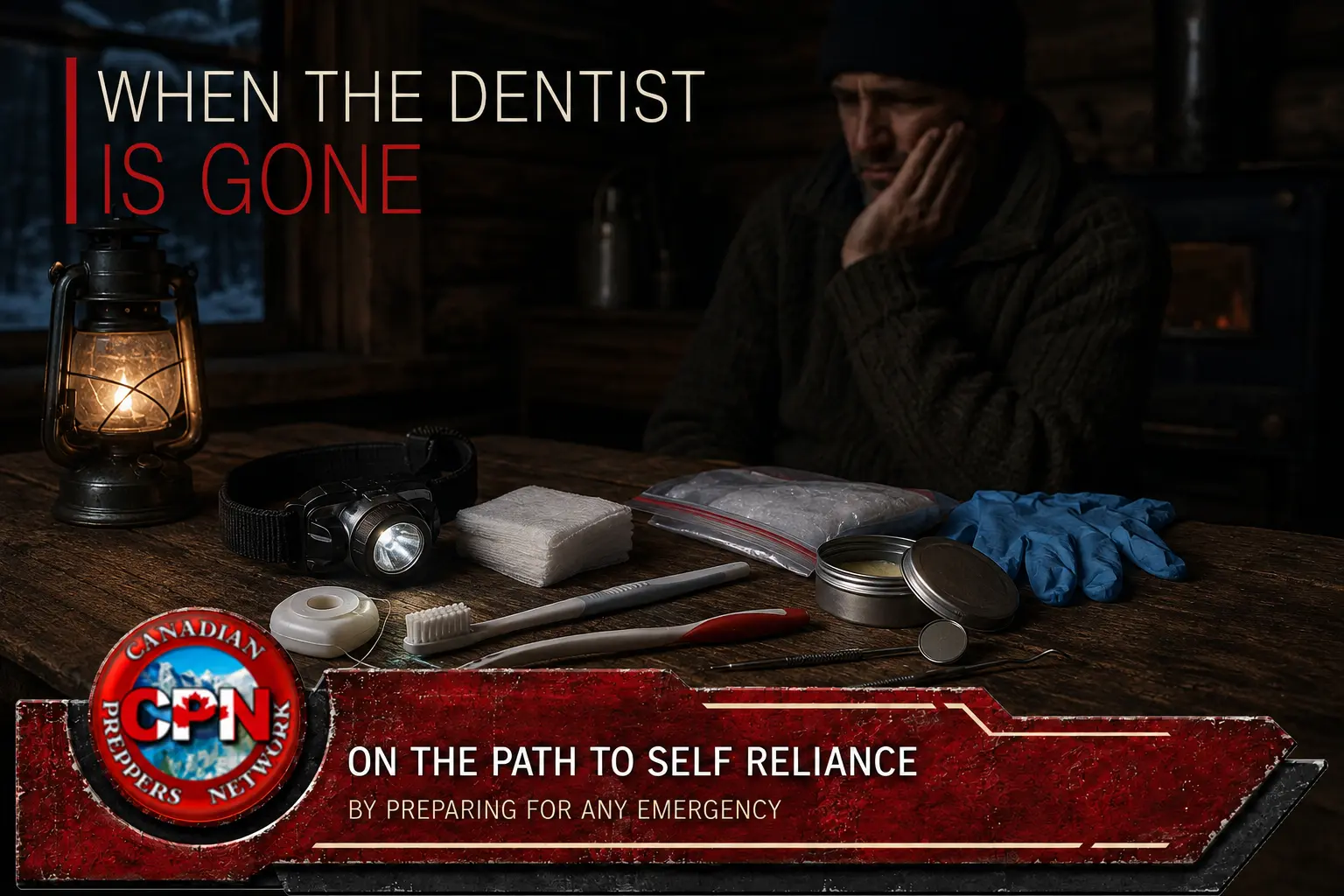
A practical household dental kit should contain:
- Fluoride toothpaste
- Manual toothbrushes
- Dental floss and interdental brushes
- Alcohol-free mouth rinse
- Dental wax
- Commercial temporary filling material
- Sterile gauze
- Cotton rolls or dental cotton
- A small dental mirror
- A bright headlamp
- Nitrile gloves
- Oral irrigation syringes without needles
- Cold packs
- Tooth-preservation solution or a suitable container
- Denture adhesive and a denture repair product, where applicable
- Written instructions supplied with the products
- A printed dental first-aid reference
Store these supplies together in a clearly labelled container. Check expiry dates and packaging during the household medical audit.
Dental picks, probes and extraction instruments are frequently marketed as survival tools. Owning an instrument does not confer the training required to use it. Sharp tools can damage gums, drive contamination deeper or turn a manageable problem into uncontrolled bleeding and infection.
Limited-Space Outdoor Event
Plinkin’ in the Woods
with Frugal Gunnie
Spend a full day developing practical outdoor rimfire marksmanship skills with Frugal Gunnie. This is a hands-on private event—not another afternoon spent sitting at a shooting bench.
Saturday, September 12, 2026
8:00 a.m.–5:00 p.m.
Great Ape Empire
267 Highway 6, Wiarton, Ontario
Event admission: $250 CAD
Weekend camping: $20 per person
Space is strictly limited. Adult participants must meet all applicable legal and organizer requirements.
Presented in collaboration with Off-Grid School, Preppers Meet, Canadian Preppers Network and Great Ape Empire.
Lost Fillings, Crowns and Broken Teeth
A lost filling may expose sensitive tissue and leave a hollow area that collects food. Gently rinsing the mouth and keeping the area clean can reduce further contamination. Commercial temporary filling material may protect the opening while professional care is being arranged, provided its directions are followed.
A loose crown should be saved. Dental wax can sometimes protect an exposed or sharp area temporarily. Household glue should not be used inside the mouth.
A chipped tooth may leave an edge sharp enough to cut the tongue or cheek. Dental wax can provide temporary protection. Larger fractures, significant pain or visible damage extending deeply into the tooth require professional attention.
Broken teeth can often be saved when treated promptly, which is another reason not to attempt unnecessary field dentistry while functioning care remains available.
Until the tooth is assessed, use softer foods and avoid chewing on the damaged side. Nuts, hard candy, ice, popcorn kernels and tough foods can turn a small crack into a larger fracture.
A Knocked-Out Tooth Is Time-Critical
When a permanent tooth is completely knocked out during an accident, handle it by the crown—the visible chewing surface—not by the root. If it is dirty, rinse it gently without scrubbing or removing attached tissue.
Where immediate professional treatment remains possible, the Canadian Dental Association advises replacing the tooth in its socket when this can be done safely, or keeping it in cold milk while travelling directly to a dentist. Speed greatly affects the chance of saving it.
In a prolonged collapse with no functioning dental service, the situation becomes much more difficult. Control bleeding with clean gauze, protect the socket from contamination and continue searching for qualified help. This is precisely why a retreat group should identify medical and dental skills before they are desperately needed.
The Antibiotic Trap
Antibiotics are often treated as the universal answer to dental infection. They are not.
An abscess normally requires definitive dental treatment to remove or drain the source of infection. Antibiotics may be prescribed when infection is spreading, when systemic symptoms are present or when the patient has particular medical vulnerabilities, but they do not repair a decayed tooth or remove infected dental tissue.
Randomly using leftover antibiotics creates several problems:
- The drug may be inappropriate for the infection.
- The supply may be too small to complete the prescribed course.
- The patient may have an allergy or dangerous interaction.
- Temporary improvement may disguise a worsening condition.
- Misuse can contribute to antibiotic resistance.
Pain relief can create the same false confidence. It may make the patient more comfortable, but it does not reveal whether the underlying damage is improving.
Prescription medications should be used only by the person for whom they were prescribed and according to professional direction. For a broader explanation, read Antibiotics in a Prolonged Emergency.
Archery Intensive with Wolf Starchild
Learn the Bow. Understand the Shot.
Spend a concentrated day improving stance, grip, drawing, anchoring, release, follow-through and arrow control. The program includes changing distances, practical shooting positions, traditional techniques and individual form correction.
Sunday, September 13, 2026
Great Ape Empire
267 Highway 6, Wiarton, Ontario
$120 per person
Equipment is available
Weekend camping: $20 per person
Instruction is provided by Wolf Starchild of Barefoot Bushcraft. Space is limited to preserve the hands-on format, and a minimum of eight registered participants is required.
Presented by Barefoot Bushcraft in partnership with Canadian Preppers Network, Preppers Meet, Great Ape Empire and Off-Grid School.
Plan Foods for an Injured Mouth
Dental emergencies also expose a weakness in the food plan.
A pantry dominated by hard grains, jerky, nuts and foods requiring heavy chewing may be difficult to use when someone has a damaged tooth, painful jaw or mouth injury. Every household should be able to produce several days of soft, calorie-dense meals.
Useful possibilities include:
- Oatmeal
- Soup and broth
- Mashed vegetables
- Soft rice
- Eggs
- Applesauce
- Canned fish
- Nut butter where tolerated
- Powdered meal drinks
- Foods that can be mashed or blended manually
This is not a separate medical diet. It is redundancy. A person who cannot chew still needs calories, protein and fluids.
High-sugar snacks may be comforting during an emergency, but constantly exposing teeth to sugar while dental hygiene deteriorates is a poor long-term strategy. Clean water, toothbrushes, toothpaste and floss are inexpensive compared with the consequences of neglect.
Find Skills Before the Crisis
A preparedness group should know who has genuine dental experience.
Dentists are the obvious resource, but dental hygienists, dental assistants, denturists and other trained professionals may also bring valuable knowledge. The important distinction is between someone who understands oral anatomy, infection control and dental instruments and someone who watched an extraction video online.
Record available skills without advertising sensitive personal details publicly. Determine what equipment trained members already have and what supplies would remain useful if they were separated from their normal workplace.
Printed references should be stored with the equipment. A dead phone containing the only copy of the instructions is not a reference library.
Related CPN Reading
- Medical & First Aid in Canada
- Medical and First Aid Buying Guide
- Antibiotics in a Prolonged Emergency
Your Mouth Is Part of the Survival Plan
Dental preparedness is unglamorous. There are no tactical pouches, dramatic rescue scenarios or heroic procedures.
There is simply the reality that a cracked tooth can stop someone from eating, an abscess can become dangerous and a person debilitated by constant pain cannot pull a security shift, cut firewood, haul water or look after anyone else.
The best strategy is straightforward:
Deal with known problems now. Maintain daily oral hygiene. Store realistic temporary-care supplies. Recognize infection early. Know the limits of improvisation. Identify qualified people before normal services disappear.
When the dentist is gone, prevention is not merely better than treatment. It may be the only treatment still available.
Which unresolved dental problem or missing supply would create the greatest weakness in your household if professional dentistry disappeared for a month?