Packaging, shelf life and freezing tolerance belong in the same plan.
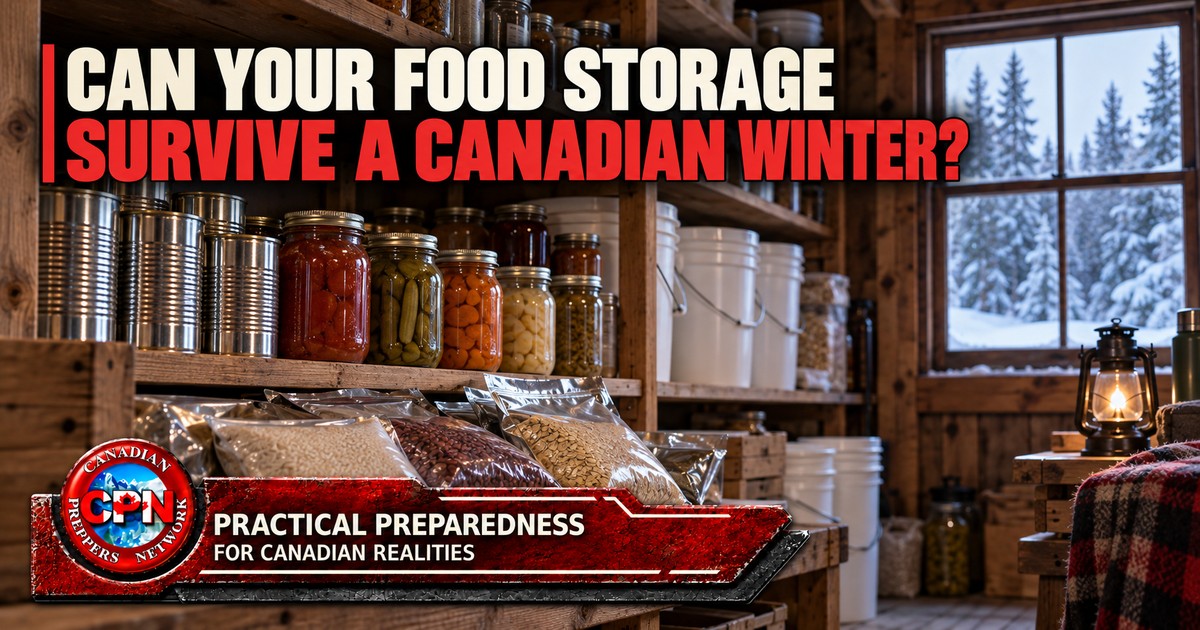
Your pantry is stocked. There are bags of rice on the bottom shelf, tins of meat beside the soup, jars from the garden and a few buckets of emergency food in the garage.
Then the heat stops.
During a prolonged Canadian winter outage, the room you protect first may be the room where people sleep. The pantry, basement corner or detached storage building can grow colder while everyone concentrates on keeping the household alive.
Those supplies will not all respond the same way. Dry wheat can tolerate sub-zero temperatures. A jar of canned vegetables can lose its seal. A tin of soup can develop a damaged seam. A paper sack can admit moisture even though the food inside handles cold perfectly well.
A food reserve needs to survive its storage location as well as its storage time.
Read the Shelf-Life Figures Properly
The figures below are quality and rotation guides for unopened foods, not guaranteed expiry dates. They assume sound packaging, a clean and dry storage area, and protection from excessive heat. Product instructions take priority, especially for formulated meals, powdered eggs and shelf-stable milk.
Long-term estimates apply only to food prepared and packaged for that purpose. Putting a grocery bag inside a bucket does not automatically give it a 25-year life.
Freezing tolerance here means accidental exposure to temperatures below 0°C. It does not mean outdoor storage is suitable year-round, that packaging is immune to cold, or that freezing makes contaminated food safe.
Dry Staples: Usually the Strongest Cold-Storage Candidates
Dry foods generally tolerate freezing when they remain dry. Packaging, pests and moisture during warming are the important weaknesses.
| Food | Typical packaging → storage improvement | Unopened shelf life or rotation guide | Response to freezing |
|---|---|---|---|
| White rice | Thin plastic or bulk sack → sealed high-barrier pouch protected inside a food-grade bucket | Ordinary pantry stock: follow package guidance and rotate regularly. Properly sealed, oxygen-controlled rice in cool storage: up to 25–30 years | Dry rice tolerates freezing. Keep moisture out when bringing it indoors |
| Brown rice | Retail bag → airtight moisture-proof container | About 6 months at room temperature; refrigerated or frozen storage extends quality | Tolerates freezing, but its bran oils still make it unsuitable for white rice’s multi-decade storage expectations |
| Wheat berries | Sack → sealed high-barrier pouch or suitable long-term storage can | Decades are possible in well-managed cool, dry storage; packaging and starting grain quality matter | Sub-zero temperatures do not damage properly dry stored grain |
| White flour | Paper sack → airtight food-safe container | Follow the product date; rotate working supplies rather than assigning whole-grain storage claims to flour | Generally tolerates freezing when kept dry |
| Wholemeal flour | Paper or plastic bag → moisture-proof package | Shorter working rotation than white flour; refrigeration or freezing can extend quality | Tolerates freezing; retained grain oils remain a storage limitation |
| Rolled oats | Cardboard canister or bag → moisture-proof container; high-barrier packaging for reserves | Follow retail guidance; use a supplier’s stated life for a specifically packaged long-term product | Generally tolerant when dry; cardboard alone provides poor moisture protection |
| Plain dry pasta | Cardboard box or thin bag → sealed moisture-proof container | About 2 years for ordinary dry pasta without eggs; other formulations vary | Generally tolerant when dry; brittle pasta and packages need careful handling |
| Dry beans | Retail bag → high-barrier pouch or storage can with appropriate oxygen control | At least 1 year in ordinary bags; 10+ years possible with suitable long-term packaging | Generally tolerant when dry; ageing beans can become harder to cook |
| Non-fat powdered milk | Carton or pouch → moisture- and oxygen-barrier packaging | Approximately 3–5 years in suitable cool storage; heat can shorten this substantially | Dry powder generally tolerates cold; protect it from condensation |
| Granulated sugar | Paper bag → airtight moisture- and odour-proof container | Indefinite keeping potential when uncontaminated and dry; about 2 years is a quality guide | Cold is usually less important than moisture, which causes hardening |
| Plain salt | Cardboard carton → airtight moisture-proof container | Indefinite for plain salt kept clean and dry; additives may have their own quality limits | Generally tolerant; moisture causes clumping |
White rice and brown rice need separate plans. So do wheat berries and wholemeal flour. Milling and retaining oils change the storage problem. Likewise, the shelf-life guidance for non-fat milk powder should not be applied automatically to whole-milk powder.
Older beans introduce another cost: cooking time. A reserve that needs much more fuel to soften is less useful when fuel is rationed.
Wet Foods: Protect the Container and Its Seal
Commercial canning makes many foods shelf-stable. It does not make their containers suitable for freezing.
| Food | Packaging | Unopened shelf life or rotation guide | Response to freezing |
|---|---|---|---|
| Canned meat, fish, beans and most vegetables | Commercial metal cans | Generally 2–5 years for best quality in proper storage | Avoid freezing: expanding contents can damage seams |
| Canned tomatoes and many canned fruits | Metal cans or commercial glass jars | Generally 12–18 months for best quality | Avoid freezing: container damage and texture changes are possible |
| Home-canned meat, vegetables and preserves | Properly processed canning jars with sound seals | Plan to use within 1 year for best quality | Avoid freezing: glass can break or seals can fail |
| Shelf-stable milk | Aseptic carton or other manufacturer’s package | Follow the exact product date and storage directions | Keep above freezing unless the manufacturer explicitly permits it; separation and package damage may occur |
| Ready-to-eat meals in retort pouches | Factory-sealed flexible pouch | Follow the manufacturer’s stated life and temperature limits | Do not assume a flexible pouch is freeze-proof; check the product’s directions |
These foods deserve space where temperatures remain above freezing. Canned meat also provides something dry beans cannot: a meal that needs no lengthy cooking.
That is why a winter pantry should contain both kinds of food. Cold-tolerant dry staples provide depth, while protected ready-to-eat foods cover the days when water, fuel or labour are scarce.
Fats, Sweeteners and Preserved Ingredients
| Food | Packaging | Unopened shelf life or rotation guide | Response to freezing |
|---|---|---|---|
| Cooking oils | Original sealed bottle or tin, protected from light | Varies by oil; ordinary olive and vegetable oils need regular rotation, with roughly 6 months a conservative pantry guide | May cloud or solidify in cold conditions; follow package instructions and protect the container |
| Commercial peanut butter | Original sealed jar | About 6–9 months; natural formulations vary | Cold can affect consistency; suitability of the filled jar must be checked separately |
| Honey | Tightly closed food-safe container | Indefinite keeping potential when properly stored; colour and texture can change | Crystallisation or thickening is a quality issue; do not assume every container tolerates extreme cold |
| Home-dehydrated fruit and vegetables | Airtight moisture-proof packages | Generally 4–12 months, depending on food and conditions | Cold storage can help preserve quality; prevent moisture entry |
| Commercial freeze-dried foods | Intact factory high-barrier pouch or storage can | Follow the exact product claim; some products carry a 30-year guarantee under specified conditions | Dry contents generally tolerate cold, but the manufacturer’s packaging and storage limits still govern |
| Powdered eggs and whole-milk powder | Original sealed barrier package | Follow the exact product’s date; formulation and packaging make generic decade claims unreliable | Protect dry powder from moisture and check package limits |
Freeze-dried food and ordinary dehydrated food are separate categories. A 30-year guarantee on a particular commercial meal cannot be transferred to vegetables dried at home or to another manufacturer’s product.
Packaging Is Part of the Reserve
Paper sacks and cardboard boxes are convenient retail packaging. They are weak protection for years in a damp basement or unattended retreat.
For appropriate dry staples, a properly sealed high-barrier pouch inside a sturdy food-grade bucket gives the food a moisture barrier and the pouch physical protection. The bucket must be clean and suitable for food storage. Plastic containers can still be attacked by rodents.
Oxygen absorbers belong only with foods and moisture levels suitable for that method. Use the supplier’s sizing instructions. Sugar and salt do not need them. Vacuum sealing does not make moist food shelf-stable.
Divide bulk reserves into manageable portions. Opening one enormous package repeatedly exposes more food to the room and makes a single packaging failure more costly.
Bringing Cold Food Into a Warm Room
Keep sealed dry-food packages closed while they warm. Opening cold food in warm, humid air creates an opportunity for condensation. Wipe moisture from the outside before opening.
Let the contents reach room temperature, not merely the outer surface of a large bucket. Check for damaged packaging, dampness or mould. Warm storage cannot reverse contamination that has already occurred.
Avoid repeated trips between a freezing shed and a humid kitchen. Bring in one working portion and leave the reserve sealed.
If Cans or Jars Have Already Frozen
Freezing alone does not automatically spoil every canned food, but container damage can remove its protection.
Discard leaking, cracked or broken containers, jars with failed seals, and cans with damaged seams or abnormal swelling. Do not taste questionable food to decide whether it is safe.
For apparently intact containers accidentally frozen, follow recognised food-safety guidance for controlled thawing and assessment. A lid that appears seated after warming is not proof that an unknown seal failure never occurred.
Preventing the incident is much easier than evaluating a shelf of frozen jars during an outage.
Build the Storage Plan Around the Building
Measure temperatures where the food actually sits. An exterior-wall shelf can experience different conditions from the centre of a room. A thermometer with minimum and maximum memory helps reveal overnight lows.
Insulation slows cooling; it cannot keep an unheated cupboard above freezing indefinitely. If the building will eventually freeze, identify which supplies move first and where they will go.
Keep wet canned foods and vulnerable liquid packages in the protected zone. Place suitable dry reserves in colder space only when packaging, dryness and pest protection support it. Keep everything away from fuels and chemicals.
A detached garage also needs a summer plan. Supplies that tolerate January can still lose quality in July heat.
Before buying more food, check whether you can protect what is already on the shelf. During a Canadian winter, the difference between a reserve and a loss may be a package, a failed seal or the decision to move one crate before the room freezes.
Which part of your food reserve would you move first if your storage room dropped below zero?
Storage References
The comparison draws on Utah State University’s food-storage guide, its guidance for white rice, dried milk and sugars, the USDA shelf-stable food chart, the Food Keeper guide, University of Minnesota drying guidance and Mountain House’s product-specific shelf-life guarantee. Product instructions take priority.