
Southern Ontario battered by severe storms, wildfire evacuations continue, employment retreats, and global food and energy pressures build.
Southern Ontario received a sharp reminder this week that a widespread emergency does not require a national crisis.
A powerful storm flooded roads, damaged buildings, brought down electrical infrastructure and left tens of thousands of people without power. Elsewhere in Canada, wildfire evacuations continued while new employment and trade figures showed growing economic weakness.
Internationally, food and energy prices moved higher, fighting intensified around critical oil infrastructure, cyber threats against electrical systems continued to develop, and European governments pushed households toward greater emergency readiness.
Here are this week’s most important preparedness developments.
Southern Ontario Storm Causes Flooding and Widespread Outages
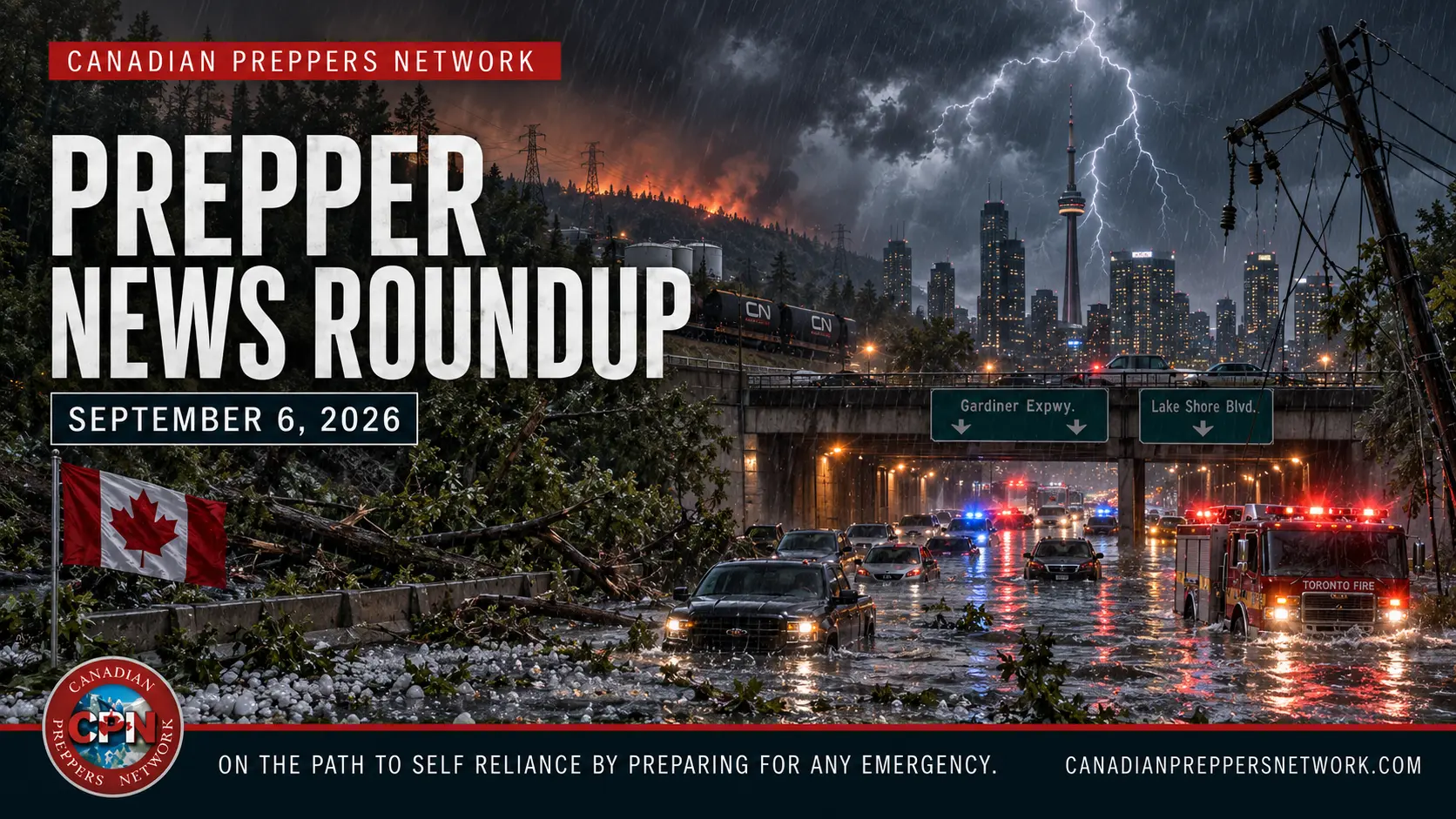
A line of powerful thunderstorms crossed southern Ontario on September 2, bringing torrential rain, large hail, damaging winds, tornado warnings and flash flooding.
Toronto declared a significant weather event following the storm. Rainfall varied considerably across the city and surrounding watersheds, with recorded amounts ranging from approximately 10 to 112 millimetres.
The Toronto and Region Conservation Authority issued a flood warning during the storm. Although that warning was later downgraded, saturated ground, elevated river levels and unstable banks remained concerns after the rain ended.
Approximately 65,000 Toronto Hydro customers lost electricity at the height of the storm. Fallen trees and branches brought down power lines while flooding affected major roads, transit routes and residential neighbourhoods.
Sections of the Don Valley Parkway, Yonge Street, Lake Shore Boulevard and the Gardiner Expressway were closed or restricted. Subway service was interrupted in some areas, flights at Toronto Pearson were delayed or cancelled, and traffic signals stopped operating where power was unavailable.
Toronto Fire Services handled nearly 1,500 calls during one 24-hour period—the department’s second-highest single-day volume since the 2013 ice storm. By Friday afternoon, the City had received approximately 2,400 storm-related service requests involving fallen trees, flooding, damaged infrastructure and other hazards.
The damage was not limited to Toronto.
GrandBridge Energy reported that more than 33,000 customers lost power in Brantford, Brant County, Cambridge and North Dumfries. Damage included broken utility poles, downed wires and trees falling onto electrical equipment.
The utility’s online outage map also failed during the emergency, temporarily removing one of the principal ways customers obtain restoration information.
In Kitchener, Waterloo and the surrounding townships, more than 19,000 Enova Power customers were without electricity at the peak. Police responded to dozens of reports involving downed trees, electrical lines and failed traffic signals.
Storm surveyors documented an EF1 downburst near Brodhagen in West Perth. The Northern Tornadoes Project also reported evidence that tornadoes likely occurred near Bamberg and Tavistock, although final classifications had not yet been issued. Additional downburst damage was identified in Toronto and near Orr Lake.
The Preparedness Lesson
This storm produced several connected failures in only a few hours. Electricity disappeared while roads flooded, traffic signals stopped operating, public transportation was disrupted and online outage information became unreliable.
Households should review backup power for sump pumps and essential medical equipment, test battery lighting and radios, and confirm that garage doors can be opened manually. Generators must be operated outdoors and well away from doors, windows and vents.
Drivers should identify routes that avoid low underpasses and known flood areas. Standing water should never be treated as passable simply because another vehicle made it through.
Every downed electrical line must be considered energized. Remain at least ten metres away and report it immediately.
Sources: City of Toronto storm response, Toronto and Region Conservation Authority, Global News, GrandBridge Energy and CityNews Kitchener.
Wildfires Continue to Displace Canadians
Although the worst of summer has passed, Canada’s wildfire season remains active.
As of September 4, Indigenous Services Canada reported that 20 First Nations were still affected by wildland fires. Eight communities remained evacuated, with approximately 698 people away from home.
Six of the evacuated communities were in British Columbia, with one each in Saskatchewan and Ontario.
Since April, 87 wildland fires have affected 83 eligible First Nations communities and forced more than 8,800 people to evacuate.
The declining numbers are encouraging, but they do not mean the danger has ended. Evacuation bags, medications, identification, fuel reserves and alternate routes should remain ready in threatened regions.
Anyone who used an evacuation kit earlier this year should replace consumed food, water, batteries and medications now. Lessons learned during an actual evacuation should also be written into the household plan while the experience is still fresh.
Source: Indigenous Services Canada wildfire evacuation update.
Canada Loses 42,000 Jobs
Canada’s employment picture weakened in August.
Statistics Canada reported that employment declined by 42,000 positions while the employment rate slipped to 60.8 per cent. The unemployment rate remained unchanged at 6.4 per cent, partly because the labour force also contracted.
Employment declined in several industries:
- Business, building and other support services lost 20,000 positions.
- Public administration declined by 8,800.
- Natural resources lost 7,700.
- Utilities declined by 5,600.
- Manufacturing was the notable exception, adding 22,000 jobs.
Canada’s merchandise trade surplus also narrowed from $4.2 billion in June to $769 million in July. Exports fell 2.3 per cent while imports increased 2.2 per cent.
There was one encouraging sign: exports to countries other than the United States rose to a record $25.6 billion, representing approximately one-third of Canadian merchandise exports during July.
These figures do not signal an immediate economic collapse. They do, however, demonstrate why financial preparedness matters.
A household can experience its own emergency because of a lost job, reduced hours or prolonged illness even while stores remain open and the electrical grid continues operating.
Emergency savings, manageable debt, stored necessities and more than one marketable skill provide protection against that kind of personal disruption.
Source: Statistics Canada weekly economic review.
Global Food Prices Reach Their Highest Level Since 2022
International food prices moved higher again in August.
The UN Food and Agriculture Organization’s Food Price Index averaged 133.3 points, an increase of 1.9 per cent from July and 2.5 per cent from one year earlier.
Prices rose across every major category tracked by the index, including cereals, vegetable oils, sugar, meat and dairy. Supply concerns, adverse production conditions and disruptions connected to conflicts in the Black Sea and Middle East all contributed to the increase.
International commodity increases do not appear at Canadian grocery stores immediately. They move through processors, transportation companies, wholesalers and retailers before reaching consumers.
That delay provides time to prepare.
A rotating pantry built around food the household normally consumes remains one of the most reliable defences against price increases. Flour, rice, oats, pasta, cooking oils, canned proteins and other frequently used staples can be purchased gradually when prices are favourable.
The objective is not panic buying. It is replacing food before it becomes more expensive and maintaining enough depth to absorb temporary shortages or income interruptions.
Source: FAO Food Price Index—August 2026 update.
Middle East Fighting Pushes Energy Prices Higher
Energy markets reacted sharply to renewed fighting between the United States and Iran.
On September 1, Brent crude rose $4.16 to settle at US$94.65 per barrel. West Texas Intermediate increased $4.46 to US$90.22.
Diesel futures also reached their highest level in more than four years as refinery and shipping disruptions tightened available supplies.
The situation escalated again on Saturday when Iran’s semi-official Tasnim news agency reported that an Iranian tanker had been struck near Kharg Island, the country’s principal oil-export hub.
No casualties were initially reported. However, neither Iranian authorities nor U.S. Central Command had officially confirmed the account when it was published. It must therefore be treated as developing information rather than an established fact.
The larger concern is the Strait of Hormuz. Before the current conflict, approximately one-fifth of the world’s oil supply moved through this narrow waterway.
Prolonged disruption can affect diesel, gasoline, heating fuel, fertilizer, transportation and food prices—even in an oil-producing country such as Canada.
The appropriate household response is not unsafe fuel hoarding. Keep vehicles above half a tank, rotate stored generator fuel, inspect heating equipment and begin accounting for higher winter energy costs.
All gasoline, diesel and propane must be stored according to local fire regulations and kept away from ignition sources.
Sources: Reuters energy-market report and Reuters Kharg Island report.
Cyber Threats Target Energy Infrastructure
A report published this week examined how artificial intelligence is lowering the technical barrier for attacks against power companies and other critical infrastructure operators.
Modern electrical grids contain interconnected generators, substations, communications networks and industrial-control equipment. Attackers are using AI to identify vulnerable devices, automate portions of an intrusion and create more convincing social-engineering material.
Older equipment and smaller utilities may be particularly vulnerable because they often lack the personnel and resources required for continuous monitoring.
The report did not identify a new nationwide Canadian outage. The important signal is that cyberattack must now be considered alongside severe weather, equipment failure and physical sabotage as a credible cause of regional power disruption.
Households do not need advanced cybersecurity knowledge to prepare for the consequences. Independent lighting, backup heat, stored water, cash, printed contact information and radio communications remain useful regardless of why the grid fails.
Source: Reuters report on cyber threats against energy infrastructure.
Diplomacy Resumes While Infrastructure Attacks Continue
American envoys arrived in Moscow on Saturday in another attempt to restart negotiations over the Russia–Ukraine war.
The visit occurred while both countries continued conducting long-range attacks.
Russia intensified drone and missile strikes against Kyiv and other Ukrainian cities. Damaged or targeted locations included airports, industrial facilities, residential buildings and the headquarters of Ukraine’s Security Service.
Ukraine continued striking Russian military facilities, oil refineries and other sites supporting the Russian war effort.
During one reported overnight attack, Russia launched 167 attack and decoy drones. Ukraine said 128 were intercepted or electronically suppressed.
Negotiations may eventually reduce the fighting, but present operations provide little evidence that either side is preparing to stop applying pressure.
The continuing attacks demonstrate how modern warfare reaches well beyond the front line. Electricity, fuel distribution, communications, transportation and civilian workplaces all become part of the battlespace.
Source: Associated Press.
Europe Faces an Uncertain Winter Energy Position
European gas-storage facilities entered September only 65 per cent full—their lowest level for this time of year in 15 years.
Interrupted liquefied-natural-gas shipments from Qatar and elevated prices have slowed efforts to refill storage. German facilities were reported at approximately 53 per cent capacity, while those in the Netherlands were at 47 per cent.
The greatest immediate risk is higher prices rather than widespread physical shortages. However, a prolonged supply disruption combined with a cold winter could place significantly more pressure on both households and industry.
A separate European Court of Auditors review warned that the European Union may struggle to reach its promised level of defence readiness by 2030.
Identified problems included fragmented national systems, industrial bottlenecks, insufficient cooperation and continued dependence on American equipment.
Both developments point to the same problem: declaring readiness is easier than building the stockpiles, infrastructure and production capacity needed to sustain it.
Sources: Le Monde and The Guardian.
Civil-Defence Watch: Households Become Part of the Plan
Ireland launched a national “Be Emergency Ready” campaign and plans to mail approximately 2.2 million preparedness booklets to households beginning September 21.
The material covers household planning, essential supplies, communications, evacuation and community support during extended disruptions.
Sweden will test its new SE-Alert cellular warning system for the first time on September 7 in Stockholm and Gotland. Sweden’s Civil Defence and Resilience Agency also advises households to be capable of managing for at least one week without normal services.
That seven-day standard is considerably more realistic than a small three-day emergency kit. A serious regional outage can easily take several days to assess, organize and repair—particularly when fallen trees, flooding or damaged infrastructure restrict access.
Sources: Ireland’s Be Emergency Ready campaign and Swedish Civil Defence and Resilience Agency.
CPN Community Calendar
The Great Ape Empire weekend in Wiarton, Ontario, takes place September 11–13.
The weekend begins Friday with a Canadian Firearms Safety Course. Saturday’s principal event is Plinkin’ in the Woods, a full day of practical firearms instruction and live-fire training presented by Frugal Gunnies at Great Ape Empire.
A separate intensive archery program is being offered by Barefoot Bushcraft, with Wolf Starchild providing instruction. An Ontario hunter-safety course follows on Sunday.
Canadian Preppers Network is helping promote these activities in partnership with PreppersMeet, Great Ape Empire, Off Grid School and Barefoot Bushcraft. These are partner events rather than CPN-operated courses. Availability and registration should be confirmed directly with the respective organizer.
The Bottom Line
This week’s southern Ontario storm turned a weather warning into widespread flooding, power failures, road closures and infrastructure damage in only a few hours.
At the same time, wildfire evacuations continued, Canadian employment weakened, international food prices rose and conflict placed additional pressure on global energy supplies.
None of this requires panic. It does justify steady action.
Review the evacuation kit. Strengthen the pantry. Test the sump pump and backup power. Maintain fuel safely. Keep communications options that do not depend entirely on the cellular network. Check insurance coverage before it is needed.
Preparedness works best when it is completed before the headlines become personal.



One Comment