Keeping a fire going takes more than ignition. Fuel, daylight and fatigue determine how useful it will remain.
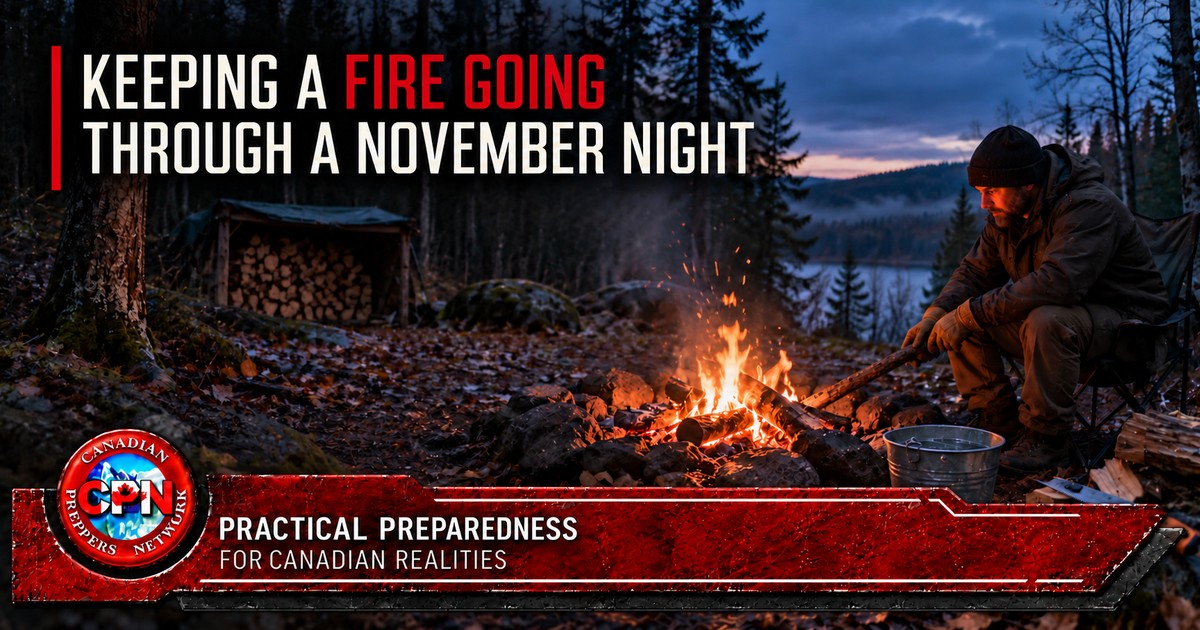
At five in the afternoon, the fire looks reassuring. Flames rise from split wood, the kettle begins to steam, and the damp November woods feel a little less hostile.
By nine, the situation has changed. The convenient wood is gone. The remaining pieces are too large or too wet. Your headlamp catches the rain while you search around camp, and every trip away from the fire costs warmth and energy.
The mistake happened before sunset: you prepared enough fuel to start a fire, but never worked out how you would maintain it.
For Canadian preppers, that distinction matters. An unexpected night outdoors, a delayed return from a hunting area or a disrupted journey can turn firewood management into an immediate practical problem. During a prolonged emergency, the same work may have to be repeated night after night.
Keeping a fire going through a long November night begins with a realistic fuel supply, an awake attendant and a sleeping arrangement that remains useful after the flames are extinguished.
Table of Contents
1. Keeping a Fire Going Starts With a Plan
Cooking supper and heating water require a different commitment from providing warmth for several people throughout the evening. Keeping a fire attended until morning requires more fuel, more labour and someone capable of staying awake.
Separate the evening into specific jobs:
- Prepare food and heat water.
- Provide warmth while people organise camp.
- Support an attended watch, if one is necessary.
- Be extinguished before everyone sleeps.
That final step belongs in the plan from the beginning. The Friends of Algonquin Park advises campers to extinguish fires completely before going to bed or leaving the campsite.
If your bedding cannot keep you warm after the fire is out, address that weakness while daylight remains. Improve ground insulation, wind protection and your sleeping arrangement—or move to a safer location while that remains possible.
After a wider disruption, a fire can support cooking, water heating and camp work. It also creates a continuing demand for fuel and supervision. Plan around the labour available rather than assuming someone can keep feeding it indefinitely.
2. Process Fuel Before Dark
Daylight makes it easier to assess wood, see your footing and operate tools. After sunset, gathering fuel competes with cooking, shelter work and rest.
Keeping a fire going is easier when you stop travelling early enough to establish camp properly. A few extra kilometres can be a poor trade if they leave you preparing shelter and cutting wood in the dark.
Check current fire restrictions and wood-collection rules before beginning. Rain does not automatically make a fire permitted or safe. Where collection is allowed, select sound dead and down wood. Reject pieces that crumble, feel spongy or are deeply waterlogged.
A folding pruning saw or compact bow saw can turn suitable branches into manageable lengths. Look for a secure locking or tensioning system, a grip you can control with gloves and a blade intended for wood. Support the work so it cannot roll, and keep your other hand clear of the cutting path.
A splitting hatchet may help with appropriate pieces, but it requires practice, a stable working surface and clear space. Avoid making your fuel plan depend on oversized timber or felling a tree.
At a vehicle-supported camp or remote property, a purpose-built logging sawhorse can support suitable wood during cutting. Follow its instructions and secure the material properly. This is base-camp equipment rather than something to add to a walking pack.
Bring locally sourced firewood when practical and permitted, observing restrictions on moving firewood between areas.
3. Prepare Three Separate Fuel Supplies
Keeping a fire going requires usable fuel, and an unsorted heap makes it difficult to see what you actually have. Organise your supply by purpose.
- Starting material: protected tinder and fine kindling for establishing the fire.
- Working fuel: small and medium pieces that can be added without burying the flame.
- Restart reserve: dry tinder and prepared kindling stored separately in case the fire fails.
It is easy to consume every dry shaving during the first lighting, then discover that nothing suitable remains when rain or a poorly timed log smothers the fire.
Keep the restart reserve in waterproof storage, safely away from sparks and heat. A small dry bag protects reserve kindling; a separate sealed container provides additional protection for tinder and matches. Package a backup ignition source separately.
Keep storage organised enough that another person can find the reserve without emptying every bag in camp. The system should remain straightforward when everyone is tired.
For the ignition process itself, read Fire After Three Days of Rain.
4. Estimate Fuel Needs From Your Own Practice
There is no dependable universal answer to “How much wood will last all night?” When keeping a fire going, species, moisture, piece size, wind and fire size all affect consumption.
During practice, establish the small fire you would actually use. Set aside a measured bundle of prepared wood and observe how long it lasts.
If one bundle lasts roughly an hour, six comparable bundles provide a starting estimate for six hours of similar use. They do not guarantee it. Worsening weather, wetter fuel or a larger fire can increase demand.
Repeat the exercise under different conditions. Notice how much time gathering and processing require, and which tools become tiring to use.
Prepare a margin while keeping the fire modest. Feeding unnecessary flames creates unnecessary gathering work. During a prolonged disruption, that wasted labour repeats every day.
5. Protect Prepared Firewood From Rain
Keeping a fire going in wet weather depends on protecting the wood you have already processed. Keep the supply clear of wet ground where practical, and cover it against continuing rain.
At a temporary camp, a waterproof cover over a supported wood supply may be enough. Secure the cover so wind cannot carry it toward the fire, and keep the entire arrangement well away from flames, sparks and radiant heat.
At a fixed camp or remote property, an elevated firewood rack with a cover helps organise the reserve and reduce contact with wet ground. Allow ventilation rather than sealing damp wood into an airtight enclosure.
Bring forward manageable amounts as needed. Leave fine kindling protected until you are ready to use it.
Damp pieces can be warmed near an attended fire, but maintain safe separation and watch for scorching. Do not build a tightly packed wall of drying wood around the flames or obstruct access to extinguishing water.
Do not hang boots, clothing or a tarp above the fire. Burned footwear or a damaged shelter can leave you worse off than before lighting it.
6. Feed the Fire Before It Collapses
A common mistake is to ignore a healthy fire, notice that it has nearly died, then drop a heavy piece of damp wood onto the remaining embers.
Use modest additions while the fire still has enough heat to accept them. Preserve air spaces and watch what happens after each addition.
If flames disappear and smoke increases, adding more wood may deepen the problem. Reposition the fuel carefully with a suitable long fire poker, restore airflow and return to smaller prepared pieces when necessary.
Leather work gloves help protect hands while handling rough wood. They do not make it safe to pick up burning logs or hot metal. Keep hands away from embers and use a suitable tool for tending the fire.
Keeping a fire going means maintaining steady, controllable heat suited to the job. A larger fire consumes more wood and sends more heat and sparks toward equipment. Moving bedding closer to compensate for inadequate insulation introduces another hazard.
7. Keeping a Fire Going Requires an Awake Attendant
When a group is keeping a fire going through the night, assign responsibility clearly. “Someone will keep an eye on it” is not a watch system.
At each handover, the next person should know:
- Where the working fuel and restart reserve are stored.
- Where extinguishing water and tools are located.
- How the fire should be maintained.
- When to wake another person or extinguish the fire.
Keep prepared fuel safely accessible so the attendant does not have to leave the fire to gather more.
A headlamp leaves both hands available for routine camp tasks. Choose simple controls, suitable weather protection and spare power you can carry. Check useful runtime at the brightness setting you intend to use.
At a vehicle-supported camp, a rechargeable work light can illuminate the fuel-preparation area. A model with an independent stand allows deliberate positioning. Keep it away from heat and use it within its stated weather rating. Better lighting does not remove the disadvantages of cutting wood while tired.
If you are alone, extinguish the fire before sleeping. If everyone is too tired to stay awake, extinguish it.
Never bring embers into a tent or enclosed improvised shelter. Keep open fires outside with adequate clearance from shelters and equipment.
8. Practise the Whole Evening
At a permitted site with extinguishing water ready, prepare enough legally obtained wood for a planned evening. Track how much you burn, how often you add fuel and whether your protected reserve stays dry.
Practise keeping a fire going while you cook a meal, heat water and manage camp through dusk. Then extinguish it completely.
- Did fuel preparation take longer than expected?
- Was the saw comfortable and controllable with gloves?
- Did your lighting last long enough?
- Was the pile mostly large wood, with too little usable kindling?
- Could you access extinguishing water immediately?
Use the results to improve equipment and habits. Pair this exercise with Your Fire Kit Needs a Rain Test to assess both ignition and sustained fire management.
9. Finish With a Cold Fire Site
Have enough water available before lighting the fire, and leave time for extinguishing it. A collapsible bucket can suit a walking kit; a sturdy dedicated bucket may be more practical at a vehicle-supported camp.
Allow the fire to burn down under supervision. Wet the remains thoroughly, stir them and add more water. Check for remaining heat throughout the material, taking care around steam and hot ash. Continue until the remains are completely cold.
Rain is no substitute for this work. Do not bury hot coals and assume the fire is extinguished.
A successful November camp ends with protected equipment, a usable sleeping arrangement and a fully extinguished fire. Keeping a fire going is only useful while it serves a purpose; managing the whole evening well gives you the option to extinguish it safely.
PREPAREDNESS BUYING BOX
Equip Your Evening Fire Routine
Choose equipment around the work: process suitable fuel, protect a restart supply, illuminate camp tasks and extinguish the fire completely.
Affiliate disclosure: This section contains affiliate links. Canadian Preppers Network may earn a commission from qualifying purchases at no additional cost to you. As an Amazon Associate, we earn from qualifying purchases. Amazon links below open product searches; VEVOR links open specific Canadian product pages.
Portable Woodland Equipment — Amazon.ca
Folding pruning saw: Cut suitable branches into manageable lengths. Look for secure locking and a controllable grip.
https://www.amazon.ca/s?k=folding+pruning+saw&tag=canadianprep-20
Small waterproof dry bag: Protect prepared tinder and reserve kindling during storage and travel.
https://www.amazon.ca/s?k=small+waterproof+dry+bag&tag=canadianprep-20
Weather-resistant headlamp: Hands-free light for organising camp and tending an attended fire. Carry spare power.
https://www.amazon.ca/s?k=water+resistant+headlamp&tag=canadianprep-20
Commercial fire-starting tinder: A protected reserve for establishing or restarting the fire.
https://www.amazon.ca/s?k=waterproof+fire+starter+tinder&tag=canadianprep-20
Collapsible camping bucket: Keep extinguishing water ready before ignition. Select a size you can carry safely.
https://www.amazon.ca/s?k=collapsible+camping+water+bucket&tag=canadianprep-20
Leather work gloves: For handling rough wood and camp materials; not for touching burning fuel or hot tools.
https://www.amazon.ca/s?k=leather+work+gloves&tag=canadianprep-20
Vehicle-Supported and Fixed-Camp Equipment — VEVOR Canada
These larger items support a base camp, cabin or remote property. Choose them around your transport capacity, working area and storage needs.
VEVOR Folding Logging Sawhorse: A purpose-built log-cutting stand with adjustable height and gripping claws. Support and secure suitable wood according to the manufacturer’s instructions.
https://s.vevor.com/QT1V7B
VEVOR 4.3-Foot Firewood Rack With Cover: An elevated storage rack supplied with a 600D Oxford cover. Useful for organising a prepared wood reserve at a fixed camp or remote property; maintain ventilation and safe separation from the fire.
https://s.vevor.com/QT1V7G
VEVOR Rechargeable LED Work Light With Stand: An 8Ah cordless light with three lamp heads, a detachable tripod and adjustable colour temperature. Position it to illuminate camp work away from heat, and follow its weather-protection instructions.
https://s.vevor.com/QT1V7O
Check current availability, specifications and instructions before purchasing. Match equipment to your skills and camp conditions.
Related Reading
Sources and Further Guidance
The fuel-use exercise is a practical planning method, not a guaranteed burn-time estimate. Follow current local fire restrictions and site rules.