Could a coordinated cyberattack explain the outages that preceded the predicted November 17 blackout?
The 90-day blackout that viral posts said would begin November 17 never came. The alarm heard on U.S. radio and television was a FEMA emergency broadcast test the FCC had announced in September. PolitiFact traced one of the viral videos to an altered clip from a November 9 news conference. The same stretch of days offered a better reason to pay attention. Major companies confirmed that attackers had reached them through suppliers they trusted. FCC test notice · PolitiFact · Skift · Reuters
Table of Contents
The attacks that got through
November 12 — Expedia confirms a breach through a supplier. Expedia Group said attackers reached its systems through a compromised data platform provider. The same incident affected other companies, according to Expedia. The company did not identify the supplier or confirm what data had been exposed. The breach showed how access through one trusted provider could reach more than one business. Skift
November 16 — One web supplier, exposure across 178 organisations. Optimizely confirmed that an attacker had inserted malicious code into some customer projects. A researcher identified sites belonging to 178 organisations, including HSBC, Equifax, Zoom and CNN. The code was designed in part to capture payment card details. The number describes organisations whose sites were exposed and says little about how many visitors lost data. Reuters
Could a coordinated cyberattack disrupt several sectors?
The Optimizely incident gives the question a concrete starting point. A single operation reached financial, media and communications websites through the same supplier. The aviation, banking and business communications outages show how widely the effects of a coordinated cyberattack could be felt if essential services were disrupted together. A common actor or compromised supplier linking it to Expedia or to the major U.S. outages remains unverified. The outages alone cannot establish a coordinated cyberattack. Reuters on Optimizely · Skift · Reuters on the outages
The FBI added a warning on November 13. It said attackers were using an AI-assisted tool called ARTEX and had gained elevated access in under three hours in some observed intrusions. That puts a time scale on a real incident. An organisation can start its morning with services running and have an intruder in sensitive parts of its network before lunch. The FBI warning helps explain the risk of a coordinated cyberattack across suppliers and customers. FBI bulletin FLASH-20261113-001
Three major outages show what’s at stake
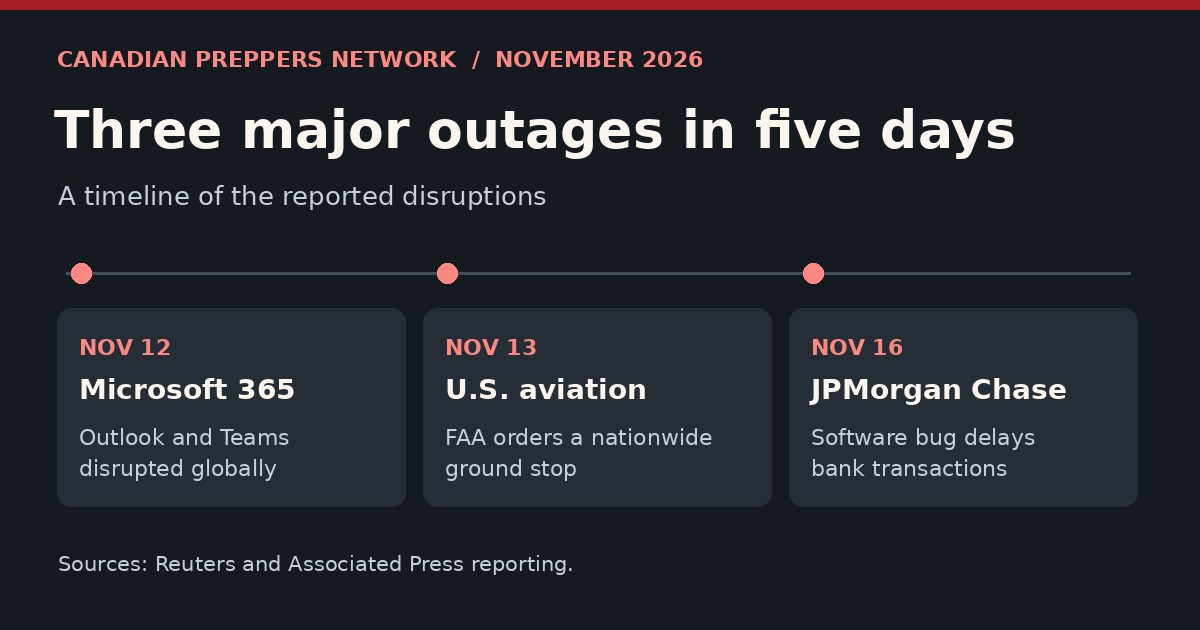
November 12 — Microsoft 365. Outlook and Teams were disrupted around the world, affecting businesses and government offices that rely on Microsoft for email and meetings. Microsoft cited server problems. Reuters · Associated Press
November 13 — U.S. aviation. An FAA communications failure prompted a nationwide ground stop lasting nearly five hours, with cancellations continuing into the weekend. Reuters reported that the disruption was blamed on a router installation. Reuters · Associated Press
November 16 — Banking and payments. JPMorgan Chase said a software bug delayed transactions. Customers reported trouble accessing services at several large U.S. banks, and some reported problems using Zelle. The Associated Press reported that Zelle itself was unaffected by the Chase bug. Chase said transactions were processing normally again later that day. Associated Press
Canada scheduled its own public alert tests for November 18, including 12:55 p.m. ET in Ontario and 1:55 p.m. ET in Quebec. Ontario test notice · Québec En Alerte
|


Add depth to the supplies you already have
Start with the part of your stockpile you’d draw down first if your usual grocery run, fuel delivery or pharmacy pickup fell through. Look at what’s actually on the shelf, what your household uses in a normal week and how often you restock it. Then work out what an extra missed shopping trip or delivery would cost you in food, water and fuel. Use that to decide what deserves more space in your stockpile.
- Non-perishable food. Count meals you can make from what’s on hand. Add the ingredients that run out first or turn what you already have into a meal. If most of your pantry needs water and fuel to prepare, add ready-to-eat options you’ll use and rotate.
- Drinking water. Count the water you can draw and use with the power off. Compare that with what your household uses for drinking, cooking, hygiene and pets. If your pantry expansion is mostly dry food, build up your water reserve alongside it. Health Canada emergency water guidance
- Fuel. Check what you have against what you actually burn in winter. Give yourself more room before the next heating-fuel delivery is due and refuel the vehicle on your normal rounds. If you use a generator, check fuel consumption under the loads you normally run. Keep reserves in approved containers within local fire rules. Run a portable generator outdoors at least 6 metres from any building. Health Canada carbon monoxide guidance
- Cash. Check whether the small bills you’ve set aside still cover the groceries, fuel or pharmacy supplies you might need to buy. Replenish what you’ve used and keep a little flexibility for the cost of shopping farther from home. Ontario emergency kit guidance
- The small things you use up. Check spare batteries, first-aid dressings, hygiene supplies, pet food and other household consumables. Charge your power banks and test your headlamps and radio with the batteries you have. Review when prescriptions are due for refill so you can deal with a gap while your pharmacy is reachable. Canadian emergency kit checklist
What Canadian households can prepare for
Think through where you’d get essentials and how you’d reach people if the services you usually rely on went down. A coordinated cyberattack is one scenario worth testing alongside ordinary outages.
- Buying essentials. Know a second place to buy groceries, fill prescriptions and refuel. Keep the addresses and phone numbers offline. If there’s a disruption, call ahead to check what’s open and what’s in stock before making the trip.
- Cross-border travel. Keep your itinerary, booking references and airline contact number available offline. If flights stop, you can still find the information you’ll need to rebook or arrange a place to stay.
- Email and cloud services. Keep offline copies of key documents and a short list of phone numbers. Agree in advance on a backup way to reach family or colleagues when email or a work messaging app goes down.
Put your communications plan to the test. Start with CPN’s Communications in Canada hub.
|
Be careful with disaster prophecies
When someone gives you an exact date, pull up the original notice and check who issued it, what systems it names, and what independent reporting can confirm. Take particular care when the countdown comes with a checkout link or an instruction to move your savings. If a prediction fails and its promoter points to a different outage as proof, compare what actually happened with what they originally said would happen. A failed blackout prediction is no grounds for assuming a coordinated cyberattack.
Check your reserves tonight. Imagine your next grocery trip and your next fuel delivery both fall through. What do you use up first? Count the meals you can make, the water you can reach and the fuel you can draw on. Put the first shortfall at the top of your shopping list and deal with it while you still have a choice of where to buy it.
|
Related Reading
- Your First 7 Days Without Normal Supply Chains
- When the Internet Goes Down, Canadians Can Still Connect
Equipment Buying Box
Choose equipment that fills a gap in the supplies you already have.
As an Amazon Associate, Canadian Preppers Network earns from qualifying purchases. CPN may also earn a commission on qualifying purchases through the VEVOR affiliate links below.
VEVOR Canada
- 2.25-gallon countertop gravity filter. For use with a suitable water source. Follow local drinking-water advisories.
- 130 W countertop vacuum sealer. Package dry pantry staples for rotation. Vacuum sealing does not make perishables shelf-stable.
- Zippered document pouch. Keep printed contacts, travel records and inventory notes together.
- Foam-lined weatherproof hard case. Protect radios, charging cables and a spare power bank.
- 296 Wh portable power station. Recharge phones and other small electronics within the unit’s rated limits.
- Rechargeable magnetic work light. Light a workbench, utility area or vehicle without relying on overhead lights.
Amazon.ca
- Food-grade water containers. Add capacity you can access when a well pump is down.
- Heavy-duty manual can opener. Keep a spare with the food it opens.
- Food-grade buckets and gamma lids. Organise bulk dry pantry staples.
- CSA-certified gasoline can. Replenish an approved reserve where local rules allow.
- Battery-powered AM/FM radio. Keep a way to listen without mobile data.
- LED headlamps. Keep both hands free during an outage.
- Rechargeable AA/AAA batteries and charger. Match the batteries to the gear you already use.
- USB-C power bank. Keep a phone charged for offline documents and contacts.
- First-aid refill supplies. Replace consumables already used.
- Heavy-duty freezer thermometer. Check cold storage when power is interrupted.