Most disruptions don’t start with a clear moment.
There’s no announcement. No obvious beginning.
Things just stop working the way they used to.
Deliveries are delayed. Shelves look thinner. Prices shift. Services slow down. What was routine becomes inconsistent—and stays that way longer than expected.
You don’t notice it all at once.
But you feel it.
If you haven’t covered the basics yet, start with the first 72 hours—that’s where most disruptions begin to take shape:
👉 https://canadianpreppersnetwork.com/72-hours-is-where-most-people-stop/
When “Normal” Stops Being Reliable
We tend to think in terms of events.
A storm. A blackout. A specific incident with a clear start and end.
But many of the disruptions people are dealing with now don’t follow that pattern.
They stretch.
They linger.
And they affect multiple systems at the same time—food, fuel, availability, services—without fully stopping any one of them.
That’s what makes them harder to manage.
Not because they’re extreme.
Because they’re persistent.
Why the First 7 Days Matter
The first few days of any disruption are about adjustment.
After that, it becomes about sustainability.
Seven days is where the difference becomes clear.
If you’re unprepared, you start running into problems:
- supplies run low
- options narrow
- stress increases
If you’re prepared, something different happens.
You stabilize.
You stop reacting—and start managing.
Day 1–2: Awareness and Adjustment
At the beginning, most people are still assuming things will return to normal quickly.
They wait.
They delay action. They avoid changing routines. They rely on existing systems to correct themselves.
Prepared households take a different approach.
They recognize early that something has changed—and they adjust immediately.
They check what they have. They reduce unnecessary use. They make small shifts that extend what’s available.
This isn’t panic.
It’s awareness.
Day 3–4: Pressure Begins
This is where the gap starts to show.
Supplies that felt sufficient begin to run low. Stores may still be open, but selection is limited. Prices begin to reflect demand.
For those without preparation, this is where stress builds.
Decisions become reactive.
For those who prepared, this phase looks different.
They’re not searching for what’s left.
They’re using what they already have.
Food is still available. Water isn’t a concern. Basic systems inside the home continue to function.
And that creates something valuable—time.
Day 5–7: Stability or Strain
By the end of the first week, the situation becomes clear.
Either systems are returning to normal—or they’re not.
If you’re unprepared, this is where options narrow significantly.
You’re dependent on what’s available externally. You’re dealing with limitations you didn’t plan for.
If you’re prepared, you’re still operating within your own system.
Food supply is holding. Water is managed. Power and lighting are controlled. You’re not comfortable—but you’re stable.
And stability changes everything.
Food and water are what carry you through once disruptions extend beyond a few days. If either one is weak, pressure builds quickly:
👉 https://canadianpreppersnetwork.com/how-to-build-a-30-day-food-supply-in-canada/
👉 https://canadianpreppersnetwork.com/water-storage-and-filtration-for-canadian-households/
The Systems That Matter Most
Preparedness isn’t about having everything.
It’s about having the essentials covered.
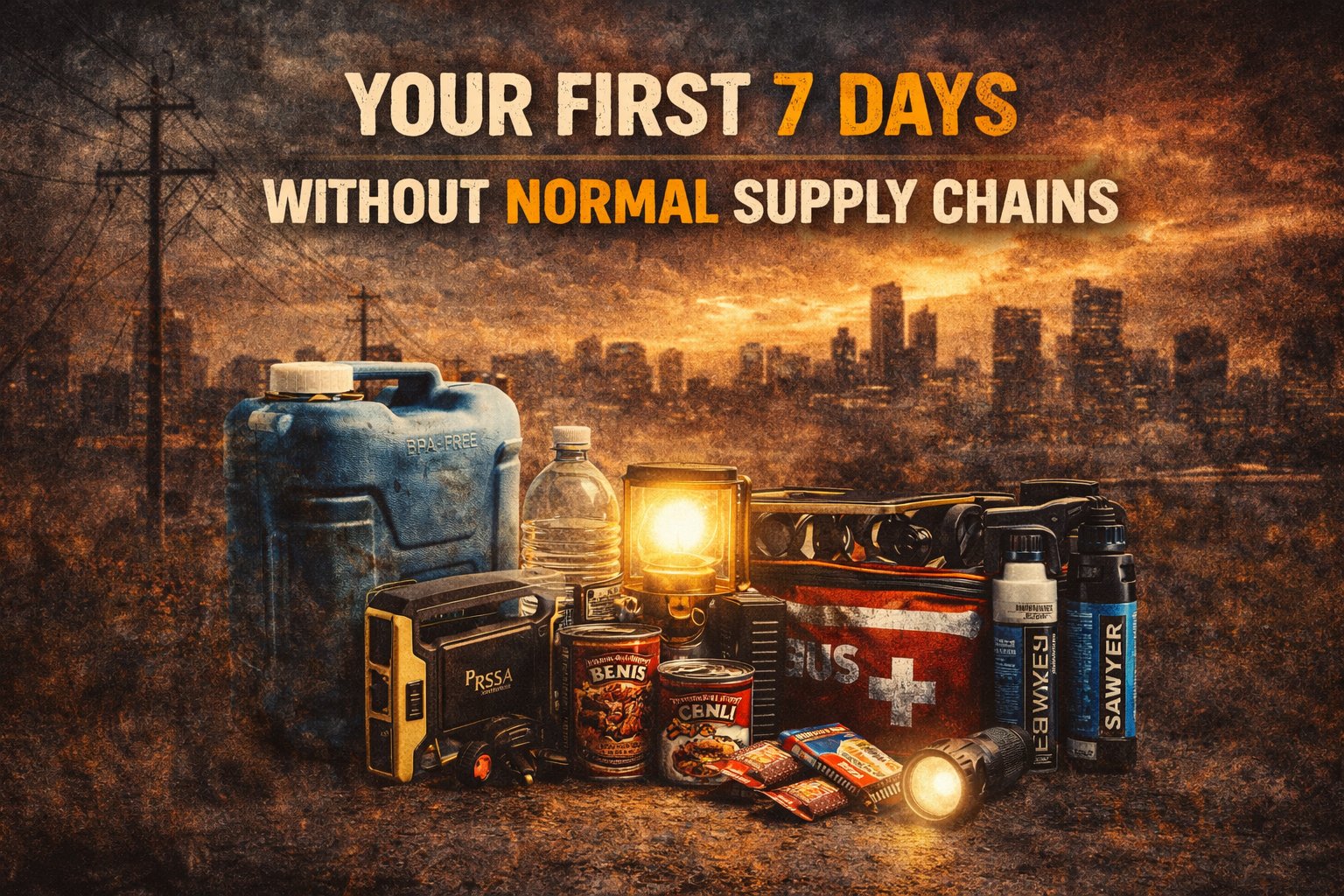
Food, water, light, and basic power form the foundation.
When those are in place, everything else becomes easier to manage.
If you’ve followed the earlier steps:
- you’ve built a food buffer
- you’ve secured water storage and filtration
- you’ve addressed lighting and basic power
- you’ve extended that mindset into your vehicle
What you’ve really done is reduce dependence.
And that’s what carries you through.
What This Isn’t
This isn’t about extreme scenarios.
It’s not about collapse.
It’s about recognizing that systems don’t always function smoothly—and building enough resilience to handle that reality.
Most disruptions don’t require drastic action.
They require preparation that was done earlier.
What Most People Get Wrong
They wait for clarity.
They want confirmation that something is serious before they act.
But by the time it’s obvious, the advantage is gone.
Availability has changed. Prices have shifted. Options are limited.
Prepared households don’t wait for certainty.
They build quietly, before it matters.
Build Before You Need It
You don’t need to prepare for everything at once.
In fact, you shouldn’t.
Start with the basics.
Extend what you already do.
Add layers over time.
Preparedness isn’t a single decision.
It’s a series of small ones, made early.
Preparedness doesn’t stop at home. Your vehicle should reflect the same mindset, especially during travel and delays:
👉 https://canadianpreppersnetwork.com/what-every-canadian-should-keep-in-their-vehicle-this-summer/
Final Thought
Most people will experience disruptions as they happen.
A few will move through them differently.
Not because they predicted anything.
Because they prepared for the possibility that things wouldn’t work the way they expected.
The first seven days don’t determine everything.
But they determine how you experience what comes next.