Across Canada, reports of violent crime and home invasions have been rising in recent years. What once felt rare—forced entries, targeted break-ins, even daytime invasions—are now appearing more frequently in both urban centres and rural communities.
More concerning is how those incidents are changing.
In some cases, homes aren’t just being entered—they’re being targeted from a distance, with shots fired into properties as a form of intimidation, retaliation, or escalation. These events are still uncommon, but they are no longer unheard of.
For most people, that shift changes something quietly but permanently.
The question is no longer “Could it happen?”
It becomes “What would I actually do if it did?”
There’s a natural instinct to think in terms of force—locks, weapons, confrontation.
But in reality, especially during a grid-down event, most threats don’t begin with violence.
They begin with observation.
Someone is looking for an opportunity. An easy win. A place where risk is low and effort is minimal.
And that single truth changes everything about how you should think about defending your home.
The Myth of the “Last Stand”
By the time someone is forcing entry—or worse—you’re already reacting.
Effective security is built earlier.
What actually stops a home invasion isn’t force.
It’s friction.
Layer 1: Visibility and Uncertainty
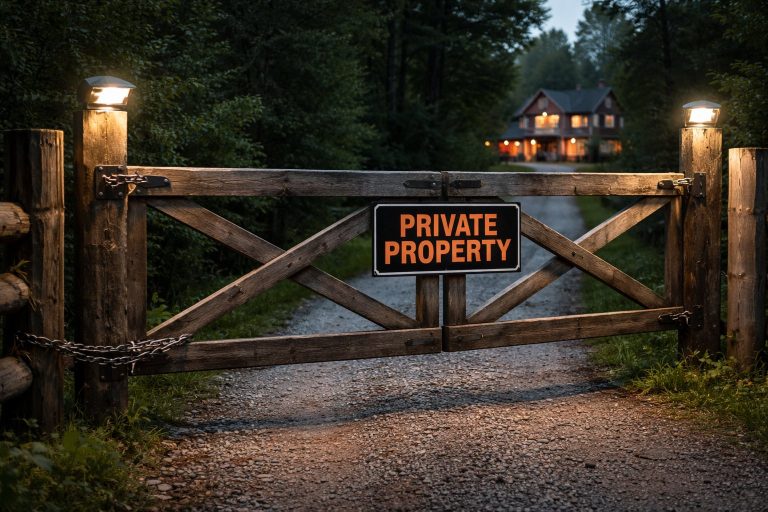
If your home looks empty, it invites attention.
If it looks occupied, it creates hesitation.
This is where solar-powered lighting becomes more than convenience—it becomes strategy.
In a grid-down situation, wired systems fail. Solar units continue working.
A set of motion-activated lights like these solar security lights
👉 https://www.amazon.ca/s?k=solar+motion+sensor+lights&tag=canadianprep-20
…provides immediate illumination on approach without relying on the grid.
Sudden light changes behaviour. People don’t like being exposed when they expect darkness.
This is your first layer:
Make your home look active, even when it’s quiet.
Layer 2: Time and Effort
If someone approaches, the next calculation is immediate:
How hard is this going to be?
Reinforced doors, proper hardware, and solid locks don’t stop everything—but they slow everything.
A reliable deadbolt such as this Schlage-style model
👉 https://www.amazon.ca/s?k=schlage+b60n+deadbolt&tag=canadianprep-20
…forces noise, delay, and commitment.
Windows are often the weakest point—but also the easiest to improve.
Reinforcing them with security window film like this
👉 https://www.amazon.ca/s?k=BDF+S8MC+window+film&tag=canadianprep-20
…helps hold shattered glass together and delays entry.
This layer is about one outcome:
Make entry slow, loud, and uncertain.
Layer 3: Detection Before Contact
Knowing someone is approaching—even seconds early—changes your options completely.
Solar-powered camera systems are one of the few modern tools that still function in a prolonged outage.
A system like this solar security camera setup
👉 https://www.amazon.ca/s?k=reolink+argus+3+pro+solar&tag=canadianprep-20
…allows for motion detection and recording without grid dependence.
Even if you’re not actively monitoring it, the presence alone changes behaviour.
Pair that with a driveway alarm system like this
👉 https://www.amazon.ca/s?k=guardline+driveway+alarm&tag=canadianprep-20
…and you gain early warning before someone reaches your door.
This layer is about one thing:
Don’t be surprised.
Layer 4: When Intimidation Replaces Entry
When homes are targeted from a distance, the conversation changes.
You’re no longer dealing with entry—you’re dealing with exposure.
There is no simple product that “solves” this.
But there are practical mitigations.
Heavier-duty options like laminate security films
👉 https://www.amazon.ca/s?k=window+security+film+laminate&tag=canadianprep-20
…can reduce glass fragmentation and help maintain a barrier longer under impact.
More importantly, this reinforces a broader principle:
Homes that appear occupied, aware, and connected are less likely to be targeted in the first place.
Even escalation follows patterns.
And those patterns favour easier targets.
Layer 5: The Human Factor
All the equipment in the world won’t compensate for predictability.
After a few days of disruption:
- Routines settle
- Attention fades
- Gaps appear
That’s when vulnerability increases.
Vary your patterns. Stay aware. Avoid becoming easy to read.
Preparedness is not a setup.
It’s a habit.
Layer 6: Community Presence
A single home can be assessed.
A connected street creates risk.
Visible cooperation—even informal—changes behaviour:
- Movement across multiple homes
- Light at different times
- Awareness of each other’s presence
People looking for opportunity avoid complexity.
And nothing introduces complexity like community.
What Actually Stops the Attempt
Most home invasions don’t end in confrontation.
They end in hesitation.
The person approaching your home decides:
- Too visible
- Too slow
- Too uncertain
- Too many variables
And they move on.
That is what stops it.
Final Thought
You don’t need extreme measures.
You need layered resistance.
Light. Delay. Awareness. Presence.
Enough friction to make your home just difficult enough—and just unpredictable enough—to be ignored.
Because in a real grid-down situation, the safest outcome is still the one where nothing happens at all.
Recommended Reading
If you’re thinking beyond short-term defense and toward building a truly resilient property, it’s worth stepping back and looking at the bigger picture.
Acres of Preparedness: Planning the Last Safe Place
👉 https://amzn.to/4mRu7b5