It doesn’t happen all at once.
At first, it’s just a delay. Messages hang. Calls don’t connect. Data slows to a crawl. Then, somewhere between hour six and hour twelve, people begin to realize something is wrong.
By the 24-hour mark, the illusion is gone.
The network isn’t “slow.” It’s down.
Across Canada, we’ve already seen how fragile communications really are—whether during the Rogers network outage 2022, wildfire evacuations in British Columbia, or ice storms that take infrastructure down in Ontario and Quebec. When the towers go silent, most people are left holding a phone that no longer connects them to anything.
Prepared households don’t panic at that moment.
They transition.
The First 6 Hours: Congestion and False Confidence
In the early phase, networks are still technically “up,” but overloaded. Everyone is calling, texting, refreshing feeds.
This is the most dangerous period—not because communications are gone, but because people assume they still work.
Messages arrive late or not at all. Calls drop mid-sentence. People make decisions based on partial information.
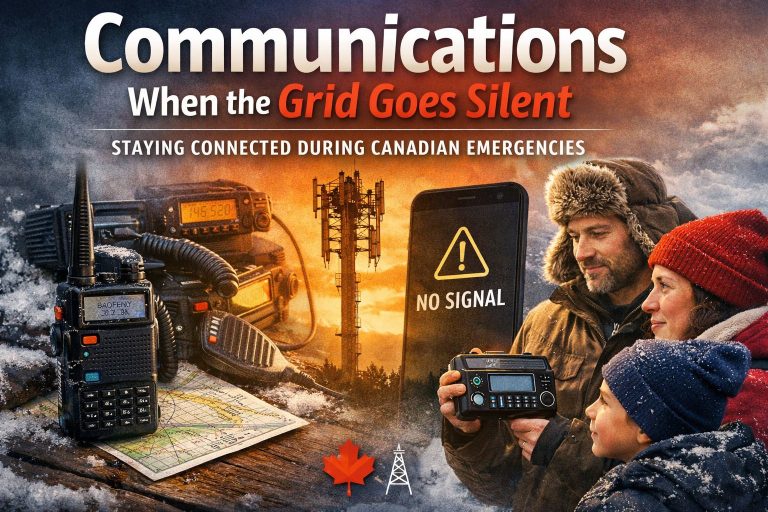
A simple but overlooked tool here is a portable AM/FM receiver like the Retekess V115.
It doesn’t transmit. It doesn’t connect you.
But it lets you hear what others can’t anymore.
👉 https://www.amazon.ca/s?k=Retekess+V115&tag=canadianprep-20
When digital systems fail, broadcast radio is often the last layer still functioning.
The 6–24 Hour Window: Local Communication Breaks Down
As backup systems at cell sites begin to fail, coverage becomes inconsistent. Entire areas drop offline.
Now the problem shifts.
It’s no longer about reaching the internet—it’s about reaching people near you.
This is where most households are completely unprepared.
A reliable set of two-way radios like the Motorola Talkabout T800 allows immediate local communication between family members and neighbours.
👉 https://www.amazon.ca/s?k=Motorola+Talkabout+T800&tag=canadianprep-20
But here’s the reality most people don’t understand:
Range collapses in real-world conditions.
Urban environments, forests, terrain—your “35 km” radio quickly becomes a 500-metre to 2 km tool.
Which is still incredibly valuable—if you planned for it.
After 24 Hours: You Either Have a System, or You Don’t
Beyond the 24-hour mark, communication becomes deliberate.
There is no longer a passive network carrying your messages. If you want to communicate, you need a method—and a plan.
This is where amateur radio operators quietly become the most connected people in the country.
With a simple handheld like the Baofeng UV-5R, you can monitor local repeaters (if operational), listen to emergency traffic, and coordinate beyond direct line-of-sight.
👉 https://www.amazon.ca/s?k=Baofeng+UV-5R&tag=canadianprep-20
But handhelds are only the beginning.
Regional Communication: Why NVIS Changes Everything
Canada’s challenge isn’t density—it’s distance.
In a wide-area disruption, you may need to communicate hundreds of kilometres, not across town.
This is where HF radio using NVIS (Near Vertical Incidence Skywave) becomes critical.
Instead of reaching outward, your signal goes up—reflects off the ionosphere—and returns within a regional footprint.
Radios like the Xiegu G90 make this capability increasingly accessible.
👉 https://www.amazon.ca/s?k=Xiegu+G90&tag=canadianprep-20
With the right setup, you can maintain communication across regions—even when everything else is down.
The Missing Piece: A Family Communication Plan
Gear without a plan is noise.
If you haven’t already, build a structured approach like the one outlined here:
https://canadianpreppersnetwork.com/emergency-communications/
And expand your capability with a deeper understanding of radio systems:
https://canadianpreppersnetwork.com/ham-radio-basics/
Because communication doesn’t fail all at once—it degrades in layers.
What Most People Get Wrong
They assume communication is permanent.
It isn’t.
Even systems like Alert Ready depend on the same infrastructure that just failed. Once that layer disappears, there is no automatic fallback.
Communication becomes intentional—or it stops entirely.
Final Thought
When the towers go silent, the question isn’t “how do I get signal?”
It’s:
“What was my plan when the signal was gone?”
Most people don’t have one.
That’s your advantage.
📘 Acres of Preparedness: Planning the Last Safe Place
If you’re serious about long-term resilience—not just reacting, but staying operational when systems don’t come back—this is required reading.
SEO Tags