When modern systems fail, your hands and your tools become your lifeline.
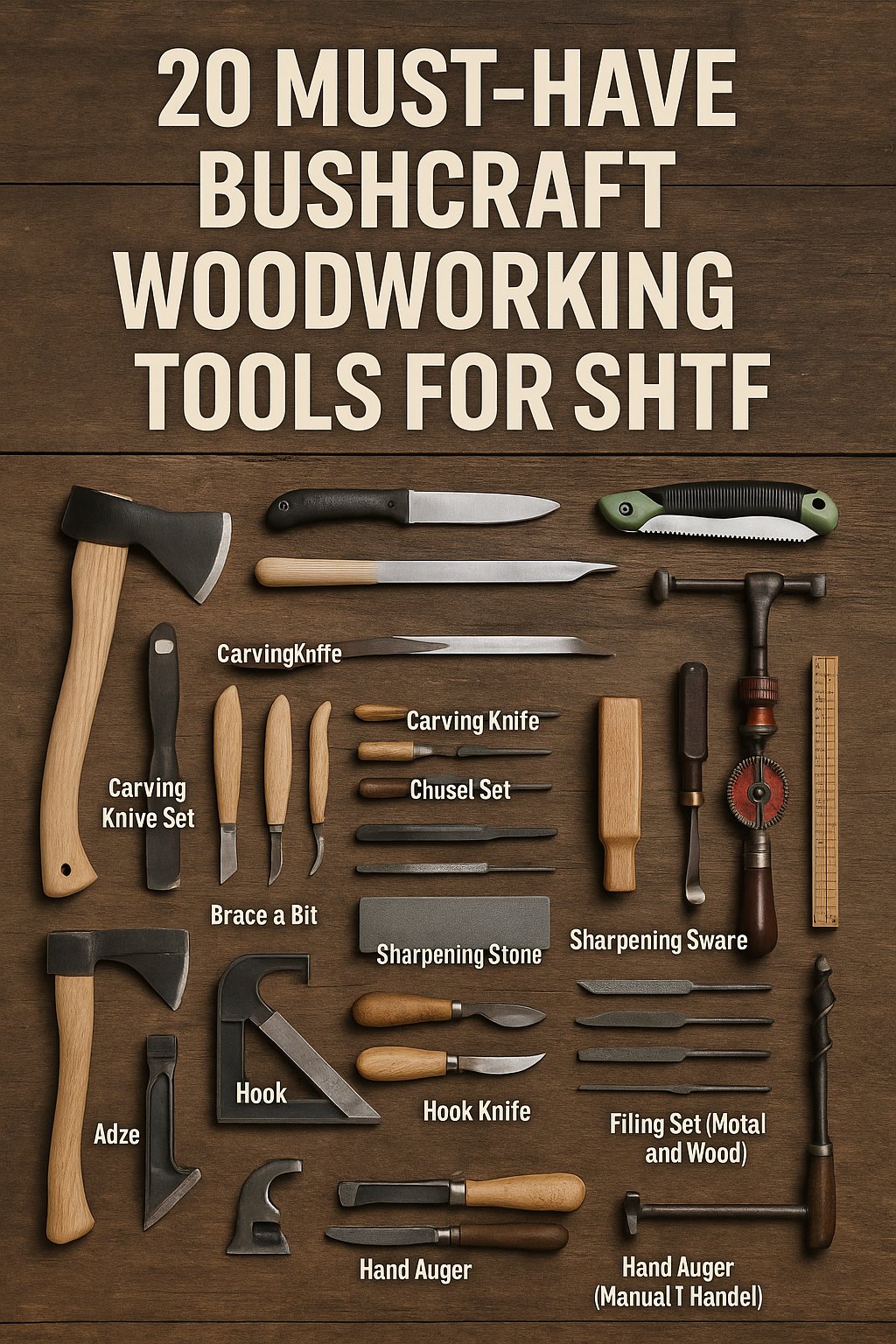
In a true SHTF (Shit Hits The Fan) scenario, the ability to build, repair, and modify your surroundings becomes critical. Whether you’re crafting shelter, tools, traps, or furniture in the wilderness, bushcraft woodworking skills — and the tools to go with them — are invaluable. But not all tools are equal when you’re off-grid. Below is a curated list of 20 must-have bushcraft woodworking tools for survival situations.
🪓 1. Bushcraft Axe
A lightweight yet durable axe is essential for chopping wood, limbing trees, and shaping logs. Look for one with a carbon steel head and a hickory handle — easy to maintain and repair in the field.
🔪 2. Full-Tang Fixed Blade Knife
Arguably the most versatile tool, a good bushcraft knife can process firewood, carve, skin game, and serve as a backup weapon. It must be razor-sharp, strong, and preferably full-tang for resilience.
🪚 3. Folding Saw
Ideal for cutting logs and branches up to 6″ thick, a folding saw is lightweight and efficient. Tools like the Silky Gomboy or Bahco Laplander are legendary among bushcrafters.
🪓 4. Small Hatchet
For tasks that don’t require a full axe, a compact hatchet is perfect for carving, splitting small logs, or batoning wood.
🛠️ 5. Drawknife
Used to remove bark and shape wood, especially for crafting tools, bows, or furniture. Requires a stable working surface or shaving horse.
✂️ 6. Carving Knife Set
Fine-detail work such as spoons, bowls, and trap triggers is made easier with a dedicated carving knife, hook knife, and chip carving tools.
🪛 7. Awl
This pointed tool is key for boring small holes in leather, wood, or bark. Great for crafting containers, sheaths, or wooden fastenings.
🧰 8. Brace and Bit
Forget cordless drills. A manual brace with a few sizes of auger bits lets you bore precision holes in timber without electricity.
🔧 9. Chisel Set
Wood chisels (1/4″, 1/2″, 1″) are essential for notching joints, mortising, or refining wood edges. Keep them sharp — they’re as useful as knives.
🪞 10. Spokeshave
Used for shaping curved surfaces like tool handles or bow limbs. Lightweight and efficient for thinning and refining projects.
🪤 11. Froe
This L-shaped splitting tool lets you split logs into planks with surgical precision. Pair it with a wooden mallet to make boards or shingles.
🧱 12. Mallet
A simple wooden mallet is indispensable for striking chisels, froes, and driving stakes — soft enough to avoid damaging metal tools.
📏 13. Folding Ruler / Measuring Tape
Precision matters when crafting joints or sizing materials. A sturdy, compact measuring device will speed up and improve your builds.
🧲 14. Sharpening Stone (Whetstone)
Your blades are only as good as their edge. Keep a quality whetstone in your kit for field sharpening. Ideally dual-grit (coarse/fine).
📎 15. Hand Drill (Manual Eggbeater Style)
For small bore holes where a brace and bit is overkill. Quiet, lightweight, and perfect for detailed crafting or repairs.
⚒️ 16. Adze
An adze is like a sideways axe, perfect for hollowing or flattening wood. Great for larger projects like bowls, canoe parts, or beams.
🪙 17. Combination Square
This helps maintain 90° and 45° angles in your projects. Useful when accuracy matters for building long-term structures or furniture.
🎣 18. Hook Knife (Crook Knife)
Essential for carving concave shapes like spoons or bowls. Pairs well with a carving knife for bushcraft utensil crafting.
🧷 19. Filing Set (Metal and Wood)
Files are underrated. Use them to smooth wood, refine tool handles, or sharpen teeth on your saws.
🧵 20. Hand Auger (Manual T-Handled)
An off-grid essential, a hand auger with a cutting tip can bore holes in thick timber for furniture joints, dowels, or water taps.
🏕️ Final Thoughts
In a SHTF world, self-reliance means craftsmanship. Your ability to shape wood with precision, efficiency, and safety could mean the difference between surviving and thriving. These 20 tools offer a well-rounded, portable bushcraft workshop — capable of everything from shelter-building to creating fine survival gear.
🔧 Pro Tip: Don’t just own these tools — practice with them. Develop your skills now so you’re not learning under pressure when survival is on the line.