By mid-winter, most Canadian households are no longer planning — they are committed. Heat sources are chosen, windows are sealed, routines are fixed, and fuel is already being consumed. This is precisely why winter shelter failures become dangerous. Once temperatures remain below freezing for weeks at a time, there is very little room left to adapt.
Cold itself rarely forces people out of their homes. What actually does it are internal shelter failures: moisture damage, air contamination, carbon monoxide exposure, and fire. These failures don’t arrive dramatically. They build quietly while the house still feels warm, until the structure, the air, or the occupants can no longer function safely.
This article is deliberately blunt and deliberately specific. It expands on earlier Canadian Preppers Network guidance and addresses what those articles assume you already understand.
The Canadian Winter Shelter Trap
When the grid goes down in January, Canadians do what they are supposed to do. Drafts are blocked. Rooms are closed off. Windows are insulated. Heat is concentrated. All of this is correct — and it is exactly what creates the next layer of risk.
A sealed house becomes a closed system. Moisture has nowhere to go. Combustion by-products accumulate. Oxygen levels drop. Heat sources run longer and harder than designed. The house may remain warm, but the living environment steadily degrades.
This is why people abandon homes that still have heat.
Articles such as
https://canadianpreppersnetwork.com/dealing-with-extreme-cold-during-a-grid-down-emergency/
and
https://canadianpreppersnetwork.com/dealing-with-heavy-snowfalls-when-the-grid-is-down/
focus correctly on heat retention and storm survival. What they do not dwell on is what happens after those strategies are implemented. That omission is where most winter shelter plans fail.
Condensation: Structural Damage in Progress
Interior condensation during winter outages is not cosmetic. It is structural failure unfolding in slow motion.
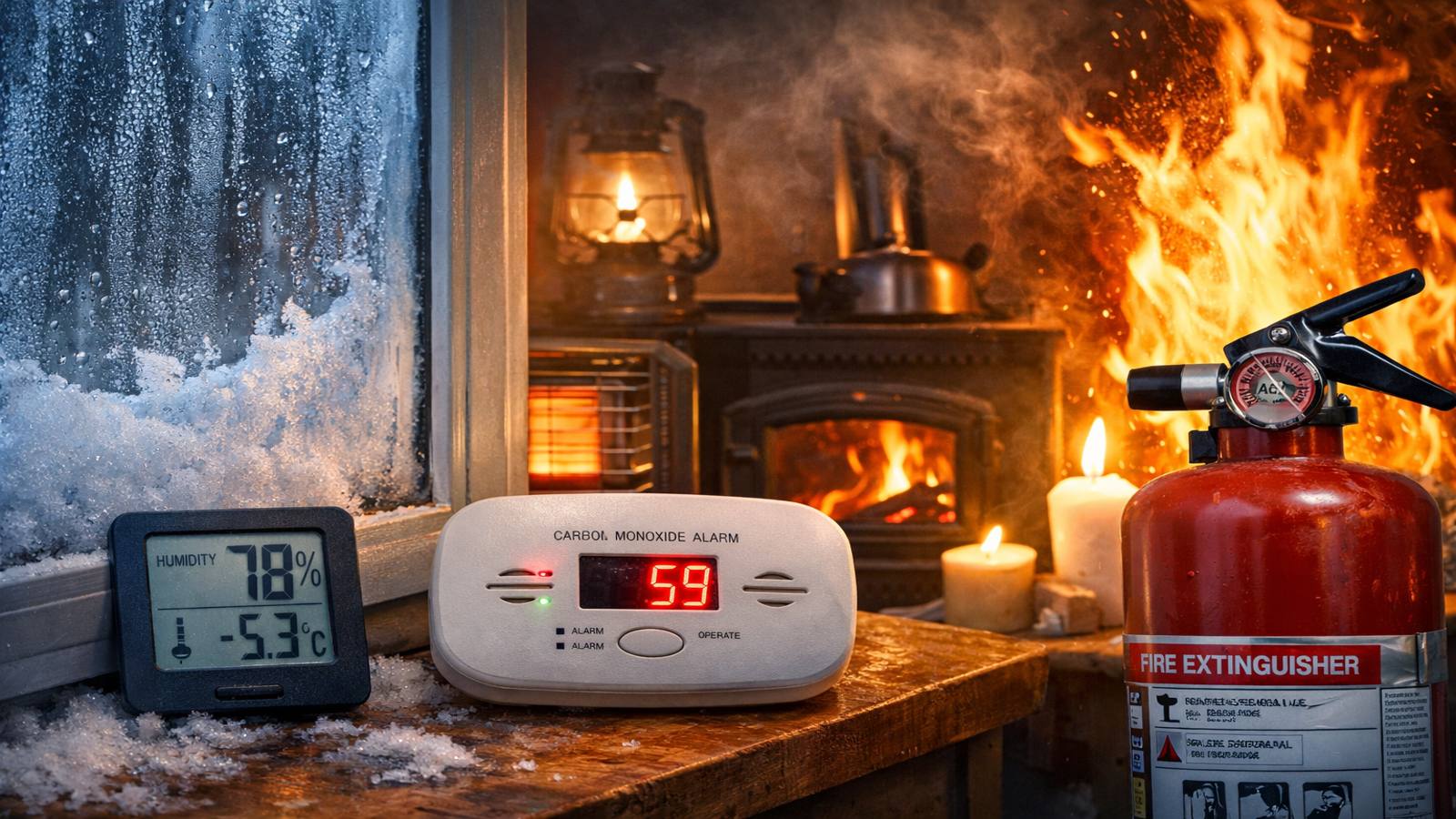
In sealed Canadian homes, moisture rises rapidly due to constant occupancy, indoor cooking, snow-covered structures, and combustion heaters. The first visible sign is fogged windows. The second is ice forming on the inside of frames and exterior walls.
Once moisture freezes inside wall cavities, insulation performance collapses. Frozen insulation loses R-value, shifts out of place, and traps moisture that later feeds mold and rot when temperatures rise. Many homes are effectively damaged beyond practical winter occupancy after power is restored — the damage simply isn’t visible yet.
Heat-retention techniques described in
https://canadianpreppersnetwork.com/dealing-with-heavy-snowfalls-when-the-grid-is-down/
only work if moisture is actively managed. Otherwise, every layer of insulation traps more water.
One of the few tools that gives early warning is a battery-powered hygrometer, which lets you ventilate before damage begins.
Amazon.ca – ThermoPro TP50 Digital Hygrometer & Thermometer
https://www.amazon.ca/dp/B01H1R0K68/?tag=canadpreppn01a-20
Ventilation does not mean cracked windows all day. It means short, deliberate air exchanges timed to humidity levels — something you cannot judge reliably by feel alone.
Carbon Monoxide: Why Winter Exposure Is So Deadly
Carbon monoxide poisoning during Canadian winter outages is rarely sudden. It is cumulative, deceptive, and often fatal because people misinterpret the warning signs.
Propane heaters, wood stoves, ice-blocked flues, and generators placed “far enough away” all produce CO. In winter, cold air inversion and snowbanks keep exhaust gases closer to buildings. The longer heat sources run, the more exposure builds.
The danger is compounded because CO symptoms overlap with cold stress. Headache, nausea, fatigue, confusion, and poor coordination are easily dismissed as exhaustion. By the time people realize something is wrong, judgement is already impaired.
This compounds the risks described in
https://canadianpreppersnetwork.com/hypothermia-causes-symptoms-and-treatment-for-cold-weather-survival/
Cold stress and carbon monoxide exposure reinforce each other. One hides the warning signs of the other.
If you are using any combustion heat, battery-operated CO detectors are not optional. They are life-support equipment.
Amazon.ca – Kidde Battery-Operated Carbon Monoxide Alarm (9CO5LP2)
https://www.amazon.ca/dp/B004Y6V5CI/?tag=canadpreppn01a-20
One detector is insufficient. Sleeping areas must be covered. If people feel “just tired,” trust the alarm — not your instincts.
Fire: The Winter Failure You Don’t Recover From
A house fire during a winter outage is rarely survivable as a property event. Roads may be blocked, hydrants frozen, and response times extended. In rural Canada, winter fire usually means total loss.
Fire risk rises sharply during outages because behaviour changes. Heaters move closer to beds. Candles burn longer. Wood stoves are over-fired to compensate for poor insulation. Extension cords carry sustained heater loads they were never designed to handle.
These behaviours spike under the same conditions discussed in
https://canadianpreppersnetwork.com/dealing-with-extreme-cold-during-a-grid-down-emergency/
Heat strategies that work mechanically can still destroy the shelter if fire discipline collapses.
Every warm room should have an immediately accessible ABC fire extinguisher — not one stored in a hallway or garage.
Amazon.ca – Kidde FA110 Multi-Purpose ABC Fire Extinguisher
https://www.amazon.ca/dp/B00002ND64/?tag=canadpreppn01a-20
In winter, you don’t fight fire aggressively. You stop it instantly or you lose the structure.
Air Quality Fails Before Health Does
Long before air quality becomes lethal, it becomes debilitating. Elevated CO₂, smoke particulates, and combustion by-products reduce concentration, increase irritability, and degrade judgement.
This is when people make irrational shelter decisions: unsafe heater placement, ignoring alarms, over-sealing rooms, or abandoning otherwise viable shelter.
Unlike storms or grid failures, indoor air hazards generate no public warning, unlike the systems discussed in
https://canadianpreppersnetwork.com/when-the-tone-blares-canadas-alert-system-at-a-glance/
Carbon monoxide, oxygen depletion, and smoke accumulation are silent problems. Your shelter plan must assume no one is coming to warn you.
Mental clarity is a survival resource. Lose it, and everything else follows.
Shelter Is a System, Not a Heater
If your winter shelter plan only answers “How do I stay warm?”, it is incomplete.
A functional Canadian winter shelter must simultaneously manage heat retention, moisture control, combustion safety, fire risk, air quality, and human decision-making under stress. These elements are inseparable. Failing one eventually collapses the entire shelter, regardless of fuel supply.
This systems-based thinking is explored much more deeply in Acres of Preparedness, which approaches shelter design and seasonal stress from a long-term Canadian perspective rather than a gadget checklist.
Amazon.ca – Acres of Preparedness
https://www.amazon.ca/dp/B0CLW1B6YT/?tag=canadpreppn01a-20
The Uncomfortable Truth
Most winter shelter failures don’t happen because people were careless. They happen because people were confident. The house felt warm. The heater worked. The windows were sealed. Everyone was tired.
By the time something felt wrong, the margin for error was already gone.
Canadian winters don’t usually punish ignorance.
They punish overconfidence in sealed spaces.
Preparedness isn’t about comfort. It’s about maintaining control when winter removes your buffer.