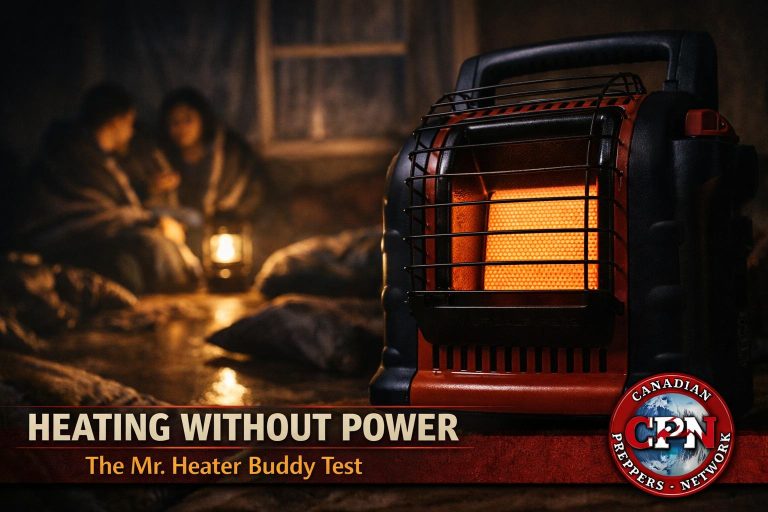
When the grid goes down in a Canadian winter, heat stops being a comfort and becomes a timeline.
You are no longer asking how to stay warm—you are asking how long you can remain inside your home before it becomes unlivable.
Most people think in terms of “having a heater.” The experienced ones think in systems—redundancy, fuel availability, burn rate, ventilation, and long-term sustainability.
This is where the real comparison begins.
The Reality of Heating Without Power
In a grid-down scenario, your primary heating system—electric furnace, heat pump, even many gas furnaces—will fail without power.
What remains are independent heat sources. Each comes with trade-offs:
Fuel storage vs availability.
Indoor safety vs output.
Short-term convenience vs long-term sustainability.
There is no perfect system. Only layered ones.
Propane: Clean, Simple, and Widely Available
Propane is often the first backup system people adopt—and for good reason.
It stores indefinitely, burns relatively clean, and requires minimal maintenance.
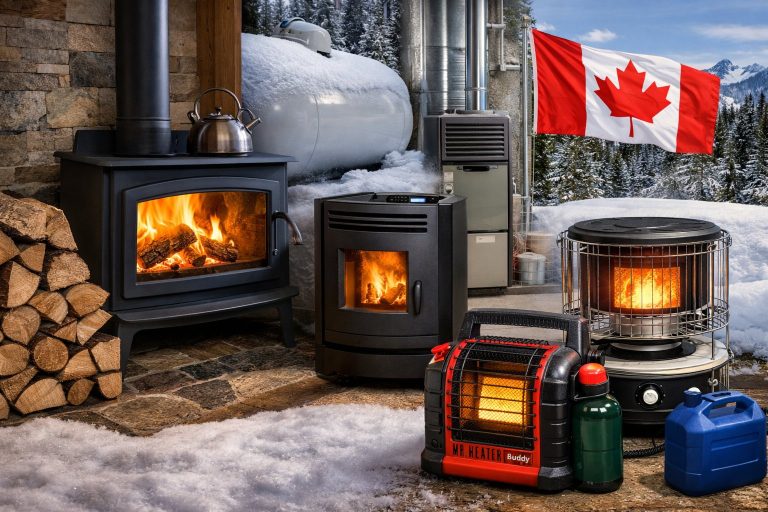
Portable indoor-safe units like this are a common starting point:
https://www.amazon.ca/s?k=Mr+Heater+Buddy+Indoor+Propane+Heater&tag=canadianprep-20
Paired with extra cylinders and a reliable carbon monoxide detector:
https://www.amazon.ca/s?k=carbon+monoxide+detector+battery+powered&tag=canadianprep-20
…you have a fast, deployable heating solution for outages.
Strengths:
- Clean burn with minimal residue
- Easy ignition and operation
- Long shelf life (fuel does not degrade)
- Widely available across Canada
Weaknesses:
- Still requires ventilation
- Tanks become bulky at scale
- Moderate output—not ideal for whole-home heating
Propane is best viewed as a short-to-medium duration solution—ideal for outages measured in days, not months.
For more on layered energy planning, see:
https://canadianpreppersnetwork.com/category/energy/
Kerosene: High Output with Trade-Offs
Kerosene heaters remain one of the most powerful portable heating options available, especially when you need to bring a cold structure back up to temperature quickly.
You can browse reliable models here:
https://www.amazon.ca/s?k=Dyna-Glo+kerosene+heater+23800+BTU&tag=canadianprep-20
Strengths:
- High heat output
- Energy-dense fuel
- Effective in larger spaces and outbuildings
Weaknesses:
- Noticeable odor (especially startup/shutdown)
- Requires careful fuel handling
- Maintenance (wicks, cleaning)
- Strict ventilation requirements
Kerosene excels in cold-start scenarios, but it’s not always the most comfortable long-term indoor solution.
Wood Heat: The Long-Term Standard
If propane is convenience, wood is resilience.
A properly installed wood stove remains the most reliable long-term heating system available in Canada.
Explore suitable options here:
https://www.amazon.ca/s?k=wood+stove+cast+iron+EPA&tag=canadianprep-20
Add in essential accessories like stove fans to improve efficiency:
https://www.amazon.ca/s?k=wood+stove+fan+heat+powered&tag=canadianprep-20
Strengths:
- Fuel can be sourced locally
- No reliance on supply chains
- High output and steady heat
- Can double for cooking
Weaknesses:
- Requires proper installation
- Needs a consistent wood supply
- Labour-intensive
- Fire risk if mismanaged
Wood heat is not just a backup—it is a primary system for long-term grid-down living.
For more shelter-focused strategies:
https://canadianpreppersnetwork.com/category/shelter-heat/
Diesel Heaters: Efficient and Underestimated
Diesel air heaters have quietly become one of the most efficient and controllable heating options available to preppers.
Modern units can be found here:
https://www.amazon.ca/s?k=VEVOR+diesel+air+heater+5kw&tag=canadianprep-20
Paired with proper fuel storage:
https://www.amazon.ca/s?k=diesel+fuel+container+approved&tag=canadianprep-20
…they offer long burn times with minimal fuel consumption.
Strengths:
- Extremely fuel-efficient
- High output relative to consumption
- Capable of continuous operation
- Sealed combustion (safer when installed correctly)
Weaknesses:
- Requires 12V power source
- More complex setup
- Noise (fan and fuel pump)
- Dependency on stored fuel
Diesel heaters are ideal for controlled, long-duration heating, especially when paired with a battery or small solar setup.
Building a Layered Heating System
The wrong question is: Which one should I choose?
The right question is: How do these systems support each other when one fails?
A realistic setup might look like this:
A wood stove as your primary long-term heat source.
A diesel heater for efficient daily control.
A propane heater for quick deployment.
A kerosene heater for rapid heat in extreme conditions.
Each fills a different role. Each covers a different weakness.
That is what redundancy actually looks like.
Final Thought
Heat determines whether your home remains a shelter—or becomes something you have to abandon.
Most people will only discover the limits of their system during the first real outage.
By then, fuel is scarce, stores are empty, and mistakes become dangerous.
Build your system now—while you still have the margin to get it wrong.