Most people think about generators when they think about power.
That’s a mistake.
Because when the grid goes down for good—or just long enough to matter—it’s not your fridge that fails first. It’s everything small. Quiet. Essential.
Flashlights. Radios. Headlamps. Thermometers. Night vision. Small medical gear. Even your ability to communicate.
And almost all of it runs on one thing:
Batteries.
The Disposable Trap
Disposable batteries feel like preparedness.
You buy a bulk pack, throw them in a bin, and tell yourself you’re ready.
But that illusion collapses fast.
They leak. They corrode. They die on the shelf. And once they’re gone—they’re gone.
No resupply. No second chance.
In a real grid-down scenario, disposable batteries are not a system.
They’re a countdown.
Rechargeables Change the Equation
Rechargeable batteries don’t just replace disposables—they fundamentally change how you think about power.
Instead of stockpiling, you’re cycling.
Instead of scarcity, you’re managing a loop.
And that loop can run for years if you build it properly.
This is where Panasonic Eneloop batteries have earned their reputation.
Why Eneloop Became the Standard


There are plenty of rechargeable batteries on the market.
Most of them are not worth trusting when things matter.
Eneloop stands out for a few reasons that actually matter in a Canadian preparedness context:
Low self-discharge
They hold their charge for months—sometimes years. You don’t pull them out of storage dead.
Cycle life
Hundreds to thousands of recharge cycles. That’s not marketing fluff—it’s field-proven.
Cold tolerance
Critical in Canada. Many batteries fail hard in winter. These don’t quit nearly as fast.
Consistency
They don’t give you that unpredictable drop-off cheap rechargeables are known for.
In short—they behave like a system, not a gamble.
What’s Actually Inside These Batteries (And Why It Matters)
Most people treat batteries like black boxes.
Put power in. Take power out. Hope for the best.
But the chemistry inside them determines whether your system works—or quietly fails when you need it most.
NiMH vs Lithium-Ion: Two Very Different Tools
The Panasonic Eneloop batteries you’re using are based on Nickel-Metal Hydride (NiMH) chemistry.
They behave very differently from the lithium-ion cells used in 18650 batteries.
Nickel-Metal Hydride (NiMH) — Stability First
NiMH batteries are built for:
- Safety and reliability
- Tolerance to abuse
- Long shelf readiness
They deliver steady output and are forgiving under real-world conditions—cold, inconsistent charging, and long storage.
Lithium-Ion (18650) — Capacity and Power
18650 batteries use lithium-ion chemistry:
- Higher energy density
- Higher voltage
- Better for high-demand devices
But they are less forgiving and require proper charging systems.
Cold Weather Reality
- Alkaline batteries fail quickly in cold
- Lithium-ion degrades
- NiMH (like Eneloop) remains usable and predictable
That predictability matters more than peak performance.
USB Is the New Grid
If your charging system depends on a wall outlet—you are still dependent on the grid.
USB changes that.
USB can be powered by:
- Solar panels
- Vehicles
- Power banks
A simple USB-powered charger paired with solar can keep your system alive indefinitely.
Standardize or Fail
Most people juggle too many battery types.
That’s not preparedness—it’s fragility.
Use Adapters Instead of Stockpiling
C and D batteries can be replaced using AA adapters.
One battery type. One system.
Step Up with 18650 Batteries
For higher-demand tools, 18650 batteries provide:
- More capacity
- Better performance
- Integration with USB charging systems
Now your system covers everything from small devices to high-output tools.
What’s Inside the Battery (And What an EMP Actually Threatens)
When people hear “EMP,” they picture batteries failing instantly.
That’s not accurate.
A battery is a chemical device, not an electronic one.
Inside an AA battery, you’ll find:
- Electrodes
- Electrolyte
- Separator
No circuits. No chips.
An EMP does not destroy the battery itself.
Where the Risk Actually Is
The vulnerability lies in:
- Chargers (USB smart chargers)
- Power banks
- Solar charge controllers
- Devices using the batteries
These contain electronics that can fail under an EMP.
Your batteries may survive—but your ability to recharge them might not.
Where This Actually Matters
This system shows up in real-world use:
- Night operations with headlamps
- Maintaining lighting without fuel
- Keeping radios active
- Supporting medical devices
You’re not powering your house.
You’re preserving capability.
The System Most People Never Build
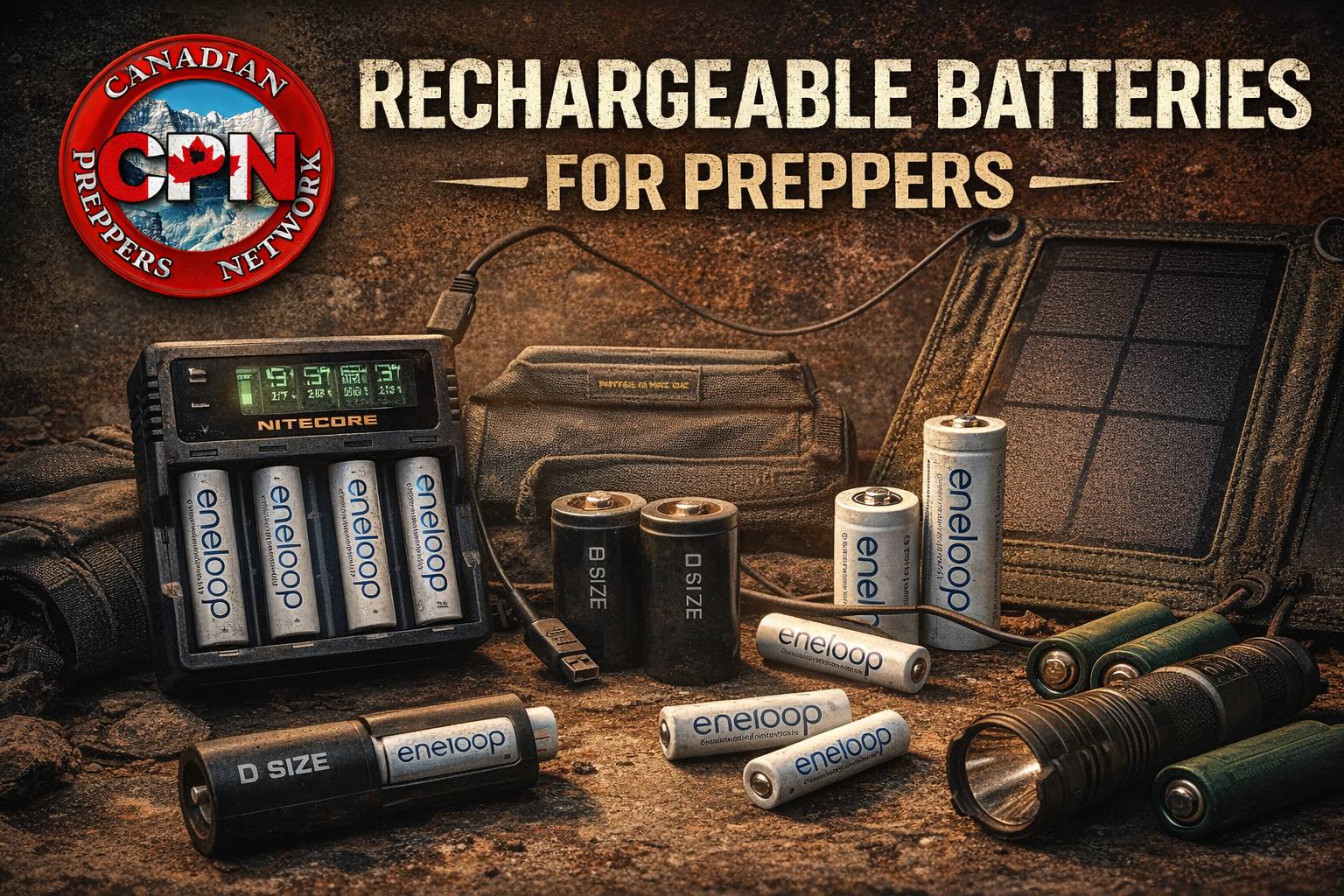
A proper setup:
- 20–40 AA batteries
- 10–20 AAA batteries
- USB-powered charger
- 20W solar panel
- C/D adapters
- 18650 batteries
And most importantly:
Rotation discipline
The Quiet Reality
If the grid goes down long enough, people will notice who still has light.
Who still has radios.
Who still has working gear.
Rechargeable systems don’t draw attention.
But they quietly separate those who planned from those who didn’t.
Recommended Gear (Amazon.ca)
Core Batteries
- Panasonic Eneloop AA Rechargeable Batteries (8-Pack)
https://www.amazon.ca/s?k=Panasonic+Eneloop+AA+8+pack&tag=canadianprep-20 - Panasonic Eneloop AAA Rechargeable Batteries (8-Pack)
https://www.amazon.ca/s?k=Panasonic+Eneloop+AAA+8+pack&tag=canadianprep-20
USB-Powered Chargers
- XTAR VC4 USB Battery Charger
https://www.amazon.ca/s?k=XTAR+VC4+charger&tag=canadianprep-20 - NITECORE UMS4 USB Smart Charger
https://www.amazon.ca/s?k=Nitecore+UMS4&tag=canadianprep-20 - Nitecore UI1 USB Charger
https://www.amazon.ca/s?k=Nitecore+UI1&tag=canadianprep-20
Solar Input
- FlexSolar 20W USB Solar Panel
https://www.amazon.ca/s?k=FlexSolar+20W+solar+panel&tag=canadianprep-20
Adapters
- AA to C/D Battery Adapters
https://www.amazon.ca/s?k=AA+to+C+D+battery+adapter&tag=canadianprep-20
18650 System
- Samsung 18650 Batteries
https://www.amazon.ca/s?k=Samsung+18650+battery&tag=canadianprep-20 - 18650 Battery Case
https://www.amazon.ca/s?k=18650+battery+case&tag=canadianprep-20
Final Thought
Preparedness isn’t about having more.
It’s about having systems that don’t run out.
And once you understand what’s inside your batteries—and what can actually break around them—you stop thinking in terms of запас…
…and start thinking in terms of staying operational.