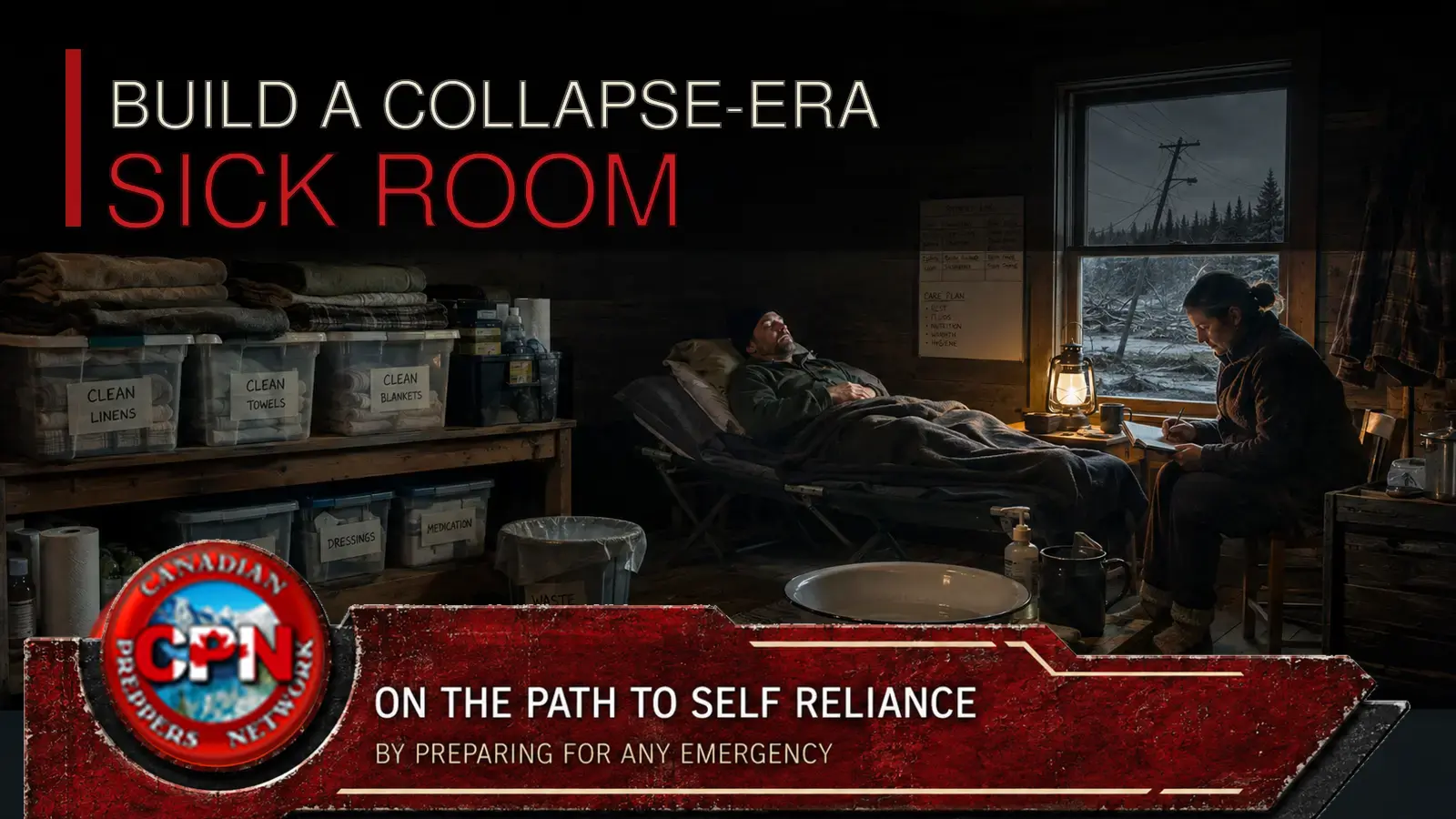
Care beyond first aid
Most medical preparedness is built around the first few minutes.
Stop the bleeding. Clean the wound. Stabilize the injury. Bring down the fever. Get the person somewhere safe.
That matters—but it is only the beginning.
When hospitals are inaccessible, clinics are closed and outside help is no longer dependable, the real challenge may begin after the immediate emergency. Someone must provide water, food, hygiene, bedding, observation and basic care for days or even weeks.
A person who cannot work still needs to be housed. Dressings must be changed. Symptoms must be recorded. Contaminated laundry must be handled. Waste must be controlled. Someone must check the patient through the night without exhausting the only capable caregiver.
That requires more than a first-aid kit.
It requires a sick room.
The Household Becomes the Care Facility
A collapse-era sick room is not an improvised hospital. It cannot replace medical training, diagnostic equipment, prescription continuity or professional treatment.
Its purpose is more realistic: create one controlled place where an ill or recovering person can rest, receive basic care and be observed without medical supplies, waste and contaminated belongings spreading throughout the household.
The room may be needed for respiratory illness, stomach illness, fever, injury recovery, reduced mobility or any condition that leaves someone temporarily unable to participate in normal household work.
Without a designated room, care spreads everywhere.
Medicine ends up on the kitchen counter. Used towels appear in the bathroom. Bedding passes through common areas. Different people provide care without recording what has already been done. The patient is moved repeatedly because nobody planned where recovery would happen.
In a functioning society, that disorder is inconvenient.
After the system fails, it can threaten the entire household.
Choose the Room Before Someone Needs It
The best sick room is warm, dry, ventilated, reasonably close to water and capable of being separated from normal household traffic.
A spare bedroom is ideal, but it is not the only option. A den, office, heated workshop room or divided section of a larger space can work. The objective is control, not luxury.
Look for a space with:
- A door or other way to limit unnecessary traffic
- Safe ventilation without exposing the patient to cold
- Enough light to observe the person and perform basic care
- Room for a bed or cot with caregiver access
- Surfaces that can be cleaned
- A practical route for moving bedding, water and waste
- Reliable heat during winter conditions
- Space for both clean supplies and a closed waste container
Avoid placing the patient directly on the floor if another option exists. A floor mattress is harder for caregivers to reach, more vulnerable to dampness and more difficult to keep clean.
The room should not be sealed airtight. Fresh-air exchange remains important, especially during respiratory illness. Ventilation must simply be balanced against the danger of chilling the patient or losing too much household heat.
Divide the Room Into Working Zones
A sick room becomes easier to manage when everything has a defined place.
The clean zone should be near the entrance. This is where unused gloves, masks, dressings, drinking water, medications, clean towels and the medical log are kept.
The care zone surrounds the bed. Keep only the supplies needed for the current period of care within reach. A small table, tray or shelf prevents everything from disappearing into the bedding.
The dirty zone should contain the lined waste bin, laundry container, used wash basin and anything awaiting cleaning or disposal. It should never overlap with drinking water, food or clean medical supplies.
This simple division prevents one of the most common failures in improvised care: a caregiver handling something contaminated and then reaching directly into the clean-supply box.
Build a Bed That Can Be Maintained
Comfort matters, but access matters more.
A normal bed can work, although a folding cot gives the household greater flexibility. Whatever is used should be stable, supported and positioned so the caregiver can reach the patient without climbing over furniture.
Start with a waterproof mattress protector. Add washable sheets, a light blanket and enough spare bedding to replace anything that becomes wet or dirty.
Store complete bedding changes together. During a crisis, searching three rooms for a clean sheet, pillowcase and blanket wastes time and spreads contamination.
A basic bedside setup should include:
- Drinking cup or bottle
- Tissues or washable cloths
- Wash basin
- Covered waste container
- Thermometer
- Flashlight or lantern
- Medical log and pencil
- Personal hygiene supplies
- A bell, radio or other way to call the caregiver
If the patient cannot walk safely, the household also needs a movement plan. A folding stretcher, emergency carry sheet or patient-transfer aid may be useful, but moving an ill or injured person requires appropriate training and enough capable helpers.
Create a Dedicated Sick-Room Kit
Do not plan to empty the household first-aid kit into the sick room.
Build a separate container for continuing care. Otherwise, the entire medical stockpile becomes tied up beside one patient while injuries continue occurring elsewhere.
A practical sick-room kit should include gloves, appropriate masks, soap, hand sanitizer, disinfecting supplies, tissues, garbage bags, washable cloths, towels, spare bedding, a waterproof mattress cover, a wash basin, a thermometer and basic wound-care supplies.
Include manual alternatives wherever possible. A non-digital thermometer, printed medical references, paper records and battery-free signalling method remain usable after screens, chargers and electronic devices fail.
Medical equipment should only be included if someone knows how to use it correctly. Owning a blood-pressure cuff or stethoscope does not automatically make the resulting information useful.
The Medical Log May Become Your Best Tool
Memory becomes unreliable when people are frightened, sleep-deprived and rotating through caregiving duties.
Record every significant observation with a date and time. Depending on the illness and the caregiver’s training, the log may include:
- Temperature
- Breathing changes
- Alertness and ability to communicate
- Food and fluids taken
- Urination and other relevant output
- Medications given according to their labels or prescriptions
- Dressing changes
- New symptoms
- Changes in pain, mobility or behaviour
The goal is not to invent a diagnosis. It is to identify trends.
Is the patient improving, remaining stable or deteriorating? Has the fever been rising? Is the person drinking less? Did a new symptom begin overnight? Was medication already given by the previous caregiver?
A written log prevents guesswork and becomes extremely valuable if contact with a medical professional is eventually restored.
Protect the Caregiver
The sick room is useless if its only caregiver becomes ill or exhausted.
Hand hygiene remains essential even when gloves are available. Gloves should be reserved for situations in which contact with bodily fluids, contaminated laundry, waste or dirty surfaces is likely. They must be removed after the task, followed by hand cleaning.
Appropriate masks may be needed when caring for someone with a respiratory illness. Ventilation, separate towels, separate bedding and reduced unnecessary contact also help limit household spread.
Care should be organized into planned visits whenever the patient’s condition permits. Instead of entering the room repeatedly for one item at a time, bring water, food, clean supplies and the medical log together. Complete the necessary tasks, remove dirty items and then clean up properly.
This reduces traffic without leaving the patient isolated or neglected.
Download the Free Canadian Grid-Down Starter Kit
A sick room is only one part of keeping a household functional when ordinary services disappear.
Use the Canadian Grid-Down Starter Kit to examine what happens during the first 72 hours and identify weaknesses in medical supplies, water, sanitation, lighting, communications and household routines.
Never Depend on One Caregiver
A household should identify a primary caregiver and at least one relief caregiver before an emergency.
The second person may not have the same training, but they should know where supplies are kept, how records are maintained and which routine tasks they can perform safely.
Each handover should include a short review:
- What changed during the last shift?
- When were food, fluids or medications last provided?
- What supplies are running low?
- What needs to be watched?
- When is the next scheduled check?
Caregiver rest is not optional. Exhaustion leads to missed observations, duplicated medication, dirty hands, poor judgement and short tempers. A sick-room plan must protect both the patient and the people keeping that patient alive.
Control Laundry and Waste
Used laundry should go directly into a dedicated container instead of travelling loose through the house. Avoid shaking it. Wash it separately when practical, use ordinary detergent and dry it thoroughly before returning it to the clean side of the system.
Keep a lined, covered waste container within the room. Waste should be sealed and moved to the household’s designated dirty area without passing near food preparation, stored water or clean medical supplies.
Do not casually burn mixed sick-room waste. Plastics, disposable products and chemical residues can produce hazardous smoke. Disposal has to fit into the household’s larger sanitation system.
The important principle is separation: clean items enter through one controlled process, while waste and dirty laundry leave through another.
Know When the Room Is Not Enough
A sick room supports basic care. It does not make serious symptoms safe.
Difficulty breathing, new confusion, inability to remain awake, severe dehydration, uncontrolled bleeding, major injury, persistent chest pain or rapid deterioration require professional assessment whenever any route to care remains available.
Before a collapse, that means contacting emergency services. During a prolonged breakdown, it means activating whatever medical communications and transport plan the household or community has established.
Identify possible medical contacts now. Know who has advanced training, which radio network might reach assistance, what vehicle can move a patient and which routes remain usable.
Waiting until a patient is deteriorating is too late to begin that discussion.
Run a Sick-Room Drill
Choose the proposed room and set it up using only what the household currently owns.
Install the cot or prepare the bed. Place the clean supplies. Establish the dirty zone. Test the lighting after dark. Carry in water without contaminating the clean area. Practise recording observations and handing the log to a relief caregiver.
The drill will quickly reveal missing bedding, poor lighting, blocked access, inadequate water storage and supplies scattered across the house.
A sick room should be assembled while everyone is healthy, not while someone is already waiting for care.
Preparedness Buying Box: Sick-Room Supplies
As an Amazon Associate, Canadian Preppers Network may earn from qualifying purchases.
Related CPN Reading
Final Thought
A trauma kit prepares you for a bad hour.
A sick room prepares you for the difficult days that follow.
After collapse, recovery will consume water, bedding, soap, dressings, food, fuel, lighting and human energy. Someone must keep the room clean. Someone must watch for changes. Someone must write things down. Someone must relieve the exhausted caregiver.
That work is not dramatic, but it is what prevents one sick or injured person from becoming a crisis for the entire household.
The household with a functioning sick room is not recreating a hospital.
It is creating time, order and a better chance of recovery.
Medical and infection-control details were checked against current Canadian Red Cross first-aid guidance and Canadian home-care infection-prevention guidance.