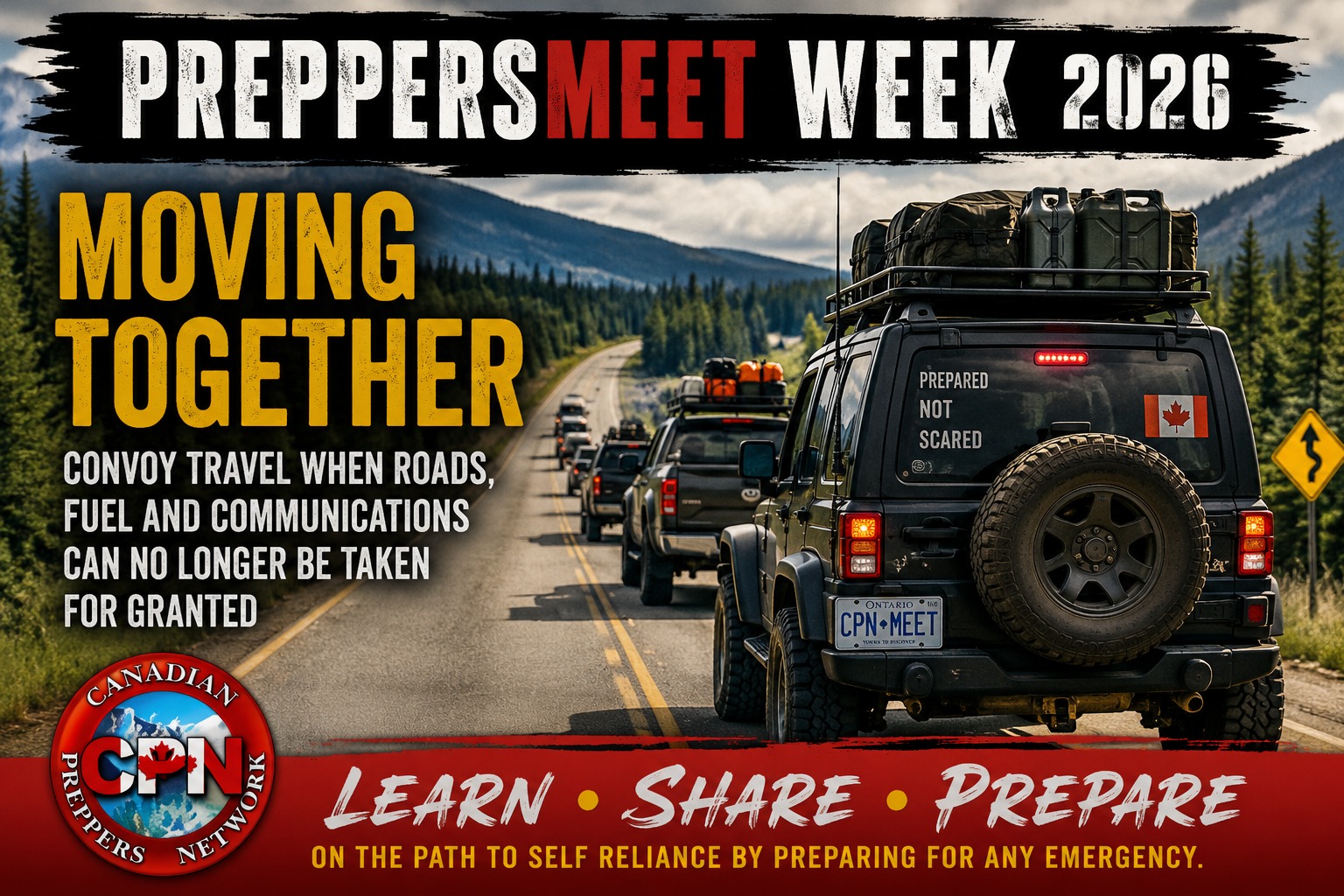
Convoy Travel When Roads, Fuel and Communications Can No Longer Be Taken for Granted
Under normal conditions, travelling with several vehicles is mostly an exercise in inconvenience. Someone leaves late, another person needs fuel, and at least one driver misses the turn even though everyone has the address.
After a major collapse, that same lack of organization could leave people stranded, separated or driving directly into a problem the lead vehicle discovered several minutes earlier.
A convoy is not simply a line of vehicles travelling toward the same destination. It is a temporary mobile community. Every vehicle has different capabilities, every driver has different habits, and every passenger adds another set of needs. Unless those differences are organized before departure, travelling together may create more problems than it solves.
The purpose of a convoy is not to look intimidating or recreate something seen in an action film. It is to move people, equipment and supplies safely while retaining the ability to deal with breakdowns, blocked roads, medical emergencies and communications failures.
The greatest threat to a convoy is often not the road ahead. It is confusion inside the convoy.
Decide Who Is Actually in Charge
Every convoy needs one person responsible for coordinating movement. That person does not need to control every decision made inside every vehicle, but someone must have the authority to establish the route, departure time, stopping procedures and response to problems.
Without a coordinator, every driver begins making independent decisions. One vehicle stops for fuel, another continues, the lead vehicle changes routes without warning, and someone at the rear assumes the convoy has left them behind.
The coordinator should assign a lead vehicle and a rear vehicle.
The lead vehicle handles navigation and provides the first warning of blocked roads, damaged bridges, traffic congestion or changing conditions. It should be driven by someone calm, observant and unlikely to make sudden decisions.
The rear vehicle confirms that the convoy remains together. It should be dependable, carry communications equipment and, where possible, include someone capable of helping with basic mechanical or medical problems.
The fastest or most capable vehicle does not automatically belong at the front. Convoy speed must be based on the slowest safe vehicle, not the enthusiasm of the lead driver.
Every Driver Needs the Entire Plan
A convoy should never depend entirely on following the vehicle ahead.
Before departure, every driver should know the final destination, primary route, alternate routes and planned rally points. Each vehicle should carry paper maps with the route marked clearly. Electronic navigation may still be useful, but it should be treated as an aid rather than the sole source of direction.
Canadian travel can involve long distances, limited fuel availability, remote highways, seasonal roads, damaged culverts and areas with little or no cellular coverage. One closure can force a detour of many kilometres. Every driver must understand where the group is going and how to get there independently.
Rally points are essential. They give separated vehicles a place to reconnect without forcing the entire convoy to stop on the side of the road.
Useful rally points might include a major intersection, a bridge, a recognizable public building or a preselected location outside a town. Each point should be obvious on a map and easy to identify from the road.
The plan should also establish how long the group will wait at each rally point. A vehicle that has suffered a minor delay may arrive ten minutes late. A vehicle that never arrives may indicate a larger problem. The group needs to know when to wait, when to send assistance and when continuing becomes necessary.
Communications Must Be Simple
Radios can make convoy travel far more effective, but only when everyone understands how they will be used.
Choose a legal radio system appropriate for the group, test every unit before departure and ensure each vehicle has spare batteries or a charging method. Everyone should know the primary channel, backup channel and basic call signs.
Radio traffic should remain brief and useful.
The lead vehicle may report a road hazard, turn, stop or route change. The rear vehicle may confirm that all vehicles cleared an intersection. Other drivers should report mechanical problems, urgent passenger needs or hazards affecting the group.
A convoy channel should not become an ongoing conversation. Constant chatter makes it harder to hear the message that actually matters.
Drivers should also agree on a few plain-language signals before departure. There is little value in complicated codes that nobody remembers under stress. Clear statements such as “convoy stopping,” “vehicle three has a mechanical problem” or “turning left at the next intersection” are difficult to misunderstand.
Radios do not eliminate the need for a communications-failure plan. A damaged antenna, dead battery or broken radio should not bring the convoy to a halt. Drivers must know what to do when they cannot reach the group.
Maintain Safe and Flexible Spacing
Convoy spacing is a balance.
Vehicles packed too closely together have little time to react to sudden braking, debris or accidents. Vehicles spread too far apart may lose sight of one another, become separated at intersections or allow unrelated traffic to enter the group.
Spacing should increase with speed, poor visibility, snow, rain, dust and road damage. The driver behind must always have enough distance to stop safely.
At intersections, each driver remains responsible for confirming that the road is clear. A green light for the lead vehicle does not guarantee that the entire convoy can proceed. Drivers should never enter an intersection simply because the vehicle ahead did.
If part of the convoy is stopped by traffic or a signal, the vehicles ahead should reduce speed or proceed to the next safe rally point. Sudden roadside stops create additional danger and may block traffic needed by emergency responders or local residents.
The goal is coordinated movement, not an unbroken bumper-to-bumper chain.
Fuel Determines How Far the Convoy Can Travel
A convoy can only travel as far as the vehicle with the shortest range.
Before departure, every vehicle should begin with as much fuel as reasonably available. Drivers should know their expected range under loaded conditions rather than relying on normal commuting estimates. Roof racks, trailers, rough roads, idling and repeated detours can increase fuel consumption significantly.
Fuel planning should include a reserve. Arriving at a destination with every fuel gauge nearly empty leaves the group unable to relocate if conditions change.
Carrying extra fuel may extend range, but it must be done with approved containers, proper ventilation and secure storage. Fuel should not be carried loosely inside passenger areas or placed where a collision could easily damage the container.
The convoy should also consider compatibility. A group containing several vehicles that use the same fuel has more flexibility than one containing a mixture of gasoline, diesel and specialized fuel requirements.
Stopping at every available station may waste time and expose the convoy to unnecessary congestion. Ignoring a safe fuel opportunity could be equally dangerous. Fuel decisions should be based on the entire group’s range, not the lead vehicle’s gauge.
Distribute Critical Supplies
Keeping every important item in one vehicle creates a single point of failure.
Medical supplies, water, food, navigation equipment, communications gear and repair tools should be distributed among several vehicles. Each vehicle should have enough basic equipment to support its occupants if it becomes separated.
At the same time, equipment should be assigned deliberately. There is little benefit in carrying five identical tool kits while nobody has a tow strap, tyre repair equipment or a suitable jack.
Before departure, the group should identify who carries what. The rear vehicle may carry recovery equipment. Another vehicle may carry the more complete medical kit. A third may carry additional water or spare communications equipment.
The loss or breakdown of one vehicle should be an inconvenience, not the loss of the convoy’s entire capability.
Prepare for Breakdowns Before They Happen
Mechanical problems are not exceptions. Over a long enough journey, they should be expected.
Every vehicle should be inspected before departure. Tyres, fluids, belts, hoses, lights, brakes and battery condition deserve attention. A vehicle that is already unreliable should not be placed in a position where the entire group depends on it.
The convoy should establish a breakdown procedure.
The affected driver reports the problem and moves off the travelled portion of the road where possible. The rear vehicle stops to assess the situation. The rest of the convoy proceeds to the next safe rally point unless immediate assistance is required.
Stopping every vehicle around a disabled car can block the road, attract unnecessary attention and place more people in danger from passing traffic. One or two vehicles can usually assess a minor mechanical problem while the others wait somewhere safer.
The group must also decide in advance when a vehicle will be abandoned. This is a difficult decision, especially when the vehicle contains valuable supplies, but allowing one failed vehicle to trap the entire convoy may create a much larger emergency.
Supplies and passengers should be redistributed before the convoy is forced to make that choice.
Plan for Medical Problems and Human Limits
Convoy planning tends to focus on vehicles, but people are often the limiting factor.
Children, older adults, animals and passengers with medical conditions may require more frequent stops. Drivers become tired, hungry and impatient. Stress increases when roads are unfamiliar or conditions become uncertain.
A planned ten-minute stop can easily become forty minutes when every vehicle treats it as an opportunity to reorganize equipment.
Stops should have a clear purpose and expected duration. Drivers should use them to check passengers, inspect loads, confirm fuel status and review the next portion of the route.
At least one person in the group should be responsible for medical coordination. Each vehicle should know how to call for assistance and which vehicle carries the primary medical equipment.
A medical emergency may require the convoy to divide. The entire group does not always need to follow one patient to a hospital, clinic or alternate location. The coordinator should decide which vehicles provide support and which continue toward the destination.
Avoid Becoming a Travelling Spectacle
A large, noisy and disorganized convoy attracts attention.
Vehicles covered with loose equipment, flashing lights, unnecessary markings or openly displayed supplies advertise both the group’s presence and its resources. The objective should be to appear orderly and ordinary.
Travel during daylight where possible. Avoid aggressive driving, unnecessary horn use and confrontations with other road users. Do not block intersections or attempt to force unrelated vehicles out of the convoy.
If the group encounters a disturbance, roadblock or threatening situation, the safest option will usually be distance and an alternate route. A convoy is difficult to reverse, turn around or manoeuvre in confined spaces, which makes early detection especially important.
The lead vehicle should never approach an uncertain situation so closely that the rest of the convoy has no room to respond.
Establish Rules Before Departure
The worst time to debate convoy procedures is after something has gone wrong.
Before leaving, every driver should understand a few basic rules:
- No unplanned route changes without notifying the convoy.
- No vehicle leaves the group without reporting it.
- Mechanical problems are reported immediately.
- The convoy does not stop in unsafe locations simply to remain together.
- Drivers proceed to the next rally point when separated.
- Fuel, passenger and medical concerns are raised before they become emergencies.
- The coordinator makes the final movement decision when time does not allow a group discussion.
These rules are not about creating a rigid command structure. They prevent small misunderstandings from growing into serious problems.
Turn the Trip to Preppers Meet Into a Convoy Exercise
Preppers Meet provides a natural opportunity to practise convoy travel while conditions are still normal.
Attendees travelling from the same region could arrange a meeting point outside a town or near a major highway, complete a radio check and travel the final portion of the trip together. Even two or three vehicles are enough to reveal weaknesses in a convoy plan.
The purpose is not to create a dramatic procession, block traffic or make the group conspicuous. It is to test the ordinary procedures that would matter during a real evacuation: maintaining safe spacing, communicating turns and hazards, tracking the rear vehicle and reconnecting after traffic lights or road delays split the group.
Before leaving, participants could agree on a primary route, an alternate route and one or two rally points. Every driver should still have the campground address, a paper map and enough information to arrive independently. The convoy should support individual drivers rather than make them dependent on constantly seeing the vehicle ahead.
The drive to Preppers Meet also provides a realistic load test. Many attendees will be carrying camping equipment, food, water, radios, tools and other preparedness supplies. Drivers can observe how that additional weight affects braking, fuel use, visibility and vehicle handling.
Radios that work perfectly during a driveway test may behave differently inside moving vehicles, around hills or in areas with interference. The trip provides an opportunity to learn who can hear the lead vehicle, whether the rear vehicle remains in contact and how well the group communicates when part of the convoy becomes separated.
Once at the campground, the participants can compare notes. Was the spacing comfortable? Did everyone hear the important radio calls? Did anyone lose the convoy at an intersection? Were the rally points easy to identify? Did one driver tend to accelerate away from the group? Did the rear vehicle know when the convoy had divided?
A routine trip to Preppers Meet can become a valuable preparedness exercise with very little additional effort. More importantly, it allows attendees to practise with people who may one day become part of a mutual-assistance group, evacuation convoy or regional preparedness network.
Practise Before the Roads Become Uncertain
The best way to learn convoy travel is to practise it before it becomes necessary.
A normal trip to a campground, preparedness event or remote property can expose problems that no written plan will uncover. Radios may not work as expected. Drivers may follow too closely. Loads may shift. Fuel consumption may be higher than predicted. Someone may discover that they cannot read the group’s maps.
Normal conditions provide room to correct those mistakes without serious consequences.
After the trip, review what worked and what did not. Adjust radio procedures, rally points, vehicle order and equipment distribution before the next journey. Good preparedness is built through correction, not assumption.
The Convoy Is Only as Strong as Its Plan
Travelling together can provide valuable support. A convoy offers additional drivers, tools, communications, medical capability and carrying capacity. It can help families and trusted groups move resources that would be difficult to transport independently.
But more vehicles do not automatically create more safety.
Without leadership, communications and agreed procedures, a convoy becomes a collection of individuals reacting to one another’s mistakes. With proper planning, it becomes a coordinated system capable of adapting when roads, vehicles or circumstances fail.
The vehicles matter, but they are not the convoy.
The convoy is the plan shared by the people inside them.