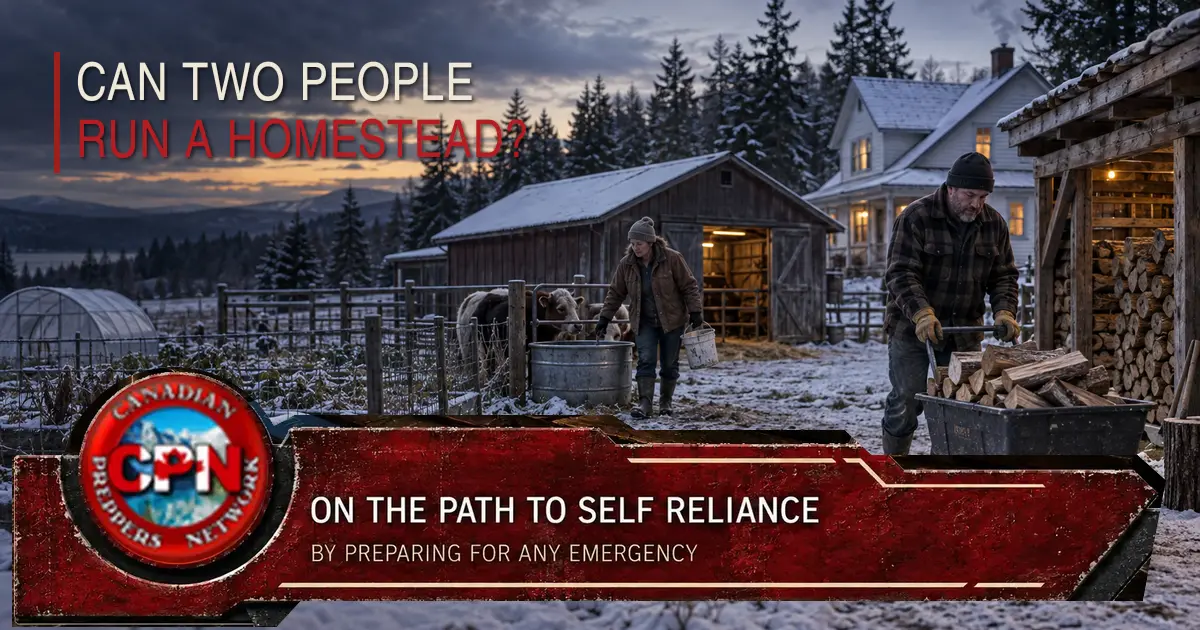
A post-collapse labour audit may reveal that your retreat has more chores than workers.
The self-reliant homestead is often imagined as a collection of things.
A garden. A wood stove. Chickens. Stored food. A well. Fruit trees. Perhaps rabbits, goats, solar panels, a greenhouse and enough land to provide firewood.
Each addition appears to increase resilience—and it can.
But every system also creates work.
Gardens must be planted, weeded, watered, harvested and preserved. Animals need food and water every day, regardless of weather, illness or exhaustion. Wood must be cut, split, moved and stacked. Pumps break. Fences sag. Snow blocks paths. Ash accumulates. Meals take longer when electric appliances are unavailable.
A homestead is not simply a collection of resources. It is a collection of recurring obligations.
That raises an uncomfortable question for the small household:
Can two adults actually keep the entire operation running after a prolonged collapse?
Count Person-Hours, Not Chores
Most preparedness plans list responsibilities without estimating the labour needed to complete them.
“Collect water” may look like one item on a checklist. In reality, it could involve walking to the source, breaking ice, operating a manual pump, filling containers, hauling them home, filtering drinking water and cleaning the equipment.
“Heat the house” may require removing ash, carrying wood, splitting kindling, lighting the stove, monitoring the fire and bringing in enough fuel for the night.
“Feed the animals” includes inspecting them, carrying water, distributing feed, collecting eggs, replacing bedding, cleaning containers and repairing whatever broke overnight.
Every chore should therefore be measured in person-hours.
If a job requires two people for one hour, it consumes two person-hours. If one person needs three hours, it consumes three. Travel time, setup, cleanup and tool maintenance must be included.
Otherwise, the household is budgeting imaginary labour.
A Sample Two-Person Workday
Every property is different, but a small grid-down homestead might require the following daily labour:
| Essential Work | Daily Planning Allowance |
|---|---|
| Collecting, treating and distributing water | 1.5 hours |
| Preparing meals, managing cooking fuel and cleaning up | 2.5 hours |
| Heating, firewood handling and ash removal | 2 hours |
| Livestock feeding, watering, bedding and inspection | 2 hours |
| Sanitation, laundry and waste management | 1 hour |
| Gardening, harvesting or food preservation | 3 hours |
| Repairs, communications, security and inventory | 2 hours |
| Total | 14 person-hours |
These are planning figures, not universal promises. A deep well, distant woodlot, large garden, heavy snowfall or additional livestock could increase them substantially.
Fourteen person-hours divided between two healthy adults may appear manageable. Each person contributes seven hours of productive work.
But that is an ordinary day.
It does not include a fallen tree, broken pump, sick animal, damaged roof, medical emergency or unexpected visitor. It does not include travelling for supplies, helping a neighbour or maintaining a continuous security watch.
It also assumes both adults are healthy, rested and present.
That is a dangerous assumption.
Limited-Space Outdoor Event
Plinkin’ in the Woods With Frugal Gunnie
Spend a full day developing practical outdoor rimfire marksmanship skills from prone, standing, seated and kneeling positions.
Saturday, September 12, 2026 · 8:00 a.m.–5:00 p.m.
Great Ape Empire · 267 Highway 6, Wiarton, Ontario
Admission: $250 CAD · Weekend camping: $20 per person
Private event. Space is strictly limited. Adult participants must meet all applicable legal and organizer requirements.
Remove One Adult From the Plan
Now repeat the calculation after removing one person.
The missing adult may be injured, ill, exhausted or required to remain on security duty. They may have left the property to gather information, obtain medicine or assist a family member. They could be physically present but unable to perform heavy work.
The remaining adult now faces fourteen hours of essential chores before personal care, proper meals, sleep or unexpected repairs.
Some tasks may also become slower or more dangerous because a second person is unavailable. Moving a large log, restraining an animal, repairing a roof or handling a heavy water barrel may no longer be practical.
A household might survive that pace for a few days.
It cannot sustainably operate that way through an entire Canadian winter.
This is where the homestead must shift from its normal routine into a reduced-manpower mode.
Decide What Cannot Be Allowed to Fail
Not every homestead activity deserves equal priority.
The first tier contains systems that cannot be neglected without quickly endangering people, animals or critical infrastructure:
- Drinking water
- Essential heat
- Livestock food, water and shelter
- Basic meals
- Sanitation
- Immediate medical needs
- Fire prevention
- Minimum security and communications
The second tier includes work that can temporarily be reduced:
- Elaborate meal preparation
- Non-essential cleaning
- Large laundry loads
- Routine construction
- Preventive maintenance that can safely wait
- Labour-intensive food processing
- Secondary security patrols
The third tier consists of activities that stop entirely when labour is short:
- Decorative gardens
- Convenience projects
- Property improvements
- Non-essential travel
- Experimental crops
- Producing goods that are not immediately needed
- Maintaining equipment or buildings with no critical purpose
This triage should be decided before the household is exhausted.
When people make these decisions during a crisis, they often continue familiar but low-priority chores while quietly neglecting a critical system.
Hands-On Outdoor Training
Archery Intensive With Wolf Starchild
Spend a concentrated day improving stance, grip, drawing, anchoring, release, follow-through and arrow control with individual coaching from Wolf Starchild of Barefoot Bushcraft.
Sunday, September 13, 2026
Great Ape Empire · 267 Highway 6, Wiarton, Ontario
Course fee: $120 per person · Equipment available
Presented by Barefoot Bushcraft in partnership with Canadian Preppers Network, Preppers Meet, Great Ape Empire and Off-Grid School.
Some Homestead Systems May Need to Be Abandoned
Preparedness discussions often focus on acquiring more capability.
More animals. More gardens. More buildings. More stored equipment. More land under cultivation.
After collapse, the correct decision may be to operate less.
A household might need to reduce the number of animals it supports before stored feed becomes scarce. It may cultivate a smaller garden more intensively rather than failing to maintain a large one. Several rooms may be closed during winter so one heated living zone can be maintained.
An outbuilding that constantly requires repair may be emptied and abandoned. A distant water source may be replaced with a smaller but more accessible supply. A crop that demands frequent watering may be dropped in favour of something less productive but easier to maintain.
The strongest homestead is not necessarily the one producing the most.
It is the one that can continue operating with the people actually available.
Buy Back Time Before the Crisis
Labour-saving preparation does not have to depend on complicated machinery.
Begin with distance.
How many steps separate the house from the woodshed, animals, water, tools and food storage? A poorly placed woodpile may waste twenty minutes every cold day. A missing bucket at the barn can create another unnecessary trip. An icy route to the well can turn a routine chore into an hour of dangerous work.
Then examine handling.
Can water be moved by cart or sled instead of carried? Can firewood be stored closer to the winter entrance? Are feed containers located where they are used? Do frequently needed tools have permanent storage locations?
Simple changes can recover hours:
- Prepare and mark winter chore routes.
- Store duplicate hand tools at distant work areas.
- Use standard containers that fit carts, shelves and water systems.
- Position firewood before snow makes access difficult.
- Keep animal feed and bedding close to their shelters.
- Install gravity-fed systems where practical.
- Batch cooking, water treatment and other repetitive work.
- Maintain passive alarms so people are not constantly patrolling.
- Keep written inventories to reduce unnecessary searching.
- Repair gates, handles and latches before they become emergencies.
Saving ten minutes on a daily chore recovers more than sixty hours over a year.
That is not merely convenience. It is labour stored in advance.
Eliminate Single-Person Knowledge
A two-adult household does not have a spare specialist.
If only one person understands the water system, radio, livestock routine, stove, medical supplies or food-preservation equipment, the homestead could lose that entire capability when the knowledgeable person becomes unavailable.
Both adults should be able to complete every life-sustaining routine.
This does not mean that everyone must possess identical skills. Specialization is efficient during normal operations. The second person must still understand the minimum safe procedure.
Written instructions should cover:
- Starting, operating and shutting down essential equipment
- Locating valves, tools, spare parts and emergency supplies
- Feeding and watering each animal
- Recognizing obvious signs of illness or system failure
- Treating and rationing water
- Operating radios and using the communications plan
- Managing the stove and preventing chimney or ash fires
- Contacting trusted neighbours
- Switching the property into reduced-manpower mode
The instructions must make sense to someone who is tired and frightened—not merely to the person who wrote them.
Canadian Amateur Radio Training for Preppers
Build Communications That Do Not Depend on the Grid
Prepper Radio Canada provides structured, self-paced preparation for the Canadian Basic Amateur Radio qualification examination, with 86 lessons and six months of course access.
$79 CAD · One-time payment
Conduct the Missing-Person Drill
Choose one adult and remove that person from homestead operations for twenty-four hours.
They may observe, but they cannot answer questions, locate equipment or perform chores. The other adult must manage the essential systems alone.
Record:
- Which chores were missed
- Which jobs took longer than expected
- Which tools could not be found
- Which tasks required two people
- Which systems only one person understood
- Where unnecessary trips occurred
- Which activities had to be abandoned
- Whether adequate sleep remained possible
Repeat the drill with the roles reversed.
Then extend it to seventy-two hours.
The purpose is not to prove toughness. It is to expose bad design while stores, vehicles, medical care and outside assistance are still available.
Knowledge and Intelligence for Only $5 Per Year
CPN Gold Membership
Access the CD3WD collection and hundreds of practical manuals covering agriculture, repairs, water, energy, food production, health and low-technology self-reliance.
Gold members also receive the monthly Canadian Preparedness Intelligence Briefing covering geopolitical developments, domestic economic pressure, employment, food and energy security and civil-defence activity.
Labour Is a Preparedness Supply
A household may possess years of stored food, several heat sources and excellent equipment.
None of those supplies operates itself.
The real limiting resource may be the number of healthy, trained and rested people available to keep essential systems functioning. When that number falls from two to one, the homestead does not simply lose half its labour. It may lose the ability to perform tasks requiring two people, specialized knowledge or continuous coverage.
Calculate your own daily labour requirement.
Include every trip, setup, cleanup and repair. Add winter conditions. Add food production. Add security. Then remove one adult and run the numbers again.
If the remaining workload cannot be completed safely, the answer is not greater determination.
The homestead needs simpler systems, shorter distances, fewer obligations, better cross-training—or more dependable people.
Free Canadian Preparedness Download
Canadian Grid-Down Starter Kit
Use this printable first-72-hours checklist to test your household’s water, power, food, sanitation, communications and operating routines before a short outage becomes a long-term emergency.
Related Reading on CPN
Amazon Buying Box
Equipment That Reduces the Labour Burden
The best labour-saving equipment reduces carrying, unnecessary travel, searching and repetitive manual handling. Select durable equipment that fits the terrain, loads and people on your property.
- Heavy-duty garden utility carts
- Heavy-duty wheelbarrows
- Heavy-duty utility sleds
- Heavy-duty water containers
- Rechargeable headlamps
- Heavy-duty work gloves
- Weatherproof notebooks for chore logs and inventories
- Tool organizers for essential work areas
Disclosure: This article contains Amazon affiliate links. As an Amazon Associate, Canadian Preppers Network may earn from qualifying purchases.