Sleep and daily work will defeat most security plans before an intruder ever does.
Most post-collapse security plans are designed around the moment of confrontation.
Someone approaches the gate. An alarm sounds. A suspicious vehicle stops on the road. A noise is heard near the barn. The household reacts.
What those plans usually ignore are the hundreds of uneventful hours before that moment—the hours during which people must sleep, cook, collect water, cut firewood, tend animals, repair equipment, care for injuries and somehow continue watching the property.
That is where many security plans fail.
A retreat does not become secure because someone owns a firearm, installs a camera or promises to remain vigilant. It becomes secure when the household can repeatedly detect unusual activity, assess what is happening and respond without exhausting its people.
One adult cannot do that continuously. Two adults cannot do it for long. Even a capable family will struggle once illness, injury, travel, heavy work and interrupted sleep begin taking people out of the rotation.
The greatest weakness in most retreat-security plans is not the perimeter. It is the number of rested, dependable people available to watch it.
Use this printable first-72-hours checklist to test your household’s water, power, food, sanitation, communications and operating routines before a short outage becomes a long-term grid-down emergency.
Twenty-Four Hours Is a Long Time
Continuous security means covering 168 hours every week.
If four adults divide that burden equally, each person must provide 42 hours of watch every week before doing any other work. That might sound manageable until those same people also need to produce meals, maintain heat, haul water, repair fencing, tend livestock and sleep.
If only two adults are available, continuous coverage becomes essentially impossible. Each would be responsible for 84 hours a week. Even if they attempted alternating shifts, the arrangement would soon erode their health, judgement and ability to perform essential work.
The watch-hour reality
Divide 168 by the number of dependable adults available. The result is each person’s weekly watch burden before cooking, water, heat, sanitation, repairs, food production or sleep are considered.
- Two adults: 84 watch hours each per week
- Three adults: 56 watch hours each per week
- Four adults: 42 watch hours each per week
- Six adults: 28 watch hours each per week
- Eight adults: 21 watch hours each per week
A household may manage an extreme pace for a night or two during an immediate threat. It cannot live that way through an entire winter.
Security therefore cannot depend upon keeping one person staring down the driveway around the clock. The property must be arranged so that fewer people can notice more, and so that routine work does not leave the retreat completely blind.
An Awake Person Is Not Necessarily an Effective Watch
Fatigue does more than make someone uncomfortable.
A tired observer misses movement, forgets check-ins, misidentifies harmless sounds and makes poor decisions. After several disturbed nights, people may become irritable, careless and overly reactive. They may start ignoring alarms because the previous five were caused by deer, wind or loose livestock.
Eventually, the watch schedule still exists on paper while meaningful observation has stopped.
This is particularly dangerous during the early morning hours. The person assigned to watch may technically be awake but mentally dulled, cold and struggling to maintain attention. Someone who has already spent the day repairing equipment or cutting wood will be even less capable.
A sustainable plan must protect sleep as deliberately as it protects food and water.
That means keeping watches short enough to remain useful, rotating the least desirable hours and ensuring that an off-duty person is genuinely relieved of responsibility. If everyone wakes whenever an alarm sounds, the entire household will become exhausted together.
Stop Trying to Watch Everything
A retreat may have hundreds of metres of boundary, several buildings, wooded approaches, fields, trails and a long driveway. Attempting to observe every part of it directly will consume more people than most households possess.
Instead, identify the places through which movement naturally passes:
- The main driveway
- A secondary lane or logging road
- Gates and fence openings
- Bridges and culverts
- Trails around water, cliffs or marshy ground
- Approaches to barns, fuel storage and workshops
- Terrain offering the easiest walking route
- Locations overlooking wells, pumps or solar equipment
These are not necessarily the property lines. The useful question is not, “Can we see every metre of the boundary?” It is, “Where would a person, animal or vehicle most likely appear?”
The objective is to turn a large, complicated property into a smaller number of monitored approaches. CPN’s early-detection planning guide expands on identifying those approaches and building warning before movement reaches the house.
Detection Must Happen Before the Door
A lock is not an early-warning system. It only becomes relevant after someone has reached the building.
Useful retreat security begins farther out.
A closed gate creates a decision point. Gravel records and announces movement. A maintained fence guides people towards controlled openings. Dogs may notice unfamiliar activity before humans do. Battery-powered driveway alarms and trail cameras can extend observation into areas that cannot be watched continuously.
None of these measures is perfect.
A branch can trigger a sensor. Wildlife can fill a camera card. Batteries can die. Heavy snow may alter an approach. Someone may deliberately avoid a gate.
The value comes from overlapping methods. When two or three indicators agree—a driveway sensor activates, the dog reacts and a camera records movement—the household has better information than it would receive from any single device.
The system should help the household answer three questions:
- Did something actually happen?
- What was it?
- Does anyone need to respond?
An alarm that cannot be assessed merely wakes people. It does not provide reliable security.
Spend a full day developing practical outdoor rimfire marksmanship skills with Frugal Gunnie. This is a hands-on private event—not another afternoon spent sitting at a shooting bench.
Saturday, September 12, 2026
8:00 a.m.–5:00 p.m.
Great Ape Empire
267 Highway 6, Wiarton, Ontario
Weekend camping: $20 per person
Space is strictly limited. Adult participants must meet all applicable legal and organizer requirements.
Presented in collaboration with Off-Grid School, Preppers Meet, Canadian Preppers Network and Great Ape Empire.
Delay Is More Valuable Than Appearance
A property does not need to look like a fortified compound. In fact, conspicuous fortification may advertise that something valuable is being protected.
The better objective is to quietly slow movement and make uncontrolled access inconvenient.
A locked gate will not stop a determined group forever, but it may force them to leave a vehicle, make noise or spend time working through an obstacle. A properly secured equipment shed may not be impenetrable, but it can prevent someone from silently entering and leaving with a generator in two minutes.
That delay gives the household time to detect, assess, communicate and decide what to do.
Ordinary measures can contribute:
- Gates that cannot simply be lifted off their hinges
- Shielded padlocks that are difficult to reach with bolt cutters
- Fuel and generators secured to substantial anchors
- Vehicles parked to restrict access to critical buildings
- Tools stored out of sight instead of beside the work area
- Doors that close and lock properly
- Fences regularly checked for damage or tampering
- Secondary storage for supplies whose total loss would be catastrophic
Security is not created by one impressive barrier. It comes from a series of small delays between the approach to the property and access to its most important resources.
The practical options in CPN’s guide to exterior barriers that restrict access can help shape movement without relying on expensive electronic systems.
The Retreat Must Be Divided into Priorities
Not every object deserves the same protection.
A household that tries to defend every shed, vehicle and pile of material equally will spread itself too thin. Instead, identify what would immediately threaten survival if it were stolen, damaged or sabotaged.
Critical assets may include:
- The working water source
- Fuel and lubricants
- Generators and charging equipment
- Livestock and stored feed
- Medical supplies
- Communications equipment
- Food-production tools
- Seeds and stored food
- Essential vehicle parts
- The primary heat source
These assets should receive the earliest warning, strongest delay and most reliable observation.
Lower-value materials can be stored farther out or in less protected buildings. In some cases, distributing supplies between several locations is wiser than concentrating everything behind one door. A single successful theft or fire should not eliminate an entire capability.
For only $5 per year, Gold members receive unlimited access to the CD3WD collection and hundreds of practical manuals covering food production, water, energy, repairs, health, agriculture and self-reliance.
Gold members also receive the monthly Canadian Preparedness Intelligence Briefing, examining global geopolitics, domestic economic pressures, employment, food and energy security, civil-defence developments and other emerging risks affecting Canadian households.
Chores Create Predictable Vulnerabilities
Every functioning retreat develops a rhythm.
Animals are fed at similar times. The generator runs on a schedule. Water is collected from the same place. Firewood is cut along familiar routes. People travel to neighbouring properties or trading locations through the same gate.
Routine improves efficiency, but it also creates predictability.
Anyone observing the property may eventually learn when most people are in the fields, when the barn is unattended or when only one person remains near the house.
The solution is not to eliminate routines. That would make the retreat chaotic and inefficient. Instead, avoid allowing essential routines to remove all observation at once.
When several people leave for a large job, someone should retain responsibility for the property. When a trade party departs, departure and return procedures should be understood. When noisy equipment is operating, someone should periodically check what can no longer be heard.
Security must be built into the workday rather than treated as a separate activity that only happens after dark.
Watches Need Jobs, Records and Relief
“Keep an eye on things” is not a complete assignment.
A watch should have defined responsibilities:
- Monitor designated approaches
- Check sensors or cameras
- Maintain scheduled radio contact
- Record unusual activity
- Note vehicles, people, tracks or damaged barriers
- Report equipment problems
- Wake or contact the correct person when necessary
A simple log is extremely useful. It allows the next person to see what has occurred instead of relying on memory. Repeated alarms in the same location may reveal an equipment fault, wildlife pattern or deliberate testing of the perimeter.
Clear relief matters just as much. The outgoing person should pass along equipment, observations and unresolved concerns. The incoming person should confirm that radios, lights and alarms are working.
This takes only a few minutes, but it turns a vague household expectation into a functioning system.
Illness and Injury Will Shrink the Rotation
Most security plans assume that every adult remains available.
That is unlikely during a prolonged emergency.
Someone may be injured cutting wood. Another person may become sick. One adult may need to provide continuous care. A trade or observation trip may take several people away for an entire day. Winter conditions may make ordinary chores slower and more exhausting.
A four-person rotation can become a two-person rotation without warning.
The plan therefore needs a reduced-manpower mode. Decide beforehand:
- Which buildings will no longer be routinely checked
- Which approaches receive priority
- Which chores can be postponed
- Whether livestock or equipment can be moved closer
- When outside travel must stop
- Which alarms remain essential
- When trusted neighbours should be contacted
A plan that only works when everyone is healthy, rested and present is not a resilient plan.
Trusted People Are a Security Resource
The lone survivor may be an entertaining character, but isolation is a serious disadvantage.
A small network of trusted neighbours can notice vehicles, share information, check routes and provide assistance when a household is shorthanded. This does not require revealing the location of every supply or surrendering control of the property.
Trust should be built slowly, before a crisis, through ordinary cooperation and demonstrated reliability.
The important questions are practical:
- Do they keep commitments?
- Can they communicate clearly?
- Do they remain calm under stress?
- Do they contribute useful work?
- Can they respect boundaries?
- Would you trust their information?
- Would they notice if something was wrong at your property?
A dependable neighbour with a radio may contribute more to long-term security than another piece of equipment. The relationships must already exist, however. They cannot be created instantly after communications and public order have failed.
CPN’s guide to building relationships with other survival groups explains how to develop cooperation gradually without disclosing sensitive information too early.
Build the knowledge required for the Canadian Basic Amateur Radio qualification while learning how radio communications support prepared households and groups.
86 lessons · Self-paced · Six months of access · $79 CAD
Build a System That Lets People Live
The purpose of security is not to keep everyone permanently frightened and awake.
It is to create enough warning and delay for people to sleep, work and maintain the systems that keep the retreat alive.
That requires more than weapons or cameras. It requires controlled approaches, functioning alarms, clear responsibilities, protected sleep, written observations, prioritized assets and enough trusted people to absorb the loss of one or two household members.
The strongest retreat is not necessarily the one with the highest fence.
It is the one that can continue noticing changes after the novelty wears off, the nights become long and everyone is tired.
A household may possess a year of food, several heat sources, backup power and excellent equipment. None of it matters if exhaustion makes the property blind.
Calculate your own 168-hour watch burden today. Then remove one adult from the calculation to represent illness, injury or travel. If the remaining schedule cannot provide useful observation and adequate sleep, the answer is not greater determination. The property needs better passive warning, fewer critical approaches or more trusted people.
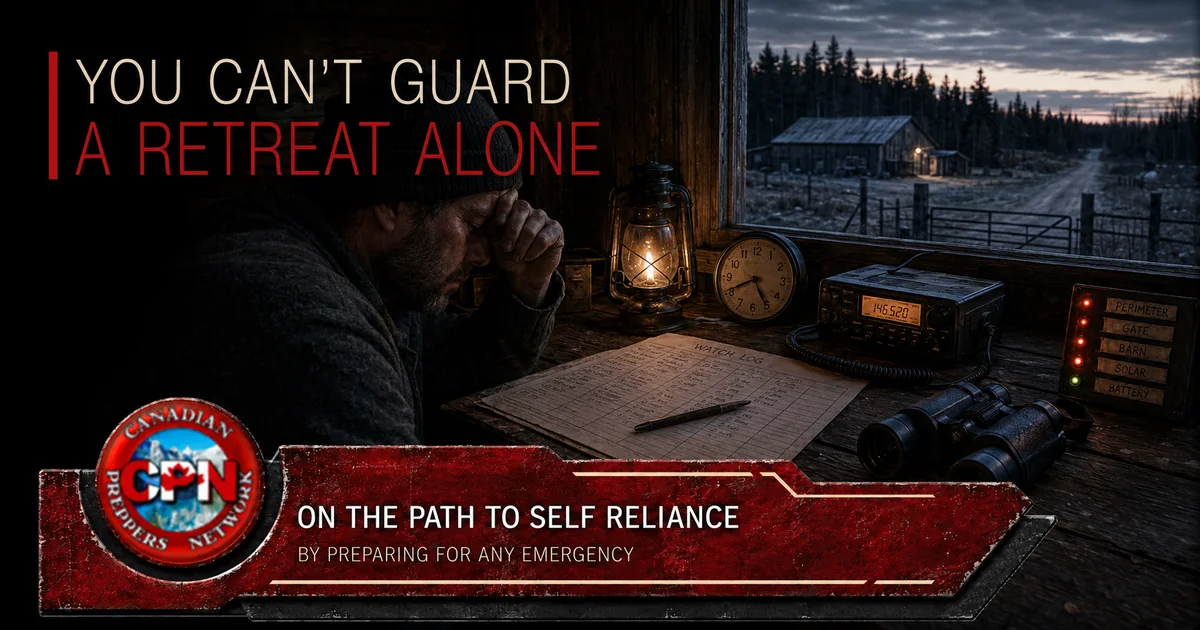
You cannot guard a retreat alone. The sooner that limitation is accepted, the sooner a security plan can be built that might actually last.
Equipment That Reduces the Manpower Burden
The most useful security equipment detects movement, helps assess an alarm, delays access or supports reliable communication. It does not replace rested people and a workable routine.
Disclosure: As an Amazon Associate, Canadian Preppers Network may earn from qualifying purchases.
- Wireless driveway alarms for monitoring likely approaches
- Trail cameras for assessing movement away from the house
- Battery-powered motion alarms for gates and outbuildings
- Shrouded security padlocks for increasing delay
- Hardened security chain for generators, fuel and mobile equipment
- Two-way radio multi-packs for household check-ins
- Weatherproof notebooks for watch logs and observations
- Compact binoculars for assessing distant activity
Discussion: After removing one adult for illness or injury, how many weekly watch hours would each dependable person in your household have to cover—and what part of the property would you stop trying to monitor first?