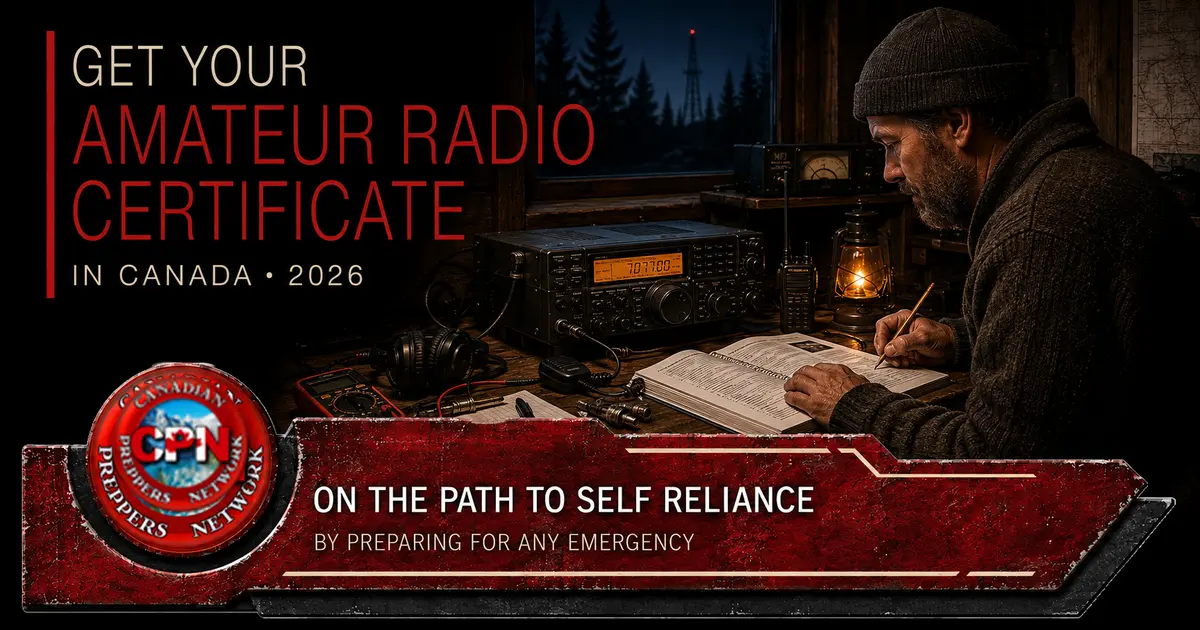
From first lesson to your first call sign
Buying an amateur radio is easy. Building a legal and dependable communications capability is harder.
A handheld radio ordered online does not make someone an amateur-radio operator. It does not teach them how to choose a frequency, reach a repeater, control interference, connect an antenna or pass a message when the cellular network is overloaded. In Canada, transmitting on amateur frequencies normally requires an Amateur Radio Operator Certificate and an assigned call sign.
For preppers, that certificate is more than permission to talk. It is the starting point for practising local nets, testing antennas, learning regional HF communication and building relationships with operators who may still be reachable when conventional systems fail.
Fortunately, the path from complete beginner to certified operator is straightforward once the steps are laid out properly.
Free Canadian Preparedness Download
The Canadian Grid-Down Starter Kit
Use this printable first-72-hours checklist to test your household’s communications, power, water, food, sanitation and operating routines before a short outage becomes a long-term emergency.
Certificate, Licence or Call Sign?
Canadians often search for a “ham radio licence,” but the official Canadian credential is the Amateur Radio Operator Certificate.
Innovation, Science and Economic Development Canada—better known as ISED—administers the certification system. To earn the entry-level Basic Qualification, a candidate must pass the official Basic examination with a mark of at least 70 per cent. The examination is administered by an ISED-accredited examiner. ISED’s certification overview explains the official process.
Passing a private course does not issue the certificate. A course prepares the student to write the official examination; the accredited examiner records the result, and ISED completes the certification and call-sign process.
That distinction matters when comparing training programs. The question is not whether a course “licenses” its students. It is whether it teaches the material well enough for students to pass the official examination—and understand what they are doing after they pass.
Aim for Basic with Honours
The Basic examination contains 100 multiple-choice questions drawn from the official Canadian question bank.
A score of 70 to 79 per cent earns the Basic Qualification. That provides useful operating privileges on amateur bands above 30 MHz, including the commonly used VHF and UHF bands.
A score of 80 per cent or higher earns Basic with Honours. This adds access to amateur bands below 30 MHz, including the HF bands used for regional, national and international communication. ISED describes these qualifications and privileges in its Information on the Amateur Radio Service.
For a casual operator interested only in local repeaters, a basic pass may be enough. For a preparedness-minded operator, stopping at 70 per cent is a poor target.
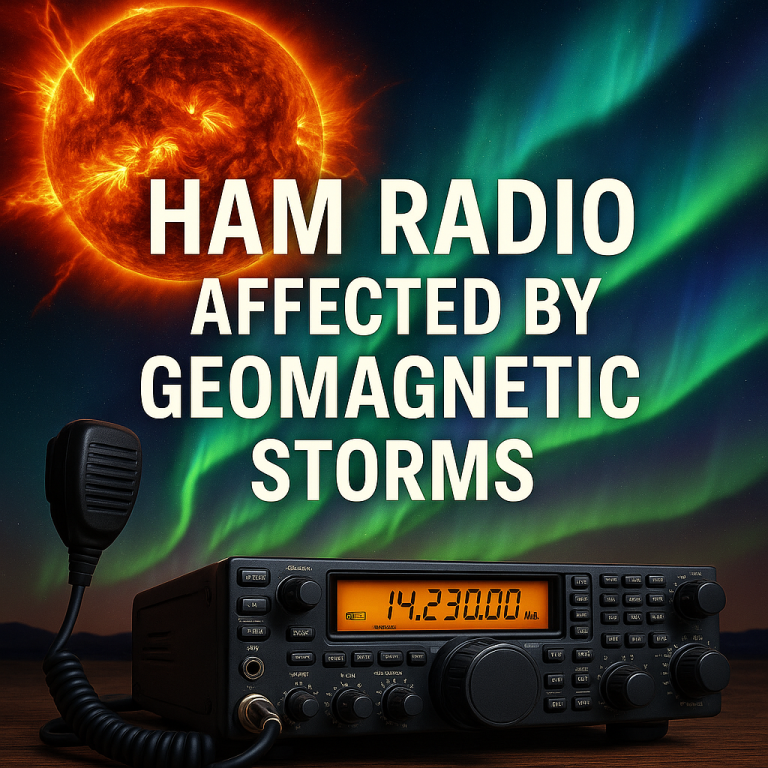
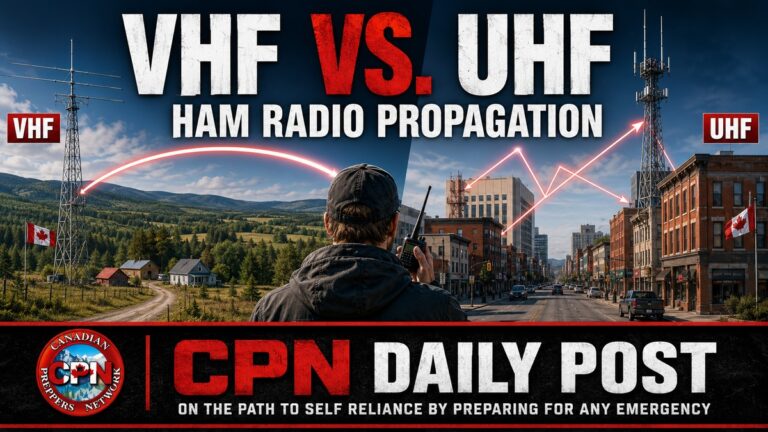
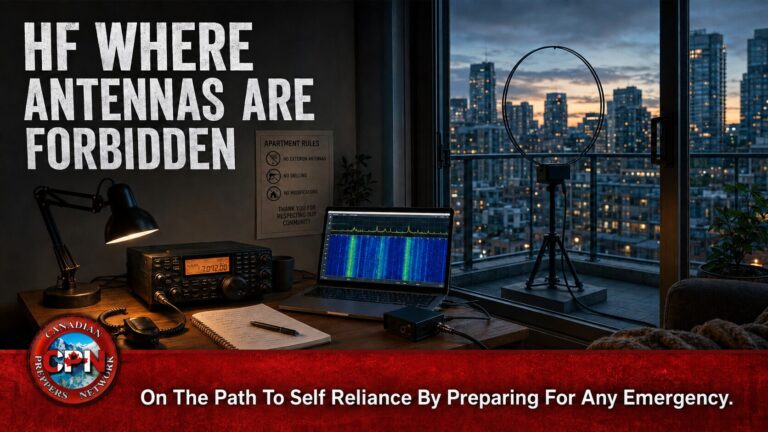
VHF and UHF are highly useful for local communication, but their practical range is affected by terrain, antenna height and repeater availability. HF adds the ability to communicate beyond the local area without depending on a repeater between the two stations. It also supports techniques such as Near Vertical Incidence Skywave for regional coverage.
CPN’s VHF versus UHF comparison explains the local-radio side, while using NVIS for regional communications shows why HF privileges can be so valuable.
Preparedness target: Do not study merely to pass at 70 per cent. Prepare to score at least 80 per cent and earn HF privileges immediately.
Limited-Space Outdoor Event
Plinkin’ in the Woods
with Frugal Gunnie
Spend a full day developing practical outdoor rimfire marksmanship skills with Frugal Gunnie. This is a hands-on private event—not another afternoon spent sitting at a shooting bench.
Saturday, September 12, 2026
8:00 a.m.–5:00 p.m.
Great Ape Empire
267 Highway 6, Wiarton, Ontario
Weekend camping: $20 per person
Space is strictly limited. Adult participants must meet all applicable legal and organizer requirements.
Step One: Choose a Study Method
Taking a course is not mandatory. Candidates may study independently using the official question bank and examination generator, learn through a local club or follow a structured online program.
Each approach has strengths and weaknesses.
Independent study costs little, but beginners can become trapped in question memorization. They may recognize an answer without understanding the underlying regulation, circuit or operating practice.
Live club courses provide access to experienced operators, but they run on fixed schedules and may only be offered once or twice a year. Missing several classes can make it difficult to catch up.
A structured online course allows the student to begin immediately, work around employment and family obligations, repeat difficult material and monitor progress. Its value depends on whether it teaches the concepts or simply drills the examination answers.
The best choice is the one that will take the student all the way from “I bought a radio” to genuine examination readiness.
A Preparedness-Focused Canadian Course
Prepper Radio Canada’s Canadian Basic Amateur Radio Course for Preppers was built specifically for Canadians who want more than a hobby-oriented introduction.
The self-paced course contains 86 focused lessons covering the eight major subject areas of the Canadian Basic Qualification. Every lesson is followed by a five-question knowledge check, and each major section concludes with a twenty-question assessment. Full 100-question practice examinations prepare students for the format of the official test.
An internal passing standard of 80 per cent encourages students to prepare for Basic with Honours rather than aiming for the minimum grade.
The material includes:
- Canadian regulations and operating responsibilities
- Repeater and simplex operation
- Voice, Morse and digital operating procedures
- Radio and electrical theory
- Transmitters, receivers and station equipment
- Batteries and backup station power
- Antennas, feed lines and propagation
- Interference control and station safety
- Preparedness communication planning
The course costs $79 CAD and provides six months of access. It prepares students for the official examination but does not replace that examination or issue an ISED certificate.
Step Two: Learn the Principles, Not Just the Answers
The most dangerous study method is memorizing which letter follows each question.
That approach may produce a passing score, but it creates an operator who cannot recognize a real-world problem when the wording changes. It is especially weak for preppers, who expect to operate under conditions that are less forgiving than a normal evening on a local repeater.
A useful study cycle looks like this:
- Learn one concept.
- Complete a short knowledge check.
- Review every incorrect answer.
- Explain the concept in your own words.
- Apply it to an actual radio, antenna or power system.
- Revisit the material during a section review.
Someone studying standing-wave ratio, for example, should understand more than the correct examination answer. They should understand why a badly matched antenna system can waste power, overheat equipment and leave a station unable to communicate effectively.
The examination is the first checkpoint. Competence is the actual goal.
Step Three: Use the Current ISED Examination Material
ISED introduced a new Basic examination system effective July 15, 2025. Candidates writing in 2026 should therefore be cautious about relying on old applications, abandoned websites or study notes created around an earlier examination system.
ISED provides an official amateur-radio examination generator. It can be used as a learning aid and gives candidates experience with the official style of questions.
Do not take one practice examination, score 72 per cent and immediately book the official test.
A stronger readiness standard is to complete several full practice examinations and score comfortably above 80 per cent each time. Consistent results in the mid-to-high eighties provide some protection against nervousness, unfamiliar wording and a difficult mix of questions on examination day.
Keep a list of every weak area. If antenna calculations, regulations or electronic components repeatedly lower the score, return to those lessons before attempting another full examination.
Step Four: Find an Accredited Examiner
Only an ISED-accredited examiner can administer the official examination and submit the result through the certification system.
ISED maintains an accredited-examiner search. Candidates can search by city, province or area code and contact an examiner directly.
Before booking, ask:
- What identification is required?
- Is the examination offered in person or remotely?
- What equipment or software will be needed?
- Is there an examination fee?
- How much time is reserved for the test?
- How will the result be submitted to ISED?
- What happens after a successful examination?
Do not wait until the day before the test to find an examiner. Contact one while studying, learn the local procedure and book the examination once practice results are consistently strong.
Build Your Offline Preparedness Library
CPN Gold Membership
For only $5 per year, Gold members receive unlimited access to the CD3WD collection and hundreds of practical manuals covering food production, water, energy, repairs, health, agriculture and self-reliance.
Gold members also receive the monthly Canadian Preparedness Intelligence Briefing, examining global geopolitics, domestic economic pressures, employment, food and energy security, civil-defence developments and other emerging risks affecting Canadian households.
Step Five: Write the Official Examination
The Basic Qualification examination consists of 100 multiple-choice questions.
A score of 70 per cent earns Basic. A score of 80 per cent earns Basic with Honours. The examiner confirms the result and submits the required information through ISED’s Amateur Radio Operator Certificate Services.
After a successful new-amateur submission, the candidate receives the information needed to complete their personal record and select an available call sign. ISED describes that handoff in its new-amateur application instructions.
Keep copies of the examination result and subsequent certification information. Confirm that the qualification and call sign appear correctly before beginning independent operation.
Step Six: Turn the Certificate into Capability
Passing the examination is not the finish line. It is the point at which practical training can finally begin.
During the first month after certification:
- Learn how to identify properly using your call sign.
- Obtain the current band plan for the frequencies you intend to use.
- Program and test several nearby repeaters.
- Make simplex contacts and record realistic range from home, vehicle and field locations.
- Join at least one regular net.
- Build a printed contact and frequency list.
- Test the station on backup power.
- Practise passing a short written message accurately.
- Identify a local contact and a regional contact you can reach without the internet.
Owning more radios will not compensate for skipping these steps. A modest station operated regularly is a stronger preparedness asset than expensive equipment that has never been tested.
The CPN Communications in Canada hub provides the broader framework: receiving information, maintaining local contact, powering equipment and building communications layers that do not all fail together.
The Mistakes That Keep New Operators Off the Air
Buying equipment before defining the mission: A local VHF station, mobile installation and regional HF station require different radios, antennas and power arrangements.
Studying only to reach 70 per cent: This can leave a preparedness operator without the HF privileges that motivated the project in the first place.
Using outdated American material: Canadian qualifications, regulations, frequencies and examination procedures are not the same as those used by the United States Federal Communications Commission.
Memorizing without understanding: Recognizing examination answers is not the same as troubleshooting a silent station.
Assuming a radio creates a network: Communication requires another trained operator, an agreed frequency, compatible equipment and regular practice.
Waiting for an emergency to learn: The first time someone attempts to program a repeater, tune an antenna or connect backup power should not be during a blackout or evacuation.
Build Your First Practical Amateur-Radio Kit
Certification should come before uncontrolled equipment buying. Once the operating mission is defined, these tools can support a basic station, range testing and continued skill development.
- Dual-band amateur-radio handhelds for local VHF and UHF operation after certification
- Dual-band magnetic-mount antennas for testing vehicle and portable installations
- VHF/UHF SWR meters for checking antenna-system performance
- Coaxial-cable and radio-adapter kits for connecting common station components
- Digital multimeters for basic voltage, resistance and continuity checks
- Amateur-radio logbooks for recording contacts, tests, frequencies and equipment changes
As an Amazon Associate, Canadian Preppers Network earns from qualifying purchases.
The Direct Path Forward
The process is simpler than many newcomers expect:
- Decide that Basic with Honours is the target.
- Choose a current Canadian study method.
- Learn the concepts and complete practice examinations.
- Find an ISED-accredited examiner.
- Pass the official Basic examination.
- Complete the ISED certification and call-sign process.
- Begin practising with real stations and real operators.
For Canadians who want a structured route built around preparedness, Prepper Radio Canada provides the complete self-paced training program for $79 CAD, with six months to complete the lessons and prepare for the official examination.
The radio can be purchased later. The knowledge, certificate, contacts and operating practice are what turn it into a communications system.
For experienced operators: what is the one skill you wish you had practised immediately after receiving your first call sign?