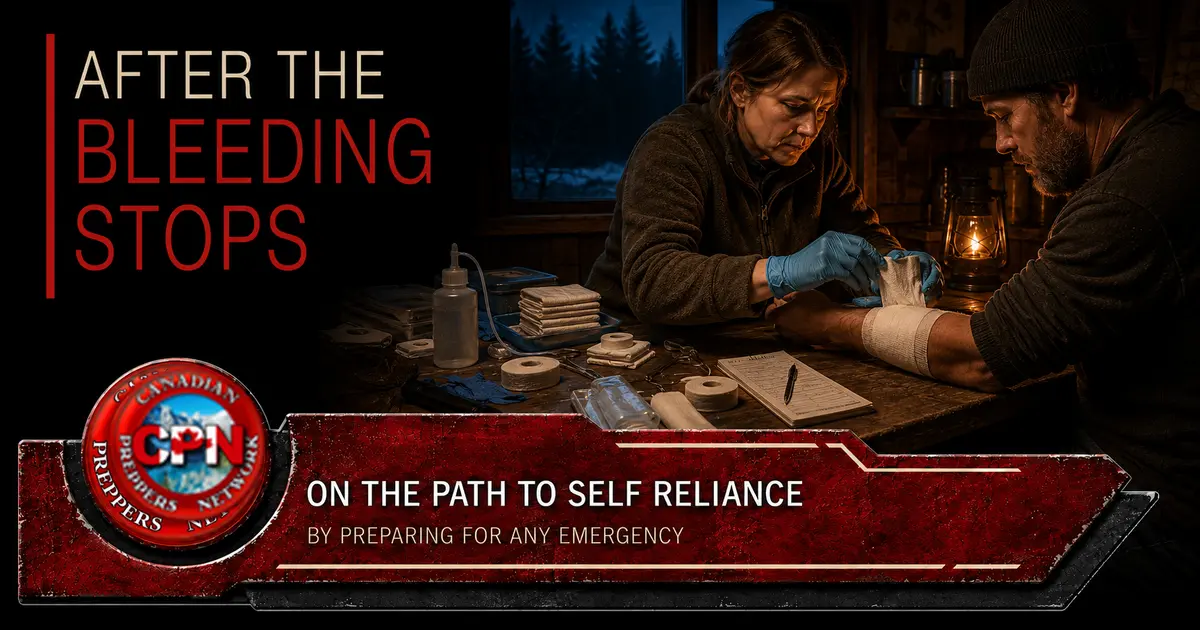
The real work begins once the immediate danger has passed
The axe slips. The workshop tool catches. A sharp edge hidden in debris opens a hand or leg. The bleeding is controlled, the injured person is stable, and everyone exhales.
In normal circumstances, this is where first aid begins handing the problem over to professionals. During a prolonged collapse, however, there may be no hand-off. The household must now keep that wound clean, protected and monitored while conserving supplies and watching for deterioration.
CPN has already examined why wound infection becomes particularly dangerous without modern care. The next step is turning that warning into an organized care cycle.
Stopping the bleeding may save a life in the first few minutes. What happens over the following several days may determine whether the injury remains manageable.
Free Canadian Preparedness Download
Canadian Grid-Down Starter Kit
Use this printable first-72-hours checklist to test your household’s water, power, food, sanitation, communications, medical readiness and operating routines before a short outage becomes a prolonged emergency.
First Aid Becomes Continuing Care
Most household medical preparations concentrate on the opening moments of an injury:
- Control severe bleeding.
- Protect the person from further danger.
- Check circulation, breathing and responsiveness.
- Cover the wound.
- Arrange evacuation.
Those priorities do not change. What changes when evacuation is delayed or impossible is the length of time the household must keep working.
Continuing care means repeatedly doing several ordinary jobs well:
- Protecting the wound from new contamination.
- Keeping dressings clean and functional.
- Monitoring circulation, sensation and movement.
- Recording changes instead of relying on memory.
- Conserving medical supplies without reusing contaminated material.
- Keeping the injured person rested, hydrated and fed.
- Recognizing deterioration early.
This is much less dramatic than applying a tourniquet. It is also where a small medical stockpile can disappear surprisingly quickly.
Establish a Baseline
Once immediate threats have been addressed and bleeding is controlled, write down what happened.
Record:
- The date and time of the injury.
- How the injury occurred.
- What contaminated the wound.
- Its location and approximate size.
- Whether bleeding was difficult to control.
- Whether anything may remain inside it.
- The person’s pain level at rest and during movement.
- Skin colour and temperature below the injury.
- Movement and sensation beyond the wound.
- The care already provided.
A photograph can be useful when working electronics are available, but it should not replace written notes. Measure the wound or place a ruler beside it in the photograph so later comparisons have some meaning.
The purpose is not to produce a medical chart for its own sake. It is to establish a starting point. Without one, gradual deterioration can be surprisingly difficult to recognize.
A wound deserves much greater concern when it involves a puncture, bite, crushing injury, heavy contamination, dirty water, an embedded object, loss of sensation, restricted movement or impaired circulation. Wounds involving the eye, face, hands, feet, joints or exposed deeper structures can also exceed what an untrained household can safely manage.
Even during a broad disruption, every viable route to qualified care should be considered for these injuries. In a complete collapse where such care truly no longer exists, recognizing that an injury is beyond household capability remains important. It changes how closely the patient must be watched, how labour is assigned and how scarce supplies are allocated.
Limited-Space Outdoor Event
Plinkin’ in the Woods with Frugal Gunnie
A full day of practical outdoor rimfire marksmanship, field positions, accuracy work and hands-on instruction.
Saturday, September 12, 2026
8:00 a.m.–5:00 p.m.
Great Ape Empire
267 Highway 6, Wiarton, Ontario
Weekend camping: $20 per person
Space is strictly limited. Adult participants must meet all applicable legal and organizer requirements.
Build a Wound-Care Station
Do not perform repeated dressing changes on the kitchen table between meal preparation and dirty dishes.
Establish one well-lit work area with a cleanable surface. Keep it away from food processing, animals, fuel, workshop dust and household waste.
Divide the area into clean and dirty sides.
The clean side holds unopened dressings, gauze, tape, gloves, irrigation equipment, clean water and record sheets. The dirty side receives used dressings, gloves and waste. Once something crosses to the dirty side, it does not return.
Before beginning:
- Gather everything that will be needed.
- Wash and dry hands thoroughly.
- Position the patient comfortably.
- Provide enough light to inspect the entire wound.
- Open only the supplies required for that dressing change.
- Prepare a bag for contaminated waste.
- Keep pets, spectators and unnecessary helpers away.
This simple layout prevents the caregiver from touching a dirty dressing and then rummaging through the clean supply bin.
Clean Water Does the Physical Work
Wound cleaning is primarily a physical process. The objective is to flush away dirt, damaged material and contaminants—not to chemically burn the wound into submission.
A 2023 systematic review found no significant difference in infection rates between wounds cleaned with tap water and those cleaned with normal saline, although the quality and circumstances of the available evidence vary. The practical lesson is that safe potable water has real value when packaged saline is unavailable. Review the research through PubMed.
That does not mean any water will do. Water questionable enough to make someone sick should not be introduced into an open wound. Medical planning therefore depends upon the household’s broader water collection and purification system.
Use gentle, thorough irrigation rather than extreme pressure. Do not blindly probe a deep wound or dig after glass, metal or another object that cannot be clearly seen and easily removed. The Merck Manual’s professional wound guidance warns that excessive force during irrigation or handling can cause additional tissue damage.
Harsh household chemicals do not belong inside a wound. More chemical action is not necessarily better care.
A deep, heavily contaminated or irregular wound should not be casually stapled, sutured or glued shut by an untrained person. Closing the surface can trap contamination and hide what is happening underneath. Wound-closure equipment is not a substitute for the judgement required to know when a wound should remain open.
Knowledge and Intelligence for Only $5 Per Year
Build an Offline Preparedness Library
CPN Gold Membership includes access to the extensive CD3WD collection and hundreds of practical manuals covering health, sanitation, water, food production, repairs, agriculture, energy and low-technology self-reliance.
Gold members also receive the monthly Canadian Preparedness Intelligence Briefing, examining global geopolitics, domestic economic pressures, employment trends, food and energy security, civil-defence developments and other emerging risks affecting Canadian households.
Dress for Protection and Reassessment
The dressing needs to protect the wound without becoming part of the problem.
A practical arrangement for many ordinary wounds consists of:
- A non-adherent contact layer.
- Enough absorbent material to manage drainage.
- Roller gauze or tape to keep everything in place.
- Sufficient room to avoid restricting circulation.
After securing the dressing, recheck the skin beyond it. Look for normal colour and warmth, and ask about numbness, tingling or increasing pressure. A wrap that is becoming painfully tight as swelling develops needs attention.
Do not treat a dressing as something that must remain untouched for a fixed number of days. Replace it when it becomes wet, dirty, saturated, displaced or no longer protects the wound. Conversely, repeatedly removing a clean, functional dressing merely to satisfy curiosity wastes supplies and disturbs healing tissue.
If a dressing sticks, do not tear it away dry. Moisten it sufficiently to release it with less damage.
Calculate the Supply Burn Rate
A kit containing ten gauze pads sounds respectable until one patient requires repeated care.
For inventory planning—not as a universal treatment schedule—assume that one moderate wound could require at least two dressing events per day for three days. Actual needs may be higher or lower depending upon the wound and whether a dressing becomes wet or contaminated.
A six-change planning module might contain:
| Supply | Practical Planning Quantity |
|---|---|
| Nitrile gloves | 8–10 pairs |
| Non-adherent pads | 8–12 |
| Sterile gauze pads | 20–30 |
| Roller gauze | 2–3 rolls |
| Medical tape | 1 full roll |
| Irrigation syringe | 1 |
| Potable irrigation water or saline | A dedicated supply |
| Sealable waste bags | 6–8 |
| Wound log sheets | Several |
| Permanent marker and pen | 1 each |
The extra gloves and dressings provide a margin for contamination, poor placement or unexpected drainage.
Now multiply that module by two injured people. Then consider a second week.
This exposes the weakness of many commercial first-aid kits: they contain a broad assortment of items but very little depth. A serious household system needs both an immediate-response kit and separately stored replenishment supplies. CPN’s Medical and First Aid Buying Guide provides the larger framework for building that reserve.
Use a Wound Log
Memory becomes unreliable when people are tired, frightened and dividing their attention between security, water, food, sanitation and an injured household member.
At every wound check, record:
- Time and date.
- Pain level and whether it is improving or worsening.
- Redness, warmth and swelling.
- Type and amount of drainage.
- Unusual odour.
- Skin colour and warmth beyond the injury.
- Sensation and ability to move.
- Body temperature when illness is suspected.
- Fluids, food and medication taken.
- Supplies consumed.
- Name of the caregiver.
Use a marker to outline the outer edge of suspicious redness on intact skin and record the time. This makes outward spread easier to recognize at the next inspection.
When several people are providing care, the written log becomes the shared memory of the group. Whenever possible, designate one person to oversee the wound-care routine so that changes are assessed consistently.
Preparedness Starts With Communication
Canadian Basic Amateur Radio Course for Preppers
Learn the radio knowledge, operating skills and Canadian regulations needed to prepare for the ISED Basic Qualification examination—and build practical communications capability before conventional systems fail.
$79 CAD · One-time payment · Six months of course access
Watch the Direction of Travel
A single observation matters less than the trend.
Reassuring signs include stable or decreasing pain, redness that is not expanding, reduced swelling, decreasing drainage and preserved movement and sensation.
Concerning changes include:
- Increasing pain rather than gradual improvement.
- Spreading redness or warmth.
- Increasing swelling.
- Pus or a foul odour.
- Fever or chills.
- Red streaks extending away from the wound.
- New numbness or loss of movement.
- Pale, blue or unusually cool skin below the injury.
- Renewed bleeding.
- Black, grey or rapidly changing tissue.
- Confusion, unusual weakness or rapid overall decline.
HealthLink BC’s guidance on puncture wounds similarly identifies worsening redness, warmth, swelling, pus, fever, loss of function and reduced blood flow as warning signs.
These are not signals to try a more aggressive home remedy. They indicate that the problem may be moving beyond local wound care. When any functioning medical option remains, this is the point to use it urgently—not after another day of observation.
Prevent the Second Injury
An injured person who immediately returns to hauling water, splitting wood or clearing rubble is likely to contaminate the wound, reopen it or worsen deeper damage.
That creates an operational problem for the entire group. Someone must absorb the patient’s work.
Prepare for that before anyone is injured:
- Identify who can take over essential duties.
- Keep the patient away from dirty work.
- Protect the dressing during necessary movement.
- Provide adequate water and food.
- Maintain clean bedding and clothing.
- Keep flies, animals and waste away from the care area.
- Do not share towels or wound-care tools.
- Give the patient meaningful rest rather than treating inactivity as laziness.
Rest is not a luxury when the body is repairing tissue. Neither are hydration, adequate food and sanitation.
Make Tetanus Planning a Pre-Collapse Job
Tetanus protection cannot be improvised from gauze and antiseptic after the medical system disappears.
Review vaccination records now. Provincial guidance may recommend additional protection after certain dirty or serious wounds based on the wound type, previous vaccination series and the time since the last dose. For example, HealthLink BC’s current guidance advises assessment for serious or dirty wounds and notes that a booster may be given for deep wounds when the last tetanus vaccine was more than five years earlier.
The preparedness lesson is straightforward: know your status while records, vaccines and qualified advice remain available.
Preparedness Buying Box
Build a 72-Hour Wound-Care Reserve
A broad first-aid kit is only the starting point. Store enough depth to clean, dress, monitor and support one injured person through repeated care.
- Nitrile medical gloves
- Non-adherent wound pads
- Sterile gauze pads
- Roller gauze bandages
- Medical tape
- Sterile saline wound wash
- Wound-irrigation syringes
- Non-digital medical thermometers
- Bleeding-control kits, tourniquets and chest seals
- Portable stretchers and emergency carry sheets
- Folding cots for a temporary care area
- Waterproof notebooks for medical records
As an Amazon Associate, Canadian Preppers Network may earn from qualifying purchases at no additional cost to you.
Build for the Sixth Dressing
The dramatic piece of trauma equipment receives most of the attention. The sixth clean dressing rarely does.
Yet prolonged medical resilience depends on the quiet supplies and routines that remain after the emergency photograph would have been taken: clean water, lighting, gloves, non-adherent pads, gauze, tape, waste control, written observations and someone disciplined enough to repeat the job correctly.
Do not ask only whether your household can stop the bleeding.
Ask whether it can keep one injured person clean, protected, fed, monitored and supplied for the next three days—and whether it can recognize when that plan is failing.
How many complete dressing changes could your present medical stockpile support for one moderate wound before you ran out of something essential?