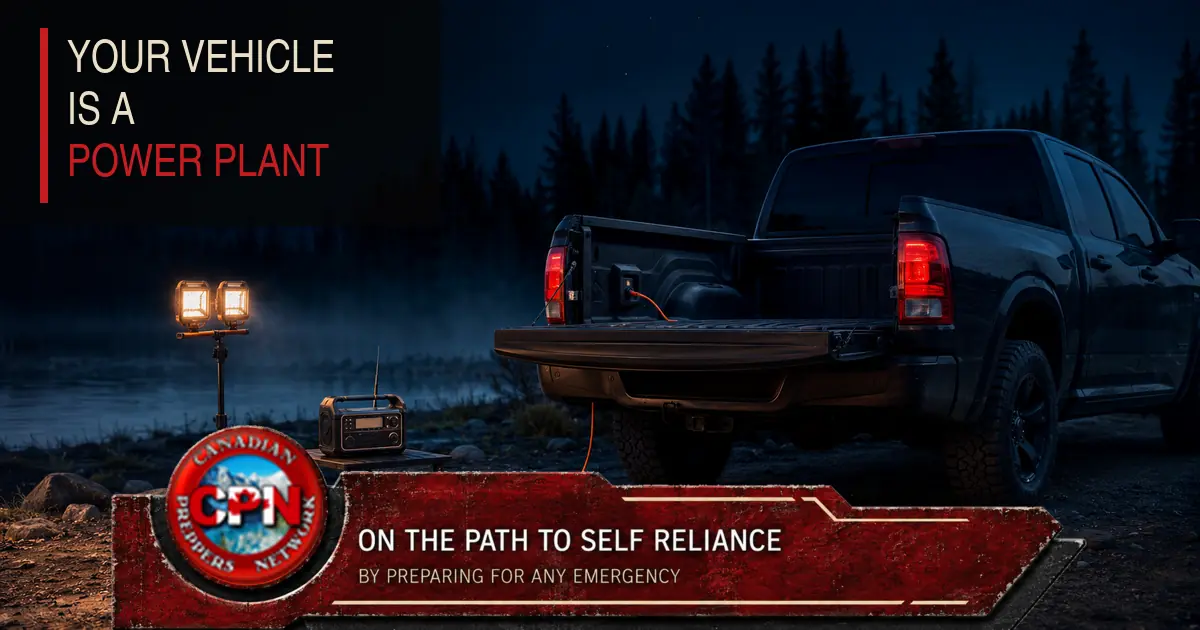
The safest ways to turn parked transportation into emergency electricity
Most Canadian households already own a machine that stores energy, produces electricity and can be refuelled or recharged: the vehicle in the driveway.
That does not mean every vehicle can power a refrigerator, furnace or house. A dashboard outlet may only handle a laptop, while a properly equipped truck or electric vehicle can supply thousands of watts. Confusing those systems can leave you with a blown fuse, damaged alternator, depleted starter battery—or a dangerous connection to the house.
Used intelligently, however, a vehicle can keep communications operating, recharge batteries, preserve refrigerated food and run selected equipment during a prolonged blackout. The first step is understanding what kind of power source you actually have.
Five Very Different Ways to Get Power From a Vehicle
“Using the car for backup power” can describe several systems that are not interchangeable.
| System | Practical Role | Major Limitation |
|---|---|---|
| USB or 12-volt accessory outlet | Phones, radios, power banks and some laptops | Limited by the outlet and fuse rating |
| Added power inverter | Selected 120-volt equipment | Limited by wiring, battery and alternator capacity |
| Factory 120-volt outlets | Tools and appliances within the stated rating | Output varies enormously between vehicles |
| Vehicle-to-load, or V2L | Appliances connected directly to a compatible EV | Usually supplies outlets, not the whole electrical panel |
| Vehicle-to-home, or V2H | Properly installed home backup from an EV | Requires compatible equipment and professional installation |
The important distinction is between powering an appliance and powering a building.
A factory outlet or V2L adapter can supply individual loads through properly rated cords. V2H uses approved equipment to isolate the home from the electrical grid and energize selected circuits safely. One does not become the other through an improvised adapter.
Start With the Load, Not the Vehicle
Before deciding what the vehicle can run, determine what actually needs electricity.
During a long outage, backup power should normally be reserved for functions that protect life, food, water and communications:
- Medical equipment that has been confirmed compatible with the power source
- Radios, phones and essential charging
- Efficient lighting
- Refrigerators and freezers
- A sump pump or water-transfer pump
- Furnace controls or a blower, where a safe connection already exists
- Selected tools needed for repairs
Electric resistance heat, kettles, hot plates, hair dryers and similar appliances can consume most or all of a small vehicle power system’s output. They turn valuable stored energy into heat very quickly.
The wattage printed on an appliance is only the beginning. Motors and compressors may require a much larger starting surge than their normal running load. Refrigerators, freezers and pumps also cycle on and off, so their average consumption must be measured over time.
A plug-in power meter is one of the most valuable tools in an emergency-energy plan. Test the actual equipment before the outage, record its running consumption and confirm that the intended power source can handle startup.
Free Canadian Preparedness Download
Canadian Grid-Down Starter Kit
Use this printable first-72-hours checklist to test your household’s power, water, food, sanitation, communications and operating routines before a short outage becomes a long-term grid-down emergency.
The Dashboard Outlet: Useful but Limited
The simplest method is the vehicle’s USB port or 12-volt accessory socket. These are appropriate for low-draw loads such as phones, radios, camera batteries, power banks and some laptop chargers.
The vehicle owner’s manual—not the inverter advertisement—sets the limit.
For example, a 12-volt circuit protected by a 15-amp fuse has a theoretical ceiling of 180 watts before wiring and conversion losses are considered:
That does not mean the socket should be operated continuously at 180 watts. The vehicle may specify a lower rating, and voltage, fuse size, connector quality and wiring vary. A commercially available pure-sine-wave vehicle inverter designed for an accessory socket may be rated around 120 watts for exactly this reason.
A plug-in inverter does not transform the dashboard outlet into a generator connection. If the appliance exceeds the vehicle’s stated socket rating, use another power source.
A Larger Inverter Is a Serious Installation
Higher-output inverters connect directly to a battery using heavy cable and correctly sized overcurrent protection. At that point, the inverter is no longer a glove-box accessory. It is part of the vehicle’s electrical system.
Three limits must be respected:
- The inverter’s continuous and surge ratings
- The battery’s safe discharge capability
- The alternator’s available output under actual operating conditions
An alternator’s nameplate rating does not represent electricity freely available to an inverter. The vehicle itself consumes power, and alternator output at idle can be substantially lower than its maximum rating. Modern smart-charging systems may also vary alternator output according to conditions the operator cannot see.
A large inverter can discharge the starter battery even while the engine is running. It can also overheat wiring or place an excessive continuous load on an alternator that was never designed to operate as a stationary generator.
For more than modest accessory power, the better arrangement is often a professionally installed auxiliary battery, DC-to-DC charger, fused cabling and appropriately sized pure-sine-wave inverter. This separates emergency loads from the starter battery and allows the system to be tested under controlled conditions.
Limited-Space Outdoor Event
PLINKIN’ IN THE WOODS
with Frugal Gunnie
Spend a full day developing practical outdoor rimfire marksmanship skills. Work from prone, standing and seated field positions while developing repeatable accuracy in a supervised outdoor setting.
Saturday, September 12, 2026
8:00 a.m.–5:00 p.m.
Great Ape Empire
267 Highway 6, Wiarton, Ontario
Weekend camping: $20 per person
Space is strictly limited. Adult participants must meet all applicable legal and organizer requirements.
View Event Details and Reserve Your Spot
Presented in collaboration with Off-Grid School, Preppers Meet, Canadian Preppers Network and Great Ape Empire.
Factory Outlets Change the Equation
Some vehicles now include factory-installed 120-volt power.
The difference between models is enormous. A passenger vehicle may provide a 400-watt outlet intended for electronics and light equipment. A work truck may offer several kilowatts and multiple outlets. Ford, for example, offers versions of its Pro Power Onboard system across several output classes, while some Kia electric vehicles sold in Canada provide V2L output up to 1,900 watts.
At 1,900 watts, an EV could operate a refrigerator, lights and communications equipment—provided their combined running and starting loads remain within the limit. It could also power one high-draw appliance near the system’s maximum, but doing so would leave little capacity for anything else.
Factory equipment has another advantage: the vehicle monitors its own battery, temperature and electrical limits. That is far safer than guessing how much continuous power an accessory inverter can draw.
The manual still matters. Confirm:
- Continuous output
- Short-term or surge output
- Available voltage
- Which outlets share the same limit
- Ground-fault protection
- Minimum battery reserve settings
- Whether the vehicle must remain in a particular operating mode
- Restrictions involving rain, snow or extension cords
Hybrids Can Be Efficient—but Only as Designed
Certain hybrids can maintain their electrical system while in “ready” mode, starting and stopping the gasoline engine as required. This can be more efficient than leaving an ordinary vehicle idling continuously.
That capability is model-specific. It does not automatically mean the traction battery can support an aftermarket high-output inverter, nor does it mean every hybrid has an external power outlet.
Use only the factory power capability or a system specifically engineered for that vehicle. Never assume that access to a large traction battery means it is safe to modify the high-voltage system.
A hybrid that may start its engine without warning must be treated like any other running fuel-burning vehicle: it stays outdoors and well away from openings.
An EV Holds a Remarkable Amount of Energy
Portable power stations are commonly measured in watt-hours. Electric-vehicle batteries are measured in kilowatt-hours—thousands of watt-hours.
A simple calculation shows why V2L has so much potential.
Imagine an EV with a 77-kilowatt-hour battery. The owner decides to use only the energy between an 80 per cent starting charge and a 20 per cent driving reserve. That makes 60 per cent of the battery available. Allow another 10 per cent for conversion losses.
At an average household emergency load of 500 watts:
That is nearly three and a half days before accounting for changing conditions or vehicle-specific limits.
This is only a planning example—not a promise of performance. Cold weather, battery condition, inverter overhead, appliance cycling and the vehicle’s protective settings will affect the result. The calculation nevertheless demonstrates the scale of the resource.
Every household can use that formula with its own measured loads and vehicle specifications.
V2L Is Not Whole-Home Backup
V2L provides one or more outlets from the vehicle. Appliances connect to those outlets within the system’s rating.
V2H is an installed system that allows a compatible vehicle to supply the home through controlled equipment. Tesla, for example, states that a properly equipped Cybertruck Powershare installation can supply up to 11.5 kilowatts to a home. That requires compatible charging and isolation equipment installed for the purpose.
The difference is not merely output. It is grid isolation.
Never Backfeed the House
During an outage, the home must not send electricity back onto utility lines. That backfeed can injure utility workers, damage equipment and create a fire hazard.
Never attempt to energize a home through a wall, dryer or range outlet. Never use a double-male cord. Turning off the main breaker is not a substitute for approved transfer equipment.
The Government of Canada’s power-outage guidance states that backup generation may only connect to a home electrical system through an approved transfer panel and switch installed by a qualified electrician.
The same rule applies whether the electricity comes from a generator, inverter, battery or vehicle.
Build Knowledge That Survives the Emergency
CPN Gold Membership
Gold Membership includes access to the extensive CD3WD offline reference collection, with practical manuals covering energy, electrical systems, repairs, agriculture, water, health and self-reliance.
Members also receive the monthly Canadian Preparedness Intelligence Briefing.
Carbon Monoxide Remains the Immediate Danger
A gasoline, diesel or hybrid vehicle used for power produces exhaust. It must never be left running in a garage—not even with the garage door open.
The Government of Canada specifically warns against idling a vehicle in a garage while charging electronics or warming occupants. Exhaust must remain well away from doors, windows and air intakes, and working carbon-monoxide alarms are essential.
Do not overlook wind direction. A vehicle parked outdoors can still send exhaust toward the house.
An EV supplying V2L power does not produce exhaust while parked, but its cables still require protection from water, traffic, damage and overloading.
Do Not Sacrifice Transportation for Convenience
The vehicle may be the household’s evacuation route, supply hauler and link to medical assistance. Draining its fuel tank or traction battery to preserve minor conveniences can create a more serious problem.
Set a mobility reserve before the outage:
- How far is the nearest reliable fuel or charging point?
- Could the household need to evacuate?
- Are nearby stations likely to be working?
- What range is lost to winter temperatures, towing or heavy loads?
- Can the vehicle be recharged without grid power?
The reserve should be based on local distances and the vehicle’s real-world range—not a universal percentage.
A sound rule of judgement is to spend vehicle energy only when the electrical load protects something more valuable than the transportation reserve. Refrigeration, medical needs, water movement and communications may qualify. Entertainment usually does not.
Build a Vehicle-Power Kit Before the Blackout
Do not wait until the lights fail to discover that the required adapter is missing.
Keep the equipment together:
- The vehicle manual with relevant power pages marked
- Manufacturer-approved V2L adapter, where applicable
- Properly rated, CSA-approved outdoor extension cords
- Plug-in power meter
- Heavy-duty power distribution suitable for the intended load
- Cord covers or high-visibility markers
- Carbon-monoxide alarms for any fuel-burning arrangement
- Headlamp and work gloves
- Written output limits and tested appliance loads
- A method of securing the vehicle while it supplies power
The broader CPN Energy Production and Blackout Power Buying Guide covers meters, cords, power stations, batteries and other equipment that can complement the vehicle.
Conduct a Real Blackout Test
A preparedness plan that has never been tested is still a theory.
Choose a safe day and disconnect the intended appliances from grid power. Set up the vehicle exactly as it would be used during an outage. Confirm that each load starts, operates and shuts down normally.
Record:
- Starting battery or fuel level
- Vehicle power mode
- Individual and combined wattage
- Any startup surges
- Operating time
- Ending battery or fuel level
- Extension-cord temperature
- Error messages or automatic shutdowns
- How much transportation reserve remains
Test the system long enough to expose problems, but do not experiment with home wiring or undocumented vehicle modifications.
Preparedness Buying Box
Build and Test Your Vehicle-Power Kit
Choose equipment that matches the vehicle manual, intended load and Canadian safety requirements. Vehicle-specific V2L equipment should come from the vehicle manufacturer or an approved supplier.
- Plug-in power meters for measuring real appliance loads
- Pure-sine-wave vehicle inverters within the vehicle’s approved limits
- Heavy-duty outdoor extension cords
- Carbon-monoxide alarms with battery backup
- High-capacity USB power banks
- Outdoor cord protectors and high-visibility cable covers
- 12-volt vehicle battery monitors
- USB-rechargeable headlamps for setup and monitoring
As an Amazon Associate, Canadian Preppers Network may earn from qualifying purchases at no additional cost to you.
The Vehicle Is a Bridge, Not the Whole Energy Plan
Vehicle power is most valuable when it connects the first hours of an outage to the rest of the household system.
It can recharge power banks while the vehicle is already being driven. It can operate refrigeration while a generator is serviced. It can run communications while solar batteries recover. It can move water during a scheduled pumping session without powering the entire house continuously.
In a prolonged collapse, fuel will eventually disappear, batteries will age and vehicles will fail. CPN’s Power from the Wreckage examines what may remain possible after manufactured systems begin to break down. Until then, the vehicle represents a substantial energy resource that too many households either ignore or misuse.
The objective is not to recreate normal electrical life from the driveway. It is to identify the few loads that genuinely matter, power them safely and preserve enough mobility to handle whatever happens next.
During a prolonged blackout, which would receive first claim on your vehicle’s energy: refrigeration, water, communications, medical equipment—or the ability to leave?
Related CPN Reading
- Energy Production in Canada
- Energy Production and Blackout Power Buying Guide
- Power from the Wreckage