
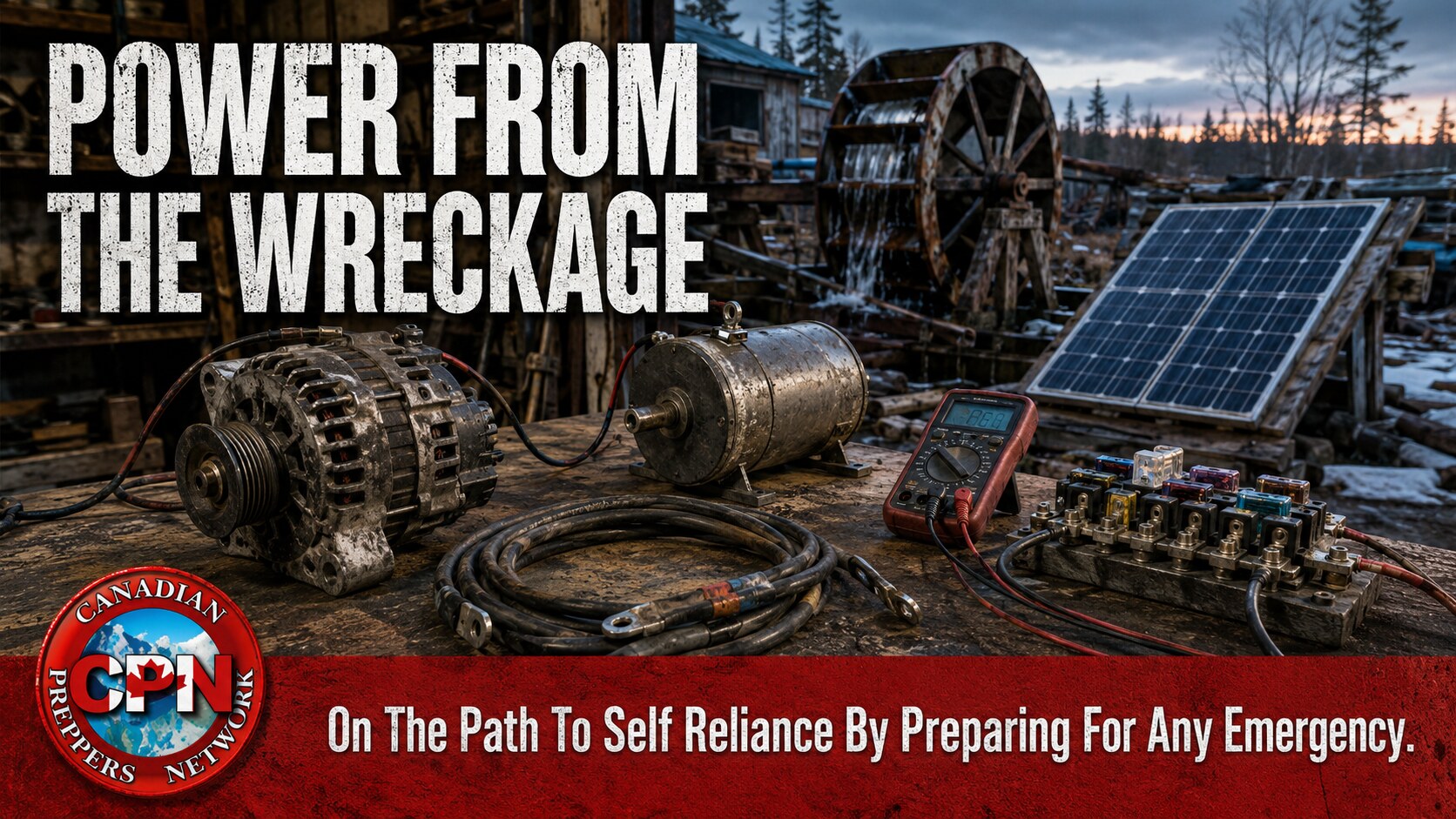
Building small, repairable energy systems from the electrical remains of a dead civilization.
Eventually, the last commercially manufactured backup-power system will fail.
Generators will consume their remaining fuel or suffer mechanical breakdowns. Lithium power stations will lose capacity. Battery-management systems will stop working. Inverters and charge controllers will burn out. Even equipment carefully protected before the collapse will gradually succumb to weather, corrosion, accidents and ordinary use.
That does not necessarily mark the end of electricity.
Modern civilization has scattered electrical equipment almost everywhere. Vehicles contain alternators, motors, heavy cable, fuse blocks, relays, switches and sockets. Buildings contain kilometres of copper wire. Computer backup systems contain batteries, chargers and inverters. Damaged solar installations may still have functional panels. Appliances contain motors, fans, switches, bearings and capacitors.
Most of this wreckage will not produce useful power on its own. Some of it will be incompatible, worn out or dangerous. However, a group with electrical knowledge, proper tools and disciplined salvage procedures may be able to assemble small energy systems long after new equipment has disappeared.
The objective will not be restoring a modern electrically powered lifestyle.
It will be producing enough power to charge radios, operate efficient lighting, move small amounts of water, ventilate a sickroom, run monitoring equipment and preserve a limited communications capability.
After collapse, a few dependable watts could be more valuable than a garage filled with dead appliances.
Scrap Is Not Yet a Power System
Finding an alternator, motor or solar panel is easy compared with turning it into a dependable source of electricity.
Every useful system still needs four basic elements:
- A source of mechanical or solar energy
- A device capable of converting that energy into electricity
- Controls that make the output usable
- A protected circuit connecting the source to a load or storage battery
The parts must also agree on voltage, current and polarity. Wiring must be large enough for the load. Batteries must be charged according to their chemistry. Fuses or breakers must protect circuits from excessive current. Rotating equipment needs secure mounting and guarding.
Attaching random wires to random components is not improvisation. It is an efficient way to destroy scarce equipment, start a fire or injure the person doing the experimenting.
The valuable scavenger is therefore not simply the person who can collect the most hardware. It is the person who can identify, test, catalogue and combine compatible components without consuming them through careless experimentation.
Solar Panels Will Be Among the Best Finds
Damaged solar installations may contain panels that continue producing power even when the original building and surrounding electronics have failed.
A panel with shattered glass, burned connectors or damaged wiring should not be assumed safe or useful. However, an intact panel removed by someone trained to handle energized solar equipment may remain valuable for years.
Labels on the rear of the panel should be preserved. They provide important electrical ratings that will determine whether the panel can be used with an available charge controller. If the original label is unreadable, the panel becomes much harder to integrate safely.
Several mismatched panels should not simply be wired together. Different electrical characteristics can reduce output or exceed the limits of surviving equipment. In a salvage economy, one tested panel matched to a suitable controller may be more useful than a pile of unidentified panels.
Panels should be treated as generating equipment whenever they are exposed to light. Covering the front can reduce production during handling, but electrical work should still be reserved for someone competent in solar and DC systems.
The greatest prize may not be a complete rooftop installation. It may be one modest panel capable of keeping a communications battery charged.
Vehicle Alternators Are Useful—but Misunderstood
Abandoned vehicles will provide an enormous supply of alternators. That makes them attractive candidates for improvised generation, but an alternator is not a magic device that produces electricity whenever its shaft turns.
A vehicle alternator is designed to operate within a specific speed range. It normally requires an excitation current and a regulator. It also demands considerable mechanical power when producing a heavy electrical load.
Turning one slowly with a bicycle, hand crank or crude windmill may produce disappointing results. Gearing it fast enough can introduce additional losses, mounting problems and mechanical hazards. Asking a person to pedal while the alternator supplies a large load quickly reveals that electricity is hard physical work.
Alternators are most useful when a dependable source of rotary power already exists. A small engine, waterwheel or properly designed mechanical drive may be suitable, but the system must match the alternator’s operating requirements.
The alternator from a vehicle should be recovered with its regulator, wiring connectors, fuse hardware, mounting brackets and any readable identification. Taking only the alternator may mean leaving behind the components needed to make it work.
Prepare Before You Have to Build from Wreckage
The Canadian Grid-Down Starter Kit helps you identify the essential household systems, supplies and capabilities you should establish while dependable equipment is still available.
Motors Can Sometimes Become Generators
Motors and generators are closely related machines. Some salvaged motors can produce electricity when their shafts are driven, but not every motor is equally suitable.
Permanent-magnet DC motors are especially interesting because they can often generate DC electricity when rotated. They may be found in mobility equipment, industrial machinery, exercise equipment, automotive systems and certain appliances.
Other motor types may require additional excitation, electronic controls or specific operating speeds. A motor that spins freely is not automatically a useful generator.
This is where testing matters. Before anyone builds a wind rotor, waterwheel or pedal drive around a recovered motor, the motor should be identified and its output measured at realistic speeds. A promising component may produce the wrong voltage, insufficient current or useful power only at an impractically high speed.
Bearings, brushes and insulation must also be inspected. A motor that spent years exposed to weather may fail as soon as it is placed under load.
Good scrap-power design begins with the generator that is actually available. The mechanical system is then designed around its characteristics—not around what someone hoped it would produce.
Moving Water Is the Strongest Mechanical Source
Where geography allows it, continuously moving water could make salvaged generation genuinely sustainable.
Wind changes. Human beings tire. Engines need fuel. Flowing water may continue turning a suitable generator throughout the day and night.
That does not mean placing an alternator beside a creek and hoping for the best. Available flow, vertical drop, seasonal changes, freezing, flooding, intake debris and transmission distance all determine whether a site is practical. The waterwheel or turbine must also suit the speed and torque required by the recovered generator.
The advantage is persistence. A modest system producing a small amount of power continuously can accomplish more than a larger system operated occasionally.
Continuous production could maintain a battery used for radio communications, LED lighting or instruments. The system would still need regulation, overcurrent protection, weatherproof connections and a method of isolating equipment for maintenance.
A reliable stream and the skills required to use it may eventually be worth more than a warehouse of fuel-powered generators.
Wind Power Must Survive the Wind
Wind appears free, but machines built to capture it face brutal conditions.
Rotors must withstand gusts, vibration, ice and imbalance. Towers and supports must tolerate changing loads. Bearings wear. Fasteners loosen. Cables twist. Overspeed can destroy a generator that performed perfectly during moderate weather.
For that reason, a salvaged wind system should begin small. Its first purpose might be charging a modest battery rather than powering an entire settlement.
A useful system also needs a way to control excessive speed or divert surplus output when the battery cannot accept more charge. Without control, the strongest wind may be the event that destroys the machine.
Vehicle radiator fans and household fan blades may look like convenient wind-turbine components, but equipment designed to move air is not necessarily suited to extracting energy from it. A serious machine requires mechanical judgement, testing and the ability to shut it down safely.
Human Power Is Best Used Carefully
Pedal and hand-powered generators can be built from salvaged components, but their proper role is limited.
Human power is valuable because it is available on demand and does not depend upon weather. It is also expensive in food and labour. A person already hauling water, cutting wood, tending crops and maintaining security should not spend hours generating electricity for inefficient loads.
Pedal generation makes the most sense for brief, important tasks: charging a radio battery, powering diagnostic equipment or restoring enough stored energy for essential lighting.
Efficiency becomes critical. Generating DC electricity, storing it in a battery, converting it to household AC and then reducing it again through a charger wastes much of the effort. Wherever safely possible within a properly designed system, low-voltage DC equipment eliminates unnecessary conversions.
The purpose of human generation is not to run a toaster.
It is to keep one capability alive when no other source is available.
Salvage the Loads as Well as the Sources
Generating equipment attracts attention, but efficient electrical loads may be equally valuable.
Vehicles contain 12-volt lights, fans, pumps, sockets, switches, fuse panels and wiring. Recreational vehicles contain appliances and controls designed for battery operation. Communications equipment may operate directly from common DC voltages. Some computer and telecommunications hardware contains efficient cooling fans and useful power-conversion modules.
A settlement operating a modest DC system should favour loads that avoid a large inverter. Every conversion consumes energy and adds another component that can fail.
Recovered loads still require testing. Their current draw should be measured, wiring inspected and function confirmed before they are connected to a valuable battery. Unknown electronics may contain short circuits, degraded capacitors or incompatible control systems.
Electrical priorities should also become smaller. One efficient task light is better than illuminating an entire room. A small ventilation fan may be more realistic than air conditioning. A compact DC pump used occasionally may replace hours of carrying water.
Scrap power works when expectations shrink to match the energy available.
Batteries Will Remain the Weakest Link
Generating electricity is only half the problem. Unless power is used immediately, it must be stored.
Recovered automotive starting batteries may provide temporary service, but they are not designed for repeated deep discharge. Batteries from golf carts, forklifts, telecommunications systems and renewable installations may be better suited—if they remain serviceable.
Unknown batteries should be treated cautiously. Physical damage, leakage, swelling, corrosion or signs of overheating can indicate a serious hazard. Lithium battery packs are especially poor candidates for amateur rebuilding because damaged cells and incompatible battery-management systems can create fire risks.
No battery lasts forever. A salvage-based energy system should therefore avoid making storage responsible for every function. Use power when it is being generated. Pump water while the sun is shining. Charge radios during scheduled generating periods. Perform workshop tasks when the waterwheel or wind system is producing surplus energy.
The smaller the battery bank, the more the settlement must organize its work around production.
Build a Scrap Power Yard
Unsorted salvage quickly becomes an incomprehensible pile.
Establish a dedicated storage and testing area for recovered electrical equipment. Keep hazardous batteries and damaged components separated from usable parts. Protect everything from rain, snow, animals and accidental contact.
Every recovered item should be labelled with:
- Its original source
- Manufacturer and model information
- Voltage and current ratings
- Date tested
- Test results
- Known defects
- Required companion components
Wire should be sorted by size and insulation condition. Fuses, terminals, connectors, bearings and switches should be stored in labelled containers. Complete assemblies should remain together whenever practical.
Documentation is part of the salvage. Wiring diagrams, service manuals and component labels may eventually be harder to replace than the metal parts.
A tested five-amp switch has value.
An unidentified switch at the bottom of a wet bucket is merely debris.
Standardization Beats Variety
A settlement could collect equipment operating at dozens of incompatible voltages. That does not mean it should build dozens of different systems.
Select a small number of manageable DC standards based on the equipment most commonly available. Label connectors clearly. Use consistent polarity. Protect every branch circuit. Prevent incompatible equipment from being accidentally connected.
Modular construction makes the system easier to repair. A generating module, storage module and distribution module can be tested separately. If one source fails, another may be connected without dismantling the entire network.
Connectors, fuse sizes and wire colours should be standardized wherever possible. Parts from a non-essential circuit can then repair an essential one.
The most successful post-collapse power network may not be the largest. It may be the one that the remaining technicians can still understand ten years later.
Skills Are the Most Valuable Component
A settlement can possess panels, alternators, batteries and kilometres of wire and still be unable to produce safe electricity.
Someone must understand electrical measurement, mechanical drives, battery charging, circuit protection and fault diagnosis. Someone must know when a recovered component is unsuitable. Someone must maintain diagrams and train replacements.
At least two people should understand every critical system. Knowledge concentrated in one person is a single point of failure.
Learn now, while instructors, manuals, replacement parts and test equipment remain available. Build and evaluate small low-voltage systems under competent adult supervision. Record what works. Practise identifying equipment and reading electrical ratings.
After collapse, the wreckage will provide materials.
It will not provide understanding.
The Goal Is Not Rebuilding the Grid
No collection of salvaged motors and vehicle alternators will recreate the electrical abundance Canadians take for granted.
That is not the objective.
The objective is retaining a narrow band of electrical capability after conventional systems have failed: enough for radios, efficient lighting, basic instruments, modest pumps and a few carefully chosen tools.
The settlement that accomplishes this will not be the one that gathers the most scrap. It will be the one that tests every component, protects every circuit, standardizes its equipment and refuses to waste electricity on tasks that can be completed another way.
Civilization’s wreckage will contain an enormous amount of electrical potential.
Whether it becomes power or remains junk will depend upon the people standing beside it.
Scrap-Power Workshop Buying Box
These are preparation and diagnostic tools to acquire while dependable equipment remains available. Electrical generation, battery systems and rotating machinery require appropriate training, guarding and circuit protection.
- DC clamp meters and digital multimeters
- Ratcheting wire crimpers and wire strippers
- Heat-shrink electrical terminal kits
- Anderson-style DC connector kits
- DC fuse blocks and replacement fuses
- DC bus bars with protective covers
- Battery disconnect switches
- Electrical parts organizers and labelling supplies
- Safety glasses and electrical work gloves


One Comment