Flood cleanup in Saskatchewan, late-season wildfire pressure, changing Canadian supply lines, and fresh international lessons in evacuation and infrastructure resilience.
Every Sunday, Canadian Preppers Network reviews the week’s most important Canadian preparedness news and separates the useful signals from the noise.
This week brought no single nationwide emergency. What it did bring was a collection of smaller warnings that point in the same direction: water can overwhelm urban systems quickly, wildfire readiness cannot be packed away simply because September has arrived, and international trade friction can alter the products and prices Canadians find on local shelves.
Beyond Canada, flash flooding in the northeastern United States, an earthquake in Tibet and a fast-moving wildfire in southern Spain reinforced familiar lessons about vehicle safety, evacuation timing and the value of independent information.
Missed last week’s edition? Read Prepper News Roundup – September 6, 2026.
Saskatchewan Cleans Up After More Than 100 Millimetres of Rain
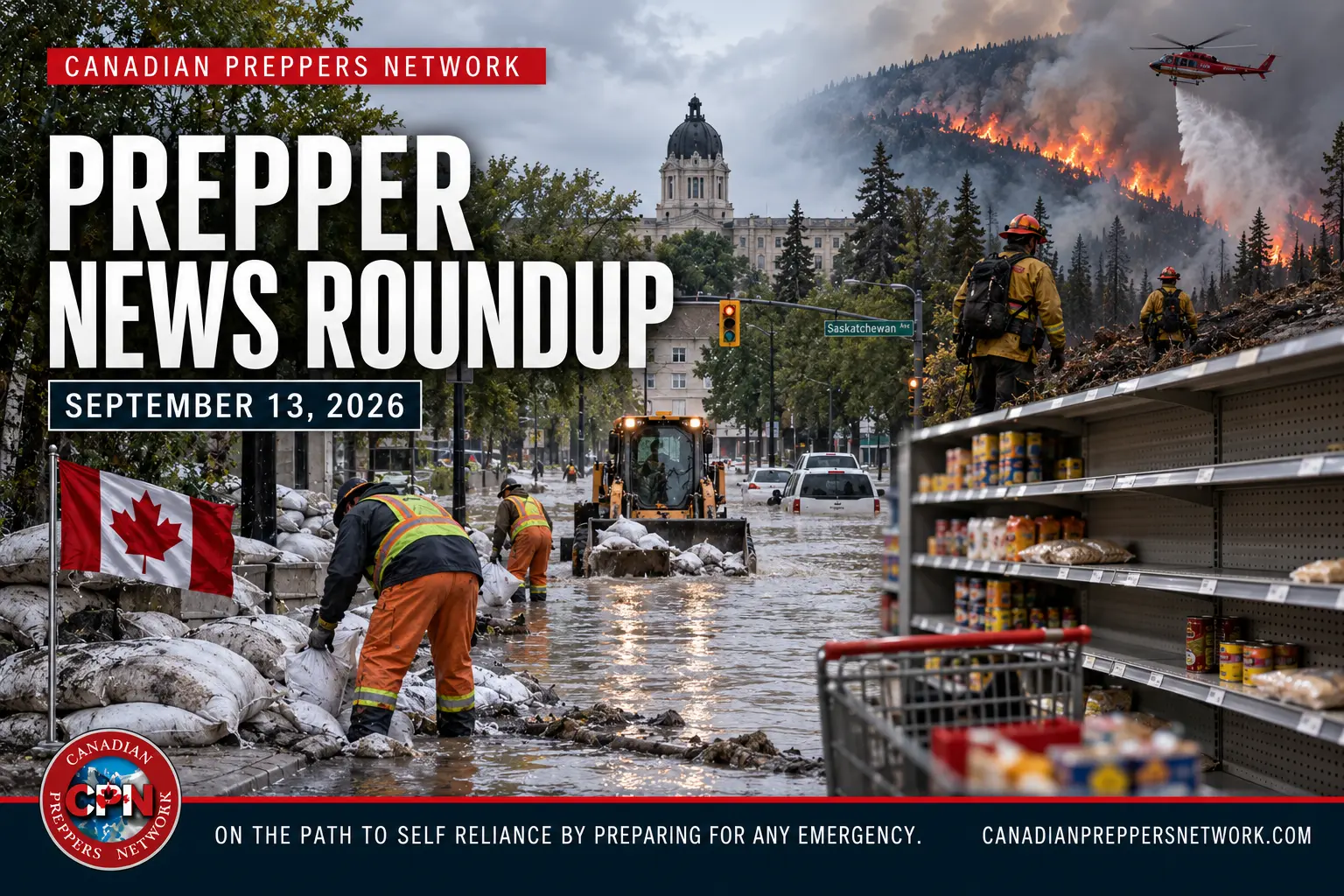
Communities in Saskatchewan spent this week clearing debris and assessing damage after a Labour Day weekend storm delivered exceptional rainfall to parts of the province.
Environment and Climate Change Canada told Global News that Regina received approximately 108 millimetres of rain over the weekend. Localized flooding affected streets and highway underpasses, forcing temporary closures. Other communities also faced flooded properties, damaged trees and prolonged cleanup work.
The most useful part of this story is not the final rainfall total. It is the way water found the weak points in an urban system: low roads, underpasses, drainage routes, basements and places where vehicles became trapped by rising water.
Source: Global News Saskatchewan storm cleanup report.
B.C. Wildfire Operations Move Into the Late-Season Phase
Mexican wildfire crews departed British Columbia this week after assisting through another demanding summer. Their departure is an encouraging sign that the peak response period is easing, but it is not an all-clear for households in fire-prone regions.
September changes wildfire behaviour; it does not automatically end it. Shorter days and cooler nights may help crews, while dry fuels, wind and difficult terrain can still produce dangerous fire movement. Evacuation information remained active in parts of the province during the week.
For households that spent part of the summer under an alert or order, this is the right time to conduct an after-action review. Replace food, water, batteries and medications removed from evacuation kits. Correct bad contact numbers, note the routes that became congested, and decide in advance where pets, livestock and trailers would go.
Source: Global News B.C. wildfire season update.
Canadian Grocers Adjust Supply Lines as the Trade Dispute Deepens
A Canadian consumer shift away from American products is forcing grocers to change sourcing and make country-of-origin information more visible. Reuters reported this week that retailers are seeking new suppliers while customers increasingly ask where their food was produced.
The political argument is less important to preparedness than the operational result. When established supply relationships change, substitutions, price differences and short-lived gaps become more likely. Produce is especially sensitive because Canadian availability changes sharply by season and replacement sources may involve longer routes.
This does not justify a buying panic. It does justify knowing which foods in the household pantry depend on a single imported source and which have practical Canadian or non-American substitutes.
Start with the items the household consumes every week. Record normal prices, keep several weeks of frequently used shelf-stable food in rotation, and learn which ingredients can be replaced without disrupting meals. A pantry built around actual menus is more useful than a random collection of cans.
Source: Reuters report on Canadian grocery sourcing.
Canada Looks Toward European Infrastructure and Supply Partnerships
Prime Minister Mark Carney is reportedly exploring a new form of closer association between Canada and the European Union. The discussions include energy, defence production, artificial intelligence, critical minerals, cloud storage and undersea data connections.
No new status or agreement has been completed, so this remains a developing diplomatic and economic story. Its preparedness significance lies in the sectors being discussed. Energy routes, communications links, computing capacity and critical minerals are not abstract trade categories; they are systems on which modern Canadian households and businesses depend.
Diversifying national supply and infrastructure relationships can reduce dependence on a single partner, but new arrangements take years to build. Households should not mistake a policy announcement for immediate resilience. Local readiness still depends on stored necessities, alternate communications, backup power and the ability to absorb price or delivery disruptions.
Source: Reuters report on Canada–EU discussions.
Stress-Test Your First 72 Hours
A short emergency rarely tests only one system. Power, water, roads, communications and access to stores can fail together. Download the free Canadian Grid-Down Starter Kit and identify the gaps before an actual disruption does it for you.
Northeastern U.S. Flash Flooding Traps Drivers and Disrupts Transport
Heavy rain caused flash flooding across parts of Connecticut, New York and New Jersey on Sunday. Rainfall rates reached as much as four inches per hour in the hardest-hit areas, closing roads, interrupting rail service and forcing numerous water rescues.
Emergency crews used boats to remove people from flooded homes, while responders rescued motorists from vehicles. Tweed New Haven Airport closed its departure terminal, and both Metro-North and Amtrak reported delays or cancellations.
For Canadians, the lesson is direct. Southern Ontario, Quebec and Atlantic Canada contain many dense road and rail corridors with the same vulnerability to intense rainfall. A vehicle is not a shelter when water is rising around it.
Source: Associated Press flash-flood report.
Wildfire in Southern Spain Forces Evacuations
A wildfire near Benahavís on Spain’s Costa del Sol forced evacuations and triggered a regional emergency alert on Sunday. More than 60 firefighters and roughly 20 aircraft were reported to be involved as wind complicated the response. Residents in affected areas were instructed to remain indoors with doors and windows closed, while one residential area was evacuated.
The story demonstrates why an emergency alert is not always a universal instruction. People close to the fire may be ordered to leave, while those in the smoke path may be told to shelter indoors. A household must be ready for either decision.
Preparing both options means having an evacuation load that can move quickly and a home that can be closed against smoke. A portable air cleaner is useful only while electricity is available, so smoke plans should also account for power failure and identify a cleaner-air room.
Source: The Sun wildfire report.
Magnitude 5.3 Earthquake Strikes Tibet
A magnitude 5.3 earthquake struck Tibet during the week at a reported depth of 35 kilometres. Initial reporting did not include confirmed damage or casualties.
Even where the immediate outcome is limited, an earthquake is a useful reminder that damage is not determined by magnitude alone. Depth, distance, building construction, ground conditions and secondary failures all matter.
In Canadian earthquake zones, especially coastal British Columbia, parts of the St. Lawrence and Ottawa valleys, and sections of the North, households should secure tall furniture, know how to shut off utilities safely, and expect roads, bridges, cellular networks and fuel distribution to be unreliable after a significant event.
Source: Reuters earthquake report.
The Bottom Line
This week’s stories are different versions of the same problem: normal systems work until demand exceeds their design or a critical connection fails.
In Saskatchewan, exceptional rain found the low points in roads and drainage. In British Columbia, the end of peak summer did not erase wildfire risk. Canadian grocers began adjusting established supply relationships. South of the border, intense rain disrupted roads, rail and an airport within hours.
The useful response is steady maintenance, not panic. Repack evacuation supplies. Test the sump pump and backup power. Map alternate routes. Add depth to the working pantry. Keep vehicle fuel above half a tank and maintain a communications plan that does not depend on one device or network.
Preparedness is strongest when these jobs are completed during an ordinary week.
The next Prepper News Roundup will appear Sunday, September 20, 2026.