
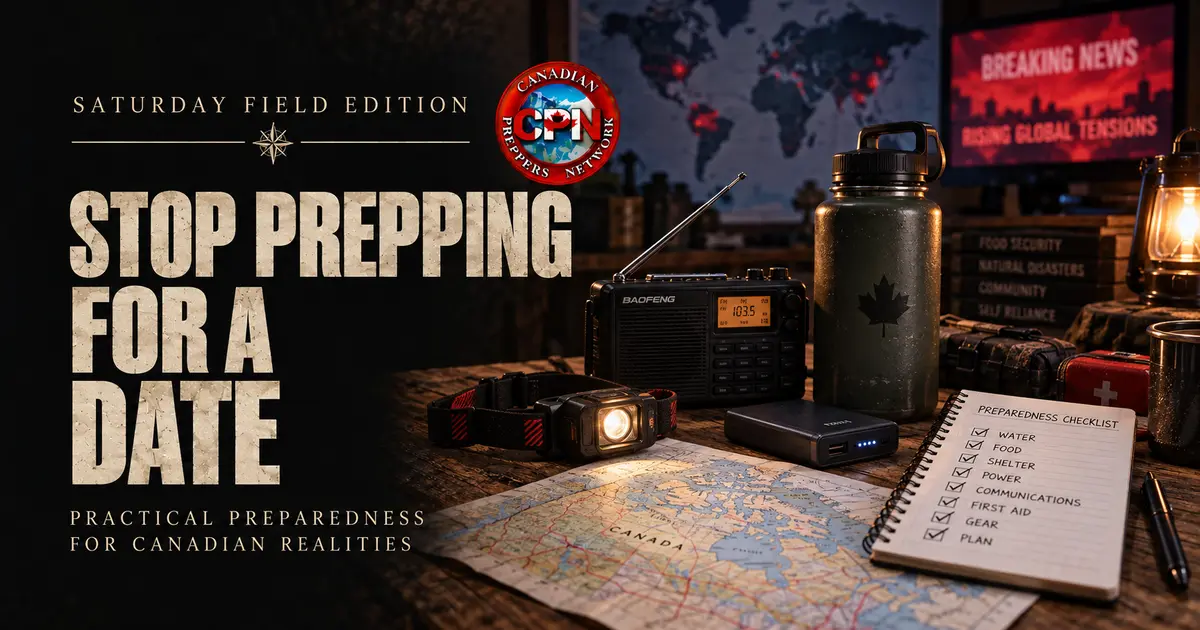
A serious threat does not make every countdown credible.
Canadian Prepper has built a substantial audience by treating the possibility of wider war as a matter for household preparedness. That is a legitimate subject. His videos also illustrate a question every viewer should ask when a warning sounds urgent: which part is confirmed, and which part predicts what happens next?
The preparedness world loves a deadline.
Something decisive will happen within weeks. A regional war will become a world war before winter. Fuel will disappear. An election will be cancelled. A cyberattack will switch off the Internet. A nuclear exchange is no longer merely possible, but inevitable.
The details change. The countdown does not.
There are good reasons to take the present international situation seriously. Europe is confronting sabotage, drone incursions and the possibility of further Russian escalation. Energy infrastructure is being attacked. Wars in several regions are putting pressure on fuel markets, shipping and national budgets. Canada already leads a NATO brigade in Latvia and has personnel and equipment committed to European defence.
None of that proves that a particular trigger event will occur on a particular schedule.
That distinction matters. Preparedness built on confirmed vulnerabilities makes a household stronger. Preparedness driven by somebody else’s certainty can make the same household anxious, cash-poor and easy to manipulate.
The Warning Signs Are Real
We do not need to minimize the danger in order to reject exaggerated certainty.
European intelligence officials are publicly warning about possible sabotage, cyberattacks, drone incidents, influence operations and limited provocations against NATO countries. Some officials believe Russia may test NATO’s cohesion. Others—particularly in the Baltic region—have cautioned that the public evidence does not support declaring a conventional attack imminent.
That disagreement is important. It is not proof that one side is asleep. It is what serious risk assessment looks like when intelligence is incomplete and the consequences of getting it wrong are enormous.
Ukraine’s recent large drone attack also forced the Moscow refinery to halt crude processing after key units were damaged. That is a major escalation with potential consequences for Russian fuel supplies and the wider diesel market. It still does not tell us what Moscow will do next, much less establish a calendar for a NATO–Russia war.
Canada’s military posture in Latvia is also real, but context matters. Canada’s NATO deployment is not a secret army suddenly assembled because world war has been scheduled. Canada has led NATO forces in Latvia since 2017. The expansion to a multinational brigade and the plan to maintain up to approximately 2,200 Canadian Armed Forces members were announced years ago and implemented progressively through 2026.
A long-planned deterrence commitment is evidence that governments take the threat seriously. It is not evidence that they know a war will begin next month.
How Evidence Becomes a Countdown
Even urgent analysis normally begins with facts. That is why it can sound convincing.
A refinery burns. A government updates its military plans. Intelligence officials warn about sabotage. Fuel prices rise. Troops exercise near a border. Civil-defence agencies review evacuation routes. Each item is real or at least plausible.
The problem appears in the connective tissue between those facts.
Possibility becomes probability. Probability becomes certainty. Events from Europe, the Middle East and the Pacific are assembled into one seamless plan. Routine military readiness becomes proof of offensive intent. A public figure’s ambiguous statement becomes evidence of secret intelligence. A personal feeling becomes a forecast. Finally, several forecasts are stacked together until the listener is told that the entire chain is effectively unavoidable.
The prediction ladder
- Verified fact: A refinery was attacked.
- Reasonable inference: Fuel markets may face additional pressure.
- Speculation: Retaliation may target another country’s oil infrastructure.
- Unsupported certainty: That infrastructure will be destroyed.
- Cascading forecast: The destruction will trigger shortages, wider war, domestic emergency powers and the suspension of elections.
The first two steps deserve attention. The third may be worth discussing if it is clearly labelled. Steps four and five require evidence that public commentators rarely possess.
When all five are delivered in the same urgent tone, the listener can easily remember the entire chain as confirmed news.
“It Is Obvious” Is Not a Source
Predictions about war should become less certain as they extend farther into the future. Too often the opposite happens.
We hear that a military operation is obvious, a second country will have no choice but to intervene, a third conflict will inevitably follow, political institutions will be suspended and nuclear escalation is only a matter of time. Each claim depends on the previous one being correct. The uncertainty multiplies at every step, even when the speaker’s confidence grows.
Intuition can help an experienced analyst decide what to investigate. It cannot replace evidence. Neither can a supposed record of earlier “hits” unless every prediction—including the misses, revised deadlines and vague warnings—is recorded and assessed by the same standard.
If someone predicts a major war often enough, an eventual crisis does not validate every previous countdown.
This is not a minor complaint about presentation. Repeated false urgency imposes real costs. People make rushed purchases, move money at the wrong time, frighten family members, neglect likely local hazards and exhaust themselves watching every headline. Some eventually tune out all warnings, including the useful ones.
The result is not greater readiness. It is warning fatigue.
Put the Sales Pitch Through the Same Test
Preparedness media operates in an uncomfortable space. Publishers need attention and revenue, while readers need trustworthy information. Those interests can coexist, but they are not automatically identical.
An urgent deadline can drive clicks and immediate purchases. A claim that war may occur someday creates little pressure to buy. A claim that the decisive event is weeks away makes every food bucket, radiation meter, medical kit and fuel container feel like a last chance.
That does not mean a recommended product is useless or every warning is dishonest. It means readers should become more demanding when a dramatic forecast and a sales pitch arrive together. Apply that standard to CPN as well: we earn revenue from some recommendations, and the equipment should still justify its place in your plan when the forecast expires.
Ask whether the recommendation would still make sense if the forecast failed. Stored food you already eat, safe backup heat, water treatment, first-aid training, independent communications and a cash reserve all pass that test. An expensive panic purchase designed for one cinematic scenario often does not.
Good preparedness equipment solves a durable problem. It should not require a countdown clock to justify its price.
What Canadians Are More Likely to Feel First
If international tensions continue to worsen, most Canadian households are unlikely to experience the opening scene of a nuclear-war film. They are more likely to encounter indirect pressure first:
- diesel, heating fuel and transportation costs rising;
- imported parts, medicines or equipment arriving late;
- cyberattacks disrupting payments, communications or public services;
- market volatility and job uncertainty;
- military deployments and louder political arguments;
- misinformation spreading faster than verified instructions;
- attempts to exploit public fear through fraud, propaganda and panic selling.
These are not trivial consequences. A rural household that depends on diesel equipment can be hurt badly by fuel shortages or price spikes. A family living paycheque to paycheque may be more vulnerable to inflation than to any direct military attack. A person who requires prescription medicine may care far more about a delayed supply chain than a distant troop movement.
This is exactly why all-hazards preparedness is more useful than prediction-based preparedness. Food, water, heat, medical continuity, communications, transportation, cash flow and community contacts remain valuable across dozens of emergencies. They do not become wasted effort when a confident forecast expires.
Five Questions to Ask Before Changing Your Plan
Before a headline causes you to spend money or change your household plan, run it through five questions:
- What is confirmed? Identify the event supported by named, independent sources.
- What is inferred? Separate what happened from what the commentator believes will happen next.
- What would disprove the forecast? A claim that can never be wrong is not a useful prediction.
- What is the time horizon? “Soon,” “imminent” and “within months” should not be allowed to slide indefinitely.
- Does the proposed action help with other emergencies? Favour preparations that remain useful even if the forecast fails.
Keep this list beside your news feed. It is one of the cheapest preparedness tools you will ever own.
What to Do This Weekend
The correct response is not to ignore world events. It is to convert uncertainty into practical, proportionate action.
Review your household’s weakest system. If you have months of food but no safe way to heat one room during a January outage, work on heat. If you own several radios but have no written contact plan or agreed check-in times, fix the plan. If you have equipment but no emergency cash, begin rebuilding liquidity instead of buying another gadget. Then perform a real test: cook a stored meal without mains power, run the backup light for an evening, or practise the agreed check-in. Write down what failed and repair that failure first.
For rural fuel users, determine actual consumption before adding storage. Rotate fuel, use approved containers or tanks, follow fire-code and insurance requirements and never treat a rumour as permission for unsafe hoarding. For everyone else, keeping the vehicle from routinely falling below half a tank may provide more resilience than storing a large quantity badly.
Check prescription refill dates and the availability of essential medical supplies. Print critical phone numbers, insurance details and account contacts. Download important documents for offline access. Test backup lighting and charging. Agree on how family members will communicate if cellular service or electronic payments fail.
Then stop.
Preparedness should include a stopping rule. Decide what “enough for now” looks like before the next frightening headline arrives. Set a monthly spending limit or a completed checklist, and revisit it only when a new fact changes your household’s actual risk. Without a stopping rule, every warning becomes a reason to spend more and worry longer.
Preparedness Without the Panic
World war is possible. So are a prolonged fuel shock, a serious cyberattack, a recession, a winter blackout, an ice storm, a wildfire evacuation and a family medical emergency. We cannot assign any of them an honest countdown simply because the consequences would be severe.
The mature prepper does not confuse calm with complacency. Calm is what allows us to compare sources, notice exaggeration, preserve resources and choose preparations that solve more than one problem.
Watch the warning signs. Strengthen the weak points. Question anyone who turns incomplete evidence into a precise deadline—and question them even more carefully when urgency is followed by a checkout link.
Be prepared for war if it comes. Just do not let someone else’s prediction take command of your household before it does.
What preparation have you made that remains useful whether the next disruption is war, a fuel shortage, a cyberattack or a winter power failure?
Related Reading
- Canadian Preparedness Hubs: build a balanced plan across every essential system
- What Level of Preparedness Should Canadians Aim For?
- Preparedness is not about predicting the exact next disaster
Keep the Plan Boring
A written communications schedule, charged batteries and known fallback methods are rarely exciting. They are also far more dependable than scrolling for one more prediction after the networks become unreliable.
Build skills and procedures during normal conditions. Equipment becomes useful only when someone understands it, maintains it and knows when to use it.