When every litre has to come home by hand
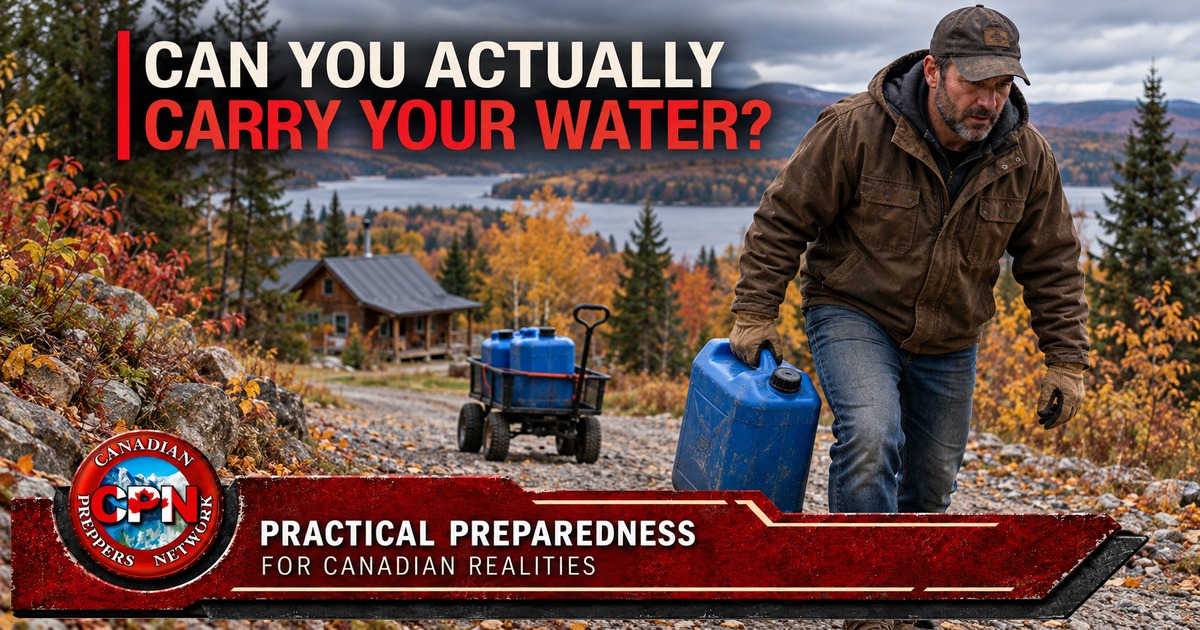
Carrying water becomes a daily survival task when the taps run dry. Your stored water is running low, but there is a usable collection point half a kilometre away. You have containers and a treatment system. On paper, the plan still works.
Then you pick up the first full twenty-litre can.
The water alone weighs roughly twenty kilograms—forty-four pounds. You still have to negotiate the return route, get it through the door and dispense it without spilling half your effort onto the floor. Tomorrow, you will do it again.
During a prolonged disruption, water becomes a daily freight problem. Your plan needs to account for the weight, the route and the work of bringing it home.
A nearby source can still be beyond your reach
Preppers often describe water access in terms of distance: a creek behind the property, a lake down the road, a neighbour’s well. That tells you where water might be found. It tells you considerably less about whether you can supply a household from it.
An accessible source must offer more than proximity. You need permission or lawful access, a workable collection point, suitable water treatment and a route you can repeatedly travel under load. A steep bank or broken footbridge can turn a short distance into a serious obstacle.
Canadian conditions add another layer. A route that is easy in October may become difficult when covered in snow or ice. A spring thaw can leave a cart bogged down. Darkness makes rough ground harder to negotiate, especially when your hands are occupied.
Walk the complete route before making that source part of your plan. Include the awkward final stretch between the water and wherever you can park or position a cart.
The weight does not care how tough the container looks
For practical planning, one litre of water weighs approximately one kilogram. Add the empty container to determine your actual load.
| Water carried | Approximate water weight | What to consider |
|---|---|---|
| 5 litres | 5 kg / 11 lb | Easier handling, more collection trips |
| 10 litres | 10 kg / 22 lb | Test over the full route |
| 15 litres | 15 kg / 33 lb | Substantial weight in one hand |
| 20 litres | 20 kg / 44 lb | Demanding over distance or stairs |
| 26 litres | 26 kg / 57 lb | Consider stationary dispensing or wheeled transport |
These figures are weights, not recommended lifting limits. Your useful carrying capacity depends on grip, balance, terrain, health and fatigue.
A strong handle does not make the contents lighter. Nor does a military appearance make a can comfortable against your leg for five hundred metres.
Container shape matters. A broad vessel may force your arm away from your body. A narrow handle can dig into your fingers. A full can may be manageable to lift but difficult to control while pouring.
Manufacturers offer different capacities for a reason. Scepter sells a twenty-litre water can, while Reliance lists fifteen- and twenty-six-litre Aqua-Tainers. Choose around the load you can repeatedly manage, rather than the largest number on the label.
You can partially fill a larger vessel. That gives you flexibility, although its size and empty weight remain part of the job.
Calculate the journeys your household would need
Imagine that you need to bring home forty litres in one day. This is a transport example, not a recommendation that forty litres meets every household’s needs.
If you carry ten litres per trip, you need four collection journeys. If the source is five hundred metres away, each return journey covers one kilometre.
That means four kilometres of walking, including two kilometres carrying water. Over seven days, it becomes twenty-eight kilometres.
Those journeys exclude collection time, queues, treatment and transferring the water into storage. They also assume that you can keep using the same route.
Now add the rest of a household’s work: cooking, heating, repairs, waste handling and looking after somebody who is ill. A water plan that consumes much of your available labour will eventually compete with other essentials.
Use this calculation for your own situation:
Collection trips = litres required ÷ litres brought home per trip, rounded up.
Multiply the number of trips by the round-trip distance. Then time a realistic trial. That gives you a much more useful planning figure than saying the creek is “only a short walk away.”
Wheels can help—if they suit the ground
A suitable cart can reduce the carrying work. The route determines whether it is useful.
A folding wagon that rolls well through a shop may struggle on ruts, roots or loose gravel. Small wheels can catch on obstacles. A tall load can become unstable on uneven ground. Stairs may require unloading and carrying everything separately.
Check wheel size, ground clearance, rated capacity and how securely you can restrain the containers. Include their weight in the total load. Think about pulling, stopping and turning, rather than considering capacity alone.
Keep heavy containers low and prevent them from shifting. Take particular care on slopes: a loaded cart has to be controlled going downhill as well as hauled uphill.
Where the cart cannot reach the source, smaller collection containers may still be necessary. You might carry manageable loads from the bank to larger transport containers waiting on stable ground.
A bicycle trailer may be worth investigating for a suitable route, but it needs the same scrutiny. Load limits, braking, attachment security and access all matter. Having wheels is only an advantage when the equipment works over the ground you actually have.
Separate transport, storage and daily use
You do not need one container design to perform every task.
Transport cans need secure closures, useful handles and a shape you can restrain on your chosen vehicle or cart. Larger reserves need a suitable storage location and a reliable way to withdraw water. Daily-use containers need controlled dispensing and manageable refilling.
A smaller working vessel beside the kitchen or handwashing station can save repeated trips to the main reserve. It also makes it easier for another adult to use the water without lifting your heaviest container.
For larger storage, investigate a compatible tap or drinking-water-rated manual pump. Confirm fittings, reach and operation before relying on it. Buying a pump that almost fits creates a repair project at precisely the wrong time.
Follow the container manufacturer’s instructions for positioning and stacking. Reliance describes the Aqua-Tainer as stackable when empty. That wording does not establish that a stack of filled containers is suitable for long-term storage.
If you elevate a vessel for dispensing, use a stable support capable of holding its full weight. Position it so you can operate the outlet and refill smaller containers without wrestling with the reserve each time.
Keep untreated water out of the clean system
Hauling water successfully does not make it safe to drink.
Use clearly identified collection vessels for untreated water and separate containers for treated drinking water. Keep their caps, funnels, hoses and dispensing equipment from being mixed up.
Use containers intended for drinking-water storage. A second-hand vessel with an unknown chemical history is a poor bargain, regardless of how sturdy it appears.
Plan the entire transfer: where collected water waits, where treatment happens and how treated water enters a clean vessel. Dirty gloves, exposed outlets and contaminated transfer equipment can undermine the work you have already done.
The treatment method must suit the source and its hazards. A backpacking filter’s stated capabilities should not be assumed to cover industrial contamination or every other problem a disrupted water supply might contain.
Transport, treatment and clean storage need to work together.
Test the plan when somebody is tired
A system that depends on one strong adult has an obvious weakness. What happens if that person becomes ill, strains a wrist or has to attend to another urgent task?
Keep some manageable containers alongside larger reserves. Store part of your ready-to-use supply near where it will be needed. In winter, consider which storage and dispensing locations you can keep above freezing during an outage.
Then run a practical trial in safe conditions:
- Fill a container to your intended carrying quantity.
- Walk the proposed route, including gates and steps.
- Bring it into the house and dispense it where it would be used.
- Record the time, spills and awkward handling points.
- Repeat enough of the process to find problems that a single lift misses.
An empty cart and an empty can prove very little. The useful test involves the water weight and the complete journey.
Buy equipment that removes the obstacle
Let the trial determine your purchases.
If weight is the obstacle, prioritize smaller purpose-made water containers. If distance is the obstacle, investigate a cart suited to the route. If accessing your reserve is awkward, address dispensing with a compatible outlet or manual pump.
Replacement caps, seals and spouts may be useful where the manufacturer supplies them for your chosen system. A drinking-water-rated hose can help where a suitable filling arrangement exists. Each purchase should remove a difficulty you have identified.
Larger capacity is valuable only when you can fill, move, store and use it.
Before adding another twenty litres to your inventory, carry the twenty litres you already own from storage to the place you would use them. Then consider the harder job: replenishing that supply from outside, day after day.
Could another adult in your household bring home the day’s water if you were unable to do it? The answer is worth discovering while you can still change the plan.