For most Canadians, composting slows down—or stops entirely—by November. Snow piles up, the pile freezes solid, and kitchen scraps get tossed into the garbage until spring.
That’s a missed opportunity.
In a true preparedness mindset, compost is not a gardening hobby. It is soil production, waste management, nutrient recycling, and food security rolled into one system. If you can maintain active composting through winter, you gain three major advantages:
- You reduce waste output year-round.
- You build finished compost ready for early spring planting.
- You maintain microbial activity and soil fertility without outside inputs.
Here’s how to make cold-climate composting work reliably in Canadian conditions.
Understanding the Winter Problem
Composting is a biological process driven by microbes. Those microbes need:
- Nitrogen (greens)
- Carbon (browns)
- Moisture
- Oxygen
- Heat
When temperatures drop below freezing, microbial activity slows dramatically. If the pile is small or poorly insulated, it freezes solid. Once frozen, decomposition essentially pauses.
The goal in winter isn’t necessarily to keep a steaming 60°C “hot pile” going constantly. It’s to retain core heat, protect microbial life, and keep the system active enough to prevent full freeze-through.
System 1: The Insulated Static Pile (Best for Rural Properties)
This is the simplest and most reliable system for cold regions like Central Ontario.
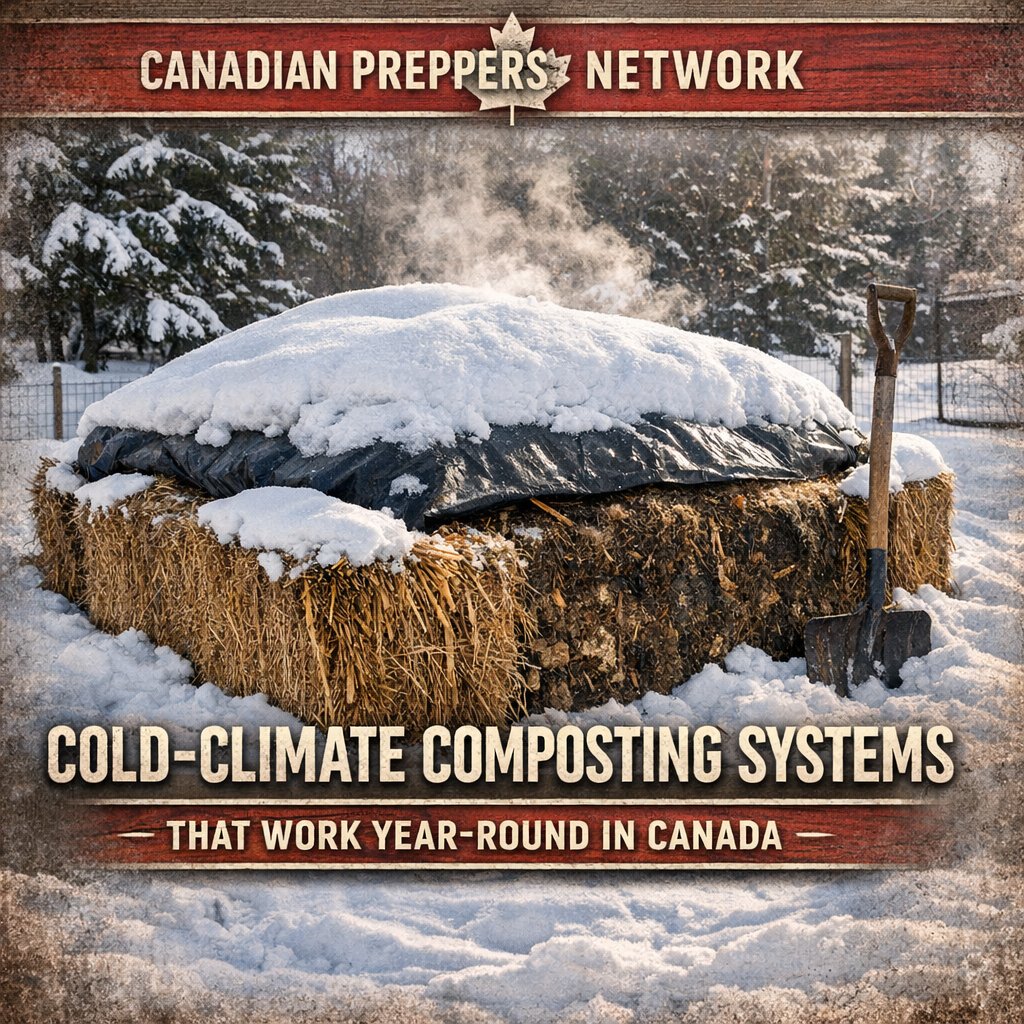
Build a large pile—minimum 1 cubic meter (3’ x 3’ x 3’). Smaller piles freeze faster. Surround it with insulation:
- Straw bales on all sides
- Leaves packed around the perimeter
- Snow intentionally piled against the walls
- A tarp or plywood lid to keep excess moisture out
Kitchen scraps should be buried deep into the core, not tossed on top where they’ll freeze. Cover every addition with a thick layer of carbon material—dry leaves, shredded cardboard, or wood shavings.
For households generating consistent food waste, this system can remain biologically active all winter if built large enough.
For carbon materials, many preppers keep a bale of straw or several compressed leaf bags stored dry in the fall. Something as simple as compressed straw bales from Amazon.ca can make winter layering easy and consistent:
👉 https://www.amazon.ca/s?k=straw+bale+garden
If you want to see how compost integrates into a larger food security system, review our earlier post on garden planning for food security:
👉 https://canadianpreppersnetwork.com/garden-planning-for-food-security/
System 2: The Compost Tumbler (Best for Suburban Lots)
Tumbler systems offer two advantages:
- Elevated design reduces ground freeze contact
- Dark plastic absorbs solar heat
However, tumblers are smaller in volume and freeze faster in extreme cold. The key is strategic management:
- Keep tumbler at least ¾ full going into winter
- Add materials in larger batches rather than daily trickles
- Position it in full winter sun
- Wrap with insulating foam board or straw during deep cold
A heavy-duty dual-chamber tumbler such as:
👉 https://www.amazon.ca/s?k=dual+chamber+compost+tumbler
can allow one side to finish while the other remains active.
In true sub-zero periods, tumblers may pause, but they thaw and reactivate quickly when temperatures rise.
System 3: The Three-Bin “Hot Core” System
The classic three-bin wooden compost system performs surprisingly well in winter because of mass.
Bin 1: Active pile
Bin 2: Heating phase
Bin 3: Finishing phase
By rotating piles before deep winter sets in, you can enter December with one pile already in a strong thermophilic phase. If properly built, the core can stay warm for weeks—even in -20°C conditions.
A long-stem compost thermometer helps monitor internal temperature:
👉 https://www.amazon.ca/s?k=compost+thermometer+long+probe
If the pile drops below 30°C, add nitrogen-rich materials (coffee grounds, kitchen scraps) and turn only the core—not the whole structure—to retain heat.
For those building long-term soil resilience systems, this pairs well with root cellar food production discussed in:
👉 https://canadianpreppersnetwork.com/cd3wd-spotlight-manual-water-access-when-the-grid-is-gone/
System 4: Indoor Vermicomposting Backup
When outdoor compost fully freezes, worms don’t.
A simple worm bin in a basement or heated garage keeps kitchen waste processing through the coldest months. Red wigglers operate best between 15–25°C.
Search:
👉 https://www.amazon.ca/s?k=vermicompost+bin
Worm castings are extremely nutrient-dense and perfect for seed starting mixes in late winter.
If you’re starting seeds early in short Canadian growing seasons, revisit:
👉 https://canadianpreppersnetwork.com/seed-starting-systems-for-short-growing-seasons/
Winter Composting Best Practices
Instead of stopping when snow flies, adjust technique:
- Chop materials smaller to accelerate breakdown
- Maintain higher carbon ratio in winter
- Avoid excessive moisture before freeze-up
- Add insulation before the first hard frost
- Store browns dry in fall (critical)
Snow itself becomes insulation. Once your pile is capped and protected, allow snow to accumulate around it.
Why This Matters for Preppers
In a grid-down or supply-chain disruption scenario, fertilizer availability becomes uncertain. Commercial inputs may not be accessible. Compost becomes a closed-loop nutrient source.
A household that produces 1 kg of food waste per day generates over 350 kg per year. Redirected into compost, that becomes soil fertility for hundreds of square feet of garden space.
This is not theory. It is resilience in practice.
Cold-climate composting means your soil system never shuts down—even when Canada does.