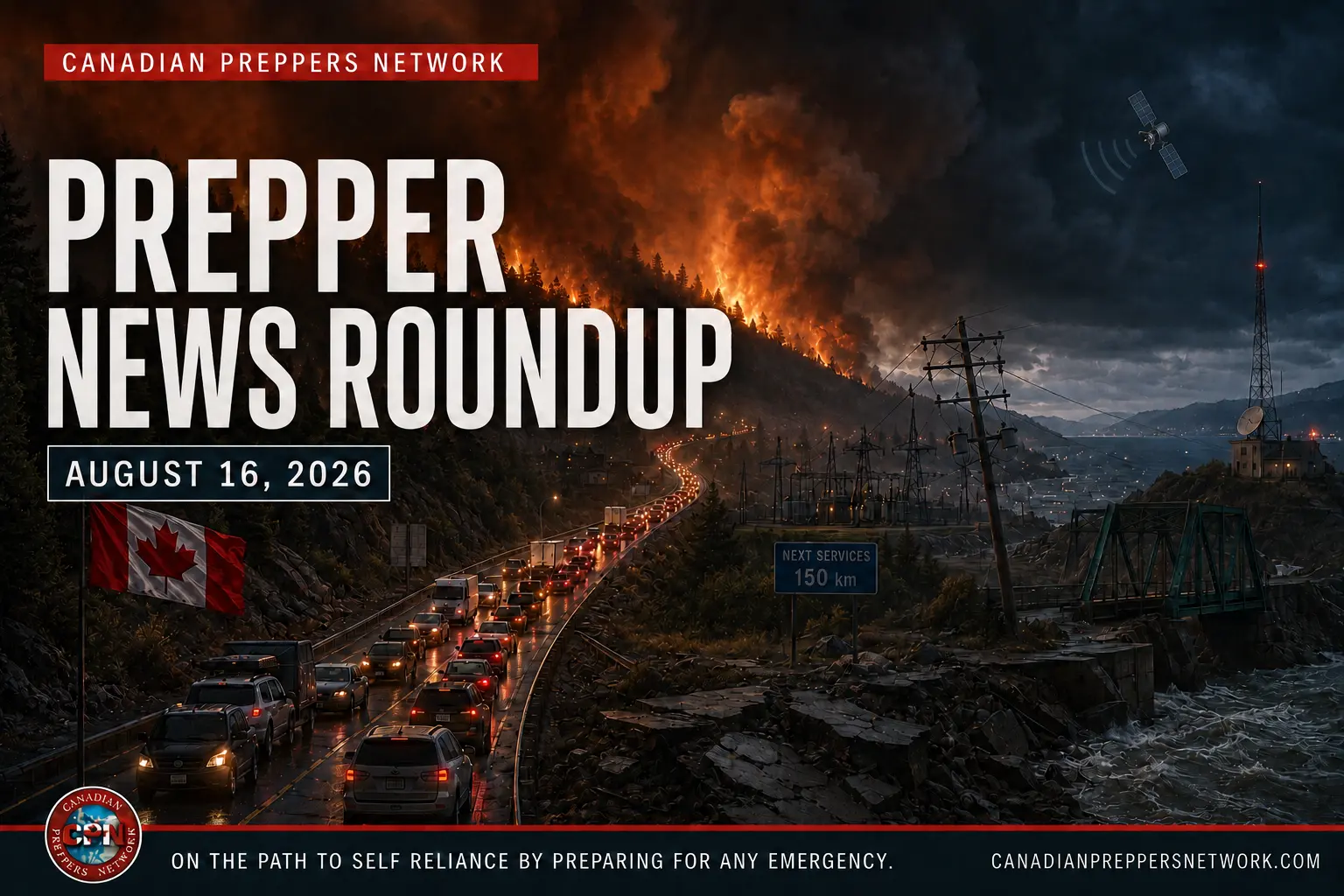
Wildfire, earthquakes, infrastructure and trade risks
This week’s preparedness news is dominated by large evacuations, damaged infrastructure and the speed with which otherwise local events can become regional emergencies. British Columbia remains the central Canadian story, while two major earthquakes, an unusually persistent typhoon and disruptions affecting nuclear and satellite infrastructure offer broader lessons.
British Columbia Wildfire Emergency Continues
The Bald Range wildfire remains out of control in British Columbia’s southern Interior. By the end of the week, it had grown to approximately 19,900 hectares—nearly twice its reported size on August 9.
The fire forced roughly 18,000 people from Summerland, Peachland and surrounding communities at the height of the emergency. British Columbia declared a provincial state of emergency, while the federal government authorized assistance with shelter and accommodations.
Hundreds of firefighters, international personnel and multiple helicopters have been assigned to the fire. Heavy smoke, turbulence and extreme fire behaviour have at times limited aerial operations.
There has been some progress. Portions of certain evacuation orders were downgraded, allowing some residents to return. That should not be mistaken for containment, however. New evacuation alerts were issued Saturday evening for Chain Lake, Bankeir, Link Lake, Osprey Lake and Mazama as the threat shifted farther into rural areas.
The fire has already demonstrated several preparedness realities:
- An evacuation order may provide very little departure time.
- Heavy smoke can remove aircraft from the response when they are needed most.
- Roadblocks may prevent residents from returning for medicine, animals or essential equipment.
- Electrical and water services can become unreliable even where buildings survive.
- Returning home does not necessarily mean that the emergency is over.
Anyone living in an evacuation-prone area should keep identification, prescription medication, insurance information, communications equipment and several days of clothing ready to load. Vehicles should be kept fuelled whenever alerts are active. Families with livestock or pets need a transportation plan that can be activated before an evacuation order is issued.
Related sources:
RDOS Emergency Operations Centre |
Reuters
Free Download: The First 72 Hours
When evacuation orders, power failures or infrastructure disruptions occur, the first three days can determine how well a household manages the emergency. Download the Canadian Preppers Network guide and use it to review your family’s immediate preparations.
New U.S. Tariffs Could Begin August 19
Canada and the United States are continuing intensive negotiations ahead of an August 19 tariff deadline.
The United States has threatened a new 50 percent tariff on a list of Canadian imports worth approximately $20 billion annually. Unlike previous measures, the new tariffs would include selected goods that would normally qualify for preferential treatment under the Canada–United States–Mexico Agreement.
Affected products reportedly include Canadian wine and spirits, furniture, clothing, cement, fishing rods, seeds, dairy products and several other consumer and industrial goods. Canadian officials have indicated that negotiations are progressing, but no agreement had been announced by Sunday morning.
This is more than a business story. A tariff at this level can reduce orders, disrupt production schedules and place employment at risk in affected industries. Canadian countermeasures could also increase the cost of American products or materials used by Canadian companies.
Households cannot predict the final agreement, but they can reduce their exposure to the uncertainty. Anyone employed in an export-dependent sector should avoid assuming that current overtime or production levels will continue. Maintaining a larger cash reserve and postponing unnecessary debt may be more useful than attempting to stockpile every potentially affected product.
Businesses should identify which inventory, replacement parts and packaging materials cross the border—even when their finished products do not. A domestic product can still become more expensive or difficult to obtain when one component comes from an affected supply chain.
Related source:
Reuters
Colombia Earthquake Leaves Hundreds Dead
The magnitude-7.4 earthquake that struck western Colombia on August 10 has become the country’s most destructive earthquake this century.
By Saturday, approximately 290 people had been reported dead and another 140 remained missing. Thousands of homes were damaged or destroyed across western Colombia, including in heavily populated areas around Cali and Pereira. Schools, hospitals and other essential facilities were also affected.
Many survivors continue to sleep in vehicles, tents and outdoor camps. A building that remains standing after a major earthquake is not automatically safe, particularly while aftershocks continue.
The destruction also demonstrates why disaster survival cannot be separated from infrastructure. A household may have food and water inside its home but be unable to retrieve them. Damaged roads can delay rescue crews, while power and communications failures make it difficult to identify where assistance is needed.
Earthquake preparation should therefore include supplies positioned in more than one location. A vehicle kit, detached shed or outdoor storage container may remain accessible when the main building does not. Sturdy footwear, gloves, dust protection, lighting and basic medical supplies can be more immediately useful after structural damage than elaborate equipment stored under debris.
Related source:
Reuters
Canadian Amateur Radio Training for Preppers
When cellular and Internet services fail, amateur radio can provide an independent communications option. Prepper Radio Canada offers a complete Canadian Basic Amateur Radio Course developed with preparedness applications in mind.
Second Powerful Earthquake Strikes Indonesia
Only days after the Colombian disaster, a magnitude-7.7 earthquake struck near Flores Island in eastern Indonesia.
At least 51 people were killed and more than 100 injured. Approximately 5,000 residents were displaced, while more than 1,300 homes were damaged. Hundreds of aftershocks followed, including a powerful magnitude-6.2 tremor.
Landslides blocked the Trans-Flores Highway and prevented rescue teams from immediately reaching some of the communities closest to the epicentre. Communications were disrupted, electrical service failed in several areas and approximately 20 petrol stations were placed out of operation by the power outage.
A tsunami warning was issued and later cancelled, but coastal residents still had to act before officials could determine whether a destructive wave was approaching.
This is an important distinction: an emergency warning is based on risk, not certainty. Waiting to see the tsunami, wildfire or flood before moving can eliminate the time needed to survive it.
The blocked roads also reinforce the need for neighbourhood-level capability. Outside assistance may be available but physically unable to arrive. Communities that can perform basic first aid, light rescue, fire suppression and welfare checks are in a much stronger position during the first hours of a disaster.
Related source:
Reuters
Typhoon Dolphin Forces Mass Evacuations
Typhoon Dolphin forced more than one million people to evacuate across eastern China as it brought severe flooding and exceptional rainfall.
Shanghai evacuated more than 200,000 residents, while roughly 900,000 people were moved in Zhejiang province. More than 1,300 flights were cancelled, ferry services were suspended and surface transportation was heavily disrupted.
One Shanghai monitoring station reportedly recorded nearly 400 millimetres of rain in 24 hours. The storm’s unusually large and persistent system continued travelling inland, extending the threat of flooding and landslides far beyond the coastal landfall area.
The preparedness lesson is not limited to people living beside the ocean. A tropical system can weaken while still carrying enough moisture to flood communities hundreds of kilometres inland. Its effects may also reach people far outside the disaster zone through cancelled transportation, delayed shipments and interrupted manufacturing.
Flood plans should account for water entering from more than a nearby river. Overloaded storm drains, saturated ground and water flowing from higher neighbourhoods can threaten properties that do not appear on conventional river-flood maps.
Related source:
Reuters
Plinkin’ in the Woods
Saturday, September 12, 2026
8:00 a.m.–5:00 p.m.
Great Ape Empire
267 Highway 6, Wiarton, Ontario
Weekend camping: $20 per person
Space is strictly limited. Adult participants must meet all applicable legal and organizer requirements.
Jellyfish Shut Down French Nuclear Reactors
A large swarm of jellyfish forced three reactors at France’s Gravelines nuclear generating station to shut down. A fourth reactor was reduced to half power, another was already undergoing maintenance and only one of the station’s six reactors remained at full output.
The jellyfish obstructed systems drawing cooling water from a canal connected to the North Sea. Plant operator EDF reported no danger to workers, the public or the environment. Crews used fishing vessels and vacuum equipment to clear the intake area.
The significance of this story is not a nuclear accident. It is the amount of electrical generation that can be lost because of a comparatively simple obstruction at one critical point.
Each Gravelines reactor can produce approximately 900 megawatts. The incident therefore removed or restricted several gigawatts of generating capacity at the same time that heat was already limiting production at other French reactors.
Modern infrastructure is highly capable but often dependent on a small number of vulnerable connections, sensors, pumps, substations or transmission corridors. Household backup plans should be built around the consequences of failure rather than assumptions about what might cause it.
Related source:
Reuters
Satellite Communications Become a Wartime Target
Ukraine says it struck Russia’s Progress rocket facility in Samara and a military airfield in the Nizhny Novgorod region. The Progress facility reportedly supports rockets used to deploy satellites for Rassvet, Russia’s developing alternative to Starlink.
Russian authorities acknowledged that industrial infrastructure in the region sustained localized damage. Russia subsequently launched another missile attack on Kyiv, causing fires in at least two districts.
Satellite communications have become important to military coordination, drone operations, civilian Internet access and emergency communications. That usefulness also makes their supporting facilities strategic targets during a war.
A strong communications plan should include several independent layers:
- Cellular voice and data
- Text messaging
- Satellite Internet or satellite messaging
- Local broadcast reception
- Amateur or other authorized radio communications
- Predetermined meeting places and written contact information
Satellite service may remain available when local towers fail, but terminals still require power, an open view of the sky and access to an operating satellite network. Radio may continue working without commercial infrastructure, but only if equipment is charged and operators practise before the emergency.
Related source:
The Guardian
The Week’s Preparedness Lesson
The common thread this week is not the scale of the disasters. It is the loss of access.
Evacuees lost access to their homes. Earthquake survivors lost access to roads, fuel and communications. Flooding interrupted transportation. A nuclear station lost access to cooling water. A satellite project became vulnerable because of the ground infrastructure required to place equipment in orbit. Preparedness should therefore be measured by more than what a household owns. The more important question is whether essential capabilities remain available when a home, road, utility, fuel station, communications network or normal supply route cannot be used.