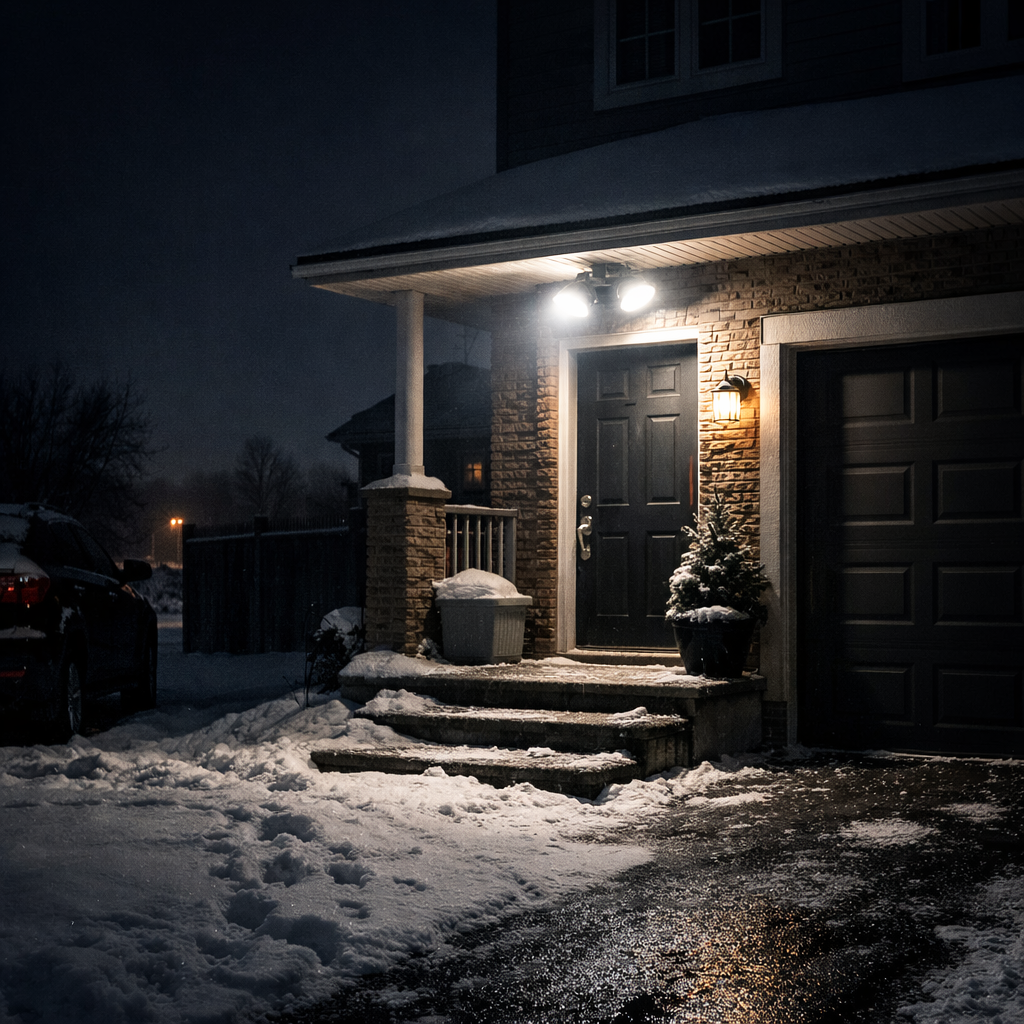
The power went out just after dusk.
Not everywhere — just enough to darken the street and quiet the neighbourhood. Phones still worked, but service was inconsistent. Police were busy responding to weather-related calls. Nothing felt dangerous, exactly.
It just felt… exposed.

That’s the phase most people never plan for — when order hasn’t collapsed, but protection is suddenly thinner than expected.
What’s Been Happening — And Why It Matters Now
Across Canada, recent storms, infrastructure failures, and service disruptions have produced a familiar pattern. Emergency services remain operational, but response times stretch. Non-priority calls are delayed. Patrols are reduced while resources are redirected elsewhere.
This isn’t a breakdown.
It’s strain.
We’ve already seen how quickly normal assumptions fail when systems are stressed — whether during extended cold snaps, regional outages, or communications failures. When multiple systems degrade at once, security stops being something you call for and becomes something you manage yourself.
If you haven’t read it yet, this same pattern was visible during recent grid-down conditions:
https://canadianpreppersnetwork.com/dealing-with-extreme-cold-grid-down/
Security problems don’t announce themselves. They surface quietly, at the edges.
Why Most Security Plans Fail First
Most households imagine security as a response to violence. In reality, vulnerability appears much earlier — when visibility drops, routines change, and uncertainty increases.
Dark entryways remove deterrence. Quiet streets remove witnesses. Delayed response removes consequence.
People testing doors or lingering near properties aren’t looking for confrontation. They’re looking for ambiguity. Homes that appear unattended, unobserved, or inconveniently dark attract attention long before any crime escalates.
This is why security failures often feel psychological before they become physical.
What Prepared Households Did Differently
Households that remained comfortable during recent disruptions didn’t rely on complex systems or constant monitoring. They focused on visibility, delay, and routine.
Exterior lighting was one of the most effective deterrents. A simple, cold-rated motion sensor light introduces uncertainty instantly and works even when services are strained. Many Canadian households use basic units like this because they function reliably through winter conditions:
https://www.amazon.ca/dp/B07Y2YFZ5P?tag=canadpreppn01a-20
Inside the home, reinforced entry points mattered more than alarms. Security isn’t about stopping someone permanently — it’s about making entry slow, loud, and obvious. A straightforward interior door security bar adds critical seconds without permanent modification:
https://www.amazon.ca/dp/B0002YUX8I?tag=canadpreppn01a-20
Just as important, prepared households didn’t improvise habits during outages. Doors were checked earlier. Vehicles were parked intentionally. Exterior walk-arounds were done before full darkness.
Security was already part of the routine — not a reaction.
The Security Mistake People Keep Making
Many people jump straight to force-based solutions. What they skip is the phase where most incidents actually end: deterrence through clarity.
People looking for opportunity move on when a home looks occupied, observed, and inconvenient. They avoid light, noise, and delay. Escalation happens only when uncertainty remains.
This same layered thinking applies beyond the individual household and into community-level preparedness:
https://canadianpreppersnetwork.com/building-survival-group-alliances/
Security works best when it never has to prove itself.
What to Fix Before the Next Disruption
The recent disruptions weren’t crises. They were warnings.
Before the next one, walk your property after dark with the power off and notice what disappears. Ask what signals occupancy when streets are quiet. Decide what slows access long enough to matter when help is delayed.
Security isn’t about paranoia.
It’s about removing ambiguity before someone else notices it first.
Because when systems are strained — whether by weather, infrastructure failure, or larger-scale instability — the gap between normal and vulnerable is much smaller than most people think.
Further Reading
- Dealing With Extreme Cold When the Grid Goes Down
https://canadianpreppersnetwork.com/dealing-with-extreme-cold-grid-down/ - Building Survival Group Alliances
https://canadianpreppersnetwork.com/building-survival-group-alliances/
Recommended Resource
For readers planning layered, long-term security into a Canadian retreat or homestead, Acres of Preparedness: Planning the Last Safe Place documents real-world considerations in depth:
https://www.amazon.ca/dp/B0F44GV789?tag=canadpreppn01a-20