A practical prepper guide to full off-grid electrical independence
For serious preppers, “backup power” is not the objective. Primary power is. Running a home on solar power alone is not a fringe experiment or a future concept — it is a proven, working model already used by thousands of off-grid households.
What separates success from failure is not technology. It is mindset, system design, and discipline.
A solar-powered home does not attempt to replicate unlimited grid electricity. Instead, it replaces fragility with control by focusing on essential systems, predictable loads, and energy independence that does not rely on fuel deliveries or outside infrastructure.
Redefining What It Means to “Run a Home”
Most solar failures happen before the first panel is installed, because people try to preserve convenience rather than function.
A solar-only home is designed to keep food preserved, water moving, lights on, communications active, and safety systems functioning. Refrigeration, lighting, device charging, radios, networking equipment, and pumps are prioritized because they directly support survival and stability.
High-draw lifestyle loads such as electric ranges, dryers, and resistance heating are intentionally excluded. They are not forbidden — they are inefficient uses of electricity when other energy sources can handle those tasks more effectively.
This same distinction between fuel-based and renewable power is covered well in CPN’s article:
https://canadianpreppersnetwork.com/solar-generators-vs-gas-generators-a-preppers-power-showdown/
Measuring Real Electrical Demand (Not Guesswork)
Before choosing panels or batteries, you need to understand how much electricity your home actually uses. This comes down to two critical measurements: total daily energy consumption (kilowatt-hours per day) and peak load (the highest watt draw at any moment).
Most people wildly overestimate both. Once loads are measured honestly, many households discover they can operate comfortably on a fraction of their former grid usage.
A simple way to get real data is with a plug-in energy monitor. These allow you to measure individual appliances and build a realistic energy profile over several days. A common example available on Amazon.ca (affiliate) is here:
https://www.amazon.ca/s?k=kill+a+watt+meter&tag=canadpreppn01a-20
Reducing demand before building the system is always cheaper, quieter, and more reliable than compensating with extra hardware.
Designing Demand So Solar Becomes Practical
Efficiency is not a compromise — it is leverage.
Successful solar-only homes aggressively eliminate waste. LED lighting replaces incandescent bulbs. Phantom loads are unplugged. Refrigerators and freezers are chosen for efficiency rather than size. High-draw tasks are scheduled during daylight hours when production is highest.
This approach shrinks the system required to sustain the home and increases resilience. A household that needs less power is harder to destabilize, easier to recover, and cheaper to support long-term.
Sizing the Solar Array as a Primary Power Source
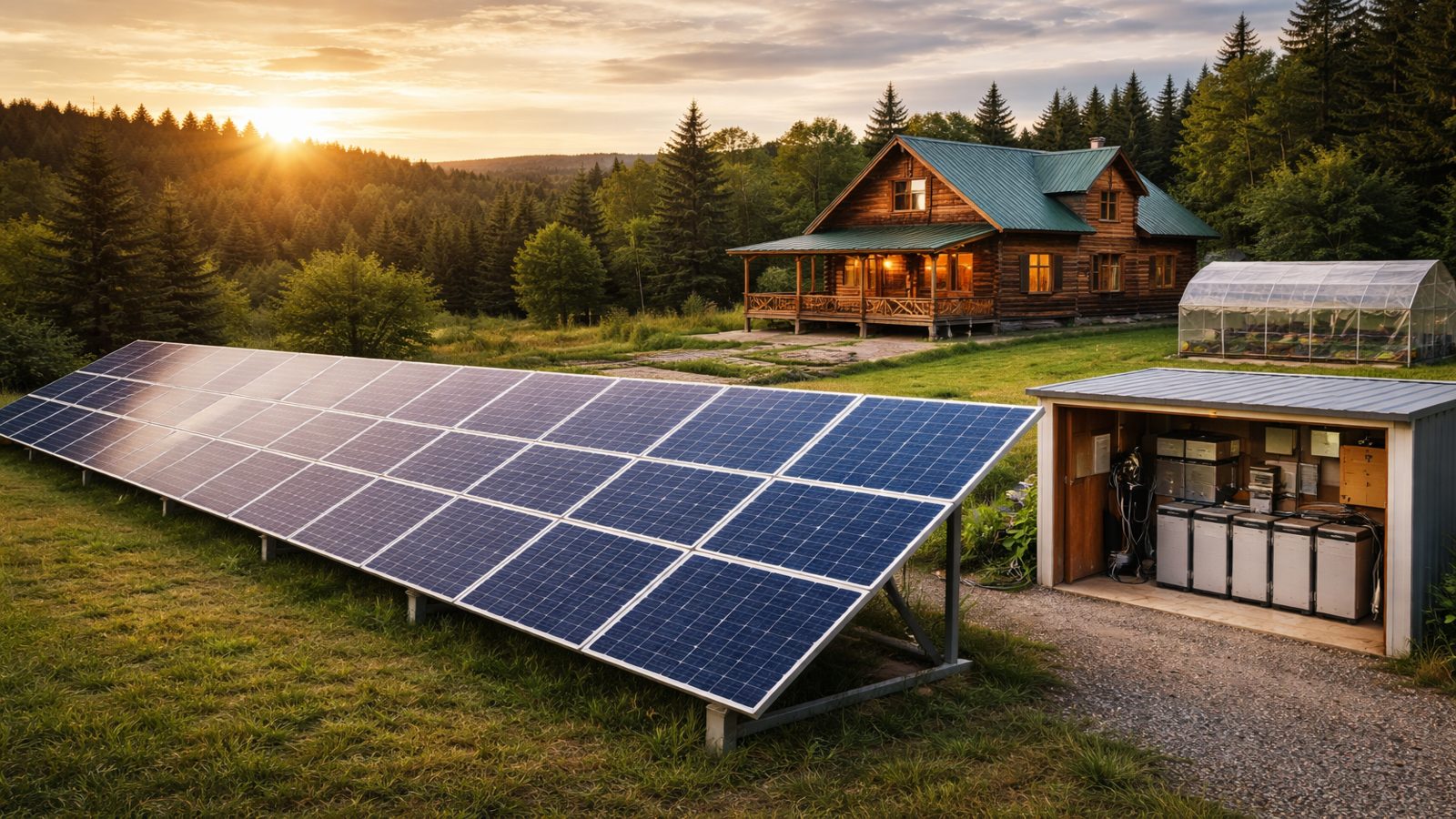
In an off-grid home, solar panels are the engine. They are not installed to “help” or offset bills — they are responsible for all electricity generation.
That means the array must be sized to cover daily usage and reliably recharge the battery bank. Designing only for average conditions leads to systems that slowly degrade during poor production periods.
Panels should be accessible for inspection and maintenance, which is why many serious systems use ground or pole mounts instead of roof-only installs. Survivability matters more than aesthetics.
For broader context on how solar fits into a complete renewable strategy, CPN’s overview is worth revisiting:
https://canadianpreppersnetwork.com/an-in-depth-look-at-off-grid-renewable-energy-benefits/
Batteries: The Heart of the System
Without batteries, solar cannot run a home — it can only power devices while the sun is shining. Storage is what turns intermittent generation into continuous power.
A solar-only home depends on batteries to run overnight, smooth production swings, and carry essential systems through periods of low output. Battery capacity is sized not for convenience, but for stability.
Most modern off-grid systems are moving toward LiFePO4 (lithium iron phosphate) chemistry due to long cycle life and usable depth of discharge. If you want to browse common configurations on Amazon.ca (affiliate), this category is a useful starting point:
https://www.amazon.ca/s?k=LiFePO4+battery+12V+100Ah&tag=canadpreppn01a-20
Battery banks are infrastructure. Treating them gently and sizing them conservatively is what allows a solar home to remain functional for years instead of months.
Inverters: Creating a Stable “Internal Grid”
Solar panels and batteries operate on DC power, but homes require AC. The inverter is what creates a stable internal grid inside the house.
A properly sized inverter handles motor start-up surges, supports overlapping loads, and delivers clean power for sensitive electronics. Undersized inverters are one of the most common failure points in DIY systems, not because they stop working, but because they silently limit what the household can do.
When researching equipment, searching Amazon.ca for pure sine wave inverter (affiliate) provides a good overview of available classes and capacities:
https://www.amazon.ca/s?k=pure+sine+wave+inverter&tag=canadpreppn01a-20
Charge Control: Protecting the Battery Investment
Between the panels and the batteries sits the charge controller, regulating how energy flows into storage. Quality charge control is essential for battery health and system longevity.
Modern MPPT charge controllers extract more usable energy from panels and prevent damaging charge patterns. Skimping here almost always shortens battery life and destabilizes the system.
A typical product category search on Amazon.ca (affiliate) looks like this:
https://www.amazon.ca/s?k=MPPT+solar+charge+controller&tag=canadpreppn01a-20
Living With Solar Power as a Primary System
Homes that thrive on solar do so because the occupants adapt to the system instead of fighting it. Loads are staggered, heavy tasks are run during production hours, and system status is checked regularly — just like checking fuel levels or weather forecasts.
Once habits align with the system, solar power fades into the background. Electricity becomes predictable again, even when external conditions are not.
This stability directly supports other preparedness layers, including security systems. CPN’s article on off-grid surveillance is a strong companion read:
https://canadianpreppersnetwork.com/off-grid-security-cameras-protecting-your-property-when-the-power-goes-out/
Backup Without Dependency
Some solar-only homes retain generators or alternate charging options, but these are treated as insurance — not as daily tools. If a system requires routine generator use to survive, it is not solar-powered in any meaningful sense.
True solar independence means the home remains functional even if fuel disappears entirely.
The Prepper Bottom Line
Running a home on solar power alone removes one of the most fragile dependencies modern households have. It replaces fuel logistics and grid uncertainty with silence, predictability, and long-term sustainability.
For preppers, solar is not a convenience upgrade.
It is foundational infrastructure.