Most Canadians who prepare for power outages focus on the equipment—generators, heaters, stoves. But the real weak point isn’t the machine.
It’s the fuel.
Across this country, we’ve already seen what happens when supply chains stall or weather events stretch longer than expected. Ice storms, flooding, and grid failures don’t just cut power—they cut access to fuel. And when that happens, what you stored weeks or months ago becomes your only option.
The problem is simple: not all fuels age the same, store the same, or fail the same.
Some degrade quietly. Others become dangerous. And a few will still perform years later—if you handled them properly.
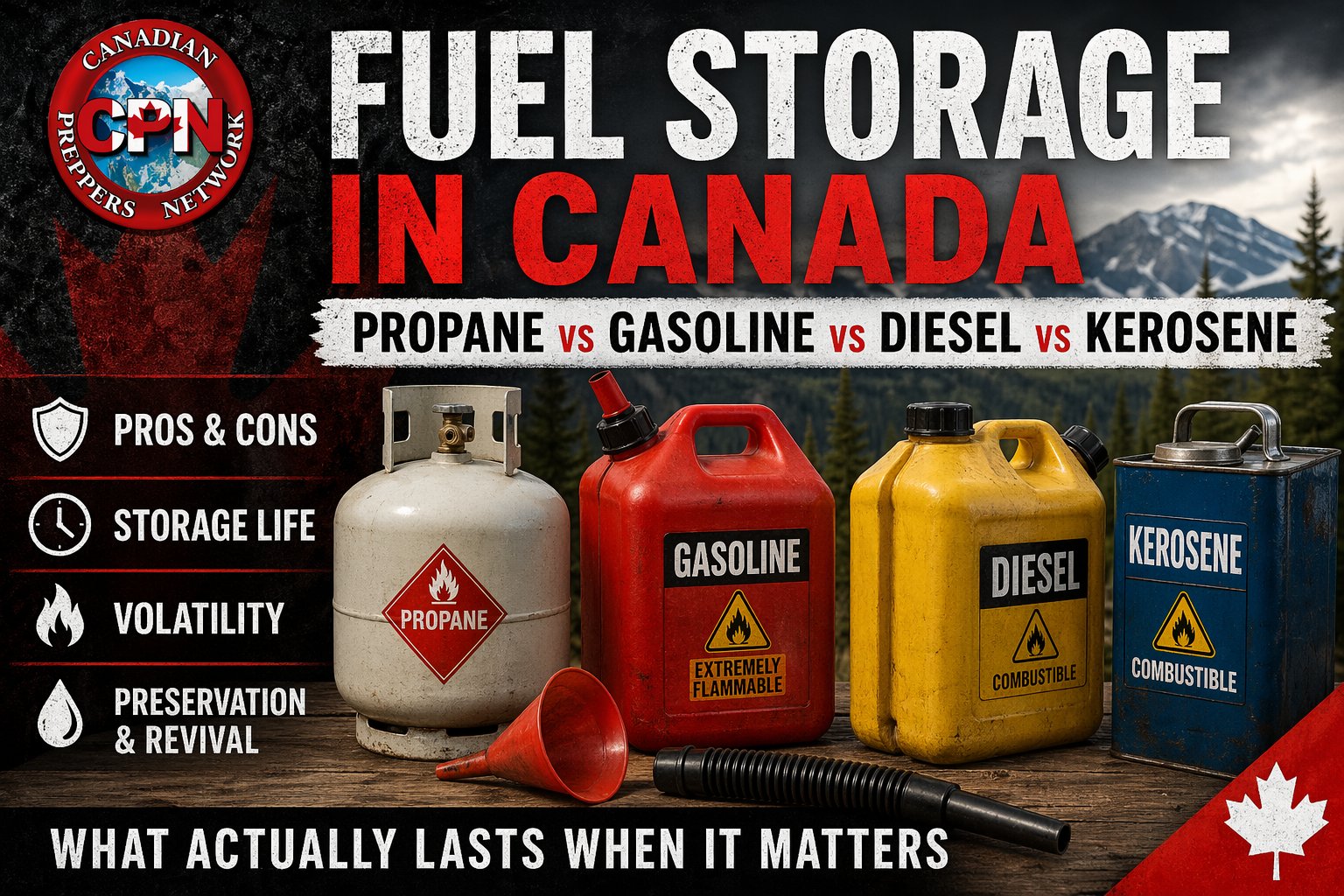
Let’s break down the four fuels most Canadian households rely on, and what you can realistically expect from each.
Propane: The Long-Term Storage Champion
Propane is one of the few fuels that doesn’t degrade over time. Stored in a sealed cylinder, it remains stable indefinitely. That alone makes it one of the most reliable options for long-term preparedness.
In Canadian conditions, propane also has a major advantage: it doesn’t gel in cold temperatures like diesel, and it doesn’t oxidize like gasoline.
Where it falls short is performance in extreme cold. As temperatures drop below roughly -20°C, tank pressure decreases, which can reduce output—especially in smaller cylinders.
Still, for cooking, heating, and even backup generators, propane remains one of the safest long-term bets.
A simple inline gauge helps prevent surprises:
https://www.amazon.ca/s?k=propane+tank+gauge&tag=canadianprep-20
If you’ve already built out a propane system, it pairs well with redundancy planning discussed in:
https://canadianpreppersnetwork.com/heating-a-home-without-power-what-actually-works-after-24-hours/
Gasoline: High Power, Short Lifespan
Gasoline is what most people default to—and it’s also the most fragile fuel you can store.
Untreated gasoline begins to degrade in as little as 3–6 months. It oxidizes, forms gums, and loses volatility. In modern engines—especially small generators—that leads to clogged carburetors and failed starts right when you need them most.
Ethanol-blended fuel makes this worse by absorbing moisture from the air, leading to phase separation.
That said, gasoline still has a role. It’s widely available, easy to use, and powers most portable generators.
The key is proactive management. A stabilizer can extend usable life to roughly 12–24 months when added early and stored correctly:
https://www.amazon.ca/s?k=fuel+stabilizer+sta-bil&tag=canadianprep-20
But gasoline is never a “store it and forget it” solution. It demands rotation, testing, and realistic expectations.
For a broader look at keeping systems running when supply chains break down, this ties into:
https://canadianpreppersnetwork.com/your-first-7-days-without-normal-supply-chains/
Diesel: Long Storage, Cold Weather Risk
Diesel stores significantly longer than gasoline and is less volatile, making it safer to handle and store.
Untreated, you can expect about a year of usable life. With proper additives and storage, that can extend several years.
But diesel has two critical vulnerabilities in Canada.
First is microbial growth. If water enters the tank, bacteria and algae can form sludge that clogs filters and damages injectors.
Second—and more immediate in winter—is gelling. As temperatures drop, diesel thickens and can become unusable.
A winter additive helps prevent this and improve reliability:
https://www.amazon.ca/s?k=diesel+anti+gel+additive&tag=canadianprep-20
If you’re relying on diesel, winter planning isn’t optional—it’s operational.
Kerosene: The Quiet Middle Ground
Kerosene sits between gasoline and diesel in both stability and usability.
It stores longer than gasoline, burns cleaner than diesel, and performs better in cold temperatures than either. For heating applications, especially with properly ventilated indoor heaters, kerosene is often one of the most reliable fuels available.
Its shelf life typically ranges from 2–5 years when stored in sealed containers and kept free from contamination.
The main drawback is availability. It’s not as widely stocked in all parts of Canada and requires dedicated equipment.
For storage, proper containers matter:
https://www.amazon.ca/s?k=fuel+storage+container+gas+can&tag=canadianprep-20
Storage Life Comparison (Realistic Expectations)
When properly stored:
- Propane: Indefinite
- Gasoline: 6 months (up to 24 months stabilized)
- Diesel: 12 months (2–5 years with treatment)
- Kerosene: 2–5 years
Preservation and “Revival”: What Actually Works
There’s a lot of bad information out there about “fixing” old fuel. Most of it leads to failure when you can least afford it.
Gasoline remains the weakest link. Once it has significantly oxidized and formed gums, it cannot be fully restored to original condition.
However, products like PRI-G do offer something different. Rather than just slowing degradation, PRI-G can re-stabilize partially degraded gasoline, improving combustion and extending usability.
If you want to review it directly:
https://www.amazon.ca/s?k=PRI-G+fuel+stabilizer&tag=canadianprep-20
In practical terms:
- Gasoline up to 1–2 years old is often recoverable
- 2–5 years becomes inconsistent and unsuitable for critical systems
- 5+ years is generally unreliable
Diesel:
- 2–3 years: often recoverable if clean
- 3–8 years: possible with treatment and filtration
Beyond that depends entirely on storage conditions.
The real takeaway is simple: fuel management is preventative first, corrective second.
What Should You Actually Store?
For most Canadian households, resilience comes from layering fuels—not choosing just one.
Propane for long-term stability
Gasoline for short-term generator use
Diesel for equipment
Kerosene for heating backup
That mix gives you flexibility when conditions shift—and they always do.
Because in a real emergency, the question isn’t whether you have fuel.
It’s whether it will still work when everything depends on it.
Build Systems That Still Work Months Later
Fuel is only one part of the equation. Storage, rotation, redundancy, and system design are what determine whether your plan actually holds together under pressure.
If you’re serious about building something that works beyond the first few days, Acres of Preparedness: Planning the Last Safe Place walks through how to design a self-reliant system from the ground up—covering energy, water, food, and long-term sustainability in a Canadian context.
Get it here:
https://canadianpreppersnetwork.com/product/acres-of-preparedness/