
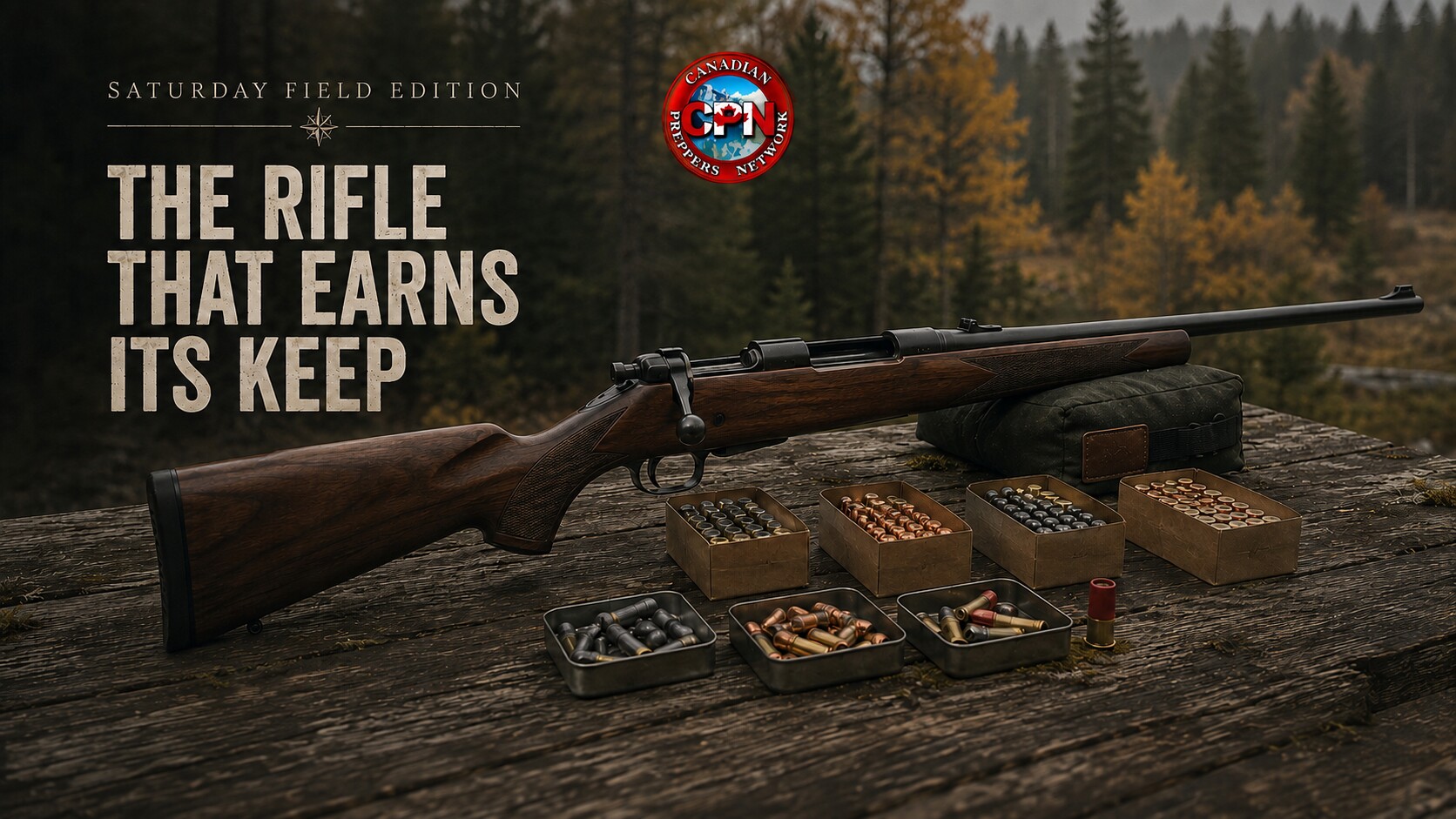
Why the .22 LR remains a preparedness workhorse
The .22 Long Rifle occupies a strange place in the firearms world.
Some shooters dismiss it as a beginner’s cartridge—useful for punching paper and teaching basic marksmanship, but not serious enough for an experienced rifleman. At the other extreme, survival folklore turns it into a magical do-everything cartridge capable of feeding, protecting and sustaining a household indefinitely.
Both views miss the point.
The .22 LR is neither a toy nor a substitute for every other rifle. Its real value comes from doing several modest jobs exceptionally well. It is economical to practise with, easy to carry, suitable for lawful small-game hunting and pest control, and available in a wider range of loads than many owners ever test.
A dependable .22 rifle earns its place by being used regularly—not by sitting in a cabinet while its owner talks about what it might accomplish after the grid goes down.
A Rifle You Can Afford To Practise With
The most important advantage of the .22 LR is not its size, weight or low recoil.
It is the amount of meaningful practice it permits.
Marksmanship is perishable. Stable positions, trigger control, sight alignment, breathing, follow-through, range estimation and wind judgement all deteriorate when they are not exercised. A centrefire rifle may be reserved for hunting season or occasional range visits because of ammunition cost, recoil, noise and range limitations.
A .22 can be used far more often.
Its low recoil makes errors easier to diagnose because the shooter is less likely to flinch or anticipate the shot. Its relatively mild report makes extended practice more manageable, although proper hearing protection and a lawful shooting location remain necessary. Hundreds of rounds can be transported in the space and weight occupied by a much smaller quantity of centrefire ammunition.
The result is a rifle that can build skill instead of merely representing it.
A prepper who fires thousands of poorly aimed rounds has accomplished little. A shooter who uses the .22 to practise prone, sitting, kneeling, standing, supported and improvised field positions is building a transferable ability.
That ability carries over to other rifles.
Canadian Grid-Down Starter Kit
Use this printable first-72-hours checklist to test your household’s water, food, power, communications, security and operating routines before a short outage becomes a prolonged emergency.
Small Game Without Excessive Cartridge
Where provincial regulations, seasons, licences and local discharge laws permit, the .22 LR remains highly useful for rabbits, hares, squirrels and certain other small game. It is also widely used for lawful pest and animal control on rural properties.
The cartridge provides enough performance for appropriate small game without the weight, expense, report and meat damage associated with larger cartridges.
That does not make every .22 load equally suitable.
A solid round-nose bullet may penetrate deeply while damaging relatively little edible meat. A hollow point may expand and transfer energy more quickly. A segmented bullet is designed to break into separate sections and can produce considerably more disruption. Reduced-velocity loads may work well at close range but shed energy and drop rapidly as distance increases.
The responsible hunter matches the load, distance and shot placement to the animal being taken.
The .22 LR is not a large-game cartridge. It should not be stretched into roles that exceed its power merely because the rifle is convenient to carry. Hunting regulations also vary by province, territory, species and local area. The firearm and ammunition must be legal for the particular hunt—not simply legal to possess.
Several Rifles Hiding Inside One Cartridge
Ammunition selection changes the character of a .22 rifle more dramatically than many owners realise.
The cartridge is offered with different bullet weights, shapes, materials and velocities. The quiet load that performs well in a bolt-action rifle may fail to cycle a semi-automatic. A lightweight hyper-velocity hollow point may strike several centimetres away from the rifle’s standard-velocity zero. A match load may group beautifully in one barrel and perform only ordinarily in another.
Published velocities are normally obtained under controlled test conditions. Actual performance changes with barrel length, temperature, ammunition lot and the individual firearm.
The following categories are useful starting points rather than universal guarantees.
| Load type | Typical example | Best role | Important limitation |
|---|---|---|---|
| Standard velocity | 40-grain solid around 1,070 fps | Training, targets and accuracy work | May not cycle every semi-automatic |
| High velocity | 36–40 grains around 1,200–1,300 fps | General practice and small game | Louder and not necessarily more accurate |
| Hyper velocity | 30–32 grains around 1,400–1,640 fps | Specialised pest and varmint roles where lawful | Light bullets lose speed quickly |
| Subsonic | Usually 40–45 grains around 950–1,050 fps | Reduced sonic crack, targets and small game | Still produces hazardous noise; test function |
| Quiet or reduced power | Often 40–45 grains around 710–835 fps | Close-range use in suitable manual actions | Usually will not cycle semi-automatics |
| Match | Usually a consistent 40-grain standard-velocity load | Precision shooting and rifle testing | The preferred brand and lot vary by rifle |
| Shotshell | Fine shot, commonly No. 12 | Extremely close pest control where lawful | Very short effective range |
| Lead-free | Usually a lighter non-lead projectile | Areas or uses where lead is restricted or undesirable | Different zero and terminal performance |
Velocity and bullet construction are separate choices. A subsonic cartridge may carry either a solid or hollow-point bullet. High-velocity ammunition may be round-nosed, hollow-point or segmented. The description on the box matters more than the colour or size of the packaging.
PLINKIN’ IN THE WOODS
Spend a full day developing practical outdoor rimfire marksmanship skills. Work from prone, standing, seated and kneeling positions while learning to use slings, bipods, tripods and shooting bags more effectively.
Saturday, September 12, 2026
8:00 a.m.–5:00 p.m.
Great Ape Empire
267 Highway 6, Wiarton, Ontario
Event admission: $250 CAD
Weekend camping: $20 per person
Space is strictly limited. Adult participants must meet all applicable legal and organiser requirements.
VIEW EVENT DETAILS AND RESERVE YOUR SPOT
Standard Velocity: The Accuracy Baseline
Standard-velocity ammunition is frequently overlooked because it lacks dramatic numbers.
That is a mistake.
CCI, for example, lists its 40-grain Standard Velocity load at 1,070 feet per second and markets it for consistent target performance. Many dedicated match loads operate in the same general velocity range.
Remaining below or close to the speed of sound can help a bullet avoid the disturbances associated with crossing from supersonic to subsonic flight. More velocity does not automatically mean a smaller group.
Standard-velocity ammunition is an excellent place to begin testing a rifle. It is mild, usually economical and often surprisingly accurate. Some semi-automatic rifles cycle it dependably; others require a stronger load or particular brand.
The rifle decides.
High Velocity: The General-Purpose Load
Bulk high-velocity ammunition is what many Canadians picture when they think of .22 LR.
Common examples use a 36- or 40-grain bullet at approximately 1,200 to 1,300 feet per second. Manufacturers offer solids and hollow points in this category, often in bulk packages intended for training, plinking and small-game use.
High-velocity ammunition normally provides more cycling energy for semi-automatic rifles and a somewhat flatter short-range trajectory than standard-velocity loads. It is a sensible general-purpose category when a particular load proves accurate and reliable in the rifle.
Bulk packaging, however, does not guarantee uniform performance.
Rimfire rifles can be remarkably selective. A bargain load that functions perfectly in one rifle may produce failures to feed, inconsistent ignition or poor groups in another. Buy smaller quantities first, test them properly and only then invest in a larger supply.
Hyper Velocity: Speed With Trade-Offs
Hyper-velocity loads achieve impressive advertised speeds by combining a lighter bullet with increased velocity.
CCI lists its 32-grain Stinger at 1,640 feet per second, while other manufacturers offer light hollow points in the 1,400-foot-per-second range.
These loads can provide a flatter trajectory over limited distances and aggressive hollow-point performance. They may be useful for particular pest or small-game applications where legal and appropriate.
They are not automatically superior.
The light projectile can lose velocity quickly. Wind still matters. The point of impact will differ from heavier ammunition. Some rifles do not shoot hyper-velocity cartridges accurately, and owners should confirm compatibility with the firearm manufacturer before using any cartridge with unusual case dimensions or pressure characteristics.
Speed is one tool—not a substitute for accuracy.
Build an Offline Preparedness Library
CPN Gold Membership includes access to the extensive CD3WD collection and hundreds of practical manuals covering food, water, agriculture, repairs, health, energy and low-technology self-reliance.
Gold members also receive the monthly Canadian Preparedness Intelligence Briefing examining global geopolitics, domestic economic pressures, employment, food and energy security and emerging risks affecting Canadian households.
Subsonic And Quiet Loads Are Not The Same Thing
Subsonic ammunition keeps the projectile below the speed of sound, eliminating the ballistic crack created by a supersonic bullet.
That does not make the rifle silent.
The discharge, action noise and bullet impact remain audible, and hearing protection may still be required. Reduced noise also does not make it legal to fire on a residential property or anywhere else where firearm discharge is prohibited.
Full-power subsonic loads, often using heavier 40- or 45-grain bullets, may cycle some semi-automatic rifles. Special semi-automatic subsonic products are designed specifically with cycling in mind.
Quiet or reduced-power loads are a different category. CCI’s 40-grain Quiet-22, for example, is listed at only 710 feet per second and recommended primarily for bolt-action and single-shot rifles.
That produces considerably less report and recoil, but also much greater drop, reduced energy and unreliable function in most ordinary semi-automatics.
These cartridges can add a useful role to a manual-action rifle. They should not be treated as interchangeable with standard ammunition.
Solids, Hollow Points And Segmented Bullets
Bullet shape determines what happens after impact.
A lead round-nose solid generally favours penetration and modest tissue disruption. It is commonly used for targets and may be appropriate where a hunter wants to limit meat damage.
A hollow point is intended to expand, but actual expansion depends on impact velocity, bullet design and the material struck. A hollow point that works well from a rifle at close range may behave differently after losing velocity.
Segmented hollow points are designed to separate into multiple pieces. Manufacturers offer both high-velocity and reduced-velocity segmented loads for small-game and pest applications. They can transfer energy rapidly, but that may also mean greater meat damage.
No catalogue description replaces testing and responsible field judgement.
Choose one proven solid and one proven expanding load before filling storage cans with six different specialty cartridges that have never been zeroed in the rifle.
Shotshells: Highly Specialised, Not Miniature Shotguns
A .22 LR shotshell replaces the conventional bullet with a small payload of fine shot.
Federal and CCI both offer versions using No. 12 shot at approximately 1,000 feet per second. These loads are intended for very close-range pest applications.
Their usefulness is narrow.
The tiny shot loses effectiveness rapidly and produces a thin pattern as distance increases. Shotshells may not cycle a semi-automatic rifle, and point of impact should never be assumed. Pattern them against a safe backstop at realistic distances before depending on them.
A shotshell can make a .22 rifle more versatile, but it does not turn the rifle into a shotgun.
The Action Matters
A bolt-action or single-shot rifle is mechanically simple and usually the most tolerant of standard, subsonic and reduced-power ammunition. It allows the shooter to extract each fired case manually, so cartridge power does not need to operate the action.
A semi-automatic offers rapid follow-up shots and enjoyable high-volume practice, but it is more dependent on ammunition energy, magazine condition and cleanliness. Every chosen load must be tested for feeding, extraction and bolt lock-back where applicable.
Lever- and pump-action rifles occupy useful middle ground. Some models can use .22 Short, .22 Long and .22 LR ammunition, but only when the firearm is specifically marked and approved for those cartridges.
A rifle chambered in .22 LR should never be assumed to accept another rimfire cartridge simply because it appears similar.
Takedown models are convenient for vehicles, packs and compact storage. The owner should confirm that the rifle returns to the same zero after repeated assembly and disassembly.
The best action is the one that performs the required job reliably and that the owner actually trains with.
Canadian Basic Amateur Radio Course for Preppers
Learn the radio knowledge, operating skills and Canadian regulations needed to prepare for the ISED Basic Qualification examination—and build practical communications capability before conventional systems fail.
$79 CAD · One-time payment · Six months of course access
Test Ammunition As A System
A practical .22 ammunition test should answer four questions:
- Does it function?
- Does it group?
- Where does it strike?
- Does it remain dependable in realistic conditions?
Begin from a stable position at 25 or 50 metres. Shoot several groups rather than judging a load from five lucky rounds. Record group size, failures, point of impact and the lot number printed on the package.
Then test from field positions.
A load that produces a beautiful bench group is only useful if the shooter can make the same first-round hit from kneeling, sitting, prone or a natural rest. CPN’s article on practical rifle accuracy expands on building repeatable field hits instead of relying entirely on bench groups.
Canadian cold also matters. Lubricants thicken, ammunition temperature changes and semi-automatic actions may slow. Lapua’s rimfire test facilities include cold-chamber testing down to –25°C because temperature can materially affect performance.
If a particular lot groups well and functions reliably, buy more of that lot when possible. Different production lots of the same product may not perform identically.
Store It Like A Working Supply
The small size of .22 LR makes bulk storage easy, but careless storage can destroy its greatest advantage.
Keep cartridges cool, dry and protected from oil, solvents, flooding and repeated temperature swings. Leave ammunition in its labelled factory packaging so bullet type, velocity and lot number remain identifiable. Place the boxes inside suitable locked ammunition containers with moisture control where needed.
Do not pour several unrelated loads into a single loose container. A mixture of solids, hollow points, quiet loads and hyper-velocity cartridges creates a zeroing and reliability problem that cannot be identified by looking at a handful of similar brass cases.
Under Canada’s current federal storage regulations, a stored non-restricted firearm must be unloaded and secured as prescribed. Ammunition must not be readily accessible to it unless the ammunition is stored in an appropriate locked container. Firearm classifications and provincial hunting rules should always be confirmed from current official sources.
Storage is not merely a matter of preserving ammunition.
It is part of legal and responsible firearms ownership.
Where The .22 LR Stops Being Versatile
A useful tool becomes dangerous when confidence exceeds capability.
The .22 LR is vulnerable to wind, loses energy quickly and has far less margin for error than a centrefire hunting cartridge. Rimfire priming can be less dependable than centre-fire ignition. Reduced-power ammunition may lodge a projectile if a cartridge is defective or fired through an unsuitable barrel, so any abnormal report must be investigated before another round is fired.
It is not suitable for large game. It is not a long-range answer. It does not remove the need for a safe backstop. Its mild recoil does not make it harmless, and its relatively modest report does not eliminate the need for hearing protection.
The .22 becomes more valuable when its limits are respected.
Build The Supply Around Roles
A sensible preparedness supply does not need one box of every load ever manufactured.
It needs defined roles:
- A dependable bulk training load that functions consistently.
- An accurate solid for target work and appropriate small-game use.
- A proven hollow point for situations where controlled expansion is desired.
- A modest supply of subsonic or reduced-power ammunition if the rifle and intended use justify it.
- Specialty shotshell, segmented or lead-free loads only where there is a genuine role for them.
Quantity should be calculated from actual annual use, replacement availability and desired reserve—not from an arbitrary internet stockpile number. CPN’s article How Much Ammunition Is Enough? explains how to calculate a working supply from training consumption rather than guesswork.
Support The Rifle You Already Own
The rifle is only one part of the system. Storage, maintenance, testing and protective equipment keep it useful.
Lockable Ammunition Cans
Keep labelled factory boxes dry, organised and secured.
.22-Calibre Rifle Cleaning Kits
Maintain the bore, chamber, bolt face and action with rimfire-sized tools.
Electronic Hearing Protection
Protect hearing while preserving the ability to hear range commands and instruction.
Impact-Rated Shooting Glasses
Basic protection for training, maintenance and field shooting.
Shooting Bags And Field Rests
Useful for ammunition testing, zero confirmation and supported field positions.
Desiccant Packs For Ammunition Storage
Help control moisture inside sealed storage containers.
As an Amazon Associate, Canadian Preppers Network may earn from qualifying purchases at no additional cost to you.
The Rifle That Keeps Teaching
The .22 LR is valuable because it can be fired frequently, carried easily and adapted to several realistic jobs.
It can teach a new shooter without becoming useless to an experienced one. It can put small game in the pot where lawful. It can control certain rural pests. It can expose flaws in marksmanship that recoil sometimes hides. With careful ammunition selection, one rifle can move from quiet manual-action practice to precision target work and general small-game use.
But versatility must not be confused with unlimited capability.
Choose the rifle carefully. Test the loads. Record the zero. Store the ammunition properly. Practise from real positions and understand the legal limits of every intended use.
A .22 rifle does not earn its place because ammunition can be stacked deep.
It earns its place because the owner knows exactly what each box can—and cannot—do.
Which .22 LR load has proved most accurate and dependable in your rifle—and did the result surprise you?
Related CPN Reading
- How Much Ammunition Is Enough?
- Practical Rifle Accuracy
- Security & Defense in Canada
- Security & Defence Buying Guide


One Comment