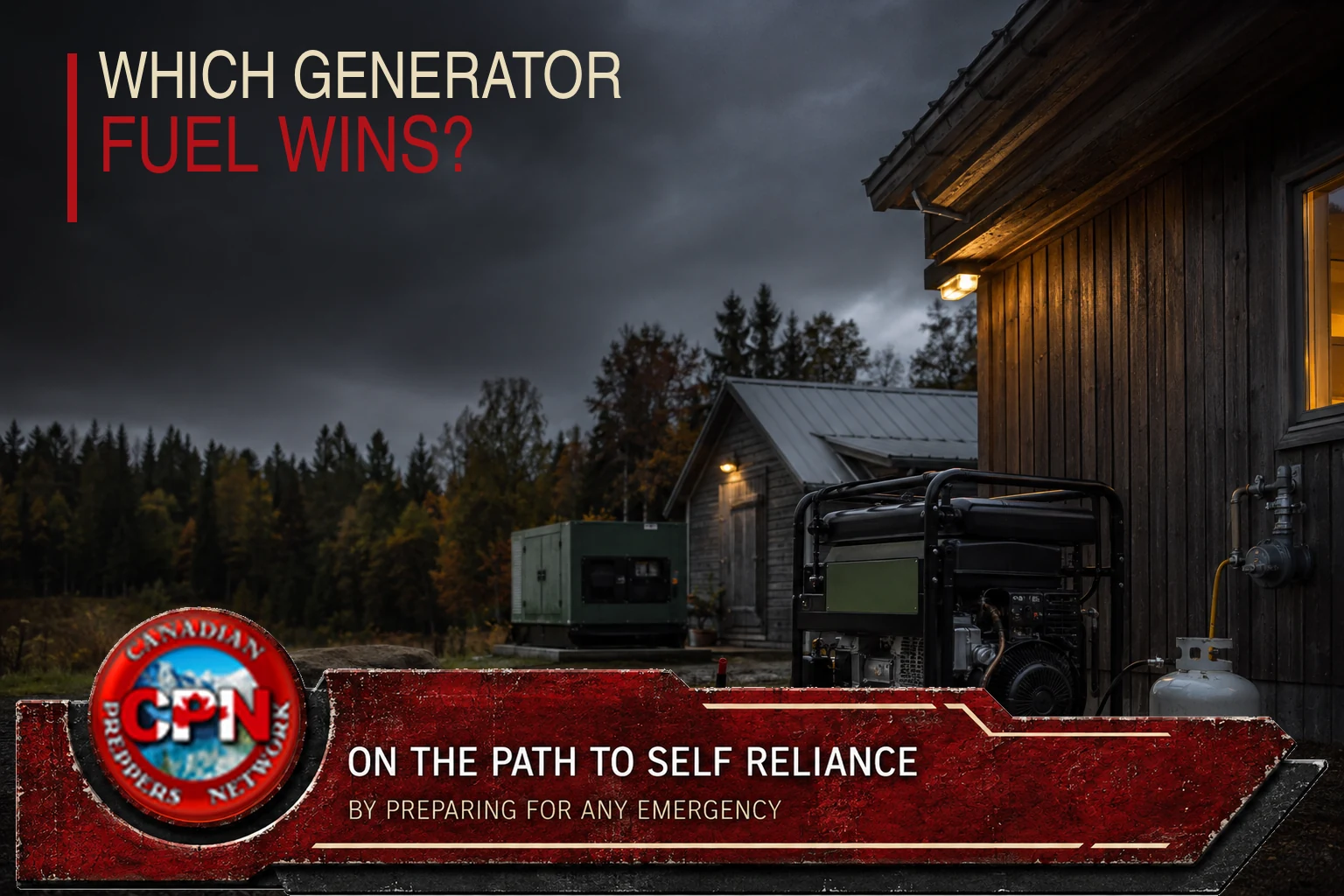
Gasoline, propane, diesel or natural gas: choosing the weaknesses you can live with
Buying a generator is easy. Keeping it supplied, maintained and running during a prolonged emergency is the difficult part.
Most generator comparisons concentrate on wattage, price and advertised running time. Those numbers matter, but they do not answer the preparedness question:
What fuel will still be available when the outage becomes a genuine crisis?
A gasoline generator may provide the best output but become useless when service stations cannot pump fuel. Propane stores well but performs differently in extreme cold. Diesel equipment is durable but expensive and temperamental when temperatures plunge. Natural gas offers effortless operation until the utility supplying it fails.
There is no universally superior generator fuel. Each option exchanges one weakness for another.
Free Canadian Preparedness Download
Canadian Grid-Down Starter Kit
Use this printable first-72-hours checklist to test your household’s power, water, food, sanitation, communications and operating routines before a short outage becomes a prolonged emergency.
Generator Fuel Comparison
| Fuel | Principal Advantage | Principal Weakness | Best Suited To |
|---|---|---|---|
| Gasoline | Availability and maximum rated output | Short storage life and fuel-system problems | Portable, short-term emergency power |
| Propane | Long-term storage without fuel degradation | Reduced output and cold-weather pressure problems | Households storing fuel in advance |
| Diesel | Efficiency and durability under sustained loads | Cost, weight and cold-weather complications | Farms, retreats and heavy-duty applications |
| Natural gas | Continuous supply without manual refuelling | Dependence on utility infrastructure | Automatic residential standby systems |
| Dual/tri-fuel | Flexibility when one fuel becomes unavailable | Added complexity and different output on each fuel | Layered household backup systems |
Gasoline: Powerful and Easy to Find—Until It Isn’t
Gasoline generators dominate the portable market. They are generally affordable, widely available and familiar to anyone accustomed to maintaining small engines.
Gasoline normally gives a multi-fuel generator its highest output. One Canadian dual-fuel model, for example, produces 3,700 running watts on gasoline but 3,330 watts on propane. Another produces 6,500 running watts on gasoline and 5,850 on propane. The precise difference varies by machine, but the pattern is consistent: gasoline normally delivers more usable power from the same engine.
Gasoline Generator Pros
- Common fuel that can be rotated through vehicles and other equipment
- Wide selection of affordable portable generators
- Usually delivers the generator’s highest rated output
- Generally dependable in cold weather when the engine is properly maintained
- Portable containers make fuel movement and rationing straightforward
- Replacement parts and small-engine knowledge are widespread
Gasoline Generator Cons
- Fuel begins deteriorating during storage
- Old gasoline can leave deposits in the carburetor and prevent starting
- Highly volatile and hazardous to handle
- Requires disciplined rotation and approved containers
- Refuelling a hot generator creates a serious fire risk
- Service stations may be closed, powerless or surrounded by long lines
- Noise can advertise that the household has electricity and fuel
Gasoline works best when treated as a rotating supply, not a forgotten stockpile. Stored fuel should be dated, inspected and regularly consumed through compatible equipment before being replaced with fresh fuel.
The generator must also be shut down and allowed to cool before refuelling. Never attempt to extend its operating time by pouring gasoline into a running or hot machine.
Preparedness verdict: Gasoline is excellent for short disruptions and intermittent high-output work. It becomes less attractive as an emergency continues and replenishment becomes uncertain.
Propane: The Storage Champion
Propane solves gasoline’s largest problem. The fuel does not become stale while sitting in a properly maintained cylinder. There is no carburetor full of ageing liquid gasoline, and a household can build a reserve without constantly rotating it through a vehicle.
Propane is also useful for more than electricity. The same stored energy may support cooking, water heating and other properly designed equipment.
Propane Generator Pros
- Fuel can remain usable for many years in serviceable cylinders
- Does not gum up a carburetor during storage
- Produces fewer engine deposits than gasoline
- Cylinders make it easier to divide and count the portable reserve
- Can supply several household preparedness systems
- Avoids pouring liquid fuel near a hot engine
- Readily incorporated into dual-fuel generators
Propane Generator Cons
- Usually produces less wattage than gasoline
- Cylinders are bulky relative to the energy they contain
- Small barbecue cylinders may empty quickly under substantial loads
- Propane pressure falls as temperature and fuel level drop
- Frost on the cylinder or regulator can eventually restrict fuel flow
- A large reserve requires considerable secure storage space
- Refilling still depends on functioning commercial infrastructure
Cold presents the distinctly Canadian problem. Liquid propane must vaporize before the engine can use it. As the temperature drops—and as a cylinder empties—its ability to supply vapour declines. Heavy demand from a large generator can worsen the problem.
This does not make propane unsuitable for winter. It means cylinder capacity, generator demand and expected temperature must be considered together. A generator that runs perfectly from a small cylinder in September may struggle with the same arrangement during a January cold snap.
Preparedness verdict: For most households, propane is the strongest stored-fuel option. It becomes especially attractive when paired with gasoline in a dual-fuel generator.
Limited-Space Outdoor Event
PLINKIN’ IN THE WOODS
with Frugal Gunnie
Spend a full day developing practical outdoor rimfire marksmanship skills from prone, standing and seated field positions while developing repeatable accuracy in a supervised outdoor setting.
Saturday, September 12, 2026
8:00 a.m.–5:00 p.m.
Great Ape Empire
267 Highway 6, Wiarton, Ontario
Event admission: $250 CAD
Weekend camping: $20 per person
Space is strictly limited. Adult participants must meet all applicable legal and organizer requirements.
VIEW EVENT DETAILS AND RESERVE YOUR SPOT
Presented in collaboration with Off-Grid School, Preppers Meet, Canadian Preppers Network and Great Ape Empire.
Diesel: Built for Work
Diesel generators occupy a different part of the market. They tend to be heavier, more expensive and less portable, but serious diesel engines are designed for sustained operation.
For a farm or retreat already using diesel tractors, vehicles or heating equipment, a diesel generator can fit naturally into the existing fuel and maintenance system. For a suburban household with no other diesel equipment, that advantage largely disappears.
Diesel Generator Pros
- Efficient under substantial, sustained loads
- Diesel engines are commonly built for long service lives
- Fuel is less volatile than gasoline
- Well suited to large generators and extended operating periods
- May share a fuel-management system with compatible farm equipment
- Strong option for pumping, workshops and other heavy loads
Diesel Generator Cons
- Higher initial purchase cost
- Generally heavier and noisier than small gasoline inverter units
- More expensive repairs and fuel-system components
- Cold starting may require heaters, suitable oil and a strong battery
- Diesel fuel can gel or create filter problems at low temperatures
- Stored fuel remains vulnerable to water, oxidation and microbial contamination
- An oversized diesel generator may not perform well when continually operated under very light loads
Cold-weather preparation is not optional. Diesel installations may require seasonal fuel, anti-gel treatment, protected lines or heating equipment. Biodiesel blends can present additional problems during cold weather and extended storage, so the generator manufacturer’s fuel requirements must be followed.
A diesel generator also needs an appropriate workload. Buying a massive machine to charge two phones and operate a few LED lights wastes fuel and prevents the engine from working as intended.
Preparedness verdict: Diesel makes the most sense for properties that already store, use and understand diesel. It is usually excessive for occasional suburban outages but extremely capable at a working retreat.
Natural Gas: Convenient but Not Independent
A natural-gas standby generator can make an ordinary outage almost uneventful. The power fails, the generator starts automatically, and nobody carries fuel cans through the snow.
Because the fuel arrives through a pipe, running time is not constrained by the size of an on-site tank. That is a major advantage during an extended but otherwise orderly outage.
It is also the system’s central vulnerability.
Natural-Gas Generator Pros
- No portable fuel containers to fill or rotate
- Potentially continuous operation while gas service remains available
- Excellent for automatic standby systems
- Produces fewer engine deposits than gasoline
- No stale fuel sitting inside the generator
- Highly convenient during storms and short-to-medium grid failures
Natural-Gas Generator Cons
- Dependent on an outside utility
- Cannot normally be moved to another location
- Provides no personally controlled fuel reserve
- Professional installation is usually required
- Natural-gas output is commonly lower than gasoline output
- A damaged line, pressure loss or utility shutdown can stop the system
- Little value at an isolated retreat without existing service
A current tri-fuel generator illustrates the output trade-off. The same engine is rated for 8,000 running watts on gasoline, 7,200 on propane and 7,000 on natural gas.
Natural gas may remain available during an electrical outage because much of its infrastructure is separate from the electrical grid. That does not make it independent. In a widespread disaster, assuming one utility will survive because another has failed remains a gamble.
Preparedness verdict: Natural gas is arguably the most convenient standby fuel, but it is not a stockpile. A system intended for serious preparedness should have another usable fuel option.
Community Training Event
ARCHERY INTENSIVE
Learn the Bow. Understand the Shot.
Spend a concentrated day improving stance, grip, drawing, anchoring, release, follow-through and arrow control. The programme includes changing distances, practical shooting positions, traditional techniques and individual form correction.
Sunday, September 13, 2026
Great Ape Empire
267 Highway 6, Wiarton, Ontario
$120 per person
Equipment is available
Weekend camping: $20 per person
Instruction is provided by Wolf Starchild of Barefoot Bushcraft. Space is limited to preserve the hands-on format.
Presented by Barefoot Bushcraft in partnership with Canadian Preppers Network, Preppers Meet, Great Ape Empire and Off-Grid School.
Dual-Fuel and Tri-Fuel Generators
A dual-fuel generator normally burns gasoline or propane. A tri-fuel model adds natural gas.
For the average Canadian household, this is often the most practical compromise. Gasoline provides maximum output and can be sourced quickly. Propane provides a stable reserve. Natural gas can handle routine outages without consuming either stored fuel.
Multi-Fuel Generator Pros
- Allows the household to use whichever fuel remains available
- Combines gasoline performance with propane storability
- Tri-fuel units can preserve stored fuel while the natural-gas utility works
- Provides options as an emergency changes
- Reduces dependence on one supply chain
Multi-Fuel Generator Cons
- More hoses, regulators, fittings and procedures to maintain
- Output changes with the selected fuel
- Every fuel mode must be tested regularly
- Fuel flexibility does not eliminate engine maintenance
- A failed engine still eliminates every fuel option
- Larger tri-fuel machines may be heavy, noisy and fuel-hungry
A multi-fuel generator should be tested on every advertised fuel, not merely started once on gasoline and assumed to be ready. The correct hoses, regulators and fittings should remain with the machine, clearly labelled and protected from damage.
Inverter or Conventional?
Fuel choice is only half the decision.
An inverter generator adjusts engine speed according to demand. It is generally quieter and more economical at partial loads, making it useful for communications equipment, refrigeration, battery charging and other modest household needs.
An open-frame conventional generator usually provides more raw wattage for the purchase price. It may be the better choice for well pumps, large tools and other heavy intermittent loads, but it will normally be louder.
For preparedness, silence and fuel economy often matter more than powering the entire house. A smaller inverter generator charging batteries for a few controlled hours can consume less fuel—and attract less attention—than a large machine running continuously.
Build Knowledge That Survives the Emergency
CPN Gold Membership
Gold Membership includes access to the extensive CD3WD offline reference collection, with practical manuals covering energy systems, electrical work, repairs, agriculture, water, health and self-reliance.
Members also receive the monthly Canadian Preparedness Intelligence Briefing.
The Best Generator Is Not the Biggest
Start with the loads, not the generator catalogue.
List the equipment that genuinely deserves fuel:
- Water pumping
- Essential medical equipment
- Communications and rechargeable batteries
- Refrigeration while the stored food remains worth protecting
- Selected heating-system controls or circulation pumps
- Necessary tools and repair equipment
- Limited security and work lighting
Electric resistance heating, electric water heaters, cooking ranges and central air conditioning can consume enormous amounts of power. Attempting to preserve every modern convenience leads to a larger generator, greater fuel consumption and a much more difficult storage problem.
In a prolonged emergency, the generator should usually run in scheduled blocks. Use those periods to pump water, cool freezers, charge batteries and complete power-intensive work. Shut it down once those jobs are finished.
Generator Safety Is Non-Negotiable
- Operate every combustion generator outdoors and well away from doors, windows and air intakes.
- Direct the exhaust away from occupied buildings.
- Keep working carbon-monoxide alarms inside the home.
- Never operate a generator in a garage, shed, basement, vehicle or enclosed porch.
- Never refuel a running or hot generator.
- Use properly rated outdoor extension cords and protect them from water and damage.
- Never energize a house through a wall, dryer or range outlet.
- Any connection to household wiring requires approved transfer equipment installed by a qualified electrician.
The Practical Choice
For most households, a moderately sized dual-fuel inverter generator offers the best balance. Propane can remain the primary stored fuel, while gasoline supplies additional output or an emergency fallback.
A rural property already operating diesel machinery may be better served by diesel. A home connected to natural gas may benefit from tri-fuel capability or a permanently installed standby unit—but stored backup fuel remains important.
Whatever fuel you choose, remember the limit shared by every combustion generator:
Eventually, it runs out.
A generator is a bridge between grid power and low-energy living. It can protect food, move water, charge batteries and operate essential tools while the household adapts. It cannot provide permanent independence unless fuel production and mechanical support survive with it.
Preparedness Buying Box
Build and Test Your Generator System
- Dual-fuel inverter generators
- Heavy-duty outdoor generator extension cords
- Plug-in electricity usage meters
- Carbon-monoxide alarms with battery backup
- Gasoline fuel stabilizer
- Approved gasoline fuel containers
- Generator maintenance supplies
As an Amazon Associate, Canadian Preppers Network may earn from qualifying purchases at no additional cost to you.
The correct fuel is not simply the one with the longest advertised running time. It is the fuel you can safely store, rotate, protect, use in Canadian weather and replace within the systems already supporting your household.
If the grid failed tonight, which fuel could you use immediately—and how many hours of essential power would you actually have?
Related CPN Reading
- Energy Production & Blackout Power Buying Guide
- The 12-Volt Survival Grid
- The Overlooked Side of Backup Power: Maintenance That Keeps It Running
- Portable Power Stations: Useful Tool or False Security?