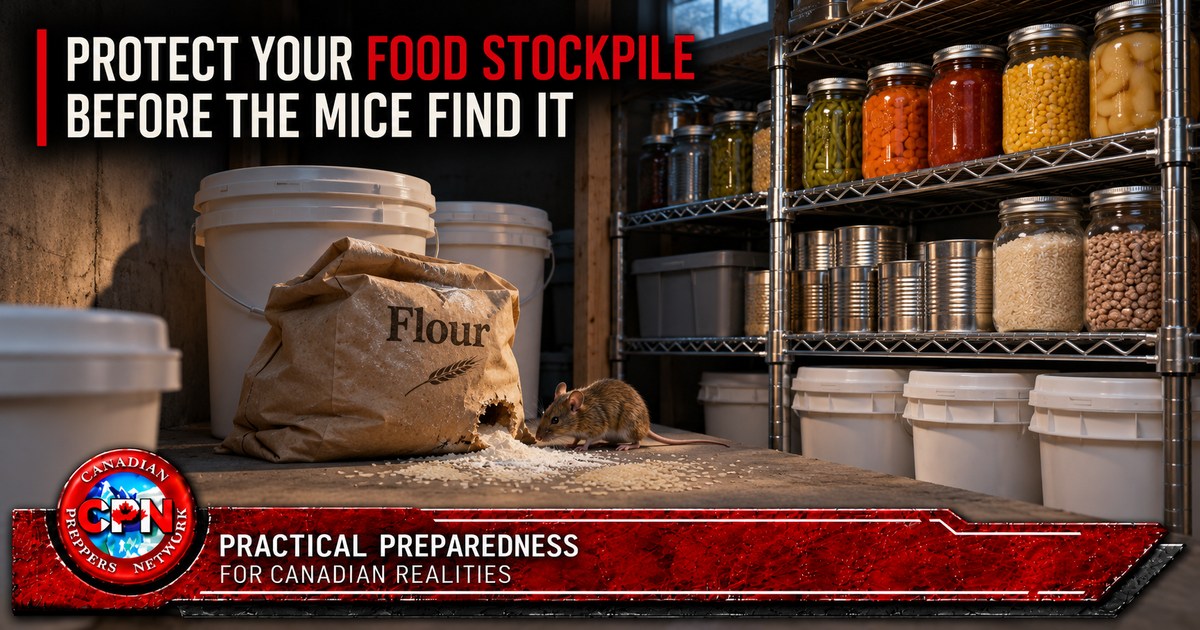
Your food stockpile can lose its value before a single emergency meal reaches the table. You open the basement pantry during a prolonged disruption and find rice scattered beneath the shelving. A flour bag has a hole in one corner. Behind the pasta boxes, there are droppings.
Yesterday, those shelves represented several weeks of meals. Today, part of that reserve is contaminated, and you have to find out how far the damage extends.
When resupply becomes unreliable, protecting your food stockpile becomes part of feeding your household. Every bag lost takes time, money and meals with it.
Before adding another sack of rice to your Canadian winter reserve, examine what stands between that food and whatever can reach it.
Grocery Packaging Has Limits
Paper flour bags, cardboard pasta boxes and thin plastic packaging make food convenient to transport and sell. They offer limited protection once pests reach the storage area.
Pantry insects can arrive inside purchased food and spread through susceptible supplies. University of Minnesota Extension recommends inspecting packages and keeping uninfested dry foods in tightly closed glass, metal or heavy plastic containers.
Rodents create a separate problem. A container that closes tightly enough to exclude insects may still have vulnerable plastic edges that a mouse can chew.
Your storage plan needs several layers: sound packaging, suitable containers, a maintained room and regular inspection. A pantry with matching bins can still have serious weaknesses behind the shelving.
1. Match Food Stockpile Containers to the Job
Different parts of your food stockpile need different handling.
| Storage job | Useful approach | What to check |
|---|---|---|
| Daily flour, rice and oats | Food-contact containers with secure lids | Lid fit, cleanability and manageable weight |
| Sealed dry-food reserves | Suitable sealed inner packaging inside protective outer containers | Punctures, damaged seals and exposed edges |
| Small quantities | Food-safe glass jars with sound lids | Chips, cracks and protection from falls |
| Areas with rodent pressure | Robust metal outer containers around properly packaged food | Tight lids, corrosion and gaps |
| Canned food | Strong shelving with labels visible | Leaks, rust, swelling and damaged seams |
Use containers intended for food contact whenever ingredients touch their interior. A utility bin’s appearance tells you little about its suitability for storing loose flour.
A clean metal utility container can serve as an outer barrier around sealed packages. Keep the food in its appropriate inner packaging unless the metal container itself is approved for direct food contact.
Plastic buckets remain useful, but inspect their lids, rims and bases. Avoid treating any plastic bucket as an unconditional guarantee against rodents.
2. Divide Your Food Stockpile Before Trouble Starts
Putting all your rice into one enormous working bin creates a convenient dispensing system. It also concentrates your risk.
For a household reserve, consider three separate portions:
- Working supply: The container you open regularly for cooking.
- Near-term reserve: Smaller sealed portions used to refill the working supply.
- Deeper reserve: Food kept sealed until rotation brings it forward.
This arrangement limits how often you expose the whole supply to handling and makes individual batches easier to inspect.
Choose sizes you can move safely when full. A large bin that works well on a commercial kitchen floor may be awkward on basement stairs.
Label each portion with its contents and packing date. Retain relevant product information, including lot details where practical, so repackaging does not erase your ability to identify a recalled batch.
Related reading: How to Build a 30-Day Food Supply in Canada Without Overspending.
CPN TRAINING
Build Your Off-Grid Communications Skills
PrepperRadio.ca offers the Canadian Basic Amateur Radio Course for Preppers, with self-paced lessons and six months of access.
3. Inspect the Room Before Buying More Containers
A storage room needs attention at its boundaries.
Examine door sweeps, foundation openings and the places where pipes or cables enter. Move enough stock to see the wall behind it.
Mice can exploit very small openings. University of Alaska Fairbanks Extension recommends repairing gaps, checking doors and thresholds, and sealing openings around services with suitable durable materials. It also recommends removing empty cardboard and paper that provide hiding and nesting material.
- Repair damaged door seals.
- Examine penetrations behind freezers and shelving.
- Remove unnecessary shipping cartons.
- Keep food spills from accumulating beneath containers.
- Leave access to inspect walls and floor edges.
Preserve required ventilation and use repairs appropriate to the building. An opening around a service pipe needs a different solution from a functioning vent.
Traps can help manage an intrusion, but a room that keeps admitting mice will keep demanding attention.
4. Put Food on Shelves You Can Inspect
Shelving should make your food stockpile easier to protect and use.
Leave enough clearance beneath the lowest shelf to inspect and clean the floor. Keep packages away from damp surfaces and arrange stock so you can see damaged containers without unloading the entire room.
Place heavier supplies low enough to handle safely. Check the manufacturer’s load rating for the actual shelf configuration, including whether weight must be evenly distributed. Secure shelving where the instructions require it.
For Canadian basements, garages and outbuildings, assess moisture and temperature as well as available space. A convenient corner beside a damp foundation wall may be a poor place for cardboard cartons and metal cans.
A thermometer and hygrometer can help reveal conditions you might otherwise miss. They are useful only if someone checks them and responds.
5. Keep Animal Feed in the Same Protection Plan
A carefully managed pantry can sit a few metres from an open bag of dog food.
Pet food, birdseed and livestock feed deserve their own secure storage. Clean up spills and avoid leaving opened sacks tucked behind household reserves.
On a homestead, treat the feed room as part of the household food system. Damage there can affect animals you depend on for eggs, meat or other production.
Use separate, clearly identified scoops and containers for animal feed and household ingredients.
PREPARED CANADIAN
Put a Network Behind Your Preparedness
Explore PreparedCanadian.ca, a private JS8Call communications network for qualified amateur-radio operators.
6. Inspect New Food Before It Joins the Reserve
Inspect incoming packages for holes, webbing, insects, moisture and broken seals.
Keep new batches identifiable rather than immediately pouring them into older stock. Empty and clean working containers before refilling them instead of continually topping them up. These habits help prevent an existing pantry-insect problem from spreading into fresh supplies.
If you find pantry insects, isolate affected products and inspect neighbouring susceptible foods. Locate and remove the source, then clean the storage area. Pheromone traps can help monitor certain pantry pests, but traps alone will not eliminate an infestation. Avoid spraying insecticides around stored food.
Bay leaves and other household remedies should never substitute for secure containers, inspection and cleaning.
Food Storage Equipment Worth Buying
Affiliate disclosure: As an Amazon Associate, Canadian Preppers Network earns from qualifying purchases. CPN may also earn a commission through the Vevor links below.
Buy equipment to correct a weakness you have identified. Start with the packaging and access problems already present.
Amazon.ca: Food-Grade Buckets and Compatible Lids
Useful for dividing dry staples into manageable quantities. Confirm food-contact suitability and lid compatibility.
https://www.amazon.ca/s?k=food+grade+bucket+with+lid&tag=canadianprep-20
Amazon.ca: Food-Safe Glass Jars
Useful for smaller working quantities that need frequent inspection and access. Choose secure lids and sizes that suit your shelves.
https://www.amazon.ca/s?k=airtight+glass+food+storage+jars&tag=canadianprep-20
Amazon.ca: Metal Outer Storage Containers
Useful as an additional barrier around packaged supplies. Check whether a product is intended for direct food contact before putting loose ingredients inside.
https://www.amazon.ca/s?k=metal+storage+container+with+lid&tag=canadianprep-20
Amazon.ca: Thermometers and Hygrometers
Check temperature and humidity where the food actually sits, including lower shelves and locations near exterior walls.
https://www.amazon.ca/s?k=indoor+thermometer+hygrometer&tag=canadianprep-20
Amazon.ca: Protected Snap-Trap Enclosures
Useful where monitoring and control are needed. Follow product instructions and keep traps inaccessible to children and pets.
https://www.amazon.ca/s?k=mouse+snap+trap+enclosed&tag=canadianprep-20
Vevor: Two 15-Litre Working Ingredient Bins
A smaller divided setup for working quantities of rice, flour or other suitable dry ingredients. The listed set includes measuring cups and attachable casters. Check dimensions, food-contact specifications and lid fit for your intended use.
Use these for dispensing convenience; do not assume the plastic construction is rodent-proof.
Vevor: Larger Ingredient Storage Bin Set
The listed 11.4- and 5.8-gallon set offers larger working storage for households that use substantial quantities of dry ingredients. Vevor lists food-grade PP and PET construction. Measure the available space and consider filled weight before choosing this size.
A bulk dispensing bin should remain part of a protected, inspected storage room.
Vevor: Five-Tier Adjustable Wire Shelving
The listed 60-by-24-by-78-inch shelving unit provides adjustable storage for packaged reserves. Plan shelf spacing around your containers and leave access beneath and behind the unit for inspection.
Follow assembly, anchoring and load-distribution instructions. Published total capacity does not mean every arrangement or individual shelf can carry that weight.
7. Give Your Food Stockpile a Ten-Minute Check
Choose a regular food stockpile inspection day and make the routine simple enough to maintain.
Check floor edges for activity. Examine container rims and bases. Look for moisture, spills, webbing and damaged packaging. Confirm lids are closed and older stock remains accessible.
During a prolonged disruption, increase checks when conditions change, especially after moving supplies, opening new batches or finding pest activity nearby.
Before expanding your food stockpile, pull out the lowest containers and inspect the space behind them.
That small job may protect more meals than another purchase adds.
Check Your First 72 Hours
Could your household manage the first three days of a serious disruption? Download the free Canadian Grid-Down Starter Kit and check your food, water, power, sanitation and communications arrangements before an outage exposes the gaps.
Related Reading
- How to Build a 30-Day Food Supply in Canada Without Overspending
- Food Storage Supplies Buying Guide
- Your Water Supply Has a Winter Problem