When the power goes out, most Canadians assume it will be back soon.
Sometimes it is.
Increasingly, it isn’t.
Outages stretch longer than expected. Repairs take time. And when disruption affects more than just your immediate area, the systems you rely on don’t recover all at once—they recover in pieces.
That’s when small problems start stacking up.
No light becomes no visibility.
No power becomes no refrigeration.
No communication becomes uncertainty.
And suddenly, what felt like a temporary inconvenience becomes something you have to actively manage.
If you’re not prepared before it happens, you’re already reacting.
Why 72 Hours Still Matters
Three days is a realistic window where you may be on your own.
Not because help isn’t coming—but because it doesn’t arrive instantly.
In a widespread disruption, response is staggered. Crews prioritize critical infrastructure. Supply chains slow down. Even once services begin returning, they don’t always return fully.
If your household can operate independently for 72 hours, you’ve bought yourself time.
And time is what most people run out of first.
Why 72 Hours Isn’t the Goal
The mistake most people make is treating 72 hours as the finish line.
It isn’t.
It’s the point where the initial disruption passes—but the after-effects begin.
Power may come back, but stores are still empty.
Fuel might be available, but only in certain areas.
Water might flow, but with restrictions or advisories.
If your plan ends at three days, you’re relying on everything else working perfectly after that.
Prepared households assume the opposite.
They prepare for a slow return to normal—not an instant one.
The First Hours: Take Control Early
The first few hours set the tone for everything that follows.
Most people hesitate. They wait to see how things unfold.
That delay is what creates problems later.
When the lights go out, your priority is to stabilize your environment immediately.
Light comes first.
A dependable flashlight isn’t a luxury—it’s basic control over your surroundings. A simple, durable option like this Energizer LED flashlight set is a reliable starting point:
https://www.amazon.ca/dp/B07PHQF4HY/?tag=canadianprep-20
Once you can see clearly, the next step is awareness.
When networks slow or fail, information becomes limited. A compact emergency radio gives you a steady stream of updates when everything else is uncertain:
https://www.amazon.ca/dp/B07FKYHTWP/?tag=canadianprep-20
These are small tools—but they immediately shift you from reacting to managing.
Water: The Quiet Failure Point
Water is one of the first systems people take for granted—and one of the first that can become uncertain.
Even when taps still run, quality and reliability can change quickly.
Most households have no backup.
Stored water is your first layer of protection. But once that runs out, you need another option.
A gravity-fed filtration system allows you to safely process water without electricity or pressure. Systems like the LifeStraw Family unit are designed exactly for this kind of situation:
https://www.amazon.ca/dp/B00FA2RLX2/?tag=canadianprep-20
Once water is handled, everything else becomes easier.
Water becomes critical quickly in any disruption—and once your stored supply runs low, your options narrow fast. If you haven’t addressed this yet, start here:
👉 https://canadianpreppersnetwork.com/water-storage-and-filtration-for-canadian-households/
For more guidance:
https://canadianpreppersnetwork.com/category/water/
Food: Keep It Practical
Food planning during a disruption isn’t about complexity—it’s about reliability.
You want food that:
- stores well
- requires minimal preparation
- delivers consistent calories
Canned goods, dry staples, and ready-to-eat options all work.
The key is having them in place before you need them.
If your food plan doesn’t extend beyond a few days, you’re relying on systems recovering quickly. A simple 30-day buffer changes that completely:
👉 https://canadianpreppersnetwork.com/how-to-build-a-30-day-food-supply-in-canada/
If you’re building your supply, start here:
https://canadianpreppersnetwork.com/category/food/
Where many households struggle is preparation without power.
A simple outdoor cooking solution—like this Coleman portable propane stove—gives you the ability to heat food and boil water safely during an outage:
https://www.amazon.ca/dp/B00005OU9D/?tag=canadianprep-20
That single capability makes a significant difference over multiple days.
Light and Power: Stay Functional
As a disruption stretches on, your goal isn’t comfort—it’s function.
Flashlights help you move.
Lanterns help you operate.
A good LED lantern can light an entire room and allow you to maintain normal routines instead of working in the dark:
https://www.amazon.ca/dp/B08L5TNJHG/?tag=canadianprep-20
For small electronics, a portable power station provides a controlled backup for essential devices like phones and radios. A compact unit like the Jackery Explorer series is a solid entry point:
https://www.amazon.ca/dp/B07D29QNMJ/?tag=canadianprep-20
You don’t need to power everything.
You just need enough to stay informed and functional.
What Most People Get Wrong
They wait.
They assume the outage will be short.
They assume stores will stay stocked.
They assume systems will recover quickly.
Sometimes that’s true.
But when it isn’t, the opportunity to prepare has already passed.
Preparedness isn’t about reacting faster.
It’s about not needing to react at all.
One Step Beyond the Minimum
You don’t need to prepare for everything.
But you do need to move beyond the minimum.
Three days gives you a buffer.
What you do beyond that determines whether you stay stable—or start feeling pressure.
Prepared households don’t aim for excess.
They aim for enough, early enough, to stay in control.
Final Thought
When systems stop working the way you expect, most people are forced to adapt in real time.
A few don’t.
They’ve already made the adjustments before it mattered.
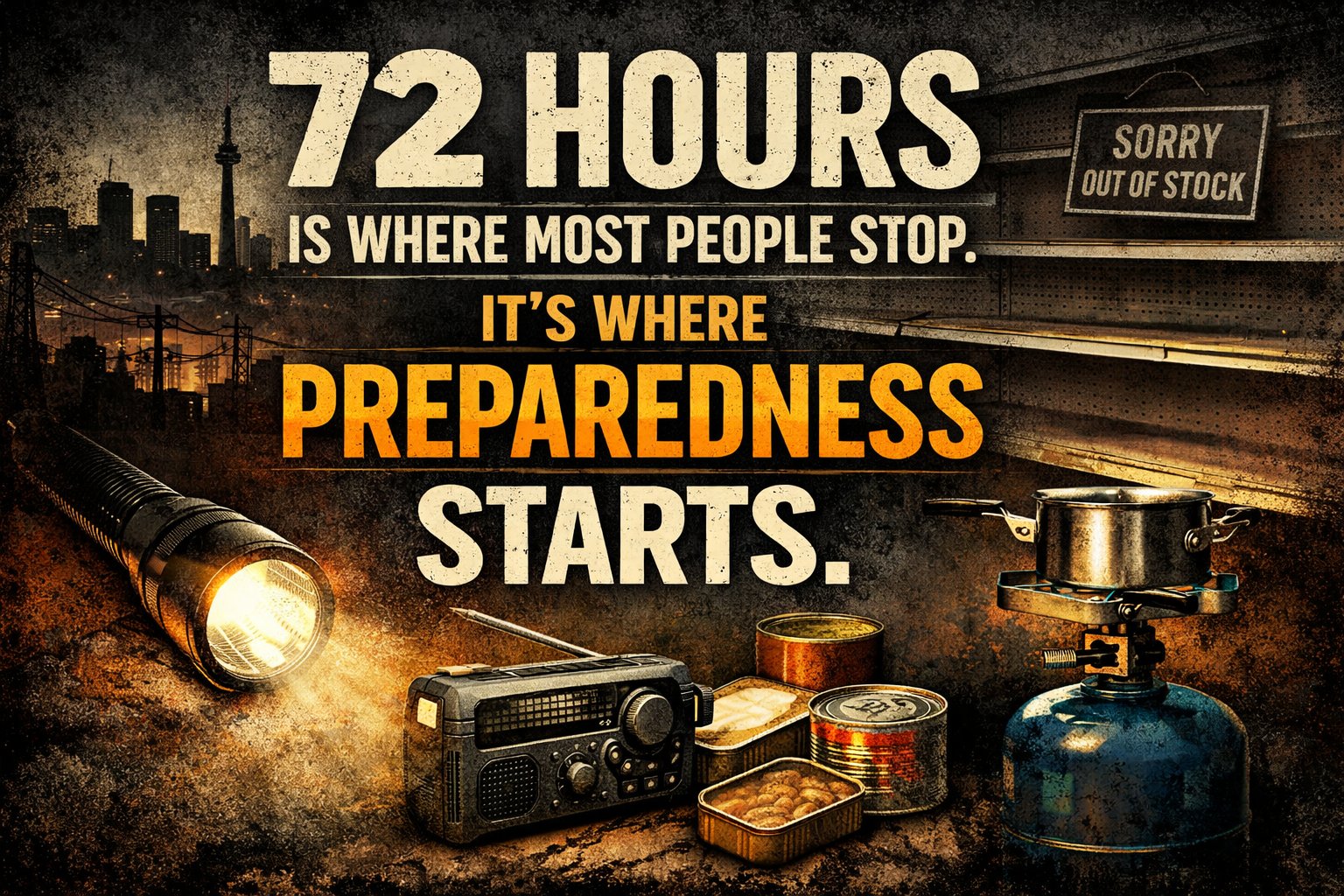
72 hours is where most people stop.
It’s where preparedness starts.
Once you’ve covered the basics, the next step is understanding how disruptions actually unfold over time—not just in hours, but in days:
👉 https://canadianpreppersnetwork.com/your-first-7-days-without-normal-supply-chains/