
Disclosure: This article contains Amazon affiliate links. As an Amazon Associate, Canadian Preppers Network may earn from qualifying purchases.
Energy preparedness is one of the most tempting areas to oversimplify.
People see a generator, a solar panel, a portable power station, or a battery bank and assume the problem is solved. It is not. A real household energy plan is not built around one device. It is built around the loads that matter, the conditions the system must survive, the fuel or sunlight available, the safety risks involved, and the length of time the household needs to function when the grid is unreliable.
For Canadian preppers, energy production has to be realistic. Winter changes solar output. Cold affects batteries. Ice storms damage lines. Wildfires can trigger evacuations. Flooding can make equipment unsafe. Fuel can degrade. Generators can create carbon monoxide hazards. Power stations can be overestimated. A freezer, furnace blower, well pump, sump pump, medical device, radio, phone, and lighting system do not all have the same power needs.
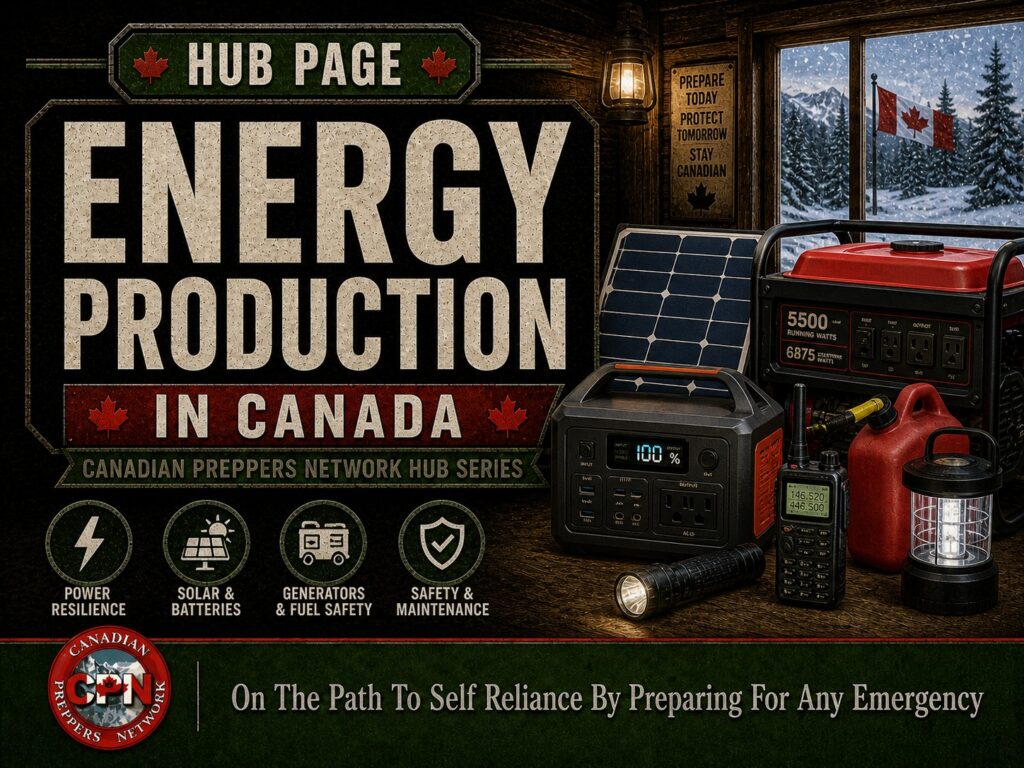
This page is the Canadian Preppers Network hub for energy production. It connects the major parts of the subject into one practical Canadian framework: reducing demand, identifying critical loads, building layered backup power, using generators safely, understanding solar and batteries, planning for communications, avoiding carbon monoxide risk, and maintaining systems before the emergency.
Why Energy Production Matters in Canada
Power outages in Canada are not rare events. They can be caused by storms, freezing rain, high winds, wildfires, flooding, equipment failures, vehicle collisions, overloaded systems, or planned shutoffs. In winter, a power outage is not just about darkness. It can affect heat, sump pumps, well pumps, refrigeration, freezers, communications, medical equipment, lighting, cooking, garage doors, internet, and the ability to receive information.
The Government of Canada’s power outage guidance recommends preparing ahead of time, checking smoke and carbon monoxide alarms, using flashlights instead of candles to reduce fire risk, and understanding how to reconnect appliances safely when power returns. It also warns that backup generators connected to a home electrical system must use an approved transfer panel and switch installed by a qualified electrician, and that a generator should never be plugged into a wall outlet.
Health Canada’s carbon monoxide guidance adds one of the most important generator safety points: fuel-burning generators should never be operated indoors and should be used at least six metres, or twenty feet, from buildings, with exhaust directed away from open windows and doors.
That matters because energy preparedness is not just about keeping devices running. It is about doing it without creating a second emergency.
Energy Preparedness Begins With Load Reduction
The first layer of energy preparedness is not production. It is reduction.
Every watt you do not need is a watt you do not have to generate, store, fuel, wire, or protect. This is the same logic used in shelter and heat preparedness. A well-insulated home is easier to heat. A household with LED lighting, charged batteries, manual backups, and efficient habits is easier to power.
Before buying equipment, ask what actually needs electricity.
A fridge or freezer may matter. A furnace blower may matter. A sump pump may matter. A well pump may matter. Medical equipment may matter. Phones, radios, and lights matter. But many household loads do not matter during an emergency. Entertainment systems, large appliances, electric space heaters, electric ovens, and convenience devices can overwhelm a backup system quickly.
A practical energy plan starts by separating critical loads from comfort loads.
Critical loads are the things that protect life, health, communication, food, water, shelter, and safety. Comfort loads are useful, but they are not the first priority. A household that understands this difference can build a smaller, safer, and more affordable backup system.
The Three Layers of a Prepared Energy System
A serious household energy plan should be built in layers. Each layer solves a different problem.
The first layer is low-draw resilience. This includes LED lighting, rechargeable batteries, power banks, battery radios, phone charging, printed information, manual tools, and non-electric alternatives. This layer keeps basic household function alive without requiring a large power system.
The second layer is stored power. This includes portable power stations, battery banks, rechargeable AA and AAA batteries, solar-charged devices, and properly maintained battery systems. Stored power is quiet, indoor-friendly when used properly, and useful for communications, lighting, small electronics, and some medical or household devices.
The third layer is power production. This includes solar panels, fuel-powered generators, vehicle charging, larger battery systems, professionally installed standby systems, and other sources that can replenish or produce power. This layer requires the most planning because it adds safety, maintenance, fuel, weather, electrical, and installation concerns.
Most households should build those layers in order. A family that has no charged power banks, no battery radio, and no LED lanterns should not begin by imagining a whole-home system. Start with the loads that matter most and build outward.
The First 30 Days
A practical starting target is thirty days of energy preparedness improvement.
That does not mean powering the whole house for a month. It means building a household energy system that can keep essential functions alive while normal power is interrupted.
The first week should focus on an energy audit. Walk through the house and identify what truly needs power during an outage. List lights, phones, radios, fridge, freezer, furnace controls, sump pump, well pump, medical equipment, internet equipment, security devices, and any other critical load. Then separate what is essential from what is merely convenient.
The second week should focus on small power. Charge and label power banks. Add LED lanterns and headlamps. Check battery supplies. Add rechargeable batteries and a charger. Keep charging cables in one place. Make sure radios and phones can be charged from more than one source.
The third week should focus on stored power. Consider whether a portable power station fits the household’s needs for phones, radios, lights, small appliances, medical devices, or short-term fridge support. Match the device to the actual load instead of trusting marketing language.
The fourth week should focus on production and safety. If using solar, test it before relying on it. If using a generator, review carbon monoxide safety, electrical connection safety, fuel storage rules, maintenance, and local requirements. If the system connects to household wiring, involve a qualified electrician and proper transfer equipment.
A month of testing and organization is more valuable than buying gear and leaving it boxed.
Critical Loads Come First
The phrase “backup power” is too broad. It encourages people to think in terms of powering the house instead of powering the mission.
A better question is: what must keep working?
For some households, the top priority is heat. For others, it is a sump pump. For rural homes, it may be a well pump. For families with medical needs, it may be a device, refrigeration for medication, or communication with caregivers. For food storage, it may be a freezer. For almost everyone, it includes lighting, phone charging, radio, and basic information access.
Once the critical loads are known, the system can be sized around them. Without that list, people often buy equipment that looks impressive but does not actually solve the household’s real problem.
For CPN’s deeper look at layered power planning, read Energy Resilience in 2026: Building Redundant Power When the Grid Can’t Be Trusted.
Portable Power Stations: Useful, But Not Magic
Portable power stations have become popular because they are quiet, clean at the point of use, and easy to operate compared with fuel-powered generators. They are useful for phones, radios, lights, laptops, small medical devices, USB equipment, and some limited household loads.
But they are not magic boxes.
Capacity matters. Output matters. Battery chemistry matters. Cold affects performance. Recharge time matters. Solar input may be limited. Large appliances can drain them quickly. Electric heating loads can overwhelm them. A power station that looks large on a sales page may not run what the household assumes it will run.
The Government of Canada’s power outage guidance notes that battery- or solar-powered portable generators do not produce carbon monoxide and can be used anywhere, which makes them safer for indoor small-device power than fuel-burning generators.
That does not remove all risk. Health Canada’s lithium-ion battery safety guidance says to use the original battery and charger, bring batteries to room temperature before use, not charge them below freezing, and never modify, tamper with, or build your own lithium-ion batteries because doing so can increase fire and explosion risk.
For CPN’s more realistic take, read Portable Power Stations: Useful Tool or False Security for Canadian Preppers?
Useful stored-power gear:
- Portable power stations are useful for phones, radios, lights, laptops, small electronics, and carefully selected low-draw loads.
- USB power banks are one of the easiest ways to keep phones and small devices running.
- Rechargeable AA and AAA batteries support radios, flashlights, headlamps, and small household devices.
- Battery organizers help keep charged and uncharged batteries from becoming a useless mixed pile.
Solar Power in Canadian Conditions
Solar can be extremely useful, but it needs realistic expectations.
Natural Resources Canada describes solar photovoltaic systems in buildings as a safe and reliable source of solar electricity that produces no on-site pollution or emissions and has few operating costs. NRCan also provides photovoltaic potential and solar resource maps for Canada, which is a useful reminder that solar performance depends heavily on location, season, roof angle, shading, weather, and system design.
For Canadian preppers, the problem is not whether solar works. It does. The problem is whether the system is matched to the actual emergency need.
A small panel may keep phones and radios alive. A folding panel may recharge a portable power station slowly when weather allows. A larger fixed system with batteries may support more serious loads, but it becomes a design, installation, cost, code, maintenance, and winter-performance issue.
Winter is the hard test. Shorter days, snow cover, cloudy weather, low sun angle, and cold-weather battery limits all matter. Solar should be treated as one layer, not the only layer.
For a deeper CPN discussion, read How to Run a Home on Solar Power Alone.
Useful solar-support gear:
- Folding solar panels can help recharge small systems when weather and sunlight cooperate.
- Portable solar panel extension cables can help position panels where the sun is stronger while keeping the power station sheltered.
- Solar charge controllers are part of properly designed small solar systems, but they must be matched to the panels and battery system.
- DC power meters can help users understand real input and output instead of relying on guesses.
Fuel-Powered Generators: Powerful, But Risky
Fuel-powered generators can provide serious capability. They may support refrigerators, freezers, pumps, tools, battery charging, furnace blowers, or selected household circuits when the system is designed properly.
But generators create some of the most serious safety risks in household preparedness.
They produce carbon monoxide. They can create electrical hazards. They require fuel. They need maintenance. They make noise. They can attract attention. They must be protected from weather without being enclosed dangerously. They can overload. They can be misconnected. They can endanger utility workers if backfeeding occurs.
The Electrical Safety Authority in Ontario states that standby generators permanently connected to home wiring must have a transfer device to protect the home and utility system, and that the transfer device prevents generator power from flowing back into the utility system.
For a portable generator that is not connected through proper transfer equipment, the safer approach is to power appropriate plug-in loads directly with properly rated outdoor extension cords and to follow manufacturer instructions and local electrical requirements. The Government of Canada is clear that a generator should never be plugged into a wall outlet.
This is not a corner-cutting category. If a generator is part of the plan, safety and maintenance are part of the plan.
Carbon Monoxide Planning Is Energy Planning
Carbon monoxide planning belongs in every energy hub because backup power and backup heat often involve fuel-burning devices.
Carbon monoxide cannot be seen or smelled. It can build up when generators, barbecues, camp stoves, fuel-burning heaters, or engines are used incorrectly or too close to openings. Health Canada warns that generators should never be operated indoors and should be kept at least six metres from buildings, with exhaust directed away from windows and doors.
A serious energy plan includes working carbon monoxide alarms, smoke alarms, safe generator placement, proper cords, no indoor fuel-burning equipment unless specifically designed and approved for indoor use, and a household rule that alarms are never ignored.
Useful safety gear:
- Carbon monoxide alarms are essential where fuel-burning appliances, generators, attached garages, wood stoves, or fireplaces are part of the home environment.
- Smoke alarms should be kept working because outages often increase fire risk.
- Home fire extinguishers belong near kitchens, heating areas, workshops, and exits.
- Battery emergency lights reduce reliance on candles and help keep movement safer during outages.
Electrical Connections Must Be Done Properly
Improvised electrical connections can be dangerous.
Backfeeding a home through a wall outlet is unsafe. Connecting generators to panels without proper transfer equipment is unsafe. Undersized cords can overheat. Indoor cords used outside can fail. Wet connections can shock or start fires. Overloaded circuits can damage equipment.
The Government of Canada says that if extension cords must be used, they should be properly rated and CSA-approved, and that a backup generator may only be connected to a home electrical system through an approved transfer panel and switch installed by a qualified electrician.
That should be the standard for a Canadian prepper household. If the system touches the home electrical panel, bring in qualified help and follow local rules. Preparedness should not create a hazard for the household, neighbours, or utility workers.
Useful electrical-support gear:
- CSA-approved outdoor extension cords are useful for safe temporary outdoor-rated connections where appropriate.
- Power outage LED lanterns reduce the need to run larger systems for basic lighting.
- Plug-in power meters help measure actual appliance loads before building backup-power assumptions around them.
- Heavy-duty cable organizers help keep cords stored, visible, and less likely to become a tangled emergency problem.
Fuel Planning Without Fantasy
Fuel is the weak point in many generator plans.
A generator without fuel is dead weight. Fuel stored improperly can degrade, leak, create fire risk, violate local rules, or become unusable. In a long disruption, refuelling may be limited by road conditions, station power, supply shortages, or safety concerns. In winter, fuel handling becomes more difficult. During evacuations, stored fuel may become something you cannot safely take with you.
Fuel planning should be conservative and lawful. Store only what is appropriate, legal, and safe for your household and location. Use approved containers. Keep fuel away from living areas and ignition sources. Follow local fire codes, insurance requirements, manufacturer guidance, and common sense. Rotate fuel as required. Do not treat fuel as an afterthought.
For the broader CPN discussion, read Fuel Storage in Canada: Propane vs Gasoline vs Diesel vs Kerosene.
The preparedness lesson is simple: do not build an energy plan that depends on fuel you do not have, cannot store safely, cannot replace, or cannot use legally.
Energy and Heat Are Connected
Energy planning and heat planning overlap, but they are not the same thing.
Trying to heat a Canadian home with electric resistance heat from a battery system is usually unrealistic for most households. Heat requires enormous energy. That is why shelter and heat preparedness should focus first on insulation, room consolidation, safe backup heat, wood heat where appropriate, and reducing heat loss.
Electric backup power is better reserved for high-value electrical functions: furnace controls, blower motors where compatible, pumps, communications, lighting, medical devices, and refrigeration.
A household that removes electric heating demand from the backup-power plan makes the entire energy system easier to build.
For more on the heat side, see CPN’s Backup Heating Systems Compared.
Energy and Water Are Connected
Water often depends on power.
Municipal water systems may lose pressure during major failures. Rural wells usually depend on electric pumps. Sump pumps depend on electricity. Pressure tanks have limits. Hot water systems may require power for controls, ignition, pumps, or safety systems. During flooding, electrical equipment can become unsafe.
This is why the water hub and energy hub should be linked. If the household depends on a well, the energy plan should include how water will be accessed or stored if the pump cannot run. If the basement is vulnerable, the sump pump becomes a critical load. If water treatment or filtration depends on electricity, there should be a non-electric fallback.
Stored water reduces the pressure on the energy system. Gravity filtration reduces dependence on powered treatment. Manual options reduce the number of loads that must be supported.
Energy and Communications Are Connected
Communications fail quickly when batteries die.
Phones, radios, routers, laptops, tablets, rechargeable lights, and signal devices all depend on power. During an emergency, people use devices more heavily, not less. They check maps, call family, follow alerts, use flashlights, take photos, and search for updates. Batteries drain faster than expected.
The communications energy plan should be simple. Keep phones charged. Keep power banks charged. Store spare cables. Keep a battery-powered AM/FM radio. Use LED lanterns instead of phone flashlights. Protect batteries from cold. Use printed plans so information does not live only on devices.
This is the easiest part of energy preparedness to improve quickly, and it often delivers the fastest results.
Manual and Low-Tech Power Still Matter
Manual systems are often overlooked because they are not impressive.
A manual can opener, hand tools, paper maps, mechanical locks, gravity-fed water, non-electric lighting, wool blankets, passive cooling habits, and simple cooking alternatives reduce the burden on the energy system. They do not generate electricity, but they reduce the amount of electricity required.
CPN’s Very Small-Scale Manual Power Generation for Charging Essential Devices looks at the limits of manual charging. The important point is that manual power is generally a supplement, not a full solution. It can help small devices, but it should not be expected to run a household.
Preparedness is stronger when essential tasks do not all depend on electricity.
Maintenance Keeps the System Real
Backup power systems fail when they are ignored.
Generators need to be run, maintained, and stored properly. Batteries need to be checked. Solar panels need to be tested. Cables need to be found. Power stations need to be recharged. Extension cords need to be inspected. Fuel needs to be rotated. Alarms need batteries. Smoke and carbon monoxide detectors need testing. People need to know how the system is supposed to work.
CPN’s The Overlooked Side of Backup Power: Maintenance That Keeps It Running is the right companion article for this hub because it addresses the part of preparedness most people skip.
A backup power system that has not been tested is only a theory.
Common Energy Preparedness Failures
Most energy failures are ordinary.
The power station is not charged. The solar panel has never been tested. The generator will not start. The extension cord is too small. The family tries to power too much at once. The freezer is plugged in without knowing the load. Fuel is old. The transfer switch was never installed. The carbon monoxide alarm is missing. Batteries were left in the cold. The household owns ten devices but no clear priority list. Everyone assumes someone else knows how the system works.
The solution is not to buy everything. The solution is to build a layered system and test it.
Know your loads. Reduce demand. Store small power. Add safe production. Protect against carbon monoxide. Use proper electrical connections. Maintain everything. Rehearse before the outage.
Energy preparedness is not a pile of gear.
It is a working system.
Practical Gear Mentioned In This Guide
If your energy plan is still mostly “we’ll charge things somehow,” start with small, safe, useful layers before chasing whole-home power.
- USB power banks keep phones, radios, and small USB devices running longer.
- Portable power stations support small electronics, lights, radios, laptops, and carefully selected low-draw loads.
- LED lanterns provide efficient lighting without relying on phone batteries.
- Rechargeable AA and AAA batteries support radios, headlamps, flashlights, and small emergency gear.
- Battery organizers keep battery storage orderly and easier to rotate.
- Plug-in power meters help measure real appliance loads before planning backup power.
- Folding solar panels can help recharge portable systems when sunlight allows.
- CSA-approved outdoor extension cords support safer temporary power setups when used within their rating.
- Carbon monoxide alarms are essential where fuel-burning appliances, attached garages, fireplaces, or generators are part of the household environment.
- Home fire extinguishers belong near kitchens, heating areas, workshops, and exits.
Recommended CPN Reading
To keep building your energy preparedness system, continue with these CPN articles:
- Energy Resilience in 2026: Building Redundant Power When the Grid Can’t Be Trusted
- Portable Power Stations: Useful Tool or False Security for Canadian Preppers?
- How to Run a Home on Solar Power Alone
- The Overlooked Side of Backup Power: Maintenance That Keeps It Running
- Very Small-Scale Manual Power Generation for Charging Essential Devices
- Fuel Storage in Canada: Propane vs Gasoline vs Diesel vs Kerosene
- Backup Heating Systems Compared
Canadian Sources Used
- Government of Canada: Power outage preparedness
- Health Canada: Carbon monoxide exposure prevention
- Health Canada: Lithium-ion battery safety
- Natural Resources Canada: Solar photovoltaic energy in buildings
- Natural Resources Canada: Photovoltaic potential and solar resource maps of Canada
- Electrical Safety Authority: Generator safety and transfer devices
- Canadian Centre for Occupational Health and Safety: Lithium-ion battery charging safety
- Canadian Preppers Network energy production archive
Final Thought
Energy preparedness is not about owning the biggest generator or the most expensive battery.
It is about knowing what must keep working.
A prepared household reduces demand, identifies critical loads, stores small power, adds safe backup production, protects against carbon monoxide, respects electrical safety, and maintains the system before the outage.
Solar has a place.
Batteries have a place.
Generators have a place.
Manual systems have a place.
But none of them should stand alone.
In Canada, real energy resilience comes from layers, testing, safety, and restraint. Keep the essentials running. Keep the household informed. Keep the lights on where they matter. Keep heat, water, communications, and safety connected.
That is energy production that actually works when the grid does not.
That is energy production that actually works when the grid does not.