
Water preparedness is not just about buying a few cases of bottled water and putting them in the basement.
Bottled water is useful, but it is only one layer of a real water plan. A household also needs storage containers, filtration, purification, hauling methods, testing supplies, hoses, pumps, and a way to move water when the taps stop working or the well pump has no power.
That matters in Canada because water problems do not only come from wilderness survival scenarios. They come from boil-water advisories, ice storms, power outages, flooded wells, municipal disruptions, broken pumps, frozen lines, contamination concerns, and supply interruptions that make bottled water disappear from store shelves quickly.
This buying guide focuses on the supplies that help a household store, move, filter, purify, and manage emergency water at home.
Start Here: Core Emergency Water Supplies
If you are building your water preparedness system from scratch, start with the items that solve the biggest problems first: storage, filtration, purification, and handling.
Emergency Water Storage Containers
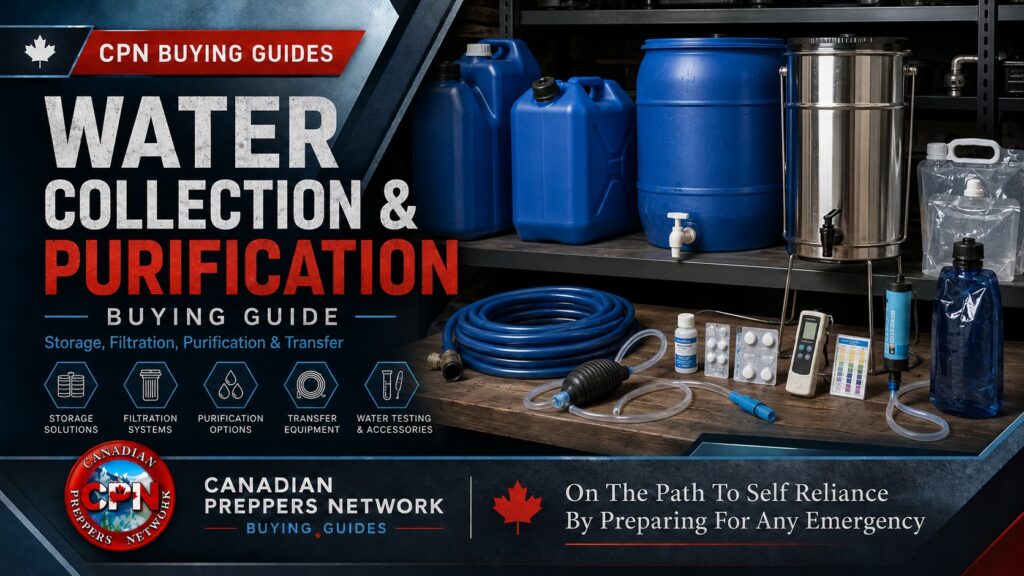
These categories create the basic water system: stored water for immediate use, filters for questionable water, purification as a backup, testing supplies for awareness, and pumps or hoses to move water when carrying it by hand is not practical.
Best For Immediate Preparedness: Water Storage Containers
The first water problem to solve is storage.
Most households do not store enough water to get through a serious disruption. A few cases of bottled water may help for drinking, but they do not cover cooking, hygiene, pets, sanitation, dishwashing, or flushing. Once the taps stop, water disappears faster than people expect.
Dedicated water containers are usually better than relying only on disposable bottles. They are easier to stack, easier to rotate, more durable, and better suited to household storage. Smaller jugs are easier to lift and pour. Larger containers store more volume but become heavy quickly, so placement matters.
Store water where it will not freeze, overheat, or sit directly on damp concrete. Label containers with the fill date and rotate them on a schedule.
Emergency Water Storage Containers
Stackable Water Storage Containers
Best For Household Filtration: Gravity Water Filters
A gravity water filter is one of the most useful filtration options for home preparedness.
It does not require household water pressure. It does not depend on electricity. It can sit on a counter or table and process water while you work on other tasks. That makes it useful during boil-water advisories, short outages, camping, cottage use, and emergency household filtration.
Gravity filters are not all the same. Before buying, check what the filter claims to reduce, how many litres the elements are rated for, how easy replacement filters are to find, and whether the system fits the number of people in your household.
A small household may be fine with a compact unit. A larger family, group retreat, or community setup may need more capacity.
Countertop Gravity Water Filters
Replacement Water Filter Elements
Best For Portable Use: Pump Filters and Squeeze Filters
Portable water filters are useful when water has to be collected away from the house.
That could mean hiking to a creek, using water from a lake, collecting from a rain barrel, travelling during an evacuation, or keeping a backup filter in a vehicle kit. Pump filters and squeeze filters are not replacements for household water storage, but they add flexibility.
For Canadian conditions, durability matters. Cold weather, muddy water, sediment, and rough handling can all affect filter performance. Keep filters from freezing after they have been used, because trapped water can damage some filter elements.
Best Backup Layer: Water Purification Tablets and Drops
Filtration and purification are not the same thing.
A filter removes or reduces certain contaminants depending on its design. Chemical purification products are used to treat water biologically when appropriate. In a real emergency, having more than one method is better than relying on a single product.
Purification tablets and drops are compact, lightweight, and easy to store. They are useful in vehicle kits, bug-out bags, camping kits, cottage supplies, and as a backup to stored water.
Read the instructions carefully. Contact time, water temperature, cloudiness, and dosage all matter. Very cold or dirty water may require extra care.
Emergency Water Purification Supplies
Best For Knowing What You Are Dealing With: Water Testing Supplies
Water can look clear and still be unsafe.
Basic test strips are not a laboratory, but they can help a household identify common water quality issues and decide whether more caution is needed. They are especially useful for wells, stored water, rainwater systems, and locations where water quality changes after flooding or seasonal runoff.
For serious contamination concerns, use proper testing through a qualified lab. But for routine preparedness awareness, having basic testing supplies is better than guessing.
Best For Moving Water: Hoses, Siphons, and Transfer Pumps
Storing water is one thing. Moving it is another.
Water is heavy. Carrying buckets across a property, up stairs, from a rain barrel, out of a storage tank, or from a wellhead gets old quickly. A water plan should include ways to move water without exhausting people.
Food-safe hoses, siphon pumps, hand pumps, and 12-volt transfer pumps can all help. A 12-volt pump can be useful with a vehicle battery, solar-charged battery, or portable power station. Manual pumps are useful when electricity is unavailable or when simplicity matters more than speed.
12-Volt Submersible Water Pumps
Best For Rainwater and Bulk Storage Support
Rainwater collection can be useful for gardens, flushing, cleaning, animals, and emergency non-potable water. With proper treatment, some households may also use collected water as part of a broader emergency water plan.
The key is to separate drinking water assumptions from general water use. Not all stored or collected water should be treated as drinking water without filtration, purification, and testing.
For bulk water handling, useful supplies include barrels, screens, diverters, hose fittings, covers, and transfer tools. Keep systems protected from debris, insects, algae growth, freezing, and contamination.
Best For Well Owners: Backup Water Movement
Well owners have a different problem than municipal water users.
They may have water underground, but no easy way to access it if the well pump has no power. That makes backup pumping and power planning important. A generator, power station, solar setup, 12-volt transfer pump, or manual pump may all have a role depending on the well, depth, property layout, and budget.
Not every pump works for every well. Deep wells, shallow wells, cisterns, tanks, and surface water all require different approaches. Before buying expensive equipment, confirm the depth, plumbing, power requirements, and realistic use case.
What To Buy First
For a new water preparedness system, start with the items that solve the most urgent problems.
Buy first:
- Emergency water storage containers
- Water storage jugs
- Gravity water filter
- Purification tablets or drops
- Drinking water test strips
- Food-safe hose or siphon pump
Then expand into:
- Portable pump filters
- Replacement filter elements
- Rain barrel supplies
- Manual water transfer pump
- 12-volt water transfer pump
- Well backup pumping options
This order builds the system in layers. First you store water. Then you filter and purify. Then you test. Then you improve your ability to collect and move water.
Related CPN Reading
Water Collection & Purification in Canada
Final Buying Advice
Do not treat water preparedness as one product.
A real household water plan needs stored water, backup sources, filtration, purification, testing, and a way to move water without exhausting everyone in the house.
Start with storage. Add filtration. Add purification. Add testing. Then improve collection and movement.
The goal is not just to have water somewhere on the property.
The goal is to have water you can actually access, treat, and use when normal systems fail.
Amazon Disclosure:
As an Amazon Associate, Canadian Preppers Network may earn from qualifying purchases made through links in this guide. This does not change the price you pay, but it helps support the site.