
Blackout Power Canada: Complete Buying Guide
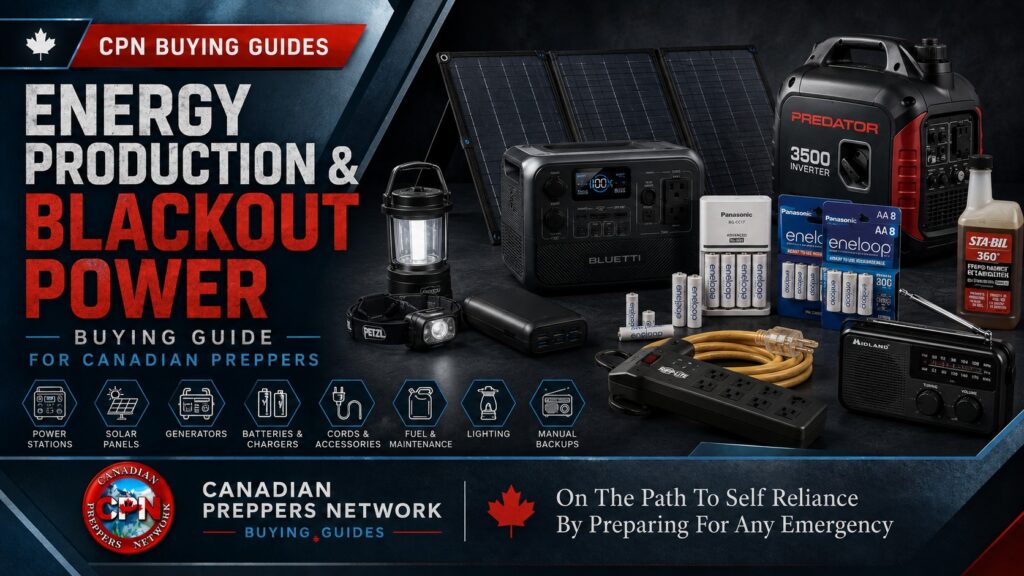
Power is not just convenience.
When the grid goes down, electricity becomes the difference between light and darkness, communication and silence, heat circulation and frozen pipes, preserved food and spoiled food, charged tools and dead batteries. In a short outage, a flashlight and a power bank may be enough. In a long one, the household needs a layered system.
Canadian preppers need to think beyond one generator in the garage.
A proper blackout power plan should include lighting, battery storage, solar charging, safe generator use, extension cords, power management, fuel storage, manual backups, and realistic priorities. You do not need to power the whole house. You need to power what matters first.
That usually means lights, phones, radios, medical devices where applicable, freezer protection, water pumps, fans, battery chargers, and selected tools.
This buying guide focuses on practical blackout and off-grid power supplies for Canadian households, rural properties, retreats, cabins, homesteads, and long-term grid-down planning.
Start Here: Core Blackout Power Supplies
If you are starting from scratch, build your power system in layers.
Solar Panels for Power Stations
Panasonic Eneloop AA Rechargeable Batteries
Panasonic Eneloop AAA Rechargeable Batteries
USB-Powered AA/AAA Battery Chargers
These categories build the foundation: lighting, charging, battery storage, solar input, safe power distribution, and backup generation.
Best First Purchase: Rechargeable Lanterns and Power Banks
Before buying large equipment, cover the basics.
Most outages become harder because people cannot see, charge phones, find supplies, or move around safely. Rechargeable lanterns, headlamps, USB lights, and power banks solve the first layer of the problem without fuel, noise, or complicated setup.
A good blackout lighting setup should include lanterns for rooms, headlamps for hands-free work, small lights for bathrooms and stairways, and enough charging capacity to keep phones and radios alive.
For long-term planning, do not rely only on built-in rechargeable batteries. Keep some lights that use replaceable AA or AAA batteries, and keep quality rechargeable battery sets with a USB-powered charger. Built-in batteries eventually age. Common battery sizes give you more flexibility, especially if you standardize around reliable rechargeable cells.
Portable Power Stations
Portable power stations have become one of the most useful blackout tools for ordinary households.
They are quiet, indoor-safe, rechargeable, and simple enough for most people to use. They can power phones, radios, laptops, lights, small fans, battery chargers, CPAP machines in some cases, and other small to medium loads depending on the unit.
They are not magic. A power station is only a battery in a box with outlets. It must be sized properly, recharged somehow, and protected from overload. Do not buy one based only on headline wattage. Look at watt-hours, surge rating, battery chemistry, AC output, USB output, solar input, recharge time, and whether it can handle the devices you actually care about.
For a Canadian prepper household, a power station makes the most sense when paired with solar panels, rechargeable batteries, LED lighting, and a clear list of power priorities.
Portable Power Station Extension Batteries
Solar Panels and Charging
Solar is slow, weather-dependent, and weaker in Canadian winter than many people expect.
It is still worth having.
A portable solar panel can recharge a power station, top up smaller devices, run USB-powered battery chargers, and extend your blackout capability without fuel. In a long outage, solar may be the only practical way to keep small electronics alive after stored battery power runs down.
The key is realistic expectation. A small folding panel will not run a house. Clouds, shade, low winter sun, short days, snow, and poor placement all reduce output. But a panel that keeps radios, phones, lanterns, and rechargeable batteries alive is still valuable.
For long-term grid-down use, solar works best as part of a small, disciplined power system. Charge during daylight. Use efficient devices. Avoid wasting battery power on non-essentials. Store cables, adapters, and charge controllers with the panels.
Solar Panels for Power Stations
Generators and Safe Backup Power
Fuel-powered generators still have a place.
For freezers, well pumps, tools, sump pumps, and larger loads, a generator can do what small batteries cannot. But generators bring real problems: fuel storage, noise, exhaust, maintenance, theft risk, oil changes, cold starts, and safe power connection.
Never run a generator indoors, in a garage, in a shed, or near windows and doors. Carbon monoxide can kill quickly. A generator plan should include carbon monoxide detectors, outdoor-rated extension cords, proper placement, fuel storage, stabilizer, oil, spare spark plugs, and a maintenance schedule.
A generator is not a set-it-and-forget-it purchase. It must be tested, run under load, maintained, and stored properly.
For serious home use, consider proper transfer switch arrangements installed by qualified people. Backfeeding a house through a dryer outlet or improvised cord is dangerous and can injure utility workers or destroy equipment.
Extension Cords, Power Bars, and Distribution
Power distribution is where many blackout plans fall apart.
People buy a generator or power station, then realize they do not have the right cords, adapters, outdoor-rated cable, surge protection, or safe way to run power where it is needed.
Use heavy-duty extension cords rated for the load. Outdoor cords should be outdoor-rated. Generator cords should match the generator output and intended use. Keep cords organized, labelled, and stored with the equipment they support.
Do not overload cheap power bars. Do not run cords under carpets. Do not use damaged cords. Do not connect multiple questionable adapters together because it “sort of works.”
In a blackout, simple and safe beats clever.
Heavy-Duty Outdoor Extension Cords
Batteries, Chargers, and Small Device Power
Small batteries keep a household functioning.
Flashlights, radios, headlamps, lanterns, thermometers, blood pressure cuffs, small fans, remotes, and other devices often depend on AA, AAA, C, D, 9V, or USB rechargeable batteries.
A good power plan should standardize where possible. Fewer battery types means easier storage, easier rotation, and fewer dead devices. Panasonic Eneloop AA and AAA batteries are a strong choice for a preparedness shelf because they are widely trusted, reusable, and fit many everyday emergency devices.
Rechargeable AA and AAA batteries are especially useful if you can recharge them from solar, a power station, vehicle USB adapter, power bank, or generator. For grid-down planning, choose a USB-powered AA/AAA charger instead of a wall-plug-only model so the charger can work from multiple backup power sources.
Keep disposable backup batteries as well. Rechargeables are useful, but they are not the whole system. In a long grid-down scenario, redundancy matters.
Panasonic Eneloop AA Rechargeable Batteries
Panasonic Eneloop AAA Rechargeable Batteries
USB-Powered AA/AAA Battery Chargers
Fuel Storage and Generator Support
Fuel is part of the system.
A generator without fuel is dead weight. Fuel storage must be treated seriously because gasoline, diesel, and propane all come with storage limits, safety concerns, rotation requirements, and local rules.
For gasoline generators, use approved fuel cans, fuel stabilizer, funnels, labels, and a rotation schedule. For propane systems, store cylinders properly, check hoses and fittings, and keep the right adapters on hand. Keep fuel away from living spaces, ignition sources, children, and anything that could be damaged by leaks or fumes.
Fuel storage is not just about having more. It is about having safe, rotated, usable fuel when you need it.
Keeping Food Cold During a Blackout
Freezers and refrigerators are often the first major power concern.
A full freezer can hold temperature for a while if it stays closed, but eventually the household needs a plan. That plan may include a generator, power station, freezer thermometer, cooler, ice packs, frozen water bottles, and a schedule for when to power the freezer.
Do not waste generator fuel running everything constantly. In many cases, cycling power to a freezer at intervals is more realistic than trying to run it nonstop. Use thermometers so you know what is actually happening inside the freezer, not what you hope is happening.
A freezer alarm or appliance thermometer is cheap compared to losing hundreds of dollars in food.
Manual and Non-Electric Backups
A long-term grid-down plan cannot depend only on rechargeable gear.
Every power system eventually runs into limits: dead batteries, broken cables, cloudy weather, fuel shortages, failed inverters, worn-out battery packs, or equipment that simply stops working. Manual backups keep the household functional when the electrical layer gets thin.
That means manual can openers, hand pumps where applicable, manual grain mills, non-electric lighting options, paper records, printed manuals, mechanical timers, hand tools, and non-electric cooking methods covered in other guides.
This buying guide is about energy, but the smartest power plan is to reduce what needs power in the first place.
Printed Emergency Preparedness Books
Power Planning and Load Management
The most overlooked blackout tool is a written plan.
Before buying more equipment, list what actually needs power. Rank it. Phones and radios first. Medical devices where applicable. Lighting. Freezer. Water pump. Battery chargers. Tools. Everything else comes after.
Then estimate how long each device must run and how often it needs charging. This prevents fantasy math. A small power station might charge phones for days but fail quickly on a heater, kettle, microwave, or large appliance. Electric heat is usually a terrible blackout load unless the system is large enough to handle it.
A plug-in power meter can show what your devices really use. Labels and checklists can help the household avoid wasting limited power.
What To Buy First
For a basic blackout power setup, start with lighting, charging, and safe small-device power.
Buy first:
- Rechargeable LED lanterns
- Rechargeable headlamps
- Power banks
- Panasonic Eneloop AA rechargeable batteries
- Panasonic Eneloop AAA rechargeable batteries
- USB-powered AA/AAA battery charger
- Battery organizer
- Heavy-duty extension cords
- AM/FM emergency radio
- USB charging cables
- Freezer thermometer
Then expand into:
- Portable power station
- Solar panel for power station
- Plug-in power meter
- Outdoor-rated extension cords
- Surge protector power bars
- Inverter generator
- Generator cords and accessories
- Carbon monoxide detectors
- Fuel cans and fuel stabilizer
- Manual can opener
- Hand tools
- Printed emergency references
This order builds the system properly. First you keep people safe, lit, and connected. Then you protect food and charge essential devices. Then you add larger backup systems, generator support, solar charging, and manual fallback tools.
Related CPN Reading
Final Buying Advice
Do not start with the fantasy of powering everything.
Start with the loads that matter.
Lights. Communications. Medical needs. Battery charging. Food preservation. Water support. Then decide how much power is required and how you will replace it when the outage keeps going.
A serious blackout plan has layers: small batteries, rechargeable lights, power banks, power stations, solar input, generator backup, fuel storage, safe cords, manual tools, and written power priorities.
The grid may come back tomorrow.
Or it may not.
Build the system so the household can still function when the easy answers run out.
Amazon Disclosure:
As an Amazon Associate, Canadian Preppers Network may earn from qualifying purchases made through links in this guide. This does not change the price you pay, but it helps support the site.