Keep producing after the summer garden fades.
Most Canadian gardens begin shutting down in August.
The best fall crops to plant in Canada do not all use the same schedule. Tomato plants slow, beans become tired, potato rows are emptied and gardeners begin treating bare soil as finished ground. That may be normal gardening practice, but it wastes one of the most useful planting periods of the year.
Fall planting can accomplish three different jobs:
- Produce another small harvest before winter.
- Establish a crop that will overwinter and resume growing in spring.
- Place dormant seed in cold soil for earlier germination next year.
Those are not interchangeable methods. A radish planted in late summer may be harvested within weeks. Garlic planted later in autumn will remain underground until the following year. Carrots or spinach sown just before the ground freezes may stay dormant until spring.
The correct choice depends on your first expected frost, soil conditions and the protection available. Canada’s plant-hardiness system ranges from Zone 0 to Zone 9, so no single planting date works nationwide.
The practical rule is to work backwards from your local frost date.
Short-season crops can be planted while several weeks of workable weather remain. Dormant seeding must wait until the soil is cold enough that the seed will not germinate before winter. Garlic goes into cooled soil before it freezes solid.
Used properly, these three strategies can keep food-producing ground working long after the conventional garden season appears finished.
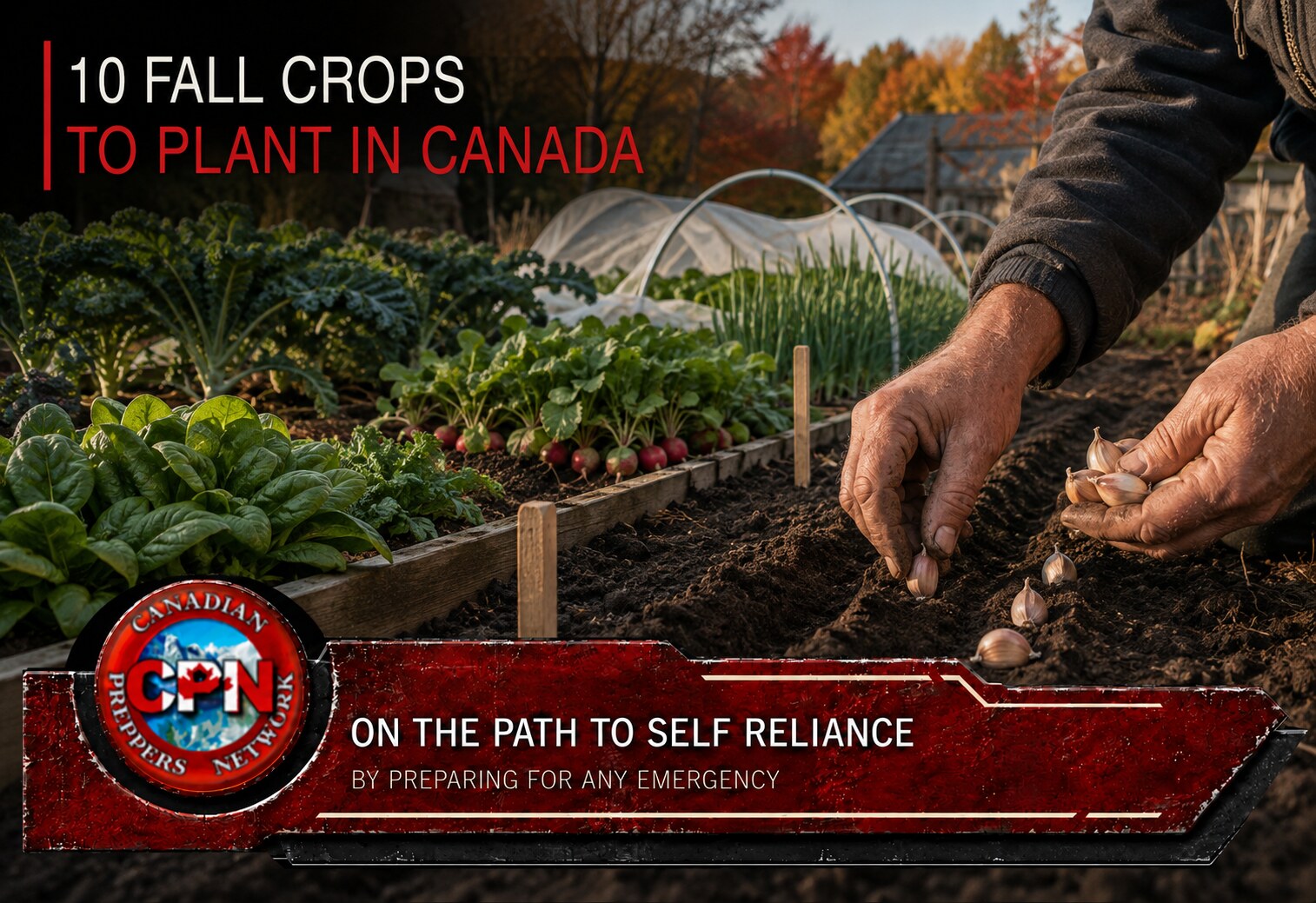
1. Garlic
Garlic is the most dependable fall-planted food crop for much of Canada.
Each clove becomes a new bulb, making garlic easy to propagate without specialized seed-saving knowledge. It stores well, occupies relatively little space and provides considerable culinary value.
Plant healthy cloves from locally adapted planting stock rather than relying on treated grocery-store garlic. Separate the bulb shortly before planting and place each clove with the pointed end upward.
The objective is to give the cloves enough time to establish roots without encouraging excessive top growth before winter. Plant after the soil has cooled, then cover the bed with a loose insulating mulch.
In spring, remove or thin the mulch as growth resumes. Save several of the healthiest and largest bulbs from the harvest for replanting. That simple practice begins turning a one-time purchase into a locally adapted garlic supply.
2. Spinach
Spinach can serve two different fall-planting roles.
Where enough growing time remains, it can produce baby leaves before winter. Under row cover or inside a cold frame, established plants may survive cold weather and resume growing during mild periods.
Spinach can also be dormant-seeded shortly before the ground freezes. The seed remains in place through winter and germinates when spring conditions become favourable.
That early start matters in a disrupted food system. Spinach produces edible leaves before most calorie crops are ready, helping bridge the seasonal gap between stored winter food and the main summer garden.
Plant more seed than you would during ideal spring conditions. Fall establishment is less predictable, and some seed or seedlings may be lost.
3. Carrots
Carrots are valuable because they combine fresh eating, cooking and longer-term storage.
A late-summer planting may produce baby carrots before severe cold arrives. Gardeners in colder regions can instead prepare a clean row and dormant-seed shortly before freeze-up for an early spring start.
Carrot seed is small and slow to emerge. Mark the row carefully so it is not accidentally cultivated in spring.
If established carrots are already growing, another option is to leave part of the crop in the ground under deep mulch and harvest as conditions permit. This does not work equally well in every climate, particularly where soil freezes deeply, but it can extend the usable harvest window.
For preparedness purposes, carrots deserve space because they provide familiar food, store reasonably well under proper conditions and can be used in soups, stews, stocks and preserved meals.
LIMITED-SPACE OUTDOOR EVENT
PLINKIN’ IN THE WOODS
With Frugal Gunnie
Spend a full day developing practical outdoor rimfire marksmanship skills in a controlled setting. Instruction covers multiple shooting positions, stability aids and individual technique.
Saturday, September 12, 2026
8:00 a.m.–5:00 p.m.
Great Ape Empire
267 Highway 6, Wiarton, Ontario
Event admission: $250 CAD
Weekend camping: $20 per person
Space is strictly limited. Adult participants must meet all applicable legal and organizer requirements.
4. Turnips
Turnips provide two foods from one planting.
The leaves can be harvested as greens while the roots continue developing. Young roots mature more quickly than many storage vegetables, making turnips useful when the remaining season is short.
Turnips can also be dormant-seeded for spring germination. This approach trades certainty for speed: weather conditions may reduce germination, but successful seed can emerge before the garden would normally be planted.
Choose varieties with shorter stated maturity times when aiming for an autumn harvest. Harvest young roots rather than waiting for maximum size.
In a food-security garden, the ability to eat both the tops and roots reduces waste and increases the usable return from a small bed.
5. Radishes
Radishes are among the fastest crops available to the late-season gardener.
They tolerate cool weather, occupy little space and can be planted between slower-growing crops. Both the roots and young leaves are edible.
Plant small amounts in succession instead of sowing the entire packet at once. That reduces the risk of having every radish mature simultaneously and gives later plantings a chance if the first encounter unusually warm weather.
Radishes are not a high-calorie survival crop. Their value is speed.
They provide fresh food while slower crops are developing and give the gardener immediate information about soil moisture, pest pressure and the effectiveness of frost protection. A row of radishes is therefore both a harvest and a test of the late-season growing system.
6. Beets
Beets offer edible roots and edible leaves.
Even when the roots do not reach full size, young beet greens can still be harvested. This makes them useful in a shrinking fall window where waiting for complete maturity may be unrealistic.
Select short-season varieties and watch the expected frost date. Beets can tolerate cool conditions, but a hard freeze may damage exposed roots.
For storage, harvest before the soil freezes solid, trim the tops and move sound roots into appropriate cold storage. Damaged beets should be eaten or preserved first.
Beets are particularly useful in a preparedness garden because they can be eaten fresh, pickled, pressure canned using a tested process or stored under suitable root-cellar conditions.
FREE CANADIAN PREPAREDNESS DOWNLOAD
Canadian Grid-Down Starter Kit
Use this printable first-72-hours checklist to examine your household’s water, food, sanitation, power, communications and operating routines before a short outage becomes a prolonged emergency.
7. Kale
Kale tolerates cold better than many common garden vegetables.
In areas where the first frost is close, transplants are usually more practical than starting seed outdoors. Established plants can continue producing leaves after lighter frosts have ended the season for more tender crops.
Harvest the lower leaves while leaving the growing centre intact. This allows the plant to continue producing instead of turning it into a single-use crop.
Protection with row cover, a cold frame or a simple hoop tunnel can extend the harvest further. The goal is not to create summer conditions. It is to reduce wind exposure and moderate rapid temperature changes.
Kale is not a substitute for stored calories, but it can supply fresh greens when most other garden plants are finished.
8. Scallions
Scallions, or green onions, use little garden space and can be harvested at several stages.
They may be planted for a small autumn crop where the season permits, or dormant-seeded for early spring growth. University of Saskatchewan guidance specifically recommends seed onions—particularly scallions—for fall seeding.
Their narrow growth habit makes them useful along bed edges and between larger crops.
Scallions add flavour to otherwise repetitive stored foods and can be harvested without disturbing an entire garden bed. In a small preparedness garden, that efficiency matters.
Mark dormant-seeded rows carefully and avoid planting them where spring runoff collects.
9. Lettuce
Lettuce is useful as a short-season crop because it does not need to form a full head before harvest.
Baby leaves can be cut while conditions remain cool. Seed can also be sown in autumn for possible early spring germination.
Choose loose-leaf varieties rather than depending on large heads. Loose-leaf lettuce produces a usable harvest sooner and can often be cut more than once if the growing centre remains intact.
The crop has limited storage value, but that is not its role.
Lettuce provides fresh food while the household is relying heavily on canned, dried or root-cellared supplies. It also uses small spaces that would otherwise remain bare.
10. Rutabagas
Rutabagas require more patience than radishes or baby greens.
A late-August sowing will not produce a mature autumn crop in much of Canada. Their fall-planting value is mainly as a dormant-seeded crop intended to germinate early the following spring.
This should be treated as an experiment rather than a guaranteed harvest. Sow into prepared soil shortly before freeze-up, use extra seed and mark the row clearly.
Where the method succeeds, the crop receives an early start from spring moisture. Where it fails, the row can be replanted once normal spring conditions arrive.
Rutabagas remain worth testing because mature roots are substantial, cold-tolerant and suitable for longer storage.
Use Two Separate Fall Beds
The simplest system is to divide the fall garden into two functions.
Bed One: Immediate Production
- Radishes
- Spinach
- Lettuce
- Baby beets
- Turnips
- Kale transplants
These crops are planted while enough growing time remains. Row cover is kept nearby and installed when frost threatens.
Bed Two: Next Year’s Head Start
- Garlic
- Carrots
- Scallions
- Spinach
- Turnips
- Rutabagas
Garlic is planted according to local autumn conditions. The remaining seeds are sown only after the soil becomes cold enough to prevent germination before winter.
Record what was planted, the date, the variety and the exact row location. Without a record, dormant-seeded crops are easily mistaken for weeds or destroyed during spring preparation.
BUILD A COMMUNICATIONS BACKUP
Canadian Basic Amateur Radio Course for Preppers
Learn the material required for the Canadian Basic Amateur Radio qualification while developing communications skills that remain useful during outages, infrastructure failures and wider emergencies.
The online course is designed specifically for Canadian preppers and can be completed at your own pace.
Protect the Bed Without Smothering It
Fall crops do not need an elaborate greenhouse, but simple protection can make a significant difference.
Floating row cover reduces wind exposure and protects against light frost. Low hoops prevent the fabric from crushing plants under rain or early snow. A cold frame provides greater protection but must be ventilated during sunny days to prevent overheating.
Mulch is useful for garlic and established roots, but it should not be piled heavily over newly germinated greens. Excessively wet mulch can also shelter rodents and encourage rot.
Protection must be managed, not merely installed.
The Preparedness Value Is Bigger Than the Harvest
A fall garden is unlikely to replace a pantry.
That is not the test.
The real value is learning how food production behaves when light is declining, temperatures are unstable and the margin for error is shrinking. The gardener learns which varieties germinate in cold soil, which beds remain workable, how much protection is required and whether dormant seeding succeeds locally.
Those lessons cannot be learned from a stored seed packet.
A household that can produce even a modest fall harvest has extended its growing season. A household that can overwinter garlic and dormant-seed spring crops has reduced the amount of work and seed required during the busiest planting period.
In a prolonged disruption, those weeks could matter.
The Fall-Garden Kit
Tools for Extending the Canadian Growing Season
These supplies support repeatable late-season planting without turning the garden into a collection of disposable gadgets.
- Open-pollinated cold-season vegetable seeds
- Floating row-cover fabric
- Reusable garden hoops
- Cold frames and compact garden shelters
- Weather-resistant plant labels
- Manual soil thermometers
- Waterproof garden journals
- Rodent-resistant seed-storage containers
Choose durable supplies that can be repaired or reused. Electricity-dependent equipment should supplement the system rather than become essential to it.
Disclosure: This article contains Amazon affiliate links. As an Amazon Associate, Canadian Preppers Network may earn from qualifying purchases.
Related Reading on CPN
- Building a Seed-Saving System Before the Stores Go Quiet
- Best Canadian Heirloom Crops for Seed Saving
- The Last Seed Packet
- Homestead Skills in Canada
- Homestead Skills Buying Guide
Research Sources
- University of Saskatchewan: Fall Seeding
- University of Saskatchewan: Succession Planting
- Natural Resources Canada: Canadian Plant-Hardiness Zones
Final Thought
The end of the summer harvest is not the end of the food-production year.
Some fall crops produce quickly. Others wait beneath the soil. Garlic establishes the foundation of next year’s harvest, while dormant seed may begin growing before the spring garden can even be worked.
The important step is to stop treating an empty bed as finished ground.
Which crop will you use to keep your garden working after summer ends?