Equipment is only one part of surviving when help is unavailable
The power has been out for several days. You are tired, your household is under pressure, and every trip outside takes more planning than it used to. While bringing supplies home, someone approaches aggressively. Your hands are occupied. Your footing is poor. The equipment you trusted is somewhere you cannot immediately reach.
How much of your preparedness still works?
It is an uncomfortable question because buying equipment provides something tangible. Training exposes weaknesses. A purchase arrives in a box; competence takes repeated practice, correction and time.
For a prepared household, personal self-defence deserves the same scrutiny as food storage or backup heat. You would not assume an unfamiliar stove will work simply because you own it. Your defensive preparations need an equally honest assessment.
What Have You Actually Practised?
There is a considerable difference between possessing a defensive tool, understanding its operation and making sound decisions during a confrontation.
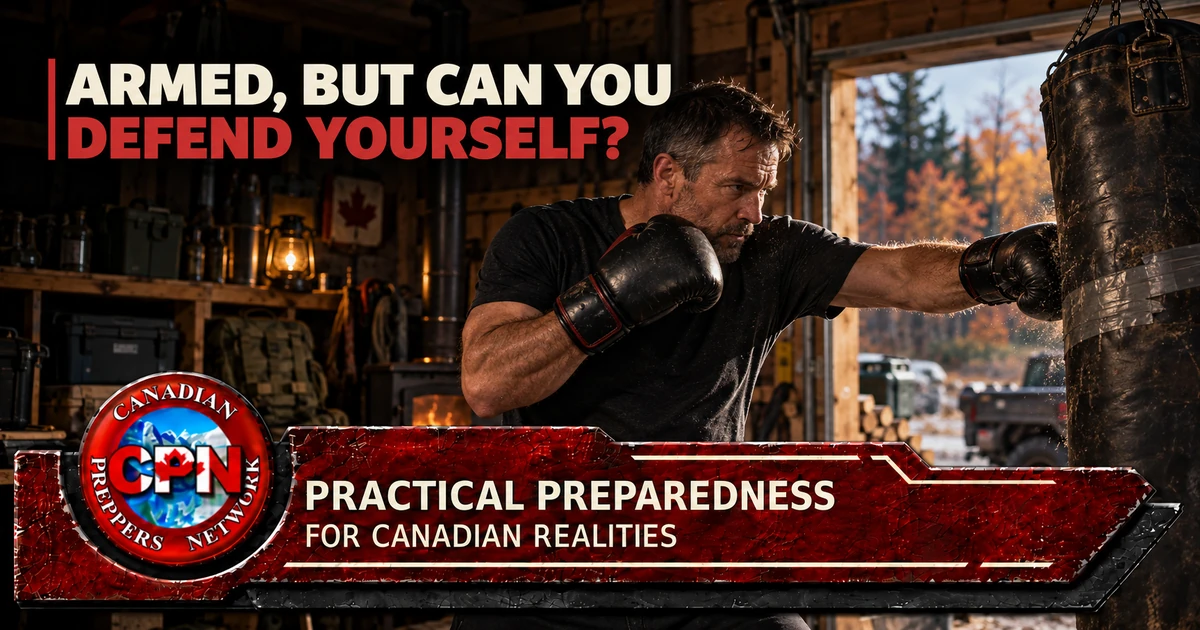
Target shooting develops useful skills. It does not, by itself, teach you how to recognise a developing threat, manage an aggressive conversation or move a family member towards an exit. Hitting a stationary punching bag does not establish that you can remain balanced when another person crowds you.
Each activity has value. The problem comes when we assume one skill covers every other part of self-defence.
Start with a practical inventory:
- Can you recognise when an encounter is becoming dangerous?
- Can you communicate a clear boundary without getting drawn into an argument?
- Can you move away while staying aware of your surroundings?
- Have you received instruction involving a partner who offers controlled resistance?
- Can you handle your equipment safely and consistently?
- Can you identify when leaving is the best available outcome?
Any answer based on “I would probably…” identifies something worth examining.
Notice Trouble While You Still Have Choices
Awareness gives you time to make decisions before a situation becomes physical.
During a prolonged disruption, ordinary tasks may put you in unfamiliar circumstances. Collecting water, waiting for supplies or checking an outbuilding can leave you distracted, carrying something heavy or separated from other household members.
Before stopping somewhere, notice the available exits. Before approaching a vehicle, look around it. If someone becomes confrontational, resist the temptation to concentrate entirely on their words while losing track of distance and surroundings.
The purpose is to preserve options. You may be able to change direction, return indoors, abandon an errand or leave supplies behind. Those decisions become harder once an encounter has moved within arm’s reach.
Discuss these situations with your household beforehand. Agree on a simple signal that means leave immediately. Everyone should understand that abandoning a container of water or a shopping bag can be an acceptable decision.
Supplies can sometimes be replaced. A serious injury may permanently reduce the household’s ability to cope.
Your Body Has to Support the Plan
A defensive plan that assumes speed, strength or endurance you no longer possess needs revision.
Consider the conditions you are likely to face: winter clothing, heavy boots, uneven ground, a loaded pack or several nights of poor sleep. Your normal movement may already be restricted before another person becomes involved.
A useful preparation programme should develop everyday capabilities: walking steadily, carrying manageable loads, maintaining balance and getting up from the ground.
Build gradually from your present ability. If you have existing injuries or health limitations, choose suitable instruction and conditioning with appropriate professional guidance.
You do not need to compete with younger athletes. You do need a realistic understanding of what your body can do. That understanding should influence how much you carry, where you go and how quickly you withdraw from a deteriorating situation.
Find Instruction That Lets You Practise
Look for an instructor who explains the purpose of an exercise, corrects mistakes and introduces resistance progressively.
A cooperative demonstration can help you learn a movement. It cannot establish that the movement will work when someone resists it. Conversely, a class that throws beginners into uncontrolled contact may produce injuries before useful competence.
Ask how the programme teaches balance, distance, escaping unwanted contact and making decisions. Explain your age, limitations and preparedness goals.
Boxing Canada’s coaching material includes structured practice of advancing, retreating and maintaining distance with a partner. Those fundamentals illustrate why movement deserves deliberate training alongside striking.
Boxing, grappling and dedicated self-defence instruction can each contribute useful experience. None offers a guarantee, and sporting practice has conditions that a real confrontation may lack.
Choose instruction you can attend consistently. A sustainable programme with competent coaching is more useful than an impressive course you never practise afterwards.
Keep Firearms Practice Honest
For licensed firearms owners, familiarity and safe handling require maintenance.
Dry-fire practice can help develop sight alignment and trigger control without consuming ammunition. Strikeman describes its system as a supplement to range practice; it does not replace live-fire experience.
Use a deliberate safety routine. Follow your firearm manufacturer’s instructions and verify that the firearm and training device are compatible. Confirm the firearm is unloaded, remove live ammunition from the training area and maintain a safe direction with an appropriate backstop.
Never include a functioning firearm in partner self-defence exercises. Use dedicated inert training equipment under competent supervision.
Keep the limits of practice clear. A laser target provides feedback about a particular task. It cannot tell you whether force was justified, whether you correctly understood a situation or whether another response would have been safer.
Practise Decisions as Well as Movements
Household scenario discussions cost nothing and can expose gaps before an emergency.
Consider someone demanding supplies at your door, an aggressive stranger approaching during a water run or an argument developing while you load a vehicle.
Talk through the decisions: Who speaks? Who moves away? Where is the exit? What happens if someone becomes separated? At what point do you abandon the task?
Keep these exercises calm and clearly announced. Surprise attacks and improvised physical confrontations create unnecessary risk.
If you want to practise contact scenarios, do so in a supervised training environment with agreed rules and appropriate equipment.
The aim is to make useful decisions familiar enough that your household does not have to invent an entire response while frightened.
Understand the Canadian Context
Emergency planning should include an accurate understanding of Canadian self-defence law.
Section 34 of the Criminal Code requires a reasonable belief that force or a threat of force is being used, a defensive purpose and an act that is reasonable in the circumstances. Relevant factors include the nature of the threat, available alternatives, weapons and the parties’ physical capabilities.
A delayed emergency response does not automatically make every use of force reasonable. Keep your planning centred on protecting people, disengaging where possible and ending the danger.
Buy Equipment That Supports Regular Practice
Build the training plan first, then purchase what it requires. Gloves, hand wraps, focus mitts, a suitable mouthguard, resistance bands and a punching bag can support a practical programme, but their usefulness depends on how you use them.
A freestanding punching bag provides a convenient station for practising technique and conditioning between coached sessions. Follow the base-filling instructions, allow clear space around it and learn correct striking mechanics before increasing intensity. Bag work complements instruction; it does not reproduce an opponent’s movement or resistance.
For licensed firearms owners, compatible dry-fire equipment can support regular practice between range visits. Appropriate eye and hearing protection remain part of the live-fire range kit.
Avoid buying an assortment of equipment without a clear purpose. Each item should support something you will practise regularly.
Your next preparedness investment may be a class, a recurring range session or a modest conditioning routine. The useful measure is whether you can make sound decisions and perform the necessary skills reliably.
When help is unavailable, your household needs that ability to exist before the confrontation begins.
Which part of your defensive plan have you actually practised—and which part still depends on what you assume you could do?
Related Reading
- Security & Defence in Canada: build a complete preparedness plan
- Learning by Doing: Why Skills Matter More Than Gear
- The Defensive Home After the Police Stop Coming