Knowledge Becomes Preparedness Only When You Put It Into Practice
Walk through any preparedness event and you will see tables full of impressive gear. Radios, water filters, first aid kits, knives, solar equipment, food preservation tools, emergency lighting, and enough gadgets to fill a trailer.
There is nothing wrong with buying quality equipment. Good gear has its place.
But gear alone has never made anyone prepared.
Preparedness comes from knowing how to use that gear confidently, safely, and efficiently. It comes from practice. It comes from making mistakes while the stakes are low, learning from them, and improving every time you try again.
That is where real self-reliance begins.
Reading Is Good. Doing Is Better.
We live in an age where almost every survival skill can be found online. Thousands of videos explain how to pressure can food, build a fire, navigate with a compass, purify water, operate a chainsaw, program a handheld radio, or administer first aid.
Watching those videos is a great way to start learning.
It is not the same as doing it yourself.
There is a world of difference between understanding a process and being able to perform it when your hands are cold, you are tired after a long day, or something does not go according to plan.
The first time you pressure can food, you will probably check every gauge twice. The first time you build a fire in the rain, you will quickly discover which techniques actually work. The first time you try to program a radio without instructions, you will likely find out just how confusing modern menus can be.
Those experiences are valuable because they expose the small details that books and videos often gloss over.
Preparedness is built by experience, not just information.
Learn From People Who Have Already Made The Mistakes
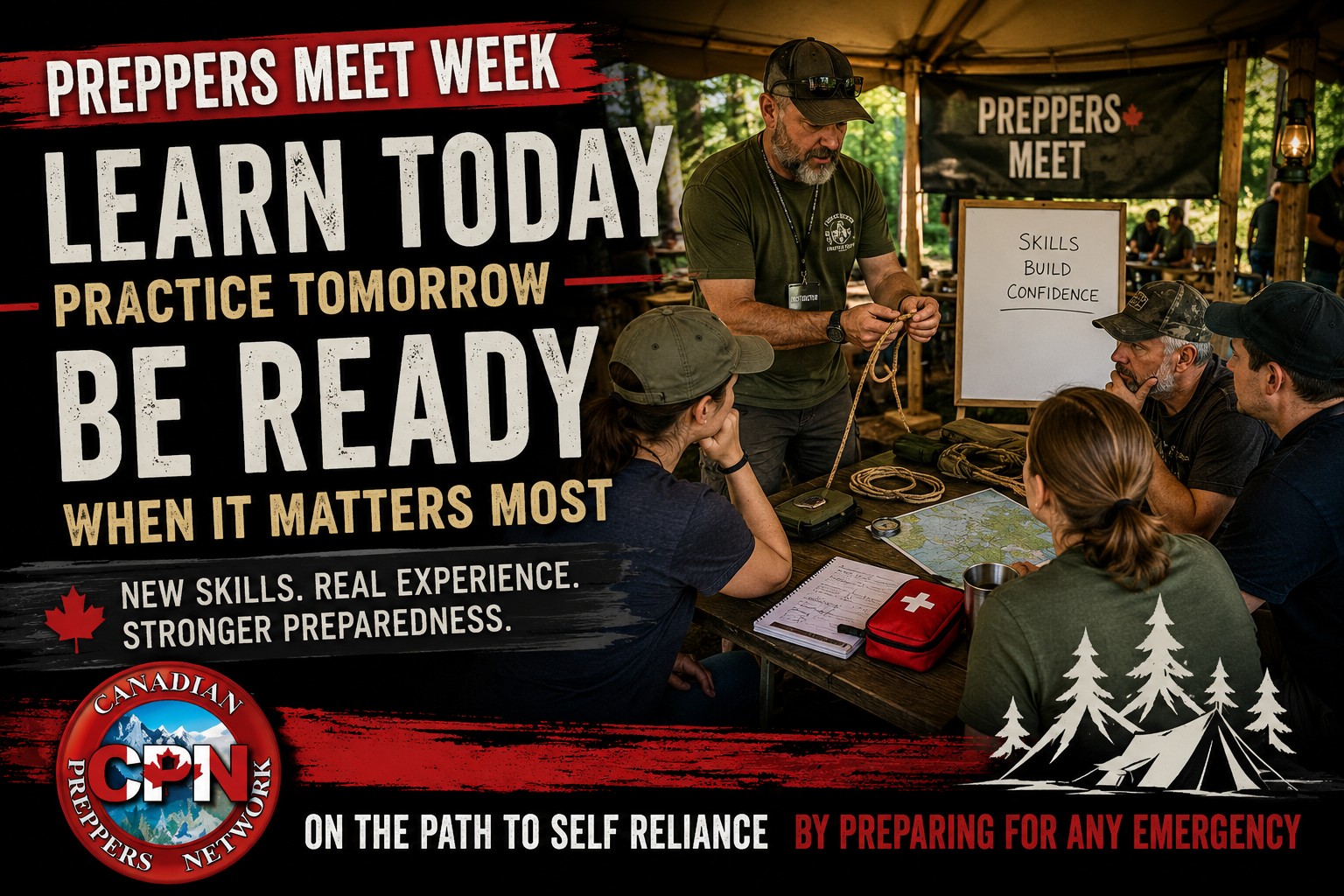
One of the greatest advantages of attending a preparedness gathering is the opportunity to learn from people who have spent years refining their skills.
Experienced instructors rarely teach only the textbook method. They explain what worked, what failed, what equipment disappointed them, and what they would do differently if they were starting again today.
That knowledge is difficult to find in a product manual.
Learning from someone else’s mistakes can save you hundreds of dollars in unnecessary purchases and countless hours of frustration.
Better yet, it can help you avoid developing bad habits that become difficult to correct later.
Every experienced prepper has a collection of stories that begin with, “Do not do what I did.”
Those stories are often worth as much as the formal lesson itself.
Get Your Hands Dirty
Watching a demonstration is valuable.
Participating is better.
If there is an opportunity to handle the equipment, volunteer.
If someone demonstrates a knot, tie it yourself.
If someone explains how to can food, pay attention to every step and ask questions afterwards.
If there is a radio programming session, bring your own radio.
If there is a first aid demonstration, practise the techniques rather than simply watching.
Muscle memory cannot be developed by observation alone.
The more senses involved in learning, the better that knowledge is retained.
The goal is not to leave saying, “That was interesting.”
The goal is to leave saying, “I know how to do that.”
Step Outside Your Comfort Zone
It is natural to attend presentations that match your existing interests.
Radio operators head for communications.
Gardeners attend food production sessions.
Hunters look for firearms or game processing.
Homesteaders gravitate toward livestock and food preservation.
There is nothing wrong with that.
But challenge yourself to attend at least one presentation completely outside your comfort zone.
Take the class you almost skipped.
Sit through the topic you know nothing about.
Ask questions that might feel basic.
Preparedness rewards broad knowledge.
You never know which skill will become valuable later.
Today’s curiosity may become tomorrow’s most important capability.
Accept Being A Beginner
Many people hesitate to try something new because they do not want to look inexperienced.
That attitude prevents learning.
Nobody arrives knowing everything.
Every skilled canner once worried about their first batch.
Every experienced radio operator once struggled to program a repeater.
Every wilderness traveller once had trouble starting a fire.
Every accomplished instructor once asked beginner questions.
Preparedness is not about pretending to know everything.
It is about becoming slightly more capable every day.
The willingness to be a beginner is often the fastest path to becoming an expert.
Skills Fade Without Practice
Learning a skill once does not make it permanent.
First aid techniques fade.
Navigation skills become rusty.
Knots are forgotten.
Radio procedures become unfamiliar.
Food preservation methods lose confidence when they are not repeated.
The weekend should be viewed as the beginning of your learning, not the end.
When you get home, repeat what you learned.
Pressure can another batch.
Program your radios again without looking at notes.
Set up your camp stove in the backyard.
Build another fire.
Practise your first aid scenarios.
Teach the skill to a family member or friend.
Teaching is one of the best ways to discover whether you truly understand something yourself.
Ask Questions
One advantage of learning in person is the opportunity to ask questions immediately.
If something is not clear, ask.
If you are wondering whether a technique would work under different conditions, ask.
If you own different equipment than the instructor, ask how the process changes.
Most instructors enjoy answering thoughtful questions because they know every question helps someone else in the audience as well.
There are very few foolish questions in preparedness.
There are only expensive mistakes that could have been prevented by asking.
Build Confidence, Not Just Knowledge
Preparedness is not about collecting facts.
It is about developing confidence through repetition.
Confidence comes from successfully completing a task more than once.
Once you have canned several batches of food, you will stop second-guessing yourself.
Once you have successfully navigated through unfamiliar woods with a map and compass, you will trust your skills.
Once you have programmed several radios, the menus stop looking intimidating.
Once you have repeatedly started fires under poor conditions, you will know exactly what works.
That confidence cannot be purchased.
It has to be earned.
Turn One Lesson Into A Practice Plan
A useful presentation should lead to action after the event.
Before leaving, write down the skill you learned, the equipment you need, the parts you found difficult, and the first date you will practise it again.
Keep the plan simple.
One new skill practised repeatedly is more valuable than ten demonstrations you never revisit.
Set aside a weekend afternoon. Gather the tools. Work through the process from beginning to end. Record what went well and what needs improvement.
Then repeat it.
That is how a demonstration becomes a dependable capability.
Take More Home Than Gear
It is tempting to measure a preparedness event by what you bought.
A new knife.
A better flashlight.
A larger first aid kit.
A portable solar panel.
Those are all useful purchases.
But the most valuable thing you will take home is not something that fits in your vehicle.
It is the skills you have gained.
Skills do not need batteries.
They cannot be stolen from a storage bin.
They do not become obsolete with next year’s model.
They can be carried into almost any situation and adapted to the tools available.
Capability Is The Real Measure Of Preparedness
Long after equipment has been replaced, the knowledge and experience gained through practice will still be serving you.
That is why the real value of a preparedness gathering is not only found at vendor tables or in the gear carried back to camp.
It is found in the first successful attempt, the useful question, the corrected mistake, and the decision to practise again after returning home.
Do not simply watch a skill being demonstrated.
Try it.
Repeat it.
Teach it.
Make it part of what you can do without hesitation.
That is what preparedness has always been about.