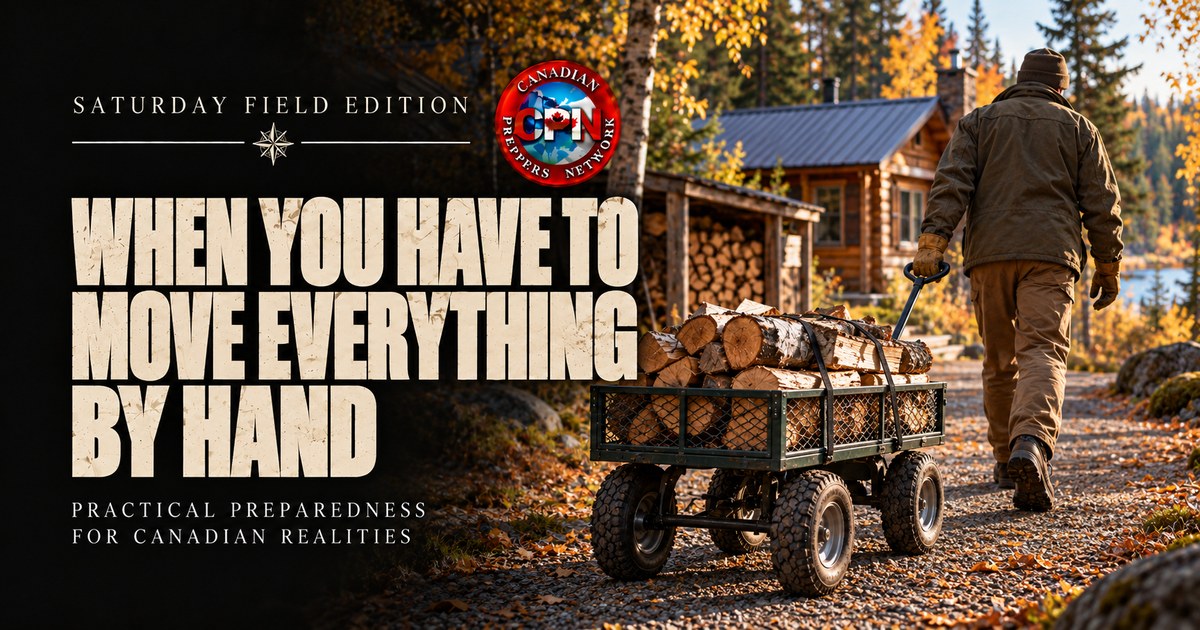
Saturday Field Edition — Manual hauling when fuel and powered equipment are gone
The woodpile is full. The water source is dependable. There are sacks of feed in the shed and enough stored supplies to keep the household going.
Now move them.
Move the firewood through wet snow. Bring water uphill from the collection point. Shift a battery across the property. Get a sack of grain from the storage building to the house without exhausting yourself before the day’s work has properly started.
Preparedness plans often account for what a household needs while overlooking the manual hauling required to move it. Once the truck, tractor, ATV and powered winch stop being available, that oversight becomes a daily burden.
A dependable manual hauling system deserves a place beside your food stores and hand tools. During a prolonged collapse, the ability to move supplies repeatedly could determine how much of your property you can actually use.
FREE CPN DOWNLOAD
Put Your Household Plan to the Test
Your supplies need to work as a system. Use the Canadian Grid-Down Starter Kit to examine your first 72 hours of water, food, heat, sanitation, power and communications.
Manual Hauling Starts With the Journeys You Repeat
Start with the loads your household already moves.
Firewood might travel from the processing area to the woodshed, then from the woodshed to the house. Water may need to come from a rain tank, well or treatment station. Animal feed goes out; manure and soiled bedding come back. Harvests, fencing supplies, tools and household waste all have destinations.
Walk those routes before shopping.
Look for narrow gates, soft ground, exposed roots, steep sections, awkward doorways and steps. Measure the tightest opening. A cart that cannot pass through the woodshed door creates an extra unloading job on every trip.
Then consider the return journey. Can the empty equipment come back easily? Is there somewhere level to park while loading? Will the route remain usable during spring thaw?
The best manual hauling equipment fits the actual journey. This is part of the practical capability discussed in our Homestead Skills in Canada hub: keeping ordinary work manageable when normal conveniences disappear.
Useful Supplies Become Heavy Quickly
Water provides a simple example.
Twenty litres weighs approximately 20 kilograms before adding the container. Four such containers mean roughly 80 kilograms of water, plus packaging.
That might fit comfortably inside a garden cart. Whether one person can move it safely along a particular route is a separate question.
Firewood presents another problem: a load can become tall and unstable before the tub looks particularly full. Feed sacks concentrate weight. Batteries combine substantial weight with the need to protect terminals, cases and connections.
The capacity printed on the equipment is a limit, not a recommended working load for your property.
Read the instructions for the model you own. For example, Gorilla specifies that the rating on its GOR-2240DEC cart assumes an evenly distributed load and calls for inspection before use. The conditions behind a rating matter as much as the headline number.
You need a load you can start, steer, stop, unload and move again. A cart that you can barely drag across the yard once is a poor foundation for a daily routine.
Choose Manual Hauling Equipment for the Job
| Equipment | Where It Earns Its Keep | What to Check |
|---|---|---|
| Hand truck | Boxes, suitable containers and bagged supplies on firm routes. | Toe-plate size, securing points, wheel clearance and load balance. |
| Single-wheel wheelbarrow | Loose materials and routes requiring tight manoeuvres. | Your ability to balance the load and control it while dumping. |
| Two-wheel barrow or yard cart | Routine yard work where less balancing is desirable. | Overall width, turning room and behaviour on uneven ground. |
| Four-wheel utility cart | Multiple containers, tools and supplies along suitable paths. | Steering, ground clearance, parking arrangements and slope restrictions. |
| Utility sled | Winter hauling where snow conditions suit dragging. | Empty weight, attachment points, underside wear and downhill control. |
A hand truck is useful for manual hauling around storage buildings, but small wheels and low clearance can become frustrating outdoors. A wheelbarrow handles many chores, although the operator still supports and balances part of the load.
A four-wheel cart supports the cargo while you move it, but that does not make it suitable for every hillside or woodland trail.
Avoid choosing solely by maximum capacity. Width, wheel size, empty weight and replacement parts may matter more during everyday use.
FROM THE CPN BOOKSHELF
Build the Knowledge Behind Your Supplies
Long-term preparedness requires practical methods you can return to when a job needs doing. Explore CPN’s preparedness books and build your reference shelf alongside your equipment.
Keep Manual Hauling Equipment Working
Wheel failure can turn a useful cart into another object that needs carrying.
Check how the wheels attach, whether replacements are available and which measurements identify a compatible replacement. Tyre size alone does not establish that the hub, axle bore and hub length will fit.
Air-filled tyres require pressure checks and suitable repair supplies. Identify whether yours use inner tubes or are tubeless before buying a repair kit. A tubeless plug kit does not repair a punctured inner tube.
Flat-free wheels remove the puncture problem. They still leave you with axles, hubs, fasteners and steering components to maintain.
For whichever equipment you choose, keep the appropriate hand tools, model information, compatible retaining hardware and manufacturer-specified maintenance supplies together.
Write the wheel and bearing details in your household records. Save the parts diagram and manual while they are easy to obtain.
A spare that fits is preparedness. A box of vaguely similar parts is an unfinished job.
For the tools and repair supplies supporting this equipment, see The Post-Collapse Workshop Box.
Improve Your Manual Hauling Route Before Increasing the Load
A few property changes can reduce the effort of every future manual hauling trip.
Move frequently used supplies closer to where they are needed. Keep gates working freely. Remove loose obstacles and organise storage so you can approach it with the hauling equipment.
Where practical, address muddy sections with a properly prepared, well-drained surface. A scrap board thrown over a rut can shift, become slippery or fail under a wheel.
Place a small working supply of firewood near the house rather than making a long journey for every stove loading. Keep stored wood outside the stove’s required clearance distances and away from escape routes.
Locate water storage with both collection and household access in mind. A convenient collection point may still leave you with a difficult daily uphill haul.
Steps deserve particular attention. A general-purpose cart does not become stair equipment because someone is willing to wrestle it. Keep loads manageable and use equipment intended for the task.
Every awkward transfer adds effort. Reducing the number of transfers can be more valuable than buying a larger cart.
Manual Hauling Requires Load Control
Keep heavy items low and distribute weight according to the equipment instructions. Secure containers and awkward objects with suitable straps attached to appropriate points.
Do not build a towering load simply because more will fit. You need visibility, clearance and room to operate the handles.
Protect food from dirty equipment. Keep potable-water containers closed and their dispensing surfaces clean. Feed, manure, waste and household supplies should have suitable containers and cleaning arrangements.
Slopes require special judgement. A loaded cart can become difficult to restrain, and a rope handle provides no brake. Follow the manufacturer’s restrictions, reduce the load or choose another route. Keep people clear of the downhill path.
Park on level ground using the equipment’s specified parking arrangements. Do not leave a loaded cart unattended on a slope.
Several controlled journeys beat one runaway load.
SUPPORT INDEPENDENT CANADIAN PREPAREDNESS
Go Beyond the Daily Post With CPN Gold
Support Canadian Preppers Network and access the Gold member reference library, exclusive preparedness material and monthly intelligence briefing covering geopolitical pressures and Canadian economic conditions.
Give Winter Its Own Manual Hauling Plan
Winter manual hauling needs its own plan. In a Canadian winter, the route that worked in October may disappear under snow.
A utility sled can be useful for firewood, tools and sealed supplies where conditions permit. Choose one that is manageable by hand: large sleds intended for powered towing can be cumbersome before anything is loaded.
Keep cargo low, secure it and protect it from snow and slush. Inspect the underside and tow attachments. Some sled systems offer replaceable wear bars; check compatibility before buying a set.
Test on a short, level route first. Deep powder, slush, bare patches and slopes change the effort and control required. A successful trip over packed snow does not establish that the same load will be manageable after a thaw.
Plan the downhill section before starting. If you cannot keep the load under control, reduce it or use another route.
A winter hauling plan should also include clearing access to doors and storage areas. Owning a sled accomplishes little if the woodshed entrance is buried.
Test Your Manual Hauling System This Weekend
Choose one real chore and test the complete manual hauling journey.
- Inspect the equipment. Check wheels, handles, frame, steering and retaining hardware.
- Walk the route empty. Identify tight turns, poor footing and loading points.
- Start with a modest load. Use something you already need to move.
- Complete the whole job. Include loading, securing, travelling, unloading and returning.
- Repeat only while comfortably in control. A useful working load must remain manageable across repeated trips.
- Record the limitation. Note whether the problem was weight, distance, terrain, storage layout or equipment.
Record the time as well. If one complete trip takes ten minutes and you need six trips, you have identified an hour of work before allowing for breaks or delays. That is an illustration of the calculation, not a prediction for your property.
Finish by making one improvement. Clear the doorway, relocate the working wood supply, repair the loose handle or order the correct replacement wheel.
The aim is to discover what your household can sustain on an ordinary working day. Account for the other chores waiting when manual hauling is finished.
PREPPERS MEET
Put Practical Preparedness on Your Calendar
Equipment is only part of self-reliance. Explore Preppers Meet for hands-on learning, practical workshops and connections with other preparedness-minded adults in Ontario.
Build Your Manual Hauling Kit
Affiliate disclosure: As an Amazon Associate, Canadian Preppers Network earns from qualifying purchases at no additional cost to you. The links below open Amazon.ca searches for comparing equipment and compatible supplies.
Choose purchases around the limitation exposed by your field trial. Check dimensions, instructions, replacement-part availability and suitability for your route.
-
Garden utility carts
Compare overall width, empty weight, wheel size, steering and load-securing options. Check the manufacturer’s terrain and slope restrictions. -
Wheelbarrows
Assess handle comfort, tub construction, balance and replacement wheels. Compare single-wheel and two-wheel designs against your actual chores. -
Heavy-duty hand trucks
Check toe-plate dimensions, wheel clearance and securing points. Choose for the containers and surfaces you intend to use. -
Utility and ice-fishing sleds
Look for manageable empty weight, useful attachment points and available wear protection. Confirm suitability for hauling by hand. -
Cam-buckle securing straps
Match working load limits, length and attachments to the cargo and equipment. Avoid excessive tightening that can damage containers. -
Replacement cart and wheelbarrow wheels
Confirm wheel diameter, axle bore, hub length, load rating and retaining arrangement. Similar appearance does not establish compatibility. -
Inner-tube patch kits
Suitable supplies for compatible tubed tyres. Check adhesive storage requirements and keep the tools needed to remove your wheel and tube. -
Manual pumps with pressure gauges
Check valve compatibility and a gauge range suited to your tyres. Follow the equipment and tyre pressure specifications. -
Utility sled wear bars
Check the exact sled model, mounting arrangement and included hardware before ordering.
Compare locally too: Canadian hardware stores, farm suppliers and equipment dealers may offer assembled carts, replacement parts and easier servicing. Include delivery costs when comparing bulky equipment.
Keep existing equipment if it performs the job well. Spend first on the missing part, unreliable wheel or unsuitable securing arrangement that prevents it from working.
Keep Supplies Within Working Reach
After a prolonged collapse, hauling continues long after the dramatic part of the emergency has passed.
The stove needs wood. The household needs water. Animals need feed. Repairs need materials.
Those jobs consume time and physical effort every day. A workable combination of manual hauling equipment, maintained routes and sensible storage makes that burden smaller.
Find out what you can move now—and arrange your property so you can keep moving it.
References and Equipment Guidance
- Gorilla GOR-2240DEC manual — model-specific loading conditions, inspection and operating instructions.
- Gorilla product manuals and resources — find instructions and parts information for the model you own.
- Gorilla 4GCG-NF garden cart — an example of a cart supplied with flat-free tyres.
- Shappell sled wear-bar kit information — model compatibility for one available wear-bar system.