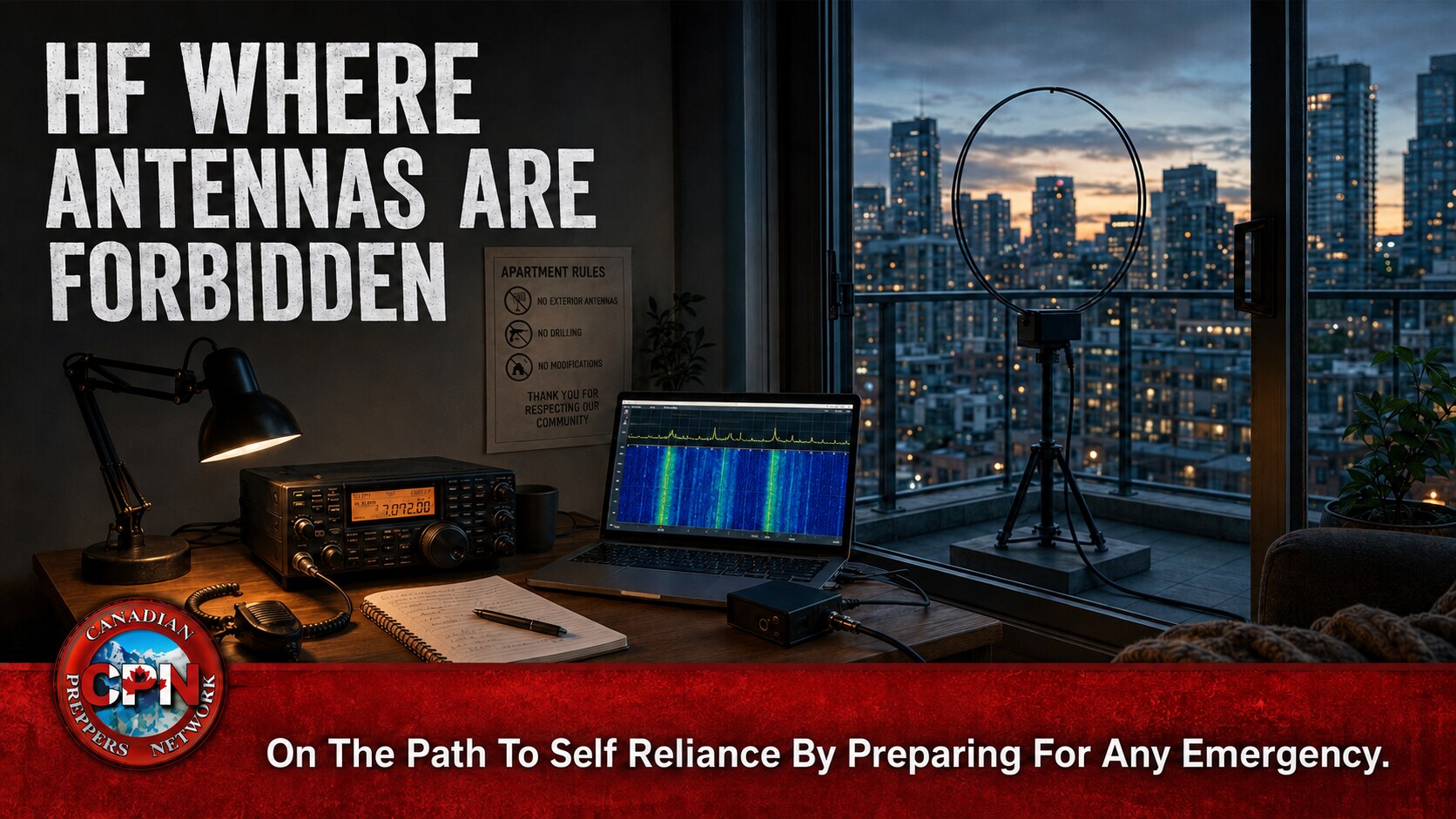
Building a discreet, transmit-capable HF station when apartment walls, limited space and ridiculous property rules work against you
The conventional HF station has a tower, a beam and enough property for long wire antennas. That is a fine arrangement—if you own the land, have the space and are permitted to use it.
Many Canadian operators have none of those advantages.
Apartment tenants may be prohibited from attaching anything to the building. Condominium and strata councils regulate what can be seen from outside. Restrictive covenants ban towers, masts and overhead wires. Even detached homes can sit on lots too small for a conventional HF antenna.
Those restrictions become particularly serious when cellular networks, internet service and local repeaters are unavailable. An operator may own a capable HF transceiver but have no effective way to transmit beyond the building.
Limited space does not eliminate HF communication. It changes the design requirements.
The objective is a complete HF station that can both hear distant stations and transmit an intelligible signal back to them. Reception testing remains important, but an antenna that cannot safely and efficiently radiate on the intended bands does not satisfy the communications requirement.
A useful restricted-property antenna must be:
- Capable of transmitting on the intended amateur bands
- Safe at the planned power level and operating mode
- Discreet without depending on deception
- Removable without damaging the property
- Repeatable to deploy and tune
- Usable during an extended communications failure
- Tested before it is needed
A compromised antenna that completes scheduled contacts is valuable. A perfect antenna that exists only in an operator’s imagination is not.
Identify the Real Restrictions
“Antenna restrictions” can describe several different problems.
An apartment may have no balcony. A condominium may permit balcony furniture but prohibit antennas extending beyond the railing. A tenant may be allowed to operate portable equipment but forbidden from drilling holes or installing permanent feed lines. A townhouse owner may have a small yard but face restrictions on visible masts and wires.
Before selecting an antenna, determine:
- Whether temporary antennas are permitted
- Whether anything may extend beyond the balcony
- Whether clamps can be used without drilling
- Whether an antenna may remain outside unattended
- Whether a thin feed line can pass through a window or door
- Whether an authorized courtyard or outdoor area is available
- How far the antenna can be kept from neighbours
- Whether a wire can be supported entirely within your own property
- How much space is available for counterpoise wires or radials
- Whether the proposed location is close to power lines
- How much radio-frequency noise exists inside the building
Read the lease, condominium declaration, strata rules or restrictive covenant. Do not rely entirely on somebody’s casual interpretation.
A temporary, freestanding antenna may be treated differently from a permanent installation. If permission is required, obtain it. Do not drill into shared structures, access a roof or run wires through common areas without authorization.
The strongest system is one you can deploy repeatedly without risking eviction, property damage or an immediate order to remove it.
Physics Does Not Care About Property Rules
No miniature apartment antenna performs exactly like a full-sized dipole installed high and clear of surrounding buildings.
Electrically small antennas usually sacrifice some efficiency, bandwidth or both. Concrete, metal framing and coated windows can weaken signals. Nearby electronics create noise, while the close proximity of occupants limits how much transmitting power can be used safely.
The answer is not to abandon HF. It is to design around the limitations.
A restricted-space station should concentrate on:
- A small number of mission-appropriate bands
- Efficient antenna configurations
- Careful impedance matching
- Suppression of common-mode current
- Low-noise power sources
- Modes capable of working with weaker signals
- Planned operating schedules
- The lowest power that reliably completes the contact
The operator should test the antenna’s transmitting performance, not merely confirm that the radio’s tuner can produce a low SWR. A tuner can make the transmitter see an acceptable load while the antenna continues to radiate poorly.
Transmitting Magnetic Loops
A small transmitting magnetic loop is one of the few HF antenna types genuinely suited to apartments, balconies and extremely restricted spaces.
It does not require the long span of a dipole or the extensive radial system normally associated with a vertical. Many portable models stand on a tripod and can be removed immediately after use. Rotating the loop may also help favour a desired direction or reduce interference from a local noise source.
The advantages come with important trade-offs.
A transmitting loop is narrow-banded. Moving even a short distance across a band may require retuning. High voltage and substantial RF current can develop in the antenna, even at moderate transmitter power. The loop must remain clear of people, pets and conductive objects while transmitting.
It should not be placed beside a chair and treated like harmless indoor décor.
Before operating, confirm:
- The antenna is designed for transmission, not reception alone
- Its supported frequency range includes the intended bands
- Its power rating is suitable for the operating mode
- The tuning system can be adjusted safely
- The antenna can be kept clear of occupants
- The manufacturer’s operating instructions are followed
- The installation meets applicable RF-exposure requirements
Many inexpensive products described as “magnetic loop antennas” are receive-only devices. MLA-30-type loops, YouLoops and similar receiving antennas must not be connected to a transmitter unless the manufacturer specifically rates them for transmission.
A genuine transmitting loop can provide a useful everyday HF station where longer antennas are impossible. Its small tuning range also discourages aimless band scanning and favours planned frequencies—an advantage for scheduled emergency networks.
Temporary Balcony Verticals
A loaded vertical or telescoping whip can provide effective HF transmission from a balcony, patio or small yard.
The radiator may be mounted on a freestanding tripod or a non-damaging support and removed after each operating period. Unlike an indoor wire, a balcony vertical can often place more of the radiating element outside the building.
The whip is only one part of the antenna.
A short vertical requires a counterpoise or radial system. Without one, the coaxial cable and radio equipment may become unintended parts of the antenna. This can reduce performance and bring unwanted RF into the operating position.
A practical temporary vertical installation may include:
- A telescoping or loaded radiator
- Band-specific loading components
- Counterpoise or radial wires
- A common-mode choke
- Short, low-loss coaxial cable
- A secure freestanding support
- An analyser or SWR meter
- Marked settings for each planned band
Counterpoise wires may be arranged around the balcony perimeter or laid along the floor where they cannot create a tripping hazard. Their placement will affect tuning, so the arrangement should be reproduced consistently.
Do not assume that a metal railing provides a safe or effective ground. Its bonding may be unknown, and it may connect to accessible metal elsewhere in the building.
Wind loading also matters. A lightweight antenna that appears stable indoors can become a falling hazard on an exposed balcony. Nothing should extend where it could fall onto people, vehicles or electrical lines.
Temporary Wire Antennas
When a wire can be deployed legally and safely into open space, it may outperform a far more expensive compact antenna.
Possible configurations include:
- A temporary dipole
- A linked dipole covering selected bands
- An end-fed half-wave
- A properly matched random wire
- An inverted-V supported from a portable mast
- A wire antenna deployed from an authorized outdoor operating position
The system can be stored on winders and erected only during scheduled communications windows. A linked dipole is particularly useful because it can provide efficient performance on several predetermined bands without depending heavily on an antenna tuner.
An end-fed antenna may be easier to deploy from one support point, but it still requires proper matching and control of common-mode current. “End-fed” does not mean “no counterpoise, choke or testing required.”
A temporary wire kit should contain:
- Insulated antenna wire
- Matching equipment appropriate to the design
- Counterpoise wire where required
- A common-mode choke
- Lightweight support cord
- Non-conductive insulators
- Strain relief
- Feed line
- An SWR meter or antenna analyser
- A printed setup diagram
Never lower a wire past another apartment, across a walkway or into a common area. Keep every part of the antenna well away from power lines. Use only authorized support points and property.
Test at low power first. Confirm that the antenna tunes predictably and does not produce RF problems inside the residence.
Indoor Transmitting Antennas
An operator without a balcony may have no choice but to transmit using an indoor antenna.
Thin insulated wire can sometimes follow a room’s perimeter, form a loop near the ceiling or create a shortened dipole across two rooms. Loading coils can reduce the required length further, although shortening generally reduces efficiency and bandwidth.
Indoor transmitting antennas present significant compromises:
- The radiator is close to occupants
- Electrical wiring and metal structures affect tuning
- Household electronics may suffer interference
- Those same electronics may generate severe receive noise
- Safe transmitter power may be limited
Keep people away from the antenna during transmission and operate at the lowest effective power. Avoid running antenna wire parallel to household electrical cables or beside ducts, plumbing and frequently touched metal objects.
An indoor antenna should be designed as a transmitting antenna from the beginning. Hanging an arbitrary length of wire around a room and allowing an automatic tuner to accept it does not guarantee useful radiation or safe RF behaviour.
Indoor operation may nevertheless support scheduled HF contacts, particularly when paired with efficient digital modes or Morse code. It should be regarded as the last workable option—not dismissed as receive-only, but not oversold either.
Loading Fences, Eaves and Other Metal Structures
A remote or external antenna tuner can sometimes turn an ordinary metallic structure into a usable HF transmitting antenna.
Privately owned chain-link fencing, metal eaves, gutters, downspouts, steel roofing or detached metal buildings may contain enough conductive material to radiate an HF signal. For an operator facing severe antenna restrictions, these structures can offer a low-profile alternative to a visible wire or mast.
The tuner should be installed as close as practical to the point where the structure is fed. A long length of coaxial cable between the tuner and the structure can introduce additional loss and common-mode current. Depending on the installation, the system may also require a counterpoise, radial network or suitable ground arrangement.
Potential candidates include:
- A privately owned chain-link fence
- Electrically continuous metal eaves
- A metal gutter and downspout system
- A detached metal shed
- Steel roofing on a privately controlled building
- An authorized balcony railing
- An unused metal clothesline support
- Another isolated metallic structure whose connections are fully understood
Before transmitting, determine whether the structure is electrically continuous. Painted sections, loose fasteners, corrosion and poor joints can divide what appears to be one large radiator into several unreliable sections.
Bonding individual sections may improve continuity, but only when the operator owns the structure or has explicit permission to alter it.
Begin testing at low power. Use an antenna analyser to determine whether the tuner can present a reasonable load across the intended bands. Watch for unstable readings, arcing, heating, RF in the operating position and interference with nearby electronics.
A successful match does not prove that the structure is an efficient antenna.
The tuner’s job is to transform impedance. It can protect the transmitter from a severe mismatch, but it cannot eliminate losses in corroded joints, poorly conducting materials or an inadequate counterpoise. The structure might load successfully while converting much of the transmitter’s output into heat instead of radiation.
Real-world contact testing is therefore essential. Compare signal reports with those from a known portable antenna using the same band, mode and transmitter power.
Accessible metal also presents an RF-safety problem. A fence, railing, eave or downspout being used as an antenna may carry substantial RF voltage or current. Keep people and animals away while transmitting, especially near feed points, ends, joints and other high-voltage areas. The system should not be used where neighbours or passersby can unknowingly touch an energized structure.
This approach is most defensible when the operator:
- Owns or has permission to use the entire structure
- Understands its electrical bonding
- Can isolate it from utility and safety systems
- Can keep people away during transmission
- Uses a tuner at or near the feed point
- Provides an appropriate counterpoise or radial system
- Tests initially at low power
- Verifies performance through actual contacts
- Disconnects the antenna during thunderstorms and when unattended
A tuned fence or eave may never equal a well-installed dipole, but it can provide a discreet transmitting antenna where a conventional installation is impossible.
Structures That Must Remain Off Limits
Do not use shared or electrically unknown infrastructure merely because a tuner can produce an acceptable SWR.
Balcony railings, gutters and fire escapes may connect to other units or accessible surfaces outside the operator’s control. Corroded joints can arc or heat, while connected metalwork can carry interference throughout the building.
Never connect a transmitter or antenna tuner to:
- Electrical wiring or conduit
- Gas lines
- Plumbing
- Sprinkler systems
- Fire escapes
- Lightning-protection systems
- Utility grounding conductors
- Shared metalwork that residents can touch
- Structures connected to neighbouring properties
- Anything close to overhead power lines
A tuner does not make an unknown structure safe. When ownership, bonding or accessibility cannot be confirmed, use a purpose-built radiator instead.
Reduce Noise Before Increasing Power
Apartment buildings can be severe HF noise environments.
LED lighting, chargers, routers, television sets, computers, elevators and switching power supplies may cover weak signals. More transmitter power does not help if you cannot hear the reply.
Run the receiver from a battery and, where safe, briefly switch off individual circuits. If the noise drops, reconnect devices one at a time until the source is identified.
Useful corrections include:
- Replacing noisy power supplies
- Unplugging unused chargers
- Adding suitable ferrites to cables
- Moving the antenna away from computers and routers
- Using battery power during scheduled contacts
- Installing a common-mode choke at the antenna feed point
- Correcting poor station bonding
- Rotating a magnetic loop to reduce local interference
- Operating when electrical activity in the building is lower
A separate receive antenna may help with noise, but it does not replace the transmitting antenna. The station must still be capable of sending a useful signal.
Use Modes Suited to Restricted Antennas
Voice remains valuable, but a compromised antenna may not produce a reliable voice circuit under poor conditions.
Narrow-band digital modes and Morse code can complete contacts at lower signal levels. JS8Call is particularly useful for preparedness groups because it supports keyboard messaging and weak-signal communications.
Digital operation requires careful station setup. Computers and power supplies may introduce noise, while long transmissions impose a higher duty cycle than casual voice operation. Equipment temperature, audio levels and RF entering interface cables must be monitored.
The benefit is substantial: a modest transmit-capable antenna can pass written information under conditions where ordinary voice becomes unreliable.
Modes and frequencies should be agreed upon before an emergency. A technically capable station is of little value if every operator listens on a different band at a different time.
Build Two Transmitting Systems
The strongest apartment plan uses two complementary transmit-capable antennas.
The first is a discreet everyday antenna. This might be a transmitting magnetic loop, removable balcony vertical or an authorized metal structure loaded through an external tuner. It provides routine check-ins and allows the entire station to be tested regularly.
The second is a more efficient rapid-deployment antenna. This could be a linked dipole, portable vertical or end-fed system taken to an authorized courtyard, open area or field operating position.
Both systems should be capable of transmitting. The difference is convenience versus efficiency.
The deployment kit should include:
- Antenna and matching components
- Feed line
- Counterpoise or radial wires
- Common-mode choke
- Tripod, portable mast or authorized supports
- Antenna analyser or SWR meter
- Battery and power cables
- Printed band settings
- Frequency and contact schedule
- Logbook and pencil
- Weather-resistant storage bag
Practise until the system can be installed, checked and operating within minutes. Record the settings that work rather than rediscovering them during every deployment.
Choose Bands Around the Communication Mission
Trying to make a miniature antenna cover every HF band often produces mediocre results everywhere.
Start with the required communication distance.
Regional contacts may favour lower HF bands when conditions support high-angle propagation. More distant contacts may require different bands depending on the season, time and propagation. Higher bands also permit physically shorter antennas.
A restricted-space operator may obtain better results by building a reliable system for two or three bands rather than claiming marginal coverage from 80 through 10 metres.
Maintain a station chart showing:
- Intended contact areas
- Primary and alternate bands
- Scheduled contact times
- Operating modes
- Antenna configuration
- Tuning or tap settings
- Normal noise levels
- Stations previously contacted
- Power required for reliable communication
Actual contacts should determine whether the system works.
Stealth Means Low Impact
Discreet does not mean secretly damaging shared property or ignoring safety rules.
Neutral-coloured wire, compact supports, removable clamps and antennas stored indoors can reduce visual impact. Existing metal structures may also make an antenna less conspicuous, provided the operator is authorized to use them and can do so safely.
Good engineering is often the best form of stealth.
A neat antenna that causes no damage or interference attracts less attention than tangled wire, loose coax and equipment extending beyond the property. Document the configuration, keep it professionally arranged and operate within your qualifications and authorized amateur bands.
The goal is not to fool the property manager. It is to build the least intrusive transmit-capable station that satisfies the communications requirement.
Free Canadian Grid-Down Starter Kit
An HF station addresses only one part of apartment preparedness. Water storage, cooking, sanitation, lighting and backup power become harder when several households share the same failing building.
Download the free Canadian Grid-Down Starter Kit and identify which household systems still depend on elevators, municipal water, cellular service or commercial electricity.
Specialty Transmitting Antenna Supplier
Chameleon transmitting-loop antennas — The Chameleon F-LOOP line is intended for transmitting and receiving in restricted locations, including apartments, condominiums and antenna-controlled properties. Confirm current availability, band coverage and power limits before ordering.
This recommendation is deliberately outside the Amazon buying box. Amazon.ca’s magnetic-loop listings are dominated by receive-only products and do not presently provide a sufficiently trustworthy transmitting-loop option.
Apartment HF Buying Box
Supporting equipment for building and testing a compact transmitting station:
- Portable multiband HF vertical antennas — Removable transmitting antennas suitable for carefully planned balcony or portable installations. Confirm supported bands and power ratings.
- Portable HF end-fed antenna kits — Temporary transmitting antennas for authorized locations with suitable support points.
- External automatic HF antenna tuners — Useful for matching approved wire antennas or privately controlled metallic structures. Confirm the frequency range, power limit and suitability for the intended feed arrangement.
- HF antenna analysers — Useful for measuring resonance, impedance and usable bandwidth without repeatedly transmitting test signals.
- HF coaxial common-mode chokes — Help prevent the feed line from becoming an unintended part of the antenna.
- Snap-on ferrite choke assortments — Useful for reducing interference on computer, power and accessory cables.
- Portable antenna tripods — Support removable loops and verticals without permanent attachment to the building.
As an Amazon Associate, Canadian Preppers Network earns from qualifying purchases.
Related Reading
- DIY UHF/VHF Ham Radio Antennas: A Practical Guide
- When the Internet Goes Down, Canadians Can Still Connect
- Amateur Radio Emergency Nets in Canada
Build a Station That Can Answer Back
A full-sized outdoor antenna would make HF communication easier. Many apartment, condominium and restricted-property operators will never have that option.
They can still build a station capable of transmitting beyond local radio range.
The practical solution combines a genuine transmitting antenna, realistic band selection, noise reduction, efficient modes and careful attention to RF safety. A compact magnetic loop or balcony vertical can provide everyday transmitting capability. An authorized fence, eave or other metallic structure may become a usable low-profile radiator when connected through a properly located tuner and tested carefully. A rapid-deployment wire or portable vertical can offer greater efficiency when circumstances permit.
The antenna may be shortened. The balcony may be small. The property rules may be ridiculous.
The final test remains simple: can the station hear the scheduled contact, transmit a useful message and receive confirmation that it arrived?
If it cannot answer back, it is not yet an emergency communications station.