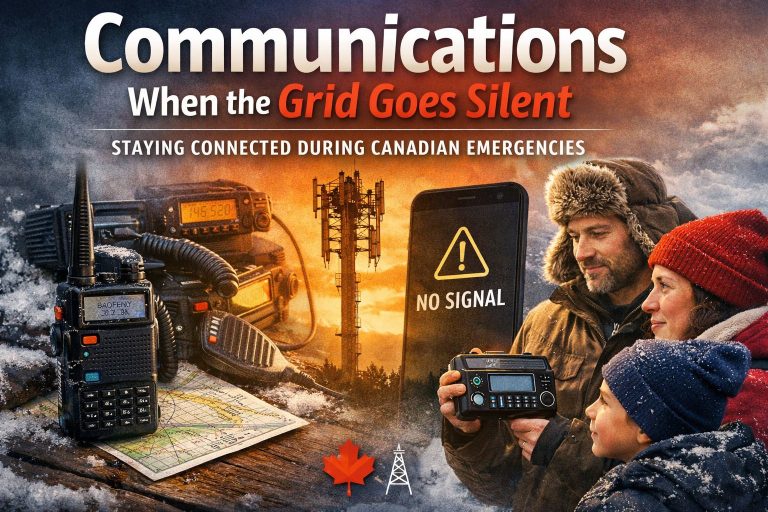
Most preparedness communication plans collapse under a simple reality: distance.
Short-range radios work—until they don’t. A handheld might serve you well within a property or even across a small town, but once you start trying to reach people 50, 100, or 300 kilometers away, everything begins to break down. Terrain gets in the way. Forest absorbs signal. Repeaters go offline. Cell networks fail or become overloaded.
And then there’s the opposite problem. High-frequency (HF) radio is often introduced as the solution, but it’s usually framed in terms of long-distance communication—thousands of kilometers, bouncing signals across continents. That’s useful, but it doesn’t solve the more immediate need: staying in contact with your own people across a region.
This is exactly where NVIS—Near Vertical Incidence Skywave—comes into its own.
Understanding the “Regional Dome”
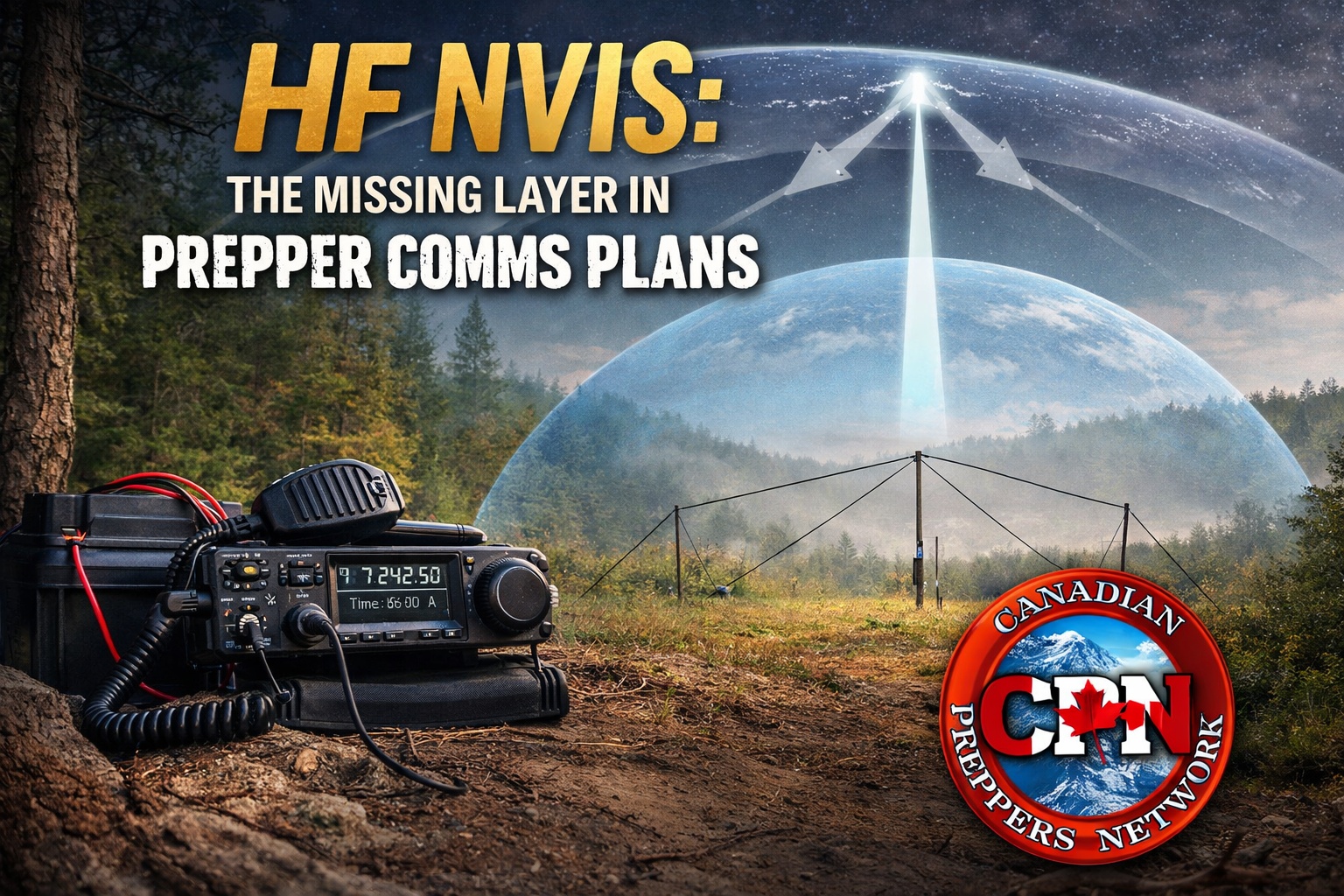
Instead of pushing your signal outward along the horizon, NVIS sends it almost straight up. The signal strikes the ionosphere and is reflected back down over a broad, circular area surrounding your position.
The effect is less like a beam and more like a canopy—a dome of coverage that can extend from roughly 50 to 500 kilometers, depending on conditions.
This matters because it removes one of the biggest weaknesses in traditional HF setups: the skip zone. With low-angle radiation, there is often a dead space between your local area and the point where your signal finally returns to earth. NVIS fills that gap.
In practical terms, that means you can sit in a remote part of Ontario or Quebec and maintain reliable contact with other communities spread across the region, without relying on any shared infrastructure.
Why NVIS Fits Canadian Reality
Canada is not friendly to line-of-sight communication.
Dense forest, rolling terrain, and vast distances create constant friction for VHF and UHF systems. Even under ideal conditions, handheld radios struggle to maintain consistent range. Add in weather, power outages, or a grid-down scenario, and the reliability drops further.
Repeaters help, but they are a dependency. In a prolonged disruption, they are unlikely to remain available.
NVIS bypasses all of this. It doesn’t care about hills, trees, or what’s between you and your contact. The signal goes up, interacts with the ionosphere, and comes back down over the target area.
The Counterintuitive Setup
One of the more surprising aspects of NVIS is that it works best when you don’t try to elevate your antenna.
A simple dipole or inverted V antenna, an HF radio, and a stable power source are enough to establish a functional NVIS station.
Here are reliable Amazon.ca affiliate search links (stable, won’t break, and convert well):
HF Radios (Base / Portable):
https://www.amazon.ca/s?k=hf+ham+radio&tag=canadianprep-20
Portable QRP HF Radios (Field Use):
https://www.amazon.ca/s?k=qrp+hf+radio&tag=canadianprep-20
Dipole / End-Fed Antennas:
https://www.amazon.ca/s?k=hf+dipole+antenna&tag=canadianprep-20
Antenna Tuners:
https://www.amazon.ca/s?k=antenna+tuner+hf&tag=canadianprep-20
LiFePO4 Batteries (Off-Grid Power):
https://www.amazon.ca/s?k=12v+lifepo4+battery&tag=canadianprep-20
Frequency Is the Real Lever
NVIS performance is heavily tied to frequency selection, and that changes with time of day and solar conditions.
During the day, 40 meters often performs best. As evening sets in and into the night, 80 meters becomes more reliable.
This is where most setups fail—not because of gear, but because of misunderstanding propagation.
Where NVIS Sits in a Real System
A well-built communications plan is layered.
Close-range radios handle immediate needs. VHF/UHF extends local coverage where terrain allows.
But beyond that, there is a gap—a critical one. Without NVIS, there is no reliable regional communication layer once infrastructure disappears.
HF used for long-distance communication skips over your most important contacts.
NVIS connects them.
The Part Most People Ignore
The technology is only half the equation.
NVIS only works if people are listening—on agreed frequencies, at agreed times, using compatible setups.
Without that, it’s just equipment.
With it, it becomes a network.
The Real Takeaway
If your communication plan depends on infrastructure, it will fail. If it depends on line-of-sight, it will be limited.
NVIS gives you something different: independent, regional communication that works with Canadian terrain instead of against it.
It’s not complicated.
But it does require intention.
And that’s exactly why most people never build it.