The Food You’ll Wish You Stored (But Didn’t)The quiet gaps in your prep—and why most of them come down to storage
Most people don’t run out of food all at once.
They run out of something specific—and that’s what breaks the system.
It’s rarely dramatic. It’s the third week, when meals start repeating, when calories are still there but flexibility is gone. You’ve got shelves of food… but nothing that actually works together anymore.
And more often than people realize, it’s not just what you failed to store.
It’s what you stored poorly.
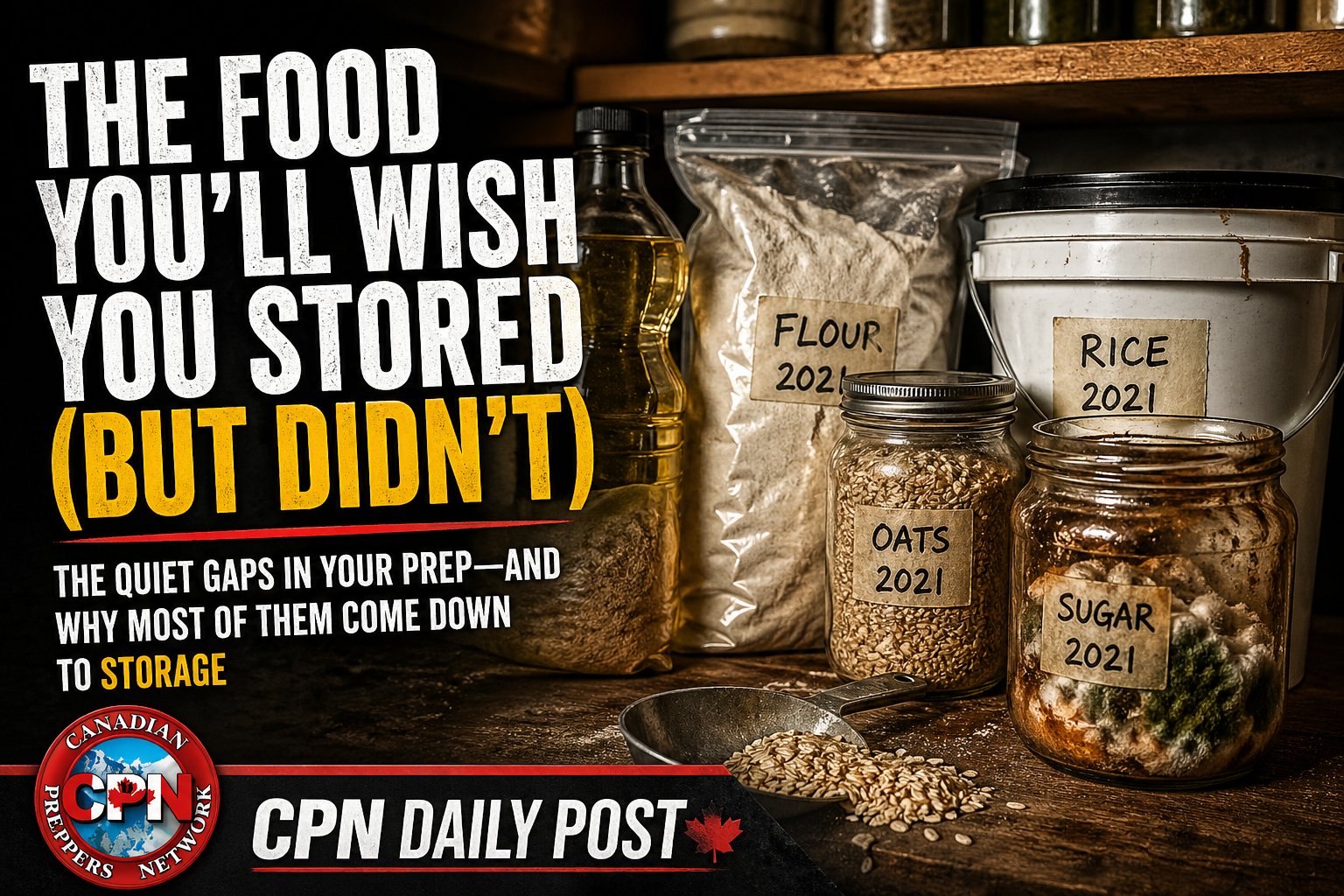
Food doesn’t usually fail overnight. It degrades quietly—flavour first, then nutrition, then usability. Air, moisture, heat, light, and pests all work slowly in the background. Ignore them, and your “long-term storage” becomes short-term without warning.
That’s where the real gaps show up.
Salt: Indestructible—Until It Isn’t
Salt is one of the most overlooked essentials in any food plan. Not just for taste, but for preservation, fermentation, and maintaining proper hydration.
Most people have a few containers in the cupboard. That’s not storage—that’s convenience.
Salt stores indefinitely—but only if you keep moisture out. Once it absorbs humidity, it hardens, clumps, and becomes difficult to use or trade.
Store it properly:
- Airtight containers
- Off concrete floors (they pull moisture)
- In a stable, low-humidity space
No oxygen absorbers needed. Just dryness and protection.
Buy this locally. Bulk salt is cheap and widely available across Canada.
Fats: Where Most Food Plans Quietly Fail
This is one of the biggest blind spots.
People stockpile rice, beans, pasta—and forget that without fats, those foods don’t sustain you. You’ll feel hungry, cold, and drained even while eating enough calories.
But fats don’t store like dry goods.
They degrade with:
- Heat
- Light
- Oxygen exposure after opening
What matters here isn’t just what you store—but how you manage it.
- Keep fats cool
- Limit air exposure
- Rotate consistently
Fats are part of an active system, not a static reserve.
Flour: The Weak Link in Most Pantries
Flour is where good intentions fall apart.
Left in its original bag, it will absorb moisture, attract pests, and degrade far faster than people expect.
If you want flour to last, it needs a system:
- Freeze it for 2–3 days first
- Store it in sealed, low-oxygen conditions
- Protect it from pests and physical damage
Without that system, it’s short-term—no matter how much you buy.
Sugar: Easy to Store—Easy to Overlook
Sugar doesn’t get much attention because it feels optional.
It isn’t.
It’s fast energy, critical for preservation, and one of the simplest morale stabilizers you can store.
Storage is simple:
- Keep it dry
- Keep it sealed
- Avoid unnecessary handling
Even if it hardens, it’s still usable.
Containers: Where Small Mistakes Add Up
This is where most food plans quietly fail.
People focus on what to store and ignore how it’s stored.
If air, moisture, or pests can reach your food, they eventually will.
A working system:
- Limits oxygen
- Blocks moisture and light
- Protects against pests and damage
Skip any one of those, and shelf life drops fast.
Temperature: The Silent Shelf-Life Killer
You can do everything else right and still lose food to temperature.
A simple reality:
- Warmer storage = faster degradation
Best option in most Canadian homes:
- Cool, stable basements
Avoid:
- Garages (freeze/thaw cycles)
- Attics (heat spikes)
- Sheds (humidity swings)
Consistency matters more than absolute cold.
Rotation: The Habit That Makes It Real
Even perfectly stored food isn’t permanent.
The difference between a stockpile and a system is rotation.
- Store what you eat
- Eat what you store
- Replace as you go
Label everything. Not for today—but for a year from now.
Rotation exposes problems early—before they matter.
Where People Notice Too Late
It usually hits somewhere between week two and week four.
That’s when:
- Variety disappears
- Missing ingredients limit meals
- Stored food becomes harder to use
And often, the issue isn’t quantity.
It’s that the food didn’t survive storage—or wasn’t stored in a way that made it usable.
Storage Gear That Actually Makes This Work
Most people already have some food.
What they don’t have is the system to protect it.
If you’re going to fix one thing, fix this.
Core setup for long-term dry storage:
- Mylar bags (5 mil, oxygen barrier for dry goods):
https://www.amazon.ca/s?k=5+mil+mylar+food+storage+bags - Oxygen absorbers (removes residual oxygen inside sealed bags):
https://www.amazon.ca/s?k=oxygen+absorbers+food+storage - Food-grade buckets (outer protection against pests and damage):
https://www.amazon.ca/s?k=food+grade+5+gallon+bucket - Gamma seal lids (airtight, reusable lids for repeated access):
https://www.amazon.ca/s?k=gamma+seal+lid
This layered approach:
- Removes oxygen
- Blocks moisture and light
- Prevents pests and physical damage
It’s not complicated—but it’s the difference between food that lasts and food that fails quietly.
Final Thought
Preparedness isn’t about stacking more food.
It’s about building a system that still works when conditions aren’t ideal.
The foods you’ll wish you stored aren’t rare or expensive.
But the system behind them determines whether they’re still there when you need them.
Internal Reads:
https://canadianpreppersnetwork.com/are-we-about-to-see-food-shortages/
https://canadianpreppersnetwork.com/your-first-7-days-without-normal-supply-chains/
Recommended Read
Acres of Preparedness: Planning the Last Safe Place
https://www.amazon.ca/s?k=Acres+of+Preparedness+Planning+the+Last+Safe+Place
This is a systems-focused guide to long-term self-reliance—moving beyond food storage into building sustainable food, water, and energy systems that continue functioning without resupply.