Most people think sanitation is an afterthought.
Something you deal with once food and water are handled.
That’s backwards.
Sanitation is what determines whether your living space stays stable—or slowly turns against you. It’s the difference between managing a situation and being worn down by it.
And unlike gear, it’s not something you can improvise well under pressure. It has to be thought through ahead of time.
What follows isn’t complicated. But it is deliberate. And if you build it properly, it holds.
Start With Layout, Not Equipment
Before you think about buckets, pits, or supplies, you need to think about where everything goes.
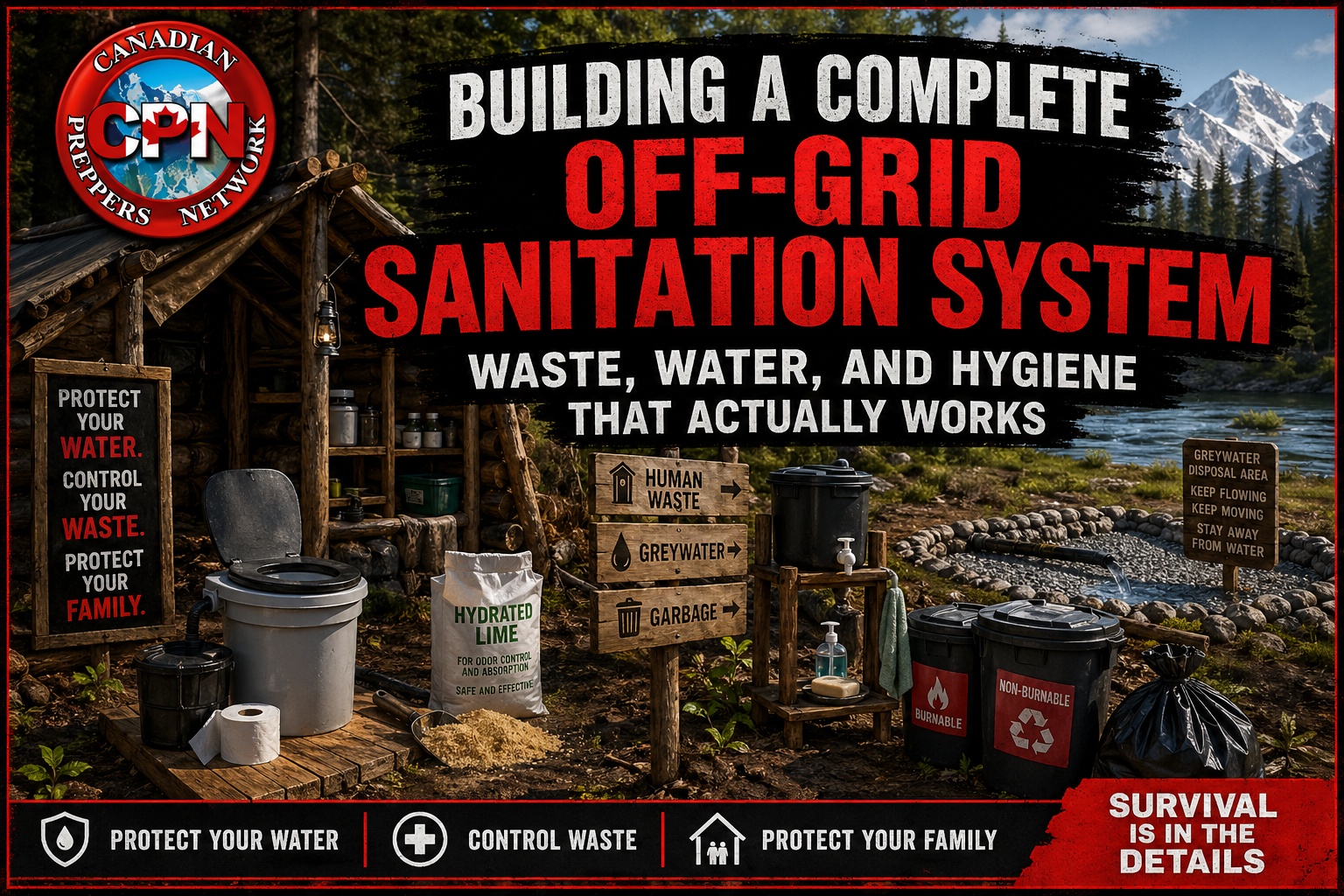
Your site needs separation between three zones:
- Living area (shelter, food prep, storage)
- Water system (collection, treatment, storage)
- Waste system (latrine, greywater, garbage)
Most failures come from overlap.
Waste ends up too close to living space. Greywater drains where people walk. Garbage piles up where it’s convenient instead of where it’s controlled.
Distance matters. So does terrain.
Waste should always be downhill and downwind from both your shelter and your water flow. If the land doesn’t allow that cleanly, you adjust your layout—not your standards.
Human Waste: Controlled, Consistent, Boring
This is the core of the system, and it works best when it’s simple.
You have two realistic approaches: a fixed latrine, or a controlled container system.
A latrine is effective when you have the space and the right soil. It needs to be far enough from water sources to eliminate contamination risk, placed in well-drained ground, and used consistently. What matters most isn’t depth or construction—it’s that waste is covered after each use and the location doesn’t shift every few days.
The container system—the classic bucket setup—works where movement, weather, or terrain make a fixed point impractical. It keeps waste contained, manageable, and mobile when needed.
What makes either system work isn’t design.
It’s discipline.
Everyone uses it. Every time. No shortcuts.
A basic setup that holds up over time:
- 5-gallon bucket with lid (base system)
https://www.amazon.ca/s?k=5+gallon+bucket+with+lid - Snap-on toilet seat lid (makes long-term use realistic)
https://www.amazon.ca/s?k=bucket+toilet+seat - Heavy-duty contractor bags (liners and containment)
https://www.amazon.ca/s?k=contractor+garbage+bags+heavy+duty - Absorbent material (lime, sawdust, cat litter)
https://www.amazon.ca/s?k=hydrated+lime
This isn’t glamorous. But it works, and it scales.
Greywater: Keep It Moving, Keep It Away
Greywater is where most setups quietly fail.
It feels harmless, so it gets dumped wherever it’s easiest. Over time, that creates a contaminated, damp zone that attracts insects and starts to smell—and it’s usually too close to where you live.
Used water carries everything with it—food particles, fats, bacteria—and it doesn’t take long before it starts to turn.
Managing greywater properly isn’t about sophistication. It’s about intentional disposal.
You need a dedicated area where greywater can be absorbed without pooling. Well-drained soil, gravel beds, or even rotating dumping points work. What matters is that the water doesn’t sit, doesn’t concentrate in one place, and doesn’t flow back toward your shelter or water system.
Spread it out, and the ground handles it.
Concentrate it, and it becomes a problem.
Garbage: Control It or It Controls You
Nothing leaves your property in a grid-down scenario.
That means everything you generate stays—and builds.
At first, it’s manageable. Then it starts attracting attention. Then it becomes a constant issue.
Garbage has to be separated and dealt with regularly.
Burn what can be burned safely. Contain what can’t. Keep everything sealed and away from living areas.
The goal isn’t elimination. It’s preventing buildup.
Because once rodents and insects establish themselves, they’re not easy to push back out.
Hygiene: The Force Multiplier
You can get everything else right and still fail here.
Poor hygiene turns manageable conditions into illness—and illness multiplies your water demand, reduces your effectiveness, and spreads quickly in close quarters.
Handwashing is the single most important piece.
It doesn’t need to be elaborate. It needs to be consistent.
A simple setup—water container, soap, controlled drainage—does more to protect your household than most gear people spend money on.
- Simple handwashing station components
https://www.amazon.ca/s?k=camp+hand+wash+station
Place it where it gets used: near food prep, near waste areas, and at entry points to your shelter.
Make it easy, and it happens.
Make it inconvenient, and it gets skipped.
Water Protection: The System Above All
Everything in your sanitation setup ties back to one thing:
Your water.
If waste, greywater, or garbage contaminates your source—even slightly—you increase your treatment burden. Push that too far, and your system starts to fail.
So every decision gets filtered through one question:
“Does this increase or decrease risk to my water?”
If it increases risk, it doesn’t belong in your setup.
Putting It All Together
A working system isn’t complicated—it’s coordinated.
Waste is handled in one controlled area.
Greywater is directed somewhere intentional.
Garbage is contained and managed.
Hygiene is easy and consistent.
Water is protected from all of it.
Nothing overlaps. Nothing is left to chance.
And once it’s in place, it doesn’t require constant thought. It just runs.
The Reality
This isn’t the part of preparedness people like to focus on.
But it’s the part that determines whether your situation stays stable over time.
Food runs out slowly.
Water problems show up quickly.
Sanitation failures sit in the middle—and quietly make everything worse.
Get this right, and your environment supports you.
Get it wrong, and you spend your time reacting instead of managing.
The Standard to Aim For
Not comfort.
Not convenience.
Control.
If you can maintain clean, stable living conditions for 30 days without outside support, your system works.
If not, this is where to fix it.