Repairable Power After the Grid Is Gone
When the electrical grid fails for a few hours, people reach for flashlights, power banks and portable generators.
When it fails for months, the problem changes.
Fuel becomes scarce. Portable power stations gradually lose capacity. Proprietary cables disappear. Electronic control boards fail. Equipment that once seemed convenient becomes useless because one irreplaceable component has stopped working.
A post-collapse electrical system cannot be judged only by how many watts it produces. It must also be understandable, repairable and capable of operating at a much smaller scale.
That is where a modest 12-volt survival grid earns its place.
It will not operate an electric stove, heat an entire house or preserve every modern convenience. It can, however, keep efficient lighting, communications equipment, small pumps, rechargeable batteries and essential electronics working without consuming precious generator fuel.
The objective is not to recreate the electrical grid. It is to preserve a small core of useful electrical capability after the grid is gone.
Why Build Around 12 Volts?
Twelve-volt equipment is common in vehicles, boats, recreational vehicles, amateur-radio stations and off-grid systems. That provides an enormous pool of compatible components:
- Batteries
- Solar charge controllers
- Fuse panels
- Switches
- Connectors
- LED lights
- Water pumps
- USB charging outlets
- Radio equipment
- Automotive accessories
Standardization matters after a collapse. A proprietary power station may perform impressively until its charging cable, internal inverter or electronic display fails. A modular 12-volt system can be divided into recognizable components that can be tested and replaced individually.
If a light fails, the rest of the system continues working. If the solar controller fails, the battery and distribution panel remain useful. If one charging source is lost, another properly matched source can potentially take its place.
That separation is what makes the system resilient.
The Five Parts of a Survival Grid
1. Generation
Solar panels will likely be the primary source because they operate silently and do not require stored fuel. They are not the only possibility. A properly designed system might also accept charging from a vehicle, small wind system or other regulated source.
The important point is that generation and storage remain separate. Permanently attaching everything to one proprietary power unit creates a single point of failure.
2. Charge Control
A solar panel should not simply be treated as a direct battery charger. A controller matched to the panel and battery chemistry manages the charging process.
This is one component worth duplicating. A spare controller is relatively small, and losing the only controller could leave an otherwise functional solar array unable to recharge the battery safely.
3. Storage
The battery bank stores energy for use after dark and during poor weather.
Large capacity is attractive, but one enormous bank is not always the most resilient answer. Several manageable battery modules provide more flexibility. A failed module can be isolated without necessarily losing all stored power.
Battery chemistry matters as well. Lead-acid batteries are widely understood but heavy and sensitive to deep discharge. Lithium iron phosphate batteries offer greater usable capacity and longer cycle life, but they depend on a functioning battery-management system and require charging equipment suitable for that chemistry.
Whatever type is chosen, use purpose-built, commercially manufactured equipment and have the completed system inspected by someone qualified. Twelve volts reduces shock risk, but a battery can still release enough current to overheat wiring or start a fire.
Free Canadian Grid-Down Starter Kit
A power system is only one part of surviving an extended disruption. The Canadian Grid-Down Starter Kit helps identify weaknesses involving water, food, communications, lighting and other essential household systems.
4. Distribution
This is the part that turns a battery into a grid.
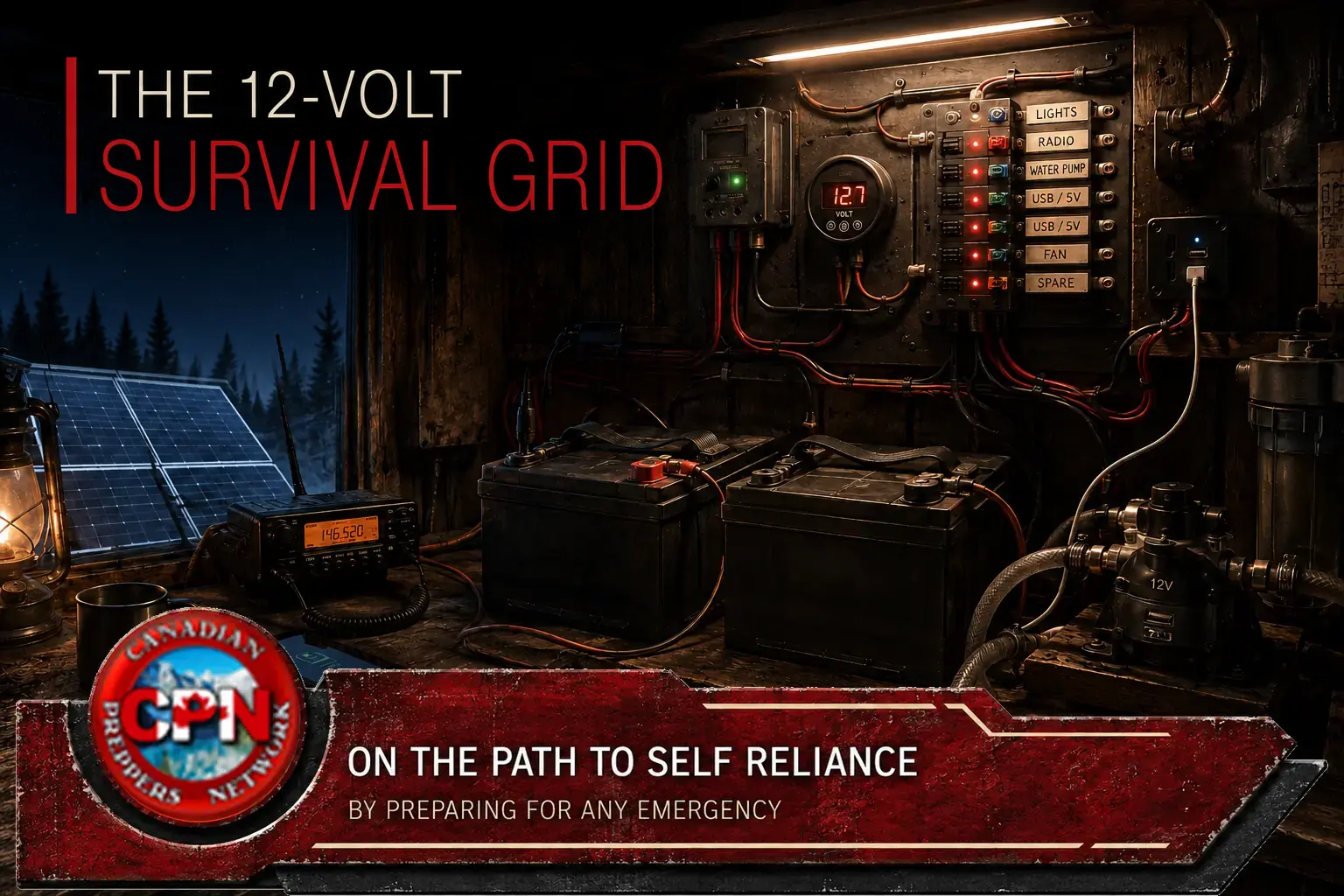
A commercially manufactured 12-volt distribution panel provides individually fused circuits for lighting, communications, pumps and charging outlets. If one circuit develops a fault, it can be isolated without shutting down everything else.
Divide the system by function rather than connecting every load to one outlet:
- Essential lighting
- Communications
- USB charging
- Water movement
- Workshop or maintenance
- Reserve circuit
Every circuit should be clearly labelled at both ends. Keep a simple diagram beside the panel showing where each cable travels and what it powers. Avoid undocumented extensions and mystery wiring.
Fuses and conductors must be selected for the equipment and installation, not guessed from a generic chart. Follow the component manufacturers’ requirements and use qualified help for system assembly.
5. Loads
The survival grid exists to perform useful work. Every device connected to it should justify the energy it consumes.
Good direct-current loads include:
- Low-wattage LED lighting
- Amateur-radio equipment
- USB device charging
- Rechargeable AA and AAA batteries
- Small, occasional-use water pumps
- Monitoring instruments
- Selected low-power electronics
Resistance heating, electric cooking appliances, kettles and other high-demand loads do not belong on a small survival grid. Converting battery power to household alternating current merely to operate an inefficient appliance wastes scarce energy.
Whenever a suitable direct 12-volt or USB alternative exists, it will usually be more practical than running an inverter.
Start With an Energy Budget
Buying a bigger battery is not a substitute for knowing where the electricity goes.
An energy budget begins with three numbers:
Device wattage × hours of operation = watt-hours consumed
Consider a modest daily plan:
| Load | Daily Energy |
|---|---|
| Three 5-watt LED lights for five hours | 75 Wh |
| Radio monitoring and scheduled transmissions | 50 Wh |
| Phone and small-device charging | 30 Wh |
| 60-watt water pump for 15 minutes | 15 Wh |
| Laptop used for one hour | 45 Wh |
| Total | 215 Wh |
Actual consumption will vary, but the exercise exposes priorities. It also reveals that disciplined operating schedules can be more valuable than adding another panel.
Do not assume the full advertised battery capacity is available. Usable capacity depends on battery chemistry, condition, temperature, discharge limits and conversion losses. Allow a substantial reserve instead of designing the system to reach empty every day.
During poor weather, the budget should become stricter:
- Communications
- Essential lighting
- Water-related equipment
- Battery charging for critical tools
- Administrative or comfort loads
Power remaining in the battery is not spare power. It is protection against tomorrow being cloudier than today.
Build Small Islands Instead of One Large System
A single central battery bank may appear efficient, but it creates dependencies. Damage to the main cable, panel or controller can affect every load.
A more resilient approach uses several small electrical islands.
One module could support the radio station. Another could operate lighting and USB charging. A third could remain portable for water pumping, repairs or temporary use at another building.
The modules do not need to be identical, but standard connectors and clearly marked voltage and polarity make them easier to exchange. Avoid loose adapters, improvised exposed contacts and an assortment of incompatible plugs.
Portable modules also make rationing easier. The communications battery does not get drained because someone plugged an unnecessary appliance into the main system.
Design for Repair Before Expansion
People naturally focus on batteries and solar panels because those are the expensive and visible parts. Long-term reliability often depends on much smaller items:
- Spare fuses
- Replacement connectors
- Proper crimp terminals
- Labelled cables
- Switches
- Compatible charging leads
- A multimeter
- Printed manuals
- A system diagram
Connections deserve regular inspection. Moisture, corrosion, vibration and repeated handling can gradually increase resistance and cause intermittent failures.
Do not wait for a collapse to learn the system. Operate it during planned grid-down weekends. Record how much energy is consumed, how quickly the batteries recover and which devices create unexpected loads.
Practise isolating a failed circuit and identifying the affected component without bypassing protective devices. The goal is not to perform hazardous live improvisation. It is to understand the modular system well enough to recognize a fault and replace a properly rated component safely.
Keep an Inverter on the Edge
An inverter can be useful for an occasional device that has no practical DC alternative. It should not become the centre of the system.
Every conversion introduces losses, additional electronics and another potential failure point. A large inverter also makes it tempting to connect appliances that quickly exhaust the battery bank.
Treat alternating-current output as a limited specialty service. Keep the core lighting, communications and charging functions on direct-current circuits so the system remains useful even if the inverter fails.
Never connect a portable inverter or battery system to household wiring. Any interface with a building’s electrical system requires approved equipment and qualified installation.
The Real Advantage Is Control
The greatest benefit of a 12-volt survival grid is not the voltage. It is the discipline the system imposes.
Every circuit has a purpose. Every load can be measured. Each module can be isolated. Spare parts can be standardized. Electricity is directed toward work that matters instead of disappearing into appliances operating out of habit.
After a long collapse, electricity would no longer be an invisible utility arriving through the wall. It would become a carefully produced resource.
A small amount of dependable power—used deliberately—could preserve communications, illuminate necessary work, move water and keep essential rechargeable equipment operating.
That is far more valuable than a large collection of impressive devices that cannot be repaired once their first proprietary component fails.
12-Volt Survival Grid Buying Box
All components must be compatible with the selected battery chemistry, voltage, current and manufacturer requirements. Battery and building-wiring work should be reviewed by a qualified adult professional.
- 12-volt LiFePO4 batteries with integrated BMS
- MPPT solar charge controllers
- 12-volt marine and RV fuse panels
- Battery monitors with shunts
- Low-voltage battery disconnects
- 12-volt LED lighting
- 12-volt USB-C charging outlets
- Electrical connector and crimping kits
- Digital multimeters
- Automotive blade-fuse assortments
As an Amazon Associate, Canadian Preppers Network earns from qualifying purchases.