
A core CPN reference guide.
When the bags fill up and nobody comes to collect them
The power has been out for four days. Your emergency toilet works. The bags fit, the seat is usable, and everyone knows where to go.
Behind the shed, however, several used bags are waiting in a container. More will join them tomorrow. Rubbish collection has stopped, the disposal facility is inaccessible, and your replacement liners suddenly look like a very small stockpile.
This is where an emergency toilet becomes a sanitation problem.
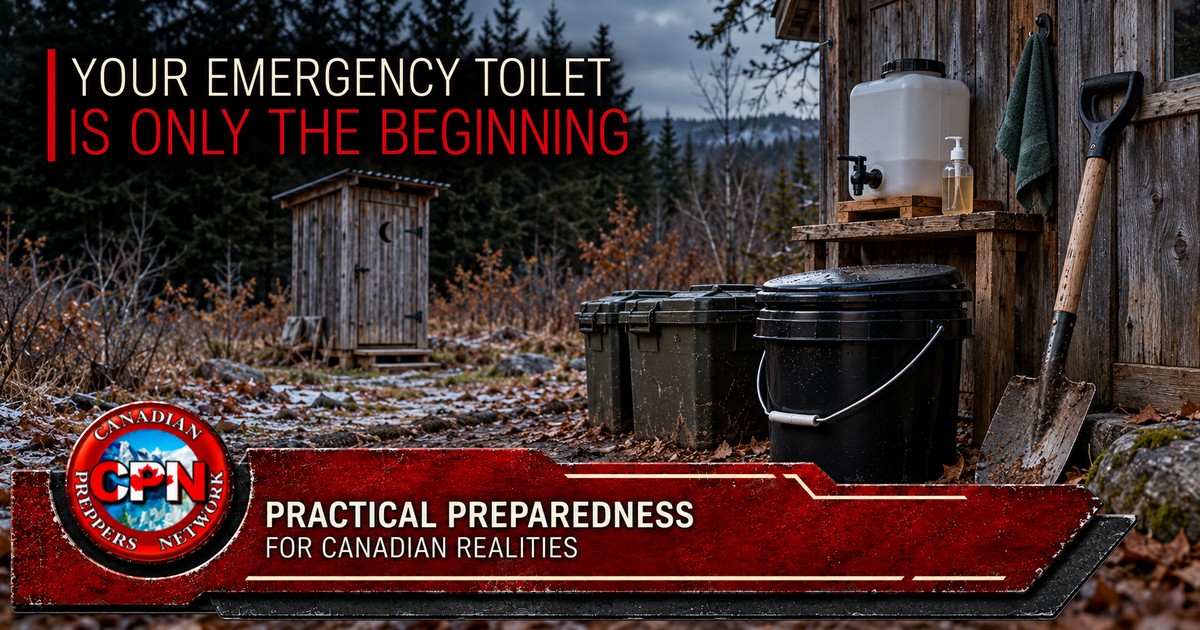
A seat and a bucket give you somewhere to relieve yourself. A complete sanitation plan must also cover containment, handwashing, storage, handling and final disposal. During a prolonged collapse, those jobs become part of keeping your household alive and your water supply usable.
Follow the Waste Beyond the Emergency Toilet
Before buying another portable toilet, follow one used liner through your proposed system.
Who closes it? Where do they put it? What happens if it leaks? How do they clean their hands? Where will the next twenty bags go?
Preparedness sanitation organisation PHLUSH identifies this weakness in emergency toilet planning: collecting waste does not resolve how to transfer, store or transport it when roads, fuel and disposal services are unavailable.
Your household needs a workable sequence:
Use the toilet → close the waste container → move it into protected storage → clean equipment and hands → transfer the waste to an appropriate disposal or treatment system.
Every step requires equipment, space and someone willing to do the work. A missing step leaves the household improvising around accumulated human waste.
Count Consumables Before Counting Days
“Thirty days of toilet supplies” means little unless you know how that figure was calculated.
Some purpose-made toilet bags support multiple uses within their stated capacity. Others have different instructions. The amount of liquid entering them also affects how quickly they reach their limit.
For example, Cleanwaste describes its GO Anywhere kit as having enough gelling agent for approximately 946 millilitres of liquid, or roughly three to four uses. That estimate applies to that product. It is not a universal capacity for toilet liners.
Start with the number of bag changes your household actually expects, then multiply:
Daily bag changes × days without disposal or resupply = minimum working stock.
| Household bag changes | 14 days | 30 days |
|---|---|---|
| 2 per day | 28 bags | 60 bags |
| 4 per day | 56 bags | 120 bags |
| 6 per day | 84 bags | 180 bags |
These figures exclude damaged liners, spills and increased use during illness. Every bag must remain within its manufacturer’s capacity and handling instructions.
Count toilet paper, absorbent material, gloves, soap and cleaning supplies the same way. Then consider the space required for used materials. A packet of liners fits neatly on a shelf; those same liners containing waste require protected storage.
Choose a System You Can Keep Operating
A bagged emergency toilet is a useful immediate backup. Its weaknesses are replacement supplies and somewhere to take the accumulated waste.
A portable flushing toilet offers familiar operation, but its holding tank still needs emptying. Identify the disposal point you would use if the usual campground or RV dump station were closed.
Urine separation is another option. PHLUSH promotes a twin-bucket emergency arrangement because separating urine reduces the liquid entering the faecal-waste container. Both streams still need managed containment and an appropriate destination.
Separation can make handling more manageable, but it creates another container to monitor. Do not treat separated urine as automatically sterile or assume it can be discharged into a ditch, stream or storm drain.
At a rural retreat, a functioning septic system may remain valuable. Its operation during a power failure depends on the installation: pumps, alarms and treatment equipment may require electricity. Learn your system before assuming that pouring water into the toilet solves everything.
Ask what stops your system first: water, electricity, liners, holding capacity or disposal access. Prepare for that limit.
Give Waste Its Own Protected Storage Area
Used toilet bags need more protection than an ordinary rubbish sack leaning against a fence.
For a bag-based arrangement, plan a dedicated, rigid, washable outer container with a secure lid, compatible with the waste system you use. It provides secondary containment and protection from punctures, animals and accidental contact.
Bag construction matters. Reliance’s Double Doodie system uses an inner collection bag and a puncture-resistant outer bag with a double zip closure. A thin household liner does not automatically provide equivalent protection.
Choose a location separated from food, drinking-water supplies and normal household traffic. Protect it from flooding and runoff, secure it against animals, and clearly mark every container.
Keep loads manageable. Consider who will carry a container when the usual person is injured or unavailable. Use dedicated handling equipment and keep it away from food and water jobs.
In winter, snow can block access and conceal damage. Frozen contents will eventually thaw. Your storage arrangement needs to remain sound through that transition.
Build Handwashing Into the Layout
A toilet in the shed and soap in the kitchen create a handling problem: people touch doors, lights and household surfaces before reaching the washing point.
Place handwashing equipment at the exit from the sanitation area. Include a stable water container with a tap, soap, a way to collect wash water, and clean drying materials. Nobody should need to dip dirty hands into stored water or handle the clean-water opening.
Reserve water for this job when calculating household requirements. Drinking and cooking account for only part of a functioning water budget.
Hand sanitiser is supplementary equipment. UCHealth’s guidance on norovirus stresses handwashing with soap and water because sanitiser does not reliably address that virus.
Use appropriate gloves for changing liners and cleaning contamination, then remove them without spreading contamination and wash your hands. Keep cleaning products labelled, follow their directions, and never mix chemicals.
When the Trucks Are Never Coming Back
After a prolonged collapse, moving sealed bags behind the shed only buys time. Eventually, your household needs a disposal system it can operate without collection trucks, treatment plants or an endless supply of liners.
For a rural retreat, that may mean a properly sited pit latrine or managed burial. Incineration is another possibility, but it brings fuel, equipment and operating demands.
Make the decision before accumulated waste forces your hand. Once bags are leaking and storage is full, every option becomes harder to manage.
Burial: Protect the Water You Intend to Drink
Burial can isolate human waste from people, flies and animals. It does not immediately disinfect it. A poorly placed pit can move contamination out of sight while putting your water supply at risk.
The Compendium of Sanitation Technologies in Emergencies describes pit and trench systems, while emphasising groundwater, soil, drainage and structural stability. Digging deeper can make matters worse if it brings waste closer to groundwater.
- Keep waste disposal away from wells, springs, streams, shorelines and food-growing areas.
- Avoid flood-prone ground, drainage channels and places where spring runoff collects.
- Account for the highest seasonal groundwater level, rather than the level during a dry autumn.
- Treat fractured bedrock, shallow soil and highly permeable ground as reasons for greater caution.
Oxfam’s emergency sanitation resources address the site assessment and disposal planning these systems require. Humanitarian guidance commonly uses 30 metres from water points and at least 1.5 metres between the pit bottom and groundwater as initial screening criteria. These distances are not universal guarantees of safety, particularly in fractured rock or other difficult ground.
For repeated household use, a properly constructed latrine can reduce the handling involved in carrying buckets to a burial area. It needs stable ground, a secure load-bearing platform, privacy, a covered opening and handwashing facilities.
An excavation must not become a fall or collapse hazard. Nobody should enter an unsupported waste pit.
During operation, appropriate soil cover helps limit exposed waste and flies. Leave room for final closure: the emergency trench guidance calls for taking a trench out of service when contents reach approximately half a metre below ground level, allowing it to be covered.
Mark and record closed sites so nobody later excavates them for a garden, foundation or water line. Identify a replacement location before the first site fills.
Bagged waste requires separate consideration. MSF’s emergency sanitation guidance describes burial arrangements using bags specifically designed for that system, with organised collection and handling. That does not make every plastic camping-toilet liner suitable for burial. Choose the collection method and final destination together.
Incineration: Budget for Fuel and Equipment
Fire seems like the obvious answer when nobody is coming to remove the waste. Burning wet toilet contents completely, however, is a different job from burning dry firewood.
Purpose-built incinerating toilets use a controlled chamber, heat and airflow to evaporate liquid and burn the remaining material. Depending on the model, they require electricity, propane or another fuel, along with ventilation, maintenance and consumables.
Cinderella’s manufacturer guidance describes the operating and installation requirements of its incinerating systems. Its propane-based off-grid arrangement also requires a 12-volt electrical supply.
That creates another preparedness calculation: how long can you fuel and maintain the toilet while also heating the shelter and cooking meals?
An open fire or improvised burn barrel does not establish that all the contents have received adequate treatment. A scorched bag and blackened surface can conceal incompletely burned material. Mixed plastic waste also introduces smoke and combustion hazards.
Oxfam’s emergency waste-management guidance identifies uncontrolled waste burning around settlements as a serious health and safety concern.
Do not pour petrol onto wet toilet waste or burn it in a cooking stove, indoor heater or food-preparation fire.
If incineration is your chosen system, prepare the equipment, fuel reserve, ventilation, maintenance supplies and ash-handling procedure in advance. Follow its operating instructions, including what happens when a cycle is interrupted.
A system that stops working when the propane runs out still needs a backup toilet.
Absorbent Material Does Not Finish the Job
Gelling agents, cover materials and deodorising products serve different purposes. Follow the instructions for the particular system.
A product that solidifies liquid or reduces smell has not necessarily disinfected the contents. Likewise, a bucket of waste with sawdust added has not automatically become finished compost.
Long-term composting requires a designed treatment process, controlled operation and suitable handling. Do not spread fresh toilet waste on food beds or treat an ageing bucket as ready-to-use fertiliser.
After collapse, protecting the growing area matters as much as producing food. Avoid creating a sanitation problem in the soil your household depends on.
Plan for Frozen Ground Before It Freezes
At a Canadian retreat, discovering you need a latrine in January can leave you facing frozen soil, deep snow and very little daylight.
Assess suitable locations while the ground is accessible. Build planned installations properly, secure unused openings and maintain the access route through winter. Where burial is unsuitable or temporarily impossible, protected containment remains necessary until a workable disposal route is available.
Freezing provides no permanent sanitation solution. The contents will thaw, and meltwater will follow the terrain.
Set up the emergency toilet, washing point and storage area now. Rehearse the handling sequence using clean water and unused materials. Check stability, liner fit, closures, lighting and carrying routes. Make sure another adult can complete the procedure without touching clean supplies.
Keep a short instruction sheet with the kit: liner type, capacity limits, change procedure, cleaning directions and waste destination.
Prepare for the Waste You Will Still Have Tomorrow
Your emergency toilet plan is ready for a serious test when you can answer five questions:
- How long will consumables last at your household’s expected rate?
- Where will used waste remain contained?
- How will everyone wash their hands?
- Who will manage changes, cleaning and supplies?
- Where will the accumulated waste eventually go?
A portable toilet can solve the first night. Handling, storage and final disposal keep the household functioning through the weeks that follow.
After collapse, sanitation becomes recurring work alongside hauling water, gathering fuel and producing food. The job is finished only when waste is contained or treated in a way that keeps it out of your household’s food, water and daily living space.
If collection stopped for thirty days, what would fill up first at your home: the toilet, the waste-storage area or your supply of replacement bags?
Related Reading
- Water Collection & Purification in Canada — connect sanitation planning with water sourcing, treatment and storage.
- Building a Complete Off-Grid Sanitation System — explore the broader system behind waste handling and household hygiene.
- A Stomach Bug Can Cripple Your Retreat — prepare for illness that consumes water, cleaning supplies and working hands.