


Any thoughts???
I'd like to pop it up on my ham tower but wonder about the noise levels?
600W Wind Turbine
$749.00/ EA-Each
Product Description
Generate power day and night with the Coleman 600 Watt Wind Turbine. This versatile wind turbine charges both 12 Volt and 24 Volt battery banks to help run your appliances and electronics. Ideal for cabins, 12 Volt battery charging, remote power, back-up power and more, this unit is made with aerodynamic fiber glass blades to ensure low wind noise. A weatherproof industrial design makes for do-it-yourself, maintenance-free installation. Safe and efficient charging is provided with the Maximum Power Point Tracking Charge Controller (included) that maximizes power output for optimal charging capability and battery health. The complete kit includes: turbine, (3) blades, a safe and highly-efficient MPPT charge controller for optimized charging, hub, vertical tail, nose cone, amp meter, screw pack and a replacement screw pack.

http://m.homedepot.ca/Product/productdetails.aspx?ProductId=986471&lang=EN

Looks like the one from Canadian Tire,
or Princess Auto, might want to do an price compare there

Hi Decadude,
Wind turbine manufacturers list the output of their machines at what ever wind speed they want to. The real benchmark of how much energy any wind turbine can produce is directly related to the amount of wind it can catch, which is directly related to the turbine's blade diameter and swept area.
The Coleman machine above seems to have a blade diameter of around 27". That's around 0.658 meters. Here's some data on the amount of power available in the wind at given wind speeds versus blade diameters: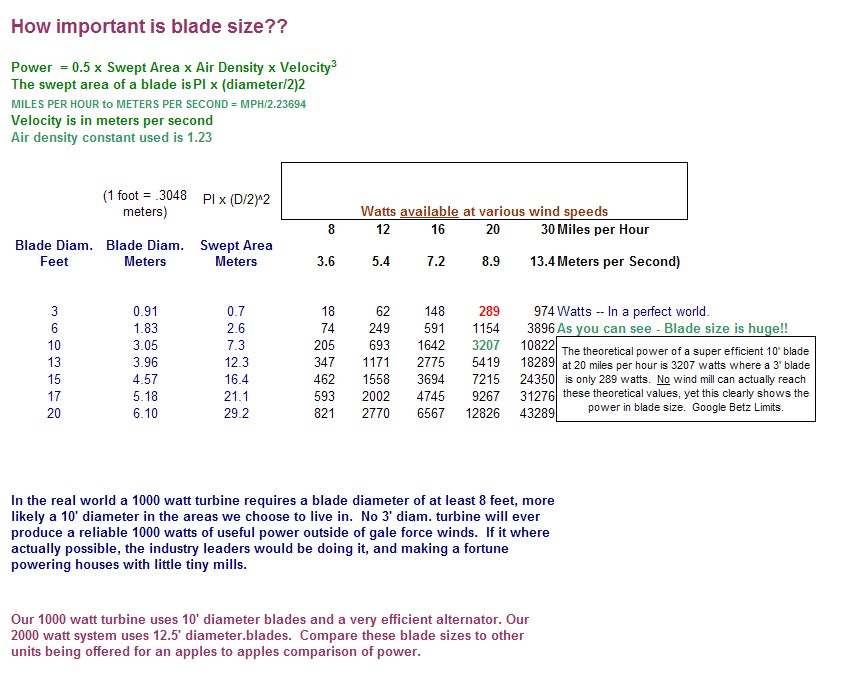
As you can see from the data above, unless the Coleman machine can defy the laws of physics, there is no way that it can produce 600 watts of power under any normal operating conditions. So, if you expect the machine to produce what it should produce under normal circumstances, it would give you less than 200 watts of power. 200 watts of power at $799 + tower costs, cement, maintenance, etc... it's a pretty expensive way to make that much energy.
I have the tower as I am a ham. I have some battery banks that I like to use as alternate power.
I would like something to trickle charge my banks. I'm not too too worried about overall power output to be honest. Was even thinking of a large solar panel. But in this hemisphere its too restrictive.
My concern would be the noise generated.
I will be running two circuit boxes. One for permanent grid for stove, fridge and hotub. The other switchable between grid and battery banks to run the other loads in the house. Eventually running the switchable circuit box off the grid permanently then focusing on the other.
Takes a while but I'll get there 🙂

While looking for specs for this thing I stumbled on the Honeywell Wind Turbine. Pretty damn good idea. Many blades with shroud. The coils are in the shroud itself and each blade carries a magnet at it's tip, doing away with a lot of the mechanical gearing losses.
Max 1500w at 30 mph but it starts at 2 mph and might produce usable power at normal wind speeds. Looks intricate and pricey.
Wind turbines of any size can be valuable, provided you have the wind resources and are realistic about the output. It should be said that the turbulent wind found low low to the ground or bouncing off objects can't be harnessed by horizontal axis wind turbines.
I've installed quite a few wind turbines, and used one at my other house for a number of years. I like wind, but since I've used both wind and solar, I have to say that solar is more reliable and consistent. In my experience, wind is best used as a winter supplement to your existing solar array.

Thanks everyone for your contribution to this thread - it`s good to know that alternative energy is mainstream. Greenguy, I value your professional opinion and the stats you provided. It`s a big investment and nobody wants to make any mistakes. I think I get it: Solar PV first, Wind second.
Perfesser,
could you post a link to the Honeywell Turbines please.

Greenguy,
I dont know where you obtained your chart but it is missleading. I do not dissagree with the numbers in the wind speed colums, but with the claim that, that power is available.
I think those numbers represent the theoretical power the wind applies to a given swept area of blade Dia. Not the power available.
It is not just the Betz limit that has to be taken into account but the losses incured in the alternator/dynamo. Each number should multiplied by a cp of 35% to arrive at the best power actually obtained in ideal conditions. (ideal blade design, well constructed alternator). It s my understanding that in real world conditions a cp of 35 has not been beat.
So that would make that 3 foot dia at 20 mile per hour mill 289x.35= if perfectly constructed 101 watts. That piece of junk is so badly built I would suspect half that.
but that (assuming 101 watts is actually put out) works out to 749/101=$7.40 a watt
The honeywell unit with a 6 foot dia blade set in a 20 mile per hour wind would at best mke 1154 x.35= 403 watts but it costs north of $5000.00
So 5000.00/403 = $12.40 a watt!! Another piece of junk, Since neither one will do much I highly recomend the first for your piece of kinetic yard art.
I suspect the Honeywell unit was designed just to recieve 30% rebates being given for alternative energy installations at the time, its most productive use has been to seperate taxpayers from their money.
Hi Analog Man,
Yes, the chart isn't totally accurate, I just used it because I was able to quickly link to it on the web. I should have used some of the charts available from Home Power Magazine, or Paul Gipe's book (Wind Power for Home and Business). The major point I was trying to make was just that the rated output of any turbine needs to be quantified against it's probable output. There have been so many bogus wind turbines released to unsuspecting customers that wind gets a bad reputation. There are good machines and good locations for them out there. As you point out, the REAL cost per watt of them is very high though.
I'm not sure what you guys are trying to power here but why don't we keep it basic. Let's use the example of a small cabin in the woods with lots of linear wind off the lake and nothing more than lights & electronics to power. I can't see a $750 wind turbine that can be carried to site & plopped on a roof, to be a piece of junk.
I stand by my assessment of that unit.Hell I bet you wont get 60 watts out of it at 20 miles per hour. Pretty junk, real pretty junk! if you like that sort of stuff. I value performance, and actual factual data.
Where is the watts vs windspeed chart? Shall we discuss the performance of those "perfect" blades, Describe to me how it protects itself in high winds. You see a sticker that says 600 watts and 750 bucks and think that must be true, ever hear of advertising? Sorry to be blunt but come on....that unit will not supply enough power to stop a unused battery bank from self discharge. There are units built to actualy work, and make real power in the typical wind speeds of 10 to say 18 mile per hr range.
Then there are units built to make real money in the consumer price range of under $1000.00 what do think that one is!
Now the data given to you is factual, pulled right from enginereing charts I will say it again. 3 foot rotor max power in the wind at 20 miles per hour is 289 watts in theory ( not obtainable), in the perfect real world a mill, and alternator could be built to get x .35= 101 watts.So at best if perfectly built you could get 100 watts at 20 miles per hr. Who are you going to believe, me who is not selling anything, or a manufacturer who is?
And I am being generous I dont believe you will get 60 watts, at 20 miles per hr. Great looking kinetic yard art, junk as a mill.
I am keeping it simple, forget powering anything with that mill not even a 60 watt light bulb.
the only place that a 3 foot mill will make any power is in the arctic circle were you may get steady winds in the 35 to 65 mile per hr range.
Just adding, that is the deffinition of junk, a 750 dollar mill that can be plopped on a roof. Anyone who is telling that your going to get real power out of a mill plopped on a roof is, and I am trying to be kind here, full of it.
I posted this before, but will one more time.
Any windmill with ratings using wind speeds greater than 28-30 mile perhr range is trying to decieve you by inflating its performance.
Any windmill with more than 4 blades( 3 considered best) and not pumping water is a poor design, and will perform worse with each blade added.
Any windmill that touches/mounts to your roof is utter junk.( slight exception for old 6 volt low watt wincharger from 1920-1930)
Any windmill stateing performance greater than what is possible,again measure the blade diameter, look up the power at 20 miles perhr, then multiply that by .35. You will have the number that mill can put out,at best, and anyone telling you different is lying if they start talking about ducted performance, they are lying more, if they yap about more blades they are lying again. You ONLY need to know that windspeed power chart, the rotor dia, and to multiply by .35. Nothing else.You can determine if any manufacturer is giving you honest info with just that little bit of info.
This was known a hundred years ago, why people refuse to believe what has solidly been proven is beyond me.
Hi decadude,
I'm only telling you what I know based on experience. I've dealt with many people over the years that have tried to do what you're suggesting. The most common report I get back from them (after selling them a wind turbine) is that they don't get the energy they thought they would, and if they had it to do all over again they wouldn't. They'd just install more solar. Again, this isn't to say that wind can't be effective, it just means that in order for it to be effective you need a good machine installed in a way that gives it unobstructed access to "laminar" wind flow. That wind only exists about 30 feet above the surrounding trees/buildings/etc...
Analog man has addressed the technical issues far better than I could.
Tnx greenguy. Makes sense. Been trying to get thru to analogman that I wasn't looking at total power advertised vs price but he seems stuck in his mantra.
60w will light up 10 x 6w LED bulbs in a cabin. Whatever.
Solar is interesting but in this hemisphere with short winter days leaves me questioning. How about hydro from creeks? Perhaps I can look at that as well.
I feel that in prepping, hypothetical isnt always practical.