Understanding the hazards of LiFePO4 batteries
LiFePO4 batteries are keeping the lights on, charging the radio and carrying the household through another night without electricity. They are quiet, produce no engine exhaust and require little attention.
That convenience can make it easy to forget what is sitting inside the case: a substantial reserve of electrical energy connected to equipment capable of drawing heavy current.
Lithium iron phosphate batteries—usually labelled LiFePO4 or LFP—have earned their place in preparedness systems. Their relatively stable chemistry, useful capacity and long service life make them attractive for solar installations, portable power stations and household backup power.
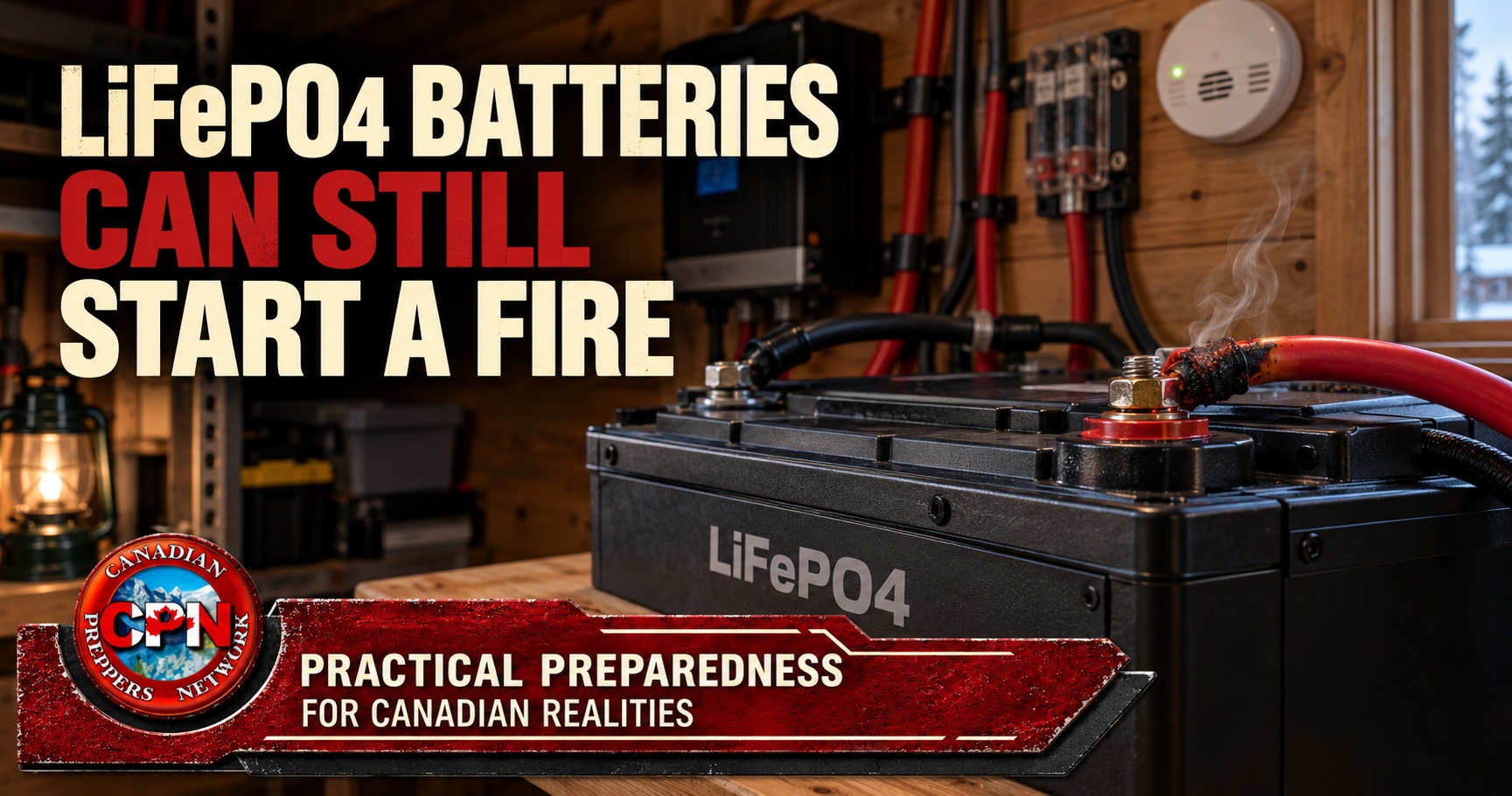
LiFePO4 batteries still deserve respect. A wiring fault, unsuitable charger, damaged battery or poorly planned installation can turn backup power into a second emergency.
In This Guide
LiFePO4 Batteries: Stable Chemistry Does Not Remove the Hazard
LiFePO4 batteries belong to the lithium-ion battery family. Their chemistry generally offers greater thermal stability than several other lithium-ion chemistries, but that advantage has sometimes been stretched into claims that these batteries cannot burn or undergo thermal runaway.
Experimental research has documented thermal runaway in LiFePO4 cells under abuse conditions. The chemistry reduces certain risks; it does not eliminate every way a battery system can fail.
There are also two separate fire problems to consider.
One begins inside a failing cell. The other begins in the electrical system around it: cables, terminals, connectors, chargers and inverters. A battery can supply the energy that starts a wiring fire without its cells first entering thermal runaway.
For a prepper, both can have the same consequence: losing power, supplies and shelter when replacements and emergency assistance are already difficult to obtain.
A Twelve-Volt System Can Carry Serious Current
Low voltage can encourage casual workmanship. Someone who would never improvise household wiring may connect a large inverter to a battery using whatever cables happen to be available.
Consider a 1,500-watt appliance supplied through an inverter from a battery operating at 12.8 volts. Even before inverter losses, the battery must supply approximately 117 amps. Actual current will be higher once those losses are included.
That is a substantial load passing through every connection along the circuit.
Cable size, cable length, terminal quality and connection tightness matter. Loose connections and unsuitable conductors can overheat. An exposed positive terminal also presents a short-circuit hazard if a tool or other conductive object bridges it to the negative side.
Cover exposed terminals. Secure cables against movement and abrasion. Have conductors, terminations and connections selected and installed for the actual system.
The Wrong Fuse Can Leave You Unprotected
A fuse’s amperage is only part of its specification.
It must also be suitable for the circuit’s DC voltage and capable of safely interrupting the fault current the battery bank could deliver. That last characteristic is its interrupt rating, sometimes called breaking capacity.
Victron’s wiring guidance explains that a fuse with an inadequate interrupt rating can fail catastrophically. Its lithium-battery guidance requires protection capable of interrupting the bank’s maximum prospective short-circuit current.
This is why copying a fuse size from a photograph or buying a breaker because its advertised amperage looks right is poor preparation.
Adding LiFePO4 batteries can also change the system’s available fault current. An expanded bank deserves a fresh protection review.
Ask the installer to identify the protection for each relevant circuit, explain its placement and confirm its ratings. Keep that information with the system documentation.
Your BMS Cannot Correct Every Installation Mistake
For LiFePO4 batteries, a battery management system monitors conditions and can interrupt charging or discharging when specified limits are reached. Depending on the product, those protections may include cell voltage, temperature and current limits.
Its capabilities must be established from the actual documentation. “Built-in BMS” is not a complete description of the protection provided.
Some batteries require an external BMS and coordinated control of connected equipment. Victron’s Lithium Smart instructions, for example, specify an approved BMS and additional protective arrangements. Those requirements belong to that product family and should not be assumed to describe every battery.
A BMS also cannot make a loose external connection tight or turn an undersized cable into a suitable conductor.
Repeated protective shutdowns deserve investigation. Record the fault, check the manual and determine why it happened. Bypassing protection to keep an appliance running removes a safeguard precisely when the system may need it.
Canadian Cold Creates a Charging Trap
LiFePO4 batteries may be permitted to discharge at a temperature where charging is prohibited.
Storage, discharge and charging limits are different specifications. An owner who reads only the advertised operating-temperature range can miss that distinction.
Victron’s Lithium Smart batteries specify charging between +5°C and +50°C, while allowing discharge over a wider range. Other products have different limits, so one universal temperature rule is insufficient.
Picture a battery bank in an unheated cabin. It powers lights overnight, then receives solar charging current after sunrise while the cells remain cold. Whether that charging is safely blocked depends on the equipment and its configuration.
Canadian manufacturer Canbat distinguishes cold storage from cold charging and describes models that use incoming charging power to warm their cells before charging begins. That is a designed feature to verify, rather than something to assume from a “winter-ready” label.
Check every charging source: solar controller, mains charger, inverter-charger and vehicle connection. Each must work within the battery’s requirements.
A Charger Must Match More Than the Voltage
Two chargers marked “12 volt” may have very different charging programmes.
When charging LiFePO4 batteries, confirm the permitted charging voltage, current and operating modes against the battery manufacturer’s instructions. A multipurpose charger must be configured correctly; a familiar plug or a lithium setting alone does not establish compatibility.
Read the details behind temperature claims, too. A charger that adjusts its output according to surrounding air temperature is not necessarily measuring the temperature inside the battery.
The useful questions are specific: What temperature is being measured? What happens at the limit? Does that behaviour satisfy this battery’s instructions?
Keep the settings recorded. During a prolonged disruption, another household member may need to operate the system.
Placement Determines What Else You Could Lose
Installing LiFePO4 batteries beside cardboard boxes, spare bedding or fuel containers adds consequences to an equipment failure.
Follow the manufacturer’s mounting, spacing, environmental and clearance requirements. Protect the installation from flooding, impacts and unsecured objects. Keep escape routes clear.
For stationary household systems, verify approval for the intended installation. UL explains that certification for a portable power pack does not automatically qualify it as a stationary residential energy-storage system. Combining separately certified components also does not automatically create a certified complete system.
A weatherproof storage case is not automatically a suitable battery enclosure. Any enclosure must address the equipment’s operating requirements and potential failure conditions.
Venting Is an Emergency Warning
A failing lithium-ion battery can release flammable and toxic gases. Those gases can accumulate and ignite. Thermal runaway can also eject hot material, spread between cells and leave a risk of reignition after visible flames disappear.
Smoke, venting, swelling or rapidly increasing heat warrant immediate action. Move people away, leave the affected area and contact emergency services. Tell responders that a lithium battery system is involved.
Do not carry a smoking battery through the house or approach it to disconnect cables. A reachable remote shutdown may help isolate equipment, but using it must not delay escape or require approaching the failure.
An ordinary extinguisher should not be treated as a guaranteed solution. UL warns that extinguishers will not fully extinguish a lithium-ion battery fire once thermal runaway is established.
Inspect the System Before You Expand It
Before expanding a bank of LiFePO4 batteries, answer these questions:
- Can you identify every battery model and obtain its manual?
- Are all charging sources configured within its limits?
- Is cold charging controlled as the manufacturer requires?
- Are cables, connections, fuses and disconnects correctly specified?
- Is the equipment securely mounted in an appropriate location?
- Does another adult understand the warnings and shutdown procedure?
Purchases should follow the gaps that inspection reveals. A compatible charger, properly selected protection equipment, battery monitor or suitable test instrument may be more useful than another block of storage capacity.
Choose those items by specification and documented suitability. A meter cannot certify an installation, and a temperature display cannot replace an automatic protection function.
LiFePO4 batteries can provide dependable power through a serious disruption. Before relying on them overnight, make sure you understand the entire installation—from the charging source to the last cable connection.
Could you explain your battery bank’s protection and charging limits to another household member without relying on the sales listing?