Your livestock waterer backup plan for a Canadian winter
Your livestock waterer is working. The feed is stacked. The bedding is dry. The animals have shelter.
Then the power fails.
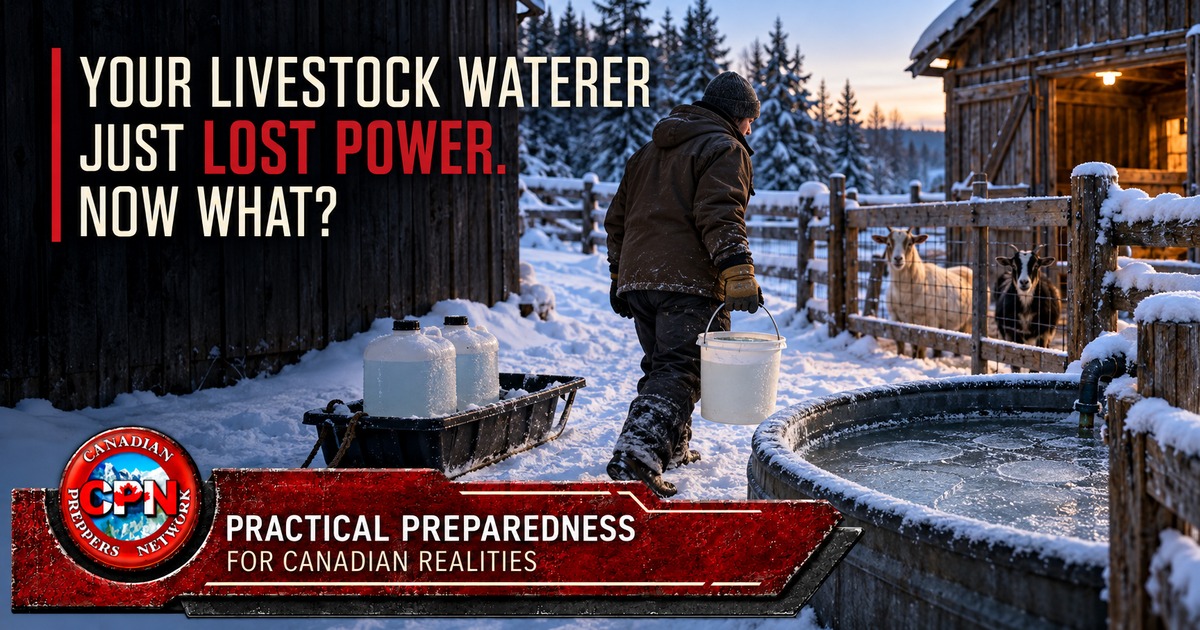
The well pump stops, the heated livestock waterer goes cold, and the hose you meant to drain freezes solid. By the next chore round, water has become the job that controls your day.
For a Canadian homestead, this is a serious weakness. Animals remain dependent on you whether the outage lasts six hours or six weeks. A winter watering plan has to connect four things: a dependable source, a way to move water, a usable drinking container and enough labour to keep repeating the process.
A spare bucket covers only one of them.
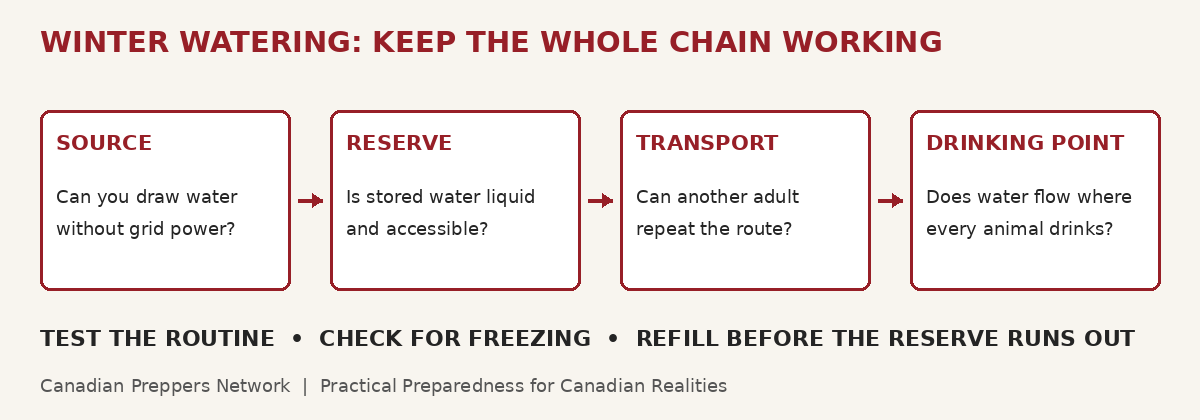
Table of Contents
Inspect Your Livestock Waterer Before Something Fails
Walk your livestock waterer system from its source to the animal.
Does the well require electricity? Does water pass through an exposed pipe? Is the hydrant functioning correctly? Does the trough depend on an electric element? Can the animals actually reach water if the float valve or drinking nipple freezes?
Write down every point where one failure stops the supply.
A full livestock waterer is little comfort if its outlet is frozen. A working generator does not solve a split pipe. A warm reservoir does not guarantee that water reaches the drinking point.
The Beef Cattle Research Council recommends matching watering systems to the site, checking them regularly and maintaining a backup supply. Winter reliability involves the components between the source and the trough as well as the source itself.
Your assessment should end with a clear answer:
If the normal system stopped tonight, where would tomorrow morning’s water come from, and how would it reach every animal?
Measure the Chore You Are Taking On
Before choosing a backup livestock waterer or building a reserve, establish how much water the animals actually use.
Requirements vary with species, body size, diet, production and conditions. Lactating animals and growing stock cannot simply be assigned the same allowance as mature animals at maintenance.
Measure normal consumption over several representative days. Account for spills, cleaning and any water discarded during container changes. Use species-specific guidance to check your figures, particularly when planning for conditions different from those you measured.
Then translate litres into trips.
Suppose your measured requirement, including routine losses, is 80 litres per day. With containers filled to 10 litres each, that means eight container loads every day. The water alone weighs approximately 80 kilograms in total.
That is an illustration, not a livestock allowance.
Now walk the route carrying a realistic load. Include the steps, gates, slopes and distance you would face after a snowfall.
A plan that looks manageable beside the kitchen sink may become exhausting halfway across an icy yard.
Keep a Livestock Waterer Reserve You Can Still Pour
When a livestock waterer fails, stored animal water gives you time to diagnose the fault and establish the next supply.
Its value depends on remaining accessible and liquid.
Choose clean containers suitable for storing water. Keep them away from fuel, pesticides and other contamination sources. Place the working reserve somewhere protected from freezing, with access that does not depend on an electric door opener or a path you routinely leave unshovelled.
Several manageable containers may serve a small homestead better than one large barrel. They allow you to carry, exchange and clean individual units without moving the whole reserve.
Work out the reserve in days. If the measured requirement is 80 litres daily, a 160-litre reserve provides two days before allowing for unexpected losses.
That is useful breathing room. It also tells you exactly when the next supply must be operating.
For longer disruptions, the reserve needs a replenishment method. A well with a compatible backup pumping arrangement, a properly developed gravity supply or another verified source has to take over before storage runs out.
For Small Stock, Build a Container Exchange
Poultry and rabbits need a system scaled to their drinking behaviour and housing.
For chickens, a second complete waterer is particularly useful. One can be in service while the other is thawed, cleaned and prepared for exchange. University of Minnesota Extension recommends fresh, clean water, routine checks and a spare waterer when one freezes or fails. It also recommends positioning the waterer to reduce contamination from scratched bedding and manure.
Choose containers that the birds can use safely. An open bucket intended for larger animals may introduce drowning or wetting hazards for smaller stock.
For rabbits, inspect the actual drinking outlet. Seeing liquid in a bottle or reservoir does not establish that water is flowing through its nipple or valve.
Canada’s rabbit Code of Practice provides the species-specific foundation for feed and water management. Use that guidance when designing the backup arrangement, including suitability for young animals and breeding does.
Introduce backup containers before an emergency and confirm that the animals use them.
The exchange routine must maintain access to drinkable water. Two visits a day are inadequate if the drinking point freezes between visits. Establish the inspection frequency under your actual conditions and increase it when temperatures or wind exposure change.
Insulation Buys Time
A sheltered, insulated livestock waterer can reduce heat loss. That makes it useful, but its performance still depends on the heat available to the system.
B.C.’s winter livestock-watering guidance distinguishes between supplying heat and reducing heat loss. Systems may use electricity, fuel, incoming water or heat from below ground, depending on their design.
For an existing livestock waterer, determine what keeps it working.
Does an “energy-free” unit depend on a specified level of animal use and incoming water? Does an earth-heated system require a particular installation? Does a drain-back arrangement actually empty its exposed components?
Check the livestock waterer manufacturer’s requirements against your installation and herd size.
For a small homestead using portable containers, wind protection, appropriate insulation and container exchanges may form a workable routine. Test that routine through real cold weather while the normal system is still available.
Measure how long the drinking point remains usable. Let the result set your chore schedule.
Larger Animals Make Transport the Main Problem
Once daily demand rises, carrying water becomes a substantial operation.
A sled may reduce carrying over snow. A suitable cart may help on a firm cleared route. Both require a practical loading point, manageable containers and somewhere safe to unload.
Plan those details now:
- Keep the route cleared and treat slippery areas.
- Store containers where they can be filled without awkward lifting.
- Keep gates operable after snow accumulation.
- Provide enough drinking access for the group.
- Prevent timid animals from being excluded by dominant stock.
- Keep spills and discarded water away from entrances and walking routes.
Drain portable hoses after use and store them where they remain serviceable. Follow the installation and operating instructions for frost-free hydrants and permanent watering equipment.
Most of all, avoid designing a routine around your strongest day. It must remain possible when you are tired, slightly injured or handling several other failures.
Snow Requires a Species-Specific Decision
Snow is an appealing answer because it appears to put water everywhere.
Canadian guidance permits its use for certain livestock under defined conditions, but suitability depends on the animals and the quality, quantity and accessibility of the snow. Saskatchewan’s guidance discusses its use for cows and sheep while identifying the need for supplemental water when suitable snow is insufficient.
That does not establish a snow-only plan for chickens, rabbits or every animal in a mixed group.
Crusted, contaminated or inaccessible snow creates another problem. Melting snow yourself creates a fuel and labour demand.
Keep a dependable liquid-water method in the plan unless you have verified that a different arrangement meets the needs of your particular animals and operation.
Test Your Livestock Waterer Backup for a Full Day
Conduct a supervised practice day using the backup routine. Keep the normal supply available so animal access to water is maintained throughout the exercise.
Record:
- Water delivered and water discarded.
- Time spent filling, transporting, cleaning and checking.
- How quickly drinking points begin to freeze.
- Problems with gates, footing, lifting and access.
- Whether every animal uses the backup arrangement.
Have another household member perform the routine too.
Then consider the less convenient version: deep snow, a frozen latch, an unavailable vehicle and the usual caregiver confined indoors.
If the routine depends on one person making repeated heavy trips, it needs improvement. Shorten the route, change container sizes, improve transport or develop a more suitable permanent supply.
For a prolonged collapse, this calculation also belongs in decisions about livestock numbers. Every additional animal adds a daily obligation that continues after fuel, spare parts and outside help become scarce.
Before buying another animal, prove that you can water the animals you already have through a winter failure.
The next useful project may be a better filling point, a cleared transport route or a tested backup livestock waterer.
Start with one complete livestock waterer chore round. Fill the containers, move the water, check every drinking point and count the work.
If the power failed tonight, how many trips would your animals require tomorrow?
Livestock Waterer Backup: Five Practical Checks
Who notices the first failure?
Assign responsibility for checking the livestock waterer and recording the result. A glance toward the barn is not an inspection. Confirm that animals can reach liquid water and that the outlet works. Leave a clear handover when another adult takes over the chores, including the last refill, remaining reserve and any equipment already thawing.
Where does the next refill come from?
Mark the working reserve with the amount remaining and the next planned refill. If the livestock waterer system is still down, replenish storage before it reaches the final container. Separate a source problem from a transport problem: having water somewhere on the property is useful only if your routine can bring it to the animals.
Can the drinking point be serviced?
Keep the relevant livestock waterer instructions with the spares. Identify the exact model of cups, valves, seals and connectors before buying replacements. Check whether a small removable part can be exchanged while another is cleaned or thawed. A compatible spare that you have already fitted is more useful than a box of assorted parts.
Can someone else do the work?
Write a short chore card showing the water source, container sizes, route, drinking points and inspection routine. Have the backup caregiver complete the livestock waterer checks without coaching. Change any lifting task or awkward gate that prevents them from managing independently. Keep this card where the equipment is stored.
What changed since the trial?
Reassess after adding animals, moving pens or changing the water source. Record colder conditions, new ice and any increase in discarded water. Your livestock waterer backup plan should reflect the animals and equipment you have today. Repeat the practical test after a material change rather than assuming last winter’s routine still covers the work.