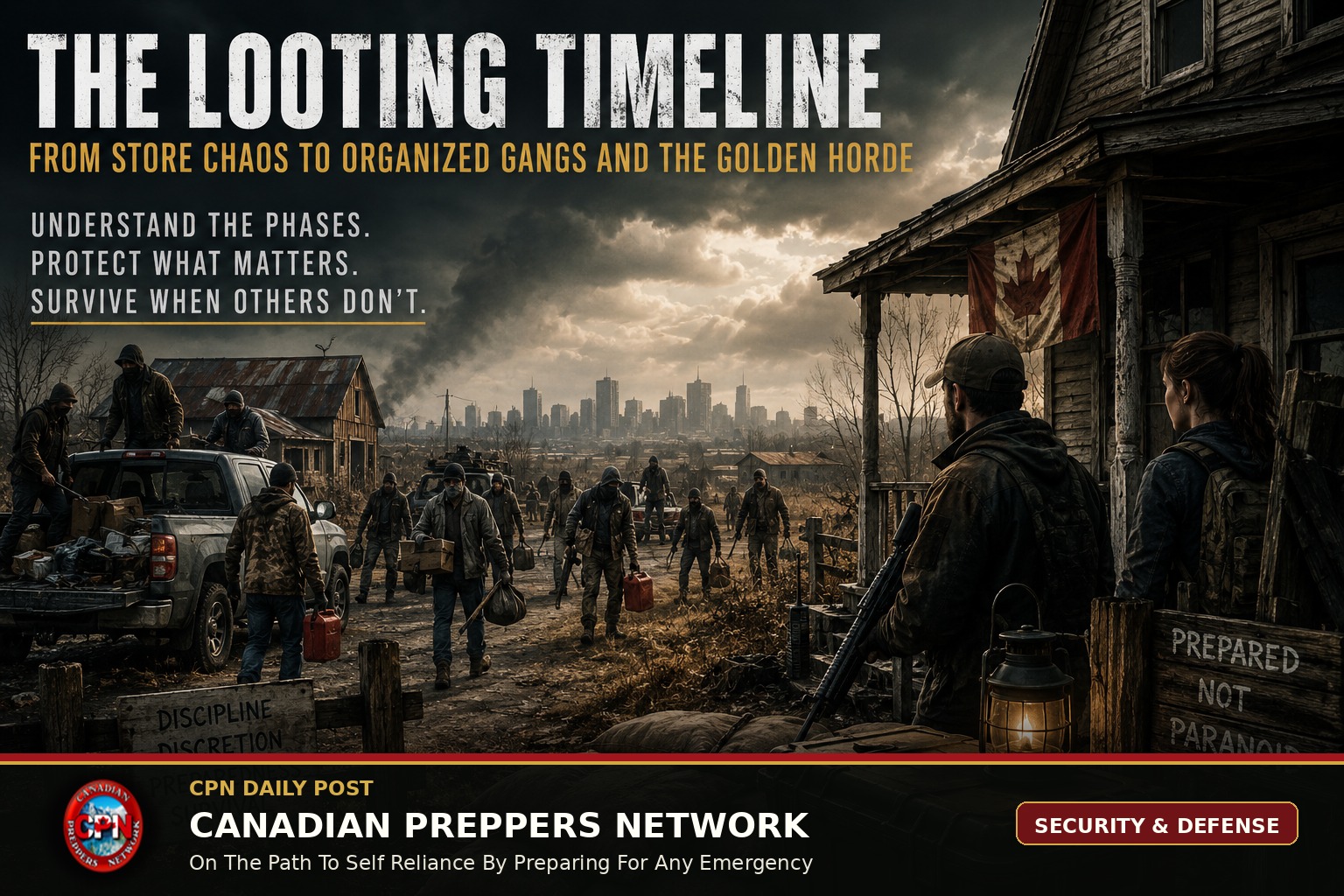
From Storefront Chaos To Organized Gangs And The Golden Horde
Most people imagine looting as something that happens somewhere else.
They picture smashed storefronts, city streets, police lines, burning cars, and crowds moving through commercial districts. In that version of the story, the danger stays downtown. It stays on the news. It stays far enough away that suburban and rural homeowners can tell themselves they are watching a problem, not living inside one.
That is a dangerous assumption.
In a short emergency, people usually stay close to normal behaviour. They check on family, buy extra groceries, complain about the power outage, wait for the road to reopen, and assume the system will catch itself. But when the disruption stretches out, when shelves stop refilling, when fuel becomes scarce, when pharmacies cannot restock, when bank machines are down, when cell service is unreliable, and when the official answers become vague, behaviour changes.
Looting does not begin with roaming gangs at the end of the driveway. It usually begins much earlier, much quieter, and much closer to normal life.
It begins with people looking for anything useful.
For Canadian preppers, the point is not to live in fear. The point is to understand the timeline before you are standing in the middle of it. Security is not something you start building after the first break-in on your road. By then, everyone is reacting. The household that prepared early is not the one looking tough. It is the one that already has supplies hidden, routines established, weak points hardened, communications planned, and neighbours quietly sorted into categories of trusted, unknown, and avoid.
Canadian Preppers Network Security & Defense Hub
The First Phase Is Denial
This is when the emergency is obvious, but most people still believe it will end quickly. The power has been out for a day. The grocery store is open but stripped thin. The gas station has a line down the street. Police are still visible. Officials are still speaking confidently. Everyone is still telling themselves that tomorrow will be better.
This phase is not harmless. It is when the unprepared make their first serious mistakes.
They burn fuel driving around looking for supplies. They spend hours in public lineups where frustration is building. They talk too much. They tell neighbours what they found, where they bought it, what they still have at home, and what they are worried about losing. They post updates online. They leave garage doors open while sorting gear. They run generators openly. They carry cases of water and fuel in plain view.
This is also when a prepared household should become boring.
No bragging. No obvious resupply trips. No visible gear piles in the driveway. No bright house when the rest of the block is dark. No loud generator running all night as an advertisement. No public discussion about how much food, fuel, medicine, ammunition, cash, propane, or water is stored at home.
In the denial phase, your job is to disappear into the background. Help where it makes sense. Stay polite. Stay calm. But do not become the neighbourhood supply depot in everyone’s imagination.
The Second Phase Is Opportunistic Theft
This is where people stop waiting politely and start testing boundaries.
At first, it may not look dramatic. A shed gets opened. A fuel can disappears. A package is taken from a porch. Someone walks up a driveway and looks into vehicles. A bicycle vanishes. Someone checks whether gates are locked. Someone knocks on the door with a story that does not quite fit. A stranger appears near the garage, the woodpile, the chicken coop, the propane tanks, or the parked trailer.
This stage is not always committed criminality. Sometimes it is desperation mixed with opportunity. That does not make it harmless. In a prolonged emergency, the difference between “just looking” and “coming back later” can be very thin.
This is where basic hardening matters.
Locks matter. Gates matter. Lighting discipline matters. Dogs matter. Cameras can matter if they still have power. Driveway alerts matter. Window coverings matter. Keeping tools out of sight matters. So does not making it easy for someone to understand what you have and where you keep it.
The average thief, desperate neighbour, or opportunist looks for easy wins. An unlocked shed. A visible generator. A fuel jug beside the garage. A cooler on the porch. A vehicle with supplies inside. A dark back corner of the property nobody checks. A house where everyone’s routine is obvious.
The prepared household should become harder to read.
That does not mean turning the place into a movie fortress. It means removing easy opportunities. Fuel is not visible. Tools are not left out. Ladders are not stored where they can be used against you. Outbuildings are locked. Sight lines are cleared. Approaches are noticed. Routines vary. Supplies are split and hidden. The house does not advertise comfort when everyone else is uncomfortable.
Security & Defence Buying Guide
The Third Phase Is Targeted Theft
This is where things become more dangerous.
By this point, people have started learning who has what. The house with the generator. The family with fuel. The person with medical supplies. The rural property with livestock. The neighbour who kept giving food away. The prepper who talked too much for years. The guy who always said, “I’m ready for anything.”
Loose talk becomes intelligence. Visible comfort becomes a target marker.
This is why operational security is not paranoia. It is common sense. The more strained a situation becomes, the more people remember what they heard before the crisis. They remember the basement pantry. They remember the solar setup. They remember the gun safe conversation. They remember the freezer full of meat. They remember who had a well, a woodstove, a tractor, chickens, diesel, propane, tools, or a radio room.
At this point, defence is not just about doors and locks. It is about information control.
Who knows what you have? Who knows where it is stored? Who knows when you are home? Who knows who else lives there? Who knows whether you have backup power? Who knows whether your group meets at your place? Who knows whether you are alone?
The hard truth is that many preppers compromise their security long before the emergency. They do it casually. They do it socially. They do it because talking about preparedness is enjoyable. They do it because they want to be seen as the person who has things figured out.
In good times, that may only be annoying. In bad times, it can become dangerous.
A smarter approach is to build quietly. Store quietly. Train quietly. Help selectively. Avoid unnecessary details. When people ask what you have, speak in generalities. When people ask where to get gear, point them toward public resources, not your basement. When people ask how long you can last, never answer the question directly.
The Fourth Phase Is Organized Looting
This is a different animal from opportunistic theft.
A desperate neighbour may take a fuel can. A petty thief may check vehicles. A hungry family may knock on doors. Those are dangerous situations, but they are still individual or small-scale problems.
Organized gangs are something else entirely.
In a long emergency, criminals adapt faster than polite society. They already understand intimidation, movement, scouting, stolen vehicles, weak targets, and the value of fear. When police are overwhelmed, communications are unreliable, and courts are not functioning normally, criminal groups do not need total collapse to become bold. They only need delayed consequences.
That is when neighbourhoods, farms, rural homes, isolated cottages, small businesses, fuel depots, pharmacies, hardware stores, feed stores, and known prepared households become valuable targets.
The mistake is assuming this begins with violence. Often, it begins with observation.
Who has lights on? Who is running a generator? Which property has livestock? Which driveway has multiple vehicles? Which home has smoke from a woodstove when everyone else is cold? Which household still looks fed, warm, and functional after everyone else is wearing down?
Organized looters do not have to know everything. They only need to identify the houses that look worth the effort.
That is why the prepared household must think beyond locks and bravado. The goal is to avoid standing out, avoid becoming predictable, avoid exposing supply locations, and avoid being isolated when pressure arrives.
The Fifth Phase Is Organized Pressure
This is the stage most people jump to in their imagination, but it usually comes after earlier stages have already revealed the weak points.
Organized pressure does not have to mean some Hollywood-style army rolling down the road. It can be a group of desperate people comparing notes. It can be several households deciding that one prepared household has “more than its share.” It can be criminals taking advantage of thin police response. It can be a group moving from property to property looking for food, fuel, tools, medicine, batteries, livestock, or transportation.
At this point, the lone-wolf fantasy begins to collapse.
One person cannot watch every direction, sleep properly, maintain heat, cook, haul water, care for children, treat injuries, monitor communications, protect livestock, and guard supplies indefinitely. Even a well-equipped family becomes exhausted if the pressure continues.
That is why real long-term security is not just hardware. It is manpower, trust, observation, communication, and routines.
This is where a trusted network matters. Not a loose social club. Not a public online group where everyone knows too much. A real preparedness network built before the crisis, with people who understand boundaries, skill sharing, communication plans, mutual aid, and discretion.
Communications When the Grid Goes Silent
The household that has no communications plan is isolated. The household that has no trusted contacts is guessing. The household that has no watch routine is reacting after the fact. The household that has no fallback plan is betting everything on one location.
That is not strategy. That is hope wearing tactical clothing.
The Golden Horde Problem
Then there is the problem preppers often call the Golden Horde.
The theory is simple. If cities and dense suburbs become unlivable because of food shortages, fuel shortages, water failures, violence, disease, or prolonged grid collapse, large numbers of desperate people will move outward. Some will be looking for relatives. Some will be looking for shelter. Some will be looking for food. Some will be looking for anything that can keep them alive one more day.
Not all of them will be criminals. That is what makes the problem harder.
A hungry family with children is not the same as a criminal gang. A stranded traveller is not the same as a looter. A neighbour who made bad choices is not the same as an organized threat. But from the perspective of a prepared homestead, retreat, or rural household, the pressure can still become overwhelming.
The Golden Horde does not have to arrive as one giant wave. More likely, it arrives as a trickle that becomes a pattern.
First come stranded motorists. Then relatives of locals. Then people looking for fuel. Then people looking for food. Then people following rumours. Then people who heard that farms have supplies. Then people who discover that rural areas are not empty, not helpless, and not always welcoming.
This is where fantasy thinking gets people into serious trouble.
A lone family cannot absorb unlimited need. A rural property cannot feed every person who walks down the road. A retreat cannot become a public refugee centre without collapsing its own survival plan. Charity without limits becomes self-destruction. Mercy without boundaries becomes an invitation to return with more people.
The Golden Horde theory is not an excuse to hate outsiders. It is a warning about scale.
When thousands of unprepared people are forced to move, even a small percentage reaching your area can change the security picture overnight.
The Sixth Phase Is Local Scarcity Politics
This is the phase few people want to discuss.
When scarcity lasts long enough, theft and looting are no longer the only concerns. Social pressure becomes part of the security problem. People begin making moral claims on other people’s supplies. “You have more than you need.” “There are children involved.” “We all have to share.” “You were prepared, so you should help.” “Nobody should be allowed to keep that much.”
Some of those pleas may be sincere. Some may be manipulative. Some may come from people you care about. That is what makes this phase so difficult.
A prepared household needs a charity policy before the emergency. Not a vague emotional feeling. A policy.
What can you give without damaging your own survival? Who are you responsible for first? What can be shared without revealing your main stores? Can you give knowledge instead of supplies? Can you help through a church, community group, or trusted intermediary rather than turning your front door into a distribution point? Do you have small giveaway items separated from core reserves?
The worst time to make these decisions is when hungry people are standing in front of you.
This does not mean becoming cold or cruel. It means understanding that uncontrolled generosity can turn into a security failure. If every act of help reveals that you have more, you may not be helping anyone for long. You may simply be training people to come back with more pressure.
Food Procurement & Storage Hub
Water Collection & Purification Hub
The Seventh Phase Is Fatigue
Security failure often comes from exhaustion, not stupidity.
People get tired. They stop locking doors. They skip checks. They leave gear outside. They sleep too deeply. They forget radio schedules. They argue. They make emotional decisions. They overreact to small threats and underreact to serious ones. They become predictable because predictable routines are easier when everyone is worn down.
Long emergencies punish weak systems.
If your security plan depends on one alert person staying sharp forever, it is not a plan. If your water plan requires exhausting labour every day, it will break down. If your heat plan requires constant fuel movement through exposed areas, it becomes a security problem. If all supplies are in one room, one fire, flood, theft, or forced evacuation can wipe you out. If all decision-making sits with one person, that person becomes the bottleneck.
This is why preparedness categories connect. Security is tied to water. Water is tied to energy. Energy is tied to heat. Heat is tied to sleep. Sleep is tied to decision-making. Decision-making is tied to whether a household survives pressure without tearing itself apart.
The looting timeline is not just about criminals. It is about systems under strain.
The Single-Family Survival Plan Has A Hard Ceiling
One household can store food. One household can harden doors. One household can install alarms, conceal supplies, and plan night routines. But one household cannot watch every approach, sleep in shifts forever, care for animals, haul water, maintain heat, monitor radios, repair equipment, handle medical problems, and deal with repeated human pressure without breaking down.
The Golden Horde problem is not solved by pretending one man with supplies can hold off the world.
It is solved by distance, discretion, early warning, trusted numbers, retreat planning, food production, water independence, communications, and clear rules before the crisis begins.
That is the uncomfortable truth many casual preppers avoid. Long-term survival is not just about being stocked. It is about being organized.
A real retreat is not a fantasy compound. It is a planned human system. It has people, roles, work routines, food systems, watch rotations, medical capacity, communications, fallback plans, and leadership before the emergency. That is what separates a serious preparedness location from a rural house full of gear.
What Canadian Preppers Should Do Before The Timeline Starts
First, stop advertising. A quieter household is a safer household. Keep supplies out of sight. Keep routines less obvious. Keep discussions general. Avoid turning preparedness into a public identity that points back to your address.
Second, harden the easy targets. Sheds, garages, vehicles, fuel storage, tools, gates, and ground-floor access points deserve attention before any fantasy scenario. Most real security failures begin with easy opportunities.
Third, build layered warning. A dog, a driveway alarm, battery lighting, cameras with backup power, radios, and alert neighbours all serve different purposes. No single tool is the answer. Layers are the answer.
Fourth, split critical supplies. Do not keep every important item in one obvious location. Food, water treatment, batteries, medical supplies, documents, tools, and cash should not all depend on one storage area remaining untouched.
Fifth, build trusted relationships before things get ugly. You cannot create trust during panic. You can only reveal whether it already exists.
Sixth, create a charity boundary. Decide what can be given, what cannot, and how help will be offered without exposing the household.
Seventh, practise boring routines. Lockup checks. Communications checks. Fuel checks. Water checks. Night routines. Morning routines. Inventory checks. These habits are dull, which is exactly why they work.
The real security lesson is simple: by the time looting reaches your neighbourhood, the important decisions have already been made.
You either built quiet strength, or you advertised weakness.
You either reduced opportunity, or you left easy targets.
You either built relationships, or you stood alone.
You either planned your boundaries, or you improvised under pressure.
The looting timeline does not end at broken storefronts.
It moves outward.
First the stores are stripped. Then vehicles are checked. Then sheds are opened. Then fuel disappears. Then livestock becomes tempting. Then rumours spread. Then known prepared homes become targets. Then organized criminals test weak areas. Then desperate movement from towns and cities begins to push into the countryside.
That is the real timeline.
Not overnight apocalypse. Not movie chaos. Not one dramatic event that announces the end of normal life.
A slow, ugly expansion of desperation.
The prepared household has to see that before everyone else does.
Because by the time organized gangs are moving, by the time rural roads are being tested, by the time desperate people are following rumours of food and fuel, by the time the Golden Horde is no longer just a prepper theory, it is too late to become discreet. It is too late to build trust. It is too late to hide the fact that you were ready.
Security begins long before the threat reaches the driveway.
It begins with silence.
It begins with distance.
It begins with not looking worth the trouble.
And for those thinking beyond a few weeks, it begins with accepting the truth that no single family is an island forever. Long-term survival belongs to prepared groups, quiet retreats, and communities that understood the timeline before the crowd started moving.
Build The Systems Before The Timeline Starts
Reading about the looting timeline is useful only if it pushes you to prepare before that timeline reaches your street.
The first hours of a serious breakdown are not the time to find weak locks, dead radios, empty batteries, poor lighting, missing medical supplies, or confused family plans. By then, stores may already be stripped, roads may be unstable, and the people who waited too long may be acting out of panic.
Start with the systems that reduce exposure, confusion, and dependency.
Security and Defence Buying Guide
Energy Production and Blackout Power Buying Guide
Medical and First Aid Buying Guide
Mental Resilience and Community Building Buying Guide
The goal is not to turn your home into a fantasy bunker. The goal is to make your household harder to surprise, harder to confuse, harder to isolate, and harder to push into panic.
Practical Security Gear Worth Considering
The point is not to buy random gadgets. The point is to close obvious gaps: seeing movement earlier, delaying easy access, keeping supplies hidden, and maintaining communication when normal systems fail.
Security Gear Buying Box
Motion Sensor Solar Security Lights
https://www.amazon.ca/s?k=motion+sensor+solar+security+lights&tag=canadianprep-20
Driveway Alarms and Motion Alerts
https://www.amazon.ca/s?k=driveway+alarm+motion+sensor&tag=canadianprep-20
Door and Window Alarm Sensors
https://www.amazon.ca/s?k=door+window+alarm+sensors&tag=canadianprep-20
Heavy Duty Padlocks and Hasps
https://www.amazon.ca/s?k=heavy+duty+padlock+outdoor+weatherproof&tag=canadianprep-20
Blackout Curtains and Window Coverings
https://www.amazon.ca/s?k=blackout+curtains&tag=canadianprep-20
Rechargeable Flashlights and Area Lights
https://www.amazon.ca/s?k=rechargeable+flashlight+area+light&tag=canadianprep-20
Handheld Radios for Local Communication
https://www.amazon.ca/s?k=handheld+two+way+radios&tag=canadianprep-20
Lockable Storage Boxes and Totes
https://www.amazon.ca/s?k=lockable+storage+box+heavy+duty&tag=canadianprep-20
For a broader gear framework, see:
Security & Defence Buying Guide
Acres of Preparedness
Long-term security is not only about locks, lights, or alarms. It is about where you live, who you trust, how supplies are arranged, how work is divided, and whether your household is part of a larger survival system.
That is the core idea behind Acres of Preparedness: Planning the Last Safe Place. It looks beyond the single-family bunker fantasy and focuses on retreat planning, land use, group structure, food systems, water, energy, and community resilience for serious long-term preparedness.
Acres of Preparedness
https://amzn.to/4mRu7b5