
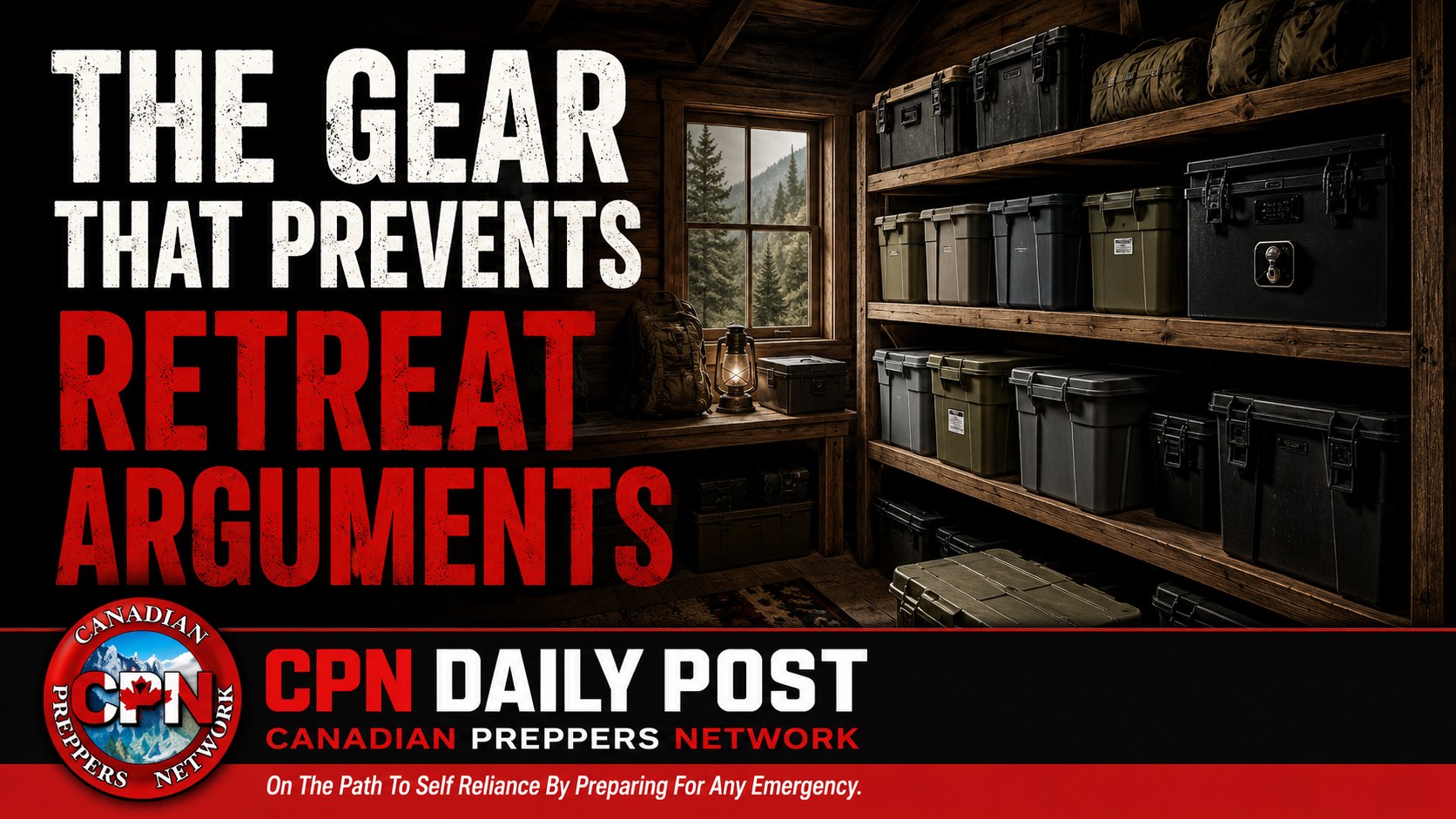
A retreat group can survive hard times, but only if supplies, access, labour, and responsibility are managed before resentment takes root.
There is a dangerous assumption in group preparedness that conflict is mostly a personality problem.
Sometimes it is. Some people are selfish. Some are lazy. Some are controlling. Some cannot handle being corrected. Some are agreeable right up until they are told that the rules apply to them too.
But many retreat conflicts do not begin because someone is a bad person. They begin because the system is unclear.
Who opened the food bin? Who used the last batteries? Who took the good gloves? Who moved the medical kit? Who left the axe outside in the rain? Who gave supplies to someone outside the group? Who keeps getting access to shared resources without doing their share of the work?
Those questions can poison a retreat faster than most people expect.
In a long emergency, the group that survives is not necessarily the group with the biggest pantry. It is the group that can keep trust intact while tired, hungry, cold, crowded, and under pressure. That does not happen by accident. It has to be designed.
A good retreat needs food, water, heat, security, communications, and medical supplies. It also needs bins, locks, labels, shelves, tags, rules, and people who understand that structure is not the enemy of community. Structure is what keeps community from turning into an argument.
For more on the people side of preparedness, visit the CPN Mental Resilience & Community Building hub.
The First Rule: Shared Supplies Are Not “Everybody’s Supplies”
One of the fastest ways to split a retreat group is to treat every stored item as common property with casual access.
That sounds cooperative at first. Everyone is trusted. Everyone is family. Everyone knows the supplies are there for the group. Nobody wants to seem controlling before anything bad has even happened.
Then stress arrives.
A lantern disappears from the common shelf. Someone opens a stored food bucket without saying anything. A child grabs batteries for a toy. A well-meaning member gives a roll of tape, a package of gloves, or a bag of rice to a neighbour. Someone uses the last of a repair supply on a low-priority job. Nobody admits it. Nobody remembers. Everyone starts watching everyone else.
That is how trust dies.
Shared supplies should not mean uncontrolled supplies. In a serious retreat, supplies belong to the group, but access belongs to the system. Food stores, batteries, radios, fuel, medical supplies, tools, sanitation items, and repair materials should have assigned storage, assigned access, and assigned accountability.
This is not about hoarding power. It is about preventing accusations.
A locked storage area does not mean nobody is trusted. It means nobody has to wonder what happened.
Physical Systems Beat Verbal Agreements
Verbal agreements are weak under pressure.
Before a crisis, people will agree to almost anything. They will say they understand rationing. They will say they support shared labour. They will say they know which supplies are restricted. They will say they would never take something without asking.
Then the emergency becomes real.
Someone is cold. Someone is scared. Someone’s child is crying. Someone feels their own contribution is worth more than another person’s. Someone convinces themselves that “just this once” does not count. Someone opens a tote, moves a tool, uses a charger, or helps themselves to a stored item because asking would be inconvenient.
That is why retreat management needs physical systems.
A lockable tote is a conflict-resolution tool. A labelled shelf is a conflict-resolution tool. A sealed bin is a conflict-resolution tool. A dedicated tool roll is a conflict-resolution tool. A battery organiser is a conflict-resolution tool. A numbered storage tag is a conflict-resolution tool.
These items are not glamorous, but they remove ambiguity. They make it clear what belongs where, who has access, and whether something has been opened, moved, or depleted.
In normal life, that may feel excessive. In a retreat under strain, it may be the difference between a calm correction and a shouting match.
The Quartermaster Role Matters
Every retreat group needs someone responsible for supplies.
Call that person the quartermaster, stores manager, inventory lead, or supply coordinator. The title does not matter. The function does.
One person, or a small trusted team, should know where things are stored, what can be issued, what is restricted, what needs replacing, what has been damaged, and what cannot be touched without approval. This role should not be treated as a power trip. It should be treated as essential infrastructure.
The quartermaster does not own the supplies. The quartermaster protects the group from confusion.
That role becomes especially important with items that disappear easily: batteries, water filter parts, gloves, cordage, tape, fasteners, lighters, headlamps, radio chargers, medical consumables, blades, fuel accessories, sewing supplies, repair kits, and hygiene products.
These are the things people borrow casually and forget to return. They are also the things that become critical when stores are no longer being replaced every week.
A retreat that loses track of small items will eventually lose track of big ones.
For more practical preparedness systems, visit the CPN preparedness hubs.
Access Control Is Not the Same as Distrust
A common mistake in retreat planning is assuming that locks are only for outsiders.
They are not.
Locks are also for tired insiders, confused insiders, impulsive insiders, and well-meaning insiders who are about to make a bad decision. A locked bin or cabinet slows people down. It forces a conversation. It prevents casual access from becoming casual depletion.
That matters most for supplies with high emotional value.
Food is obvious. Nobody wants to believe that food stores will become a source of resentment, but they will if access is poorly managed. In a multi-family retreat, food represents labour, money, planning, and survival. If one household believes another household is taking more than agreed, the retreat has a serious problem.
Medical supplies are another major flashpoint. Bandages, gloves, antiseptics, pain relief, splints, and wound-care supplies can disappear quickly once people are scared. These supplies should be easy to access in an emergency, but not casually raided for minor convenience.
For medical preparedness planning, visit the CPN Medical & First Aid hub.
Tools can create the same problem. A missing axe, dull saw, misplaced socket set, broken radio charger, or empty propane cylinder may not seem like a relationship issue, but it becomes one when people are cold, behind schedule, or trying to repair something important.
A retreat group should decide ahead of time which supplies are open-access, which are controlled-access, and which are emergency-access only.
Those categories should be physical, not just verbal.
Open-Access, Controlled-Access, and Restricted Supplies
A simple three-level system can prevent a lot of trouble.
Open-access supplies are items group members can use without asking, as long as they return them properly. This might include cleaning rags, basic hand tools, common kitchen equipment, some work gloves, general-use lanterns, and daily sanitation supplies. Even these should have assigned homes.
Controlled-access supplies require sign-out, approval, or direct issue by the quartermaster. This could include batteries, radios, fuel accessories, water treatment supplies, medical consumables, repair parts, spare headlamps, cordage, tarps, and stored food outside the daily ration system.
Restricted supplies are items that should not be accessed without clear leadership approval or an actual emergency. These may include critical medical kits, reserve food, reserve fuel, backup communications gear, spare water filters, irreplaceable parts, and anything needed for security, emergency repair, or winter survival.
The point is not to create bureaucracy. The point is to prevent confusion.
When people know what category an item belongs to, there is less room for argument. When the category is marked on the bin, shelf, cabinet, or tag, there is less room for excuses.
This is where simple gear pays off: colour-coded bins, lockable totes, shelf labels, cable tags, tamper-evident seals, waterproof markers, and dedicated storage racks.
Labour Conflict Starts With Missing Equipment
The freeloader problem gets a lot of attention in group preparedness, and rightly so. A person who eats from the group but avoids work will create resentment quickly.
But sometimes labour conflict begins before anyone refuses to work.
It begins when the tools are not ready.
The firewood crew cannot find gloves. The water team has one working headlamp. The sanitation crew cannot find the shovel assigned to waste management. The radio battery is dead. The repair team is missing the right fasteners. Someone took the good tarp. Someone used the last roll of tape.
Now the job takes twice as long, the people doing the work get frustrated, and the people not doing the work are blamed whether they caused the problem or not.
Retreat leaders should think of equipment control as labour protection. If a task matters, the tools for that task should be stored together, labelled, and returned together.
A firewood kit should be a kit. A water collection kit should be a kit. A sanitation kit should be a kit. A communications charging kit should be a kit. A repair kit should be a kit.
That way, when a job is assigned, the team is not wandering around the retreat hunting for gear before the work even begins.
For communications planning, visit the CPN Communications hub.
Privacy Supplies Also Prevent Arguments
Conflict is not only about food and tools.
A crowded retreat will create friction even when supplies are well managed. People need somewhere to sleep, somewhere to put their belongings, somewhere to change clothes, somewhere to calm down, and somewhere to be away from other people for a short time.
Privacy is not a luxury in a multi-family retreat. It is pressure relief.
Folding cots, storage cubes, hanging organisers, privacy tarps, room dividers, blackout curtains, earplugs, and low-light lanterns may not seem like conflict-resolution supplies, but they are. They help people maintain dignity and reduce the constant irritation that comes from crowding.
Crowding turns small habits into big problems. Someone snores. Someone talks too loudly. Someone leaves belongings in the walkway. Someone’s children touch another family’s supplies. Someone is awake when others are trying to sleep.
A retreat leader who ignores privacy is choosing more conflict later.
The System Must Apply to Leadership Too
Rules that only apply downward will not hold.
If leadership, founding members, property owners, or major contributors casually bypass the system, everyone else will notice. They may not complain immediately, but resentment will build.
The person who owns the retreat land may need certain authority. The person who funded a large portion of supplies may deserve respect. The person with critical skills may carry extra responsibility. But none of that should mean they can quietly ignore storage rules, labour expectations, ration procedures, or access controls.
The system works only when everyone can see that it works.
That does not mean every decision is democratic. A retreat in crisis may need clear leadership and fast decisions. But it does mean the basic supply system should be consistent enough that people do not feel cheated.
A group can survive unequal roles. It cannot survive hidden privilege.
Make the System Before You Need It
A retreat group should build these systems before there is an emergency.
Do not wait until families are already on site, vehicles are parked in the yard, power is unreliable, and everyone is looking for instructions. That is the worst possible time to decide where the batteries go, who controls stored food, how tools are signed out, or whether guests can access supplies.
Set up storage now. Label bins now. Divide supplies now. Decide what is open access, controlled access, and restricted now. Build task kits now. Assign responsibility now. Practice returning items now.
A system that feels slightly unnecessary during normal times may feel like sanity when conditions are bad.
This is also where a retreat group learns who respects structure. If someone cannot handle a labelled bin, a locked tote, a return rule, or a basic supply procedure during peacetime, that is useful information. Better to discover it early than after the retreat is already under strain.
Buying Box: Gear That Helps Prevent Retreat Conflict
As an Amazon Associate, Canadian Preppers Network may earn from qualifying purchases.
Lockable storage totes
Useful for controlled-access supplies, reserve food, batteries, medical items, and task-specific kits.
Search Amazon.ca for lockable storage totes
Heavy-duty shelving
A retreat storage area needs clear, visible organisation. Floor piles create confusion and damaged supplies.
Search Amazon.ca for heavy-duty storage shelving
Colour-coded storage bins
Useful for separating food, medical, communications, sanitation, repair, and work-party supplies.
Search Amazon.ca for colour-coded storage bins
Tamper-evident security seals
Good for reserve bins, emergency kits, and supplies that should not be opened casually.
Search Amazon.ca for tamper-evident security seals
Waterproof labels and bin tags
Labels reduce arguments by making storage locations, categories, and kit contents obvious.
Search Amazon.ca for waterproof storage labels
Keyed padlocks or combination locks
Useful for cabinets, totes, gates, fuel storage areas, tool storage, and controlled-access supplies.
Search Amazon.ca for padlocks
Tool rolls and tool organisers
Help keep task kits together and make missing tools obvious before resentment starts.
Search Amazon.ca for tool roll organisers
Battery organisers and storage cases
Loose batteries disappear quickly. Organised battery storage supports radios, headlamps, lanterns, and chargers.
Search Amazon.ca for battery organisers
Hanging organisers and privacy storage
Useful in crowded sleeping areas where personal belongings need to stay contained and separated.
Search Amazon.ca for hanging storage organisers
Room dividers and privacy screens
A practical way to reduce crowding stress in shared retreat spaces.
Search Amazon.ca for folding room dividers
The Takeaway
A retreat group does not fall apart only because of hunger, cold, or outside pressure.
It can fall apart because nobody knows who used the last batteries. It can fall apart because tools disappear. It can fall apart because food access feels unfair. It can fall apart because one family believes another family is getting special treatment. It can fall apart because everyone assumed trust would be enough.
Trust matters, but trust needs support.
The gear that prevents retreat arguments is not exciting. It is storage, locks, labels, shelves, bins, organisers, tags, and privacy barriers. It is the unglamorous infrastructure that keeps people from guessing, accusing, and resenting each other.
In a real long-term emergency, that may matter as much as another bucket of rice.
A retreat is not only a place to store supplies. It is a place where people must live together under pressure.
The supplies help keep people alive. The system helps keep the group together.


